Highlights:
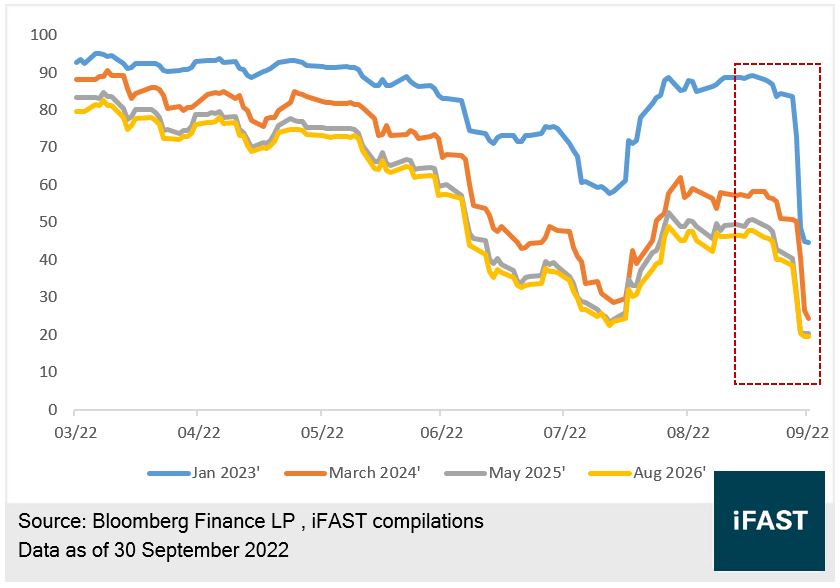
- A rumor that CIFI missed a payment of onshore trust loan led to a sharp drop in the bond price last week, with the price of bond due in January 2023 slumped from $90 to $50.
- As one of the members of "High-quality Developer", CIFI's fundraising capability remains good enough. The company just issued an onshore bond with a principal of RMB 1.2 billion in September, therefore, the trust loan default is completely out of the market's expectation.
- CIFI is in talks with trust investors to reach a solution, and we believe the company will likely fulfill the repayment obligation. But the trust crisis might lead to the suspension of CIFI's further refinancing schemes and even the risk of earlier withdrawal from banks, which would probably result in a default of USD bond due in January next year.
Onshore Trust Loan Failed to Pay, Bond Price Slumped
A rumor that CIFI Holdings (Group) Co. Ltd. ("CIFI" hereafter) failed to repay a trust loan designed for a Tianjin project as scheduled. Following the news, the price of USD bonds slumped, with the bond due in January 2023 dropping from $90 to $ 50 (Chart 1).
Chart 1: Bond Price of CIFI
On 29 September, CIFI acknowledged the veracity of the rumor and stated that the development and sales of the project was affected by the weak market sentiment, which further affected the payment of the trust loan. CIFI is currently in talks with trust investors to reach a reasonable solution.
Credit Looks Rather Good with Adequate Refinancing, Trust Default is Out of Market’s Expectation
Since the default crisis of the Chinese real estate industry, CIFI is one of few non-SOE developers that have managed to survive until now and was included in the first batch of "High-quality Developers" by authorities in May this year, together with developers such as Country Garden and Seazen, reflecting the authorities' endorsement of their fundamentals and ability to carry on business. Meanwhile, they are allowed to issue bonds with full guarantees from the state-owned credit enhancement provider China Bond Insurance CO.LTD
After being included in the list, high-quality developer CIFI has issued bonds multiple times from the beginning of the year (Table 1). Even two weeks ahead of the trust crisis, CIFI just completed the issue of an onshore bond with a principal of RMB 1.2 billion. Apart from the onshore issue, CIFI issued a USD 150 million bond earlier this year and a USD 2.5 billion convertible bond in April. Also, the company completed a stock placement in August, raising approximately HK$630 million. All in all, CIFI has been raising funds almost every month, signaling that the company is favored by the capital market and has strong fundraising ability.
Table 1: CIFI’s Refinancing Records Year to Date
|
Project |
Fund |
|
|
Jan |
Issue of USD green bond |
USD 150 million |
|
Mar |
Issue of onshore MTN |
RMB 1 billion |
|
Apr |
Issue of convertible bond |
Around HKD 2.5 billion |
|
May |
Issue of onshore RMB bond |
RMB 800 million |
|
June |
Issue of onshore RMB bond (with Credit Risk Mitigation Warrant) |
RMB 500 million |
|
Aug |
300 million share placing |
HKD 630 million |
|
Sep |
Issue of onshore RMB bond (with Credit Risk Mitigation Warrant) |
RMB 1.2 billion |
|
Sources: Company Reports, iFAST Compilations Data as of 30 Sep 2022 |
||
In the midst of the market downturn, the credit indicators of CIFI inevitably deteriorated (Table 2). As of June 2022, cash and cash equivalents after deducting the restricted part dropped by 33.1% to RMB 31.1 billion, while interest-bearing debt roughly remained unchanged at RMB 112.4 billion, leading to the net gearing ratio rose from 62.8% in end-2021 to 76.8% in Mid-2022, reflecting upward moving leverage. Moreover, the adjusted cash to short-term debt decreased from 1.7x in 2021 to 1.0x at the end of June this year. Objectively, the liquidity is somewhat tight but still a rather good one among non-SOE developers, so with a good credit indicator and smooth financing, the trust crisis of CIFI was unexpected by the market.
Table 2: Credit Metrics of CIFI
|
End-2021 |
Mid-2022 |
|
|
Net Gearing Ratio |
62.8% |
76.8% |
|
Average Borrowing Cost |
5.0% |
4.9% |
|
Adjusted Cash to Short-term Debt |
1.7 |
1.0 |
|
Sources: Company Reports, iFAST Compilations Data as of 30 June 2022 |
||
Off-balance-sheet Debt Triggers the Trust Loan Crisis, Liquidity Constraints Are Well Indicated
CIFI faces poor off-balance-sheet credit indicators in spite of good results of reported credit metrics. As a cooperation-oriented developer, Previously, CIFI has high exposure to "less ownership but dominating the project" mode, which owns a portion share of projects (usually less than 10%), and manages property projects, including design, engineering, marketing, as well as delivery. It also shares the profits of the project's sales. However, a portion of projects is not consolidated into CIFI's financial statements, resulting in an underestimating debt.
Looking into off-balance-sheet credit indicators (Table 3), as of June 2022, the minority interest/total equity ratio and payable to associate and joints ventures over total debt ratio were 58.5% and 31.7%, respectively, a slight decline in comparison to the beginning of this year, but it is still much higher than the industry average, reflecting a larger proportion of development projects not included in CIFI's financial statements and significant off-balance sheet debt risk. It’s worth mentioning that the guaranteed joint ventures/associated companies’ debts totaled RMB 12.4 billion, if this amount of contingent debt is eventually absorbed by CIFI, it will undoubtedly have a significant impact on the credit quality.
Apart from joint ventures, CIFI is also exposed to other kinds of off-balance-sheet debt. We suspect that the trust loan is essentially a "Disguised Debt", meaning that parties would invest in the name of equity, but the original shareholder would reclaim the equity through repurchasing or distributing interest upon project completion. When sales fell short of expectations, the trust investors intend to exit the project and let CIFI make an early repayment, which eventually result in the trust loan crisis of CIFI. In addition, CIFI owns some financial wealth management platforms for fundraising, which is also a source of off-balance-sheet debt.
Table 3: CIFI’s Off-balance-sheet Credit Indicators|
End-2021 |
Mid-2022 |
|
|
Payable to Associate and Joint Ventures to Total Debt |
43.9% |
31.7% |
|
guaranteed joint ventures/associated companies’ debt (billion RMB) |
15.8 |
12.4 |
|
Adjusted Cash to Short-term Debt |
1.7 |
1.0 |
|
Sources: Company Reports, iFAST Compilations Data as of 30 June 2022 |
||
In summary, we believe that CIFI's large off-balance-sheet debt has left the company's actual liquidity far weaker than reported. In practice, we noted that the company is disposing of some assets in the last three months (Table 4). Such intensive disposals would have been evidence of a liquidity crunch, as developers would not give priority to asset disposals in exchange for cash inflow if other refinancing channels remain smooth.
Table 4: CIFI’s Asset Disposal List
|
Project |
Fund |
|
|
Jul |
Sold a rental property in Shanghai |
RMB 180 million |
|
Aug |
Sold a subsidiary in Hong Kong |
HKD 1.3 billion |
|
Sep |
Sold a subsidiary in Nanjing |
RMB 120 million |
|
Sources: Company Reports, iFAST Compilations Data as of 30 Sep 2022 |
||
Trust Loan is Expected to Pay Soon, but Enterprise-bank Relationship May Deteriorate
In our experience, a real estate trust loan amount is usually less than RMB 1.0 billion. Based on the asset size of CIFI, we don't think it's too difficult to raise RMB 1.0 billion. Besides, in view of the political sensitivity in recent, from the perspective of market stability, regulators will not allow such a larger developer to “lying flat” or “let it rot”, instead, it probably coordinates with CIFI and trust loan investors to complete the payment.
However, we also feel that the trust loan crisis has caused irreversible negative impacts on CIFI. In general, banks are fund providers and actual controllers of trust companies. Banks are expected to carefully re-examine their relationship with CIFI afterward, which might in the suspension of CIFI's further refinancing schemes, or even the early withdrawal of loans. If that's the case, it would have a dramatic blow to the company's financial profile.
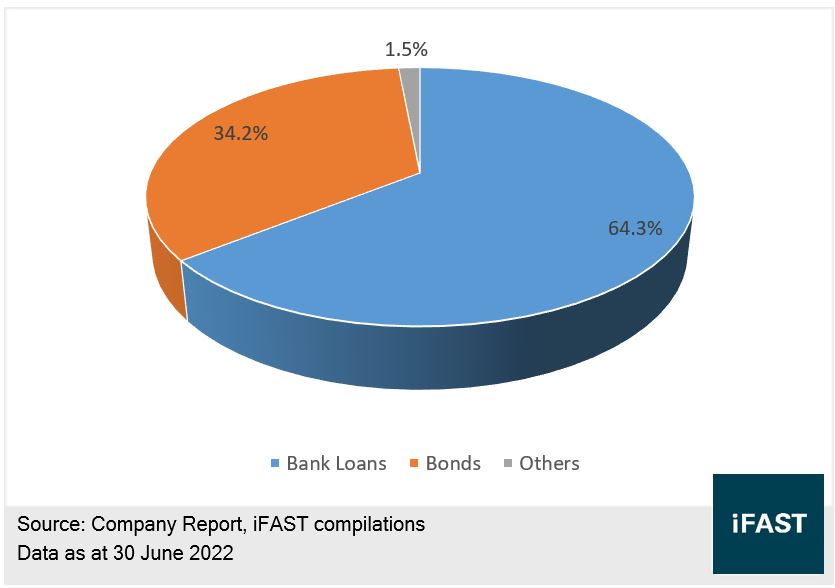
We see that the proportion of bank loans in CIFI's financing structure is quite high (Chart 2), reaching 64.3% as of June 2022. Additionally, CIFI's repayment of bank and other borrowings in 1H2021 amounted to RMB 16.9 billion, while new bank and other borrowings raised spiked to RMB 14.2 billion, translating into a loan refinancing rate of 84.1%, which topped among Chinese property developers. The high number in loan refinancing rate suggests a good rapport with banks and a high reliance on bank loans, so if the rapport deteriorates, CIFI would be able to get sufficient financing from banks, then slip into full-scale distress in the future.
Chart 2: Debt Structure of CIFI
USD Bond Prospect Might Be Bleak
Referring to the case of Shimao Group, which defaulted on a trust loan in December last year, leading to a downward-moving USD bond price and actual default in July this year. We believe that CIFI would likely follow Shimao's footsteps if the trust crisis could not settle down in the near term, particularly in the relationship restoring with banks.
CIFI has a relatively large number of USD bonds, totaling 10 with maturity dates ranging from 2023 to 2028. The bond due in 2023 is trading at approximately $50, while the price of the remaining ones fell to $20, reflecting the significant default risk. We think there is still a downside potential for the 2023 USD bond, and investors may consider selling it.
Furthermore, looking at the examples of Evergrande and Sunac, in case of default, developers with a large number of outstanding USD bonds usually take debt restructuring, instead of rollover or exchange offer. Notably, the uncertainty of debt restructure is larger than exchange offers, the bond price may fall further to $10 and below. Given the large size of the USD bonds of CIFI, we expect CIFI to take debt restructuring if it defaults on bond due in January next year. It's also important to highlight that the potential recovery value would be lower if the future property market sentiment remains depressed.
Conclusion
A rumor that CIFI missed a payment of onshore trust loans led to a sharp drop in the bond price last week, with the price of bond due in January 2023 slumped from $90 to $50.
As one of the members of "High-quality Developer", CIFI's fundraising capability remains good enough. The company just issued an onshore bond with a principal of RMB 1.2 billion in September, therefore, the trust loan default is completely out of the market's expectation.
CIFI is in talks with trust investors to reach a solution, and we believe the company will likely fulfill the repayment obligation. But the trust crisis might lead to the suspension of CIFI's further refinancing schemes and even the risk of earlier withdrawal from banks, which would probably result in a default of USD bond due in January next year.
Declaration: For specific disclosure, at the time of publication of this report, IFPL (via its connected and associated entities) and the analyst who produced this report hold a NIL position in the abovementioned securities.
Our podcast series, Yield Hunters, is available on Spotify, iTunes Podcasts and Google Podcasts. We share our thoughts on new bond issues and hold discussions on the fixed income space. Listen to our latest episode below and follow us!