Two weeks ago, Oxley Holdings Limited gave notice that the company will redeem its 5% notes due 2019 on 5 Nov. One of our favorite high-yield ideas this year (see “G8 Education's 5.5% notes are maturing next month: here are some replacement ideas”), the OHLSP 5% ‘19s are also among the rare retail SGD corporate bonds in the market.
Our Retail Bonds webpage shows only 15 retail SGD corporate notes. And that includes three bonds of Hyflux and KrisEnergy, which are both under debt moratorium1; and two private equity bonds of the Astrea Group2. While we have been a fan of the Astrea series of PE bonds (see “Your Ultimate Guide to Astrea V (Part 1)”) for a few years now, the two retail Astrea bonds in the market look expensive to us at their current prices. Taking Astrea V’s 3.85% Class A-1 notes for instance, at their yield to call of just about 2.98% as of this writing, we think they no longer offer a premium for a novel product with higher complexity relative to regular corporate debentures.
With the current scarcity of retail SGD corporate bonds, holders of the OHLSP 5% ‘19s are probably, like us, struggling to find replacements for their maturing investment. Nonetheless, we have come up with this listicle to highlight six decent high-yield SGD-denominated alternatives for bondholders to consider reinvesting their capital into. We managed to unearth three retail bonds and three wholesale bonds, two of which are on iFAST’s Bond Express platform, where accredited investors can purchase the notes in smaller “retail-like” amounts.
If you are still starved for more bond ideas after getting to the end of this article, you might want to check out our Recommended Bonds webpage. You will find there a list of our preferred bonds, updated on a monthly basis.
1. OHLSP 5.150% 18May2020 Corp (SGD) - Retail
- Oxley Holdings Limited is a SGX-listed homegrown property developer with a market cap of S$1.43 billion (as at 30 Oct 19).
- Since its incorporation in 2010, Oxley has launched a portfolio of 44 projects across eleven geographical markets, and completed 30 projects.
- The company’s main businesses include property development, property investment, and operation of owned hotels. Property development is the primary revenue contributor, making up 89% of total revenue in the most recent financial year.
The first natural replacement choice for an existing Oxley bondholder would be the company’s longer-dated bonds. However, given Oxley’s track record of ramping up leverage quickly when it senses market opportunities and its currently high indebtedness, investors may be rationally cautious about the company’s credit outlook. We have explored this topic in detail in a just-published report (see the article link below), and our conclusion is the market has yet to fully priced in the fact that Oxley is currently in the deleveraging phase of its debt cycle.
The company had acted fast in the face of property cooling measures implemented in July 2018 and an economic slowdown this year. In January 2019, Oxley indicated its intention to sell its pair of Singapore hotels at Stevens Road to pare down debt. In April, the company signed an agreement to sell the commercial property Chevron House for S$1.025 billion.
More importantly, management had laid out their debt repayment plans and emphasized several times their commitment to deleverage. Although Oxley had just S$474m of cash and cash equivalents against S$1.34 billion of short-term maturities, we think the company should face little difficulty in meeting its short-term financial liabilities (see Figure 1).
Figure 1: Oxley’s debt maturity profile and repayment plan
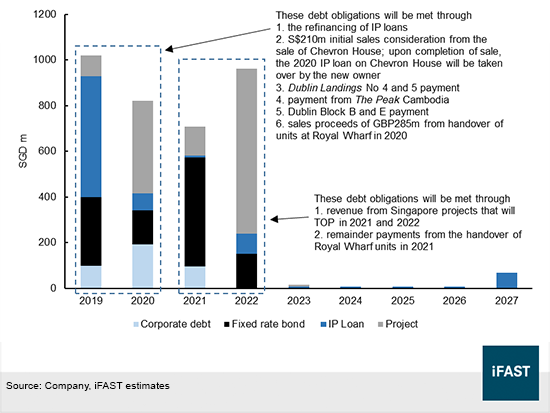
S$814m of Oxley’s short-term borrowings comprised of secured loans that were, in part, tied to the Mercure and Novotel hotels and quoted equity investments. Oxley intends to refinance the S$529m investment property loan secured by the hotels, which are estimated to have a carrying value of S$1.05 billion.
Furthermore, Oxley’s strong sales progress since 2018 provides high earnings and cash-flow visibility in the near-to-medium term. The company reported S$2.75 billion of attributable future progress billings3 as of 26 August, which will contribute progressively to earnings and cash flows over the next few years.
For instance, the waterfront development in London, Royal Wharf, was more than 94% sold as of September. According to Oxley’s presentation slides dated May 2019, the project should bring in sales proceeds of GBP285m in 2020 and GBP61.5m in 2021 upon handover of units. The company also just last week completed the sale of two commercial buildings at Dublin Landings for gross proceeds of EUR205m, from which it received 79.5% of the sale consideration.
Oxley has another retail bond outstanding that has just less than seven months before it is due for repayment—the OHLSP 5.150% 18May2020 Corp (SGD) - Retail. At their ask yield to maturity (“YTM”) of 4.69% as of 30 Oct 19 (based on exchange prices), we think the OHLSP 5.15% ‘20s still offer a decent return for their short remaining maturity. The OHLSP 5.700% 31Jan2022 Corp (SGD) also looks interesting to us with its ask YTM of 7.52%, offering a generous yield pickup to compensate for its longer duration.
Related article: Oxley Holdings: an exciting opportunity beckons with a high yield north of 7%
2. FPLSP 3.650% 22MAY2022 CORP (SGD) - RETAIL
- Frasers Property Limited (“FPL”) is the second largest Singapore real estate company with total assets of S$33.6 billion in June. To put that number in perspective, the leading local developer, CapitaLand Limited, has total assets of S$81.5 billion, while City Developments Limited and UOL Group Limited trail behind FPL with S$23.2 billion and S$20.0 billion of total assets respectively.
- Listed on the SGX since 1988, FPL sported a market cap of S$5.23 billion as of 30 Oct 19.
- FPL’s businesses include property development, and investment in and management of retail, commercial, industrial, and hospitality properties and property trusts. The property giant is also the sponsor of four Singapore-listed real estate investment trusts. Frasers Centrepoint Trust, Frasers Commercial Trust, Frasers Logistics and Industrial Trust, and Frasers Hospitality Trust serve as the platform for FPL’s retail, commercial and business parks, logistics and industrial, and hotel properties respectively.
FPL logged S$1.9 billion of pre-sold revenue in the nine months ended June (“9MFY19”), which compared favorably with the S$2.2 billion of presales in financial year 2018 (see Figure 2). Although development presales still lagged behind FY15-FY17, they provide good earnings visibility over the next two to three financial years.
Figure 2: FPL’s unrecognized revenue from key markets
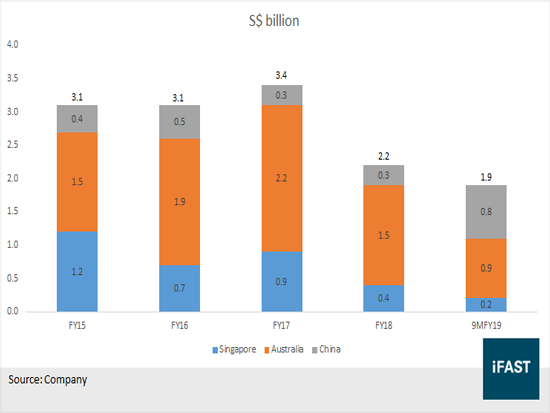
The lag between property sales and completion—when revenue is recognized—should help FPL mitigate headwinds from property curbs in Singapore and falling home prices and sales volumes in Australia, two of the group’s major residential development markets. In addition, recurring income made up 76% of FPL’s operating profit4 in 9MFY19, more than doubled from five years ago. The group’s focus is clearly shifting away from development projects to growing its recurring income asset portfolio, having invested S$957.9m this year in PGIM Real Estate AsiaRetail Fund Limited for a 63.1% stake. PGIM owns and manages six Singapore retail malls, one Singapore office, and four Malaysian malls.
The increased reliance on rental income should weigh on FPL’s return on invested capital (i.e. its profitability). On the other hand, a strong and growing recurring income base increases the company’s earnings resilience and stability, which have a stronger bearing on its credit profile.
The second retail bond in this list and the only one that is labelled under the “Stable Income Seeker” investor profile by our classification system, the FPLSP 3.650% 22May2022 Corp (SGD) - Retail was quoted on the exchange at a YTM of 3.09% as at 30 Oct 19. This number may seem low next to the 5% coupon rate of the maturing Oxley bond.
However, consider this: out of all 30 fixed-term SGD bonds issued by the “Big Four” Singapore real estate companies mentioned above, only three are yielding more than 3%, and among those three, only the FPLSP 3.65% ‘22s have a remaining maturity of less than six years. We think the FPLSP 3.65% ‘22s provide good value for money, especially in the context of a dearth of retail SGD bonds.
Related article: Good Recurring Income from a Large SG Property Co: The Frasers Property Bonds
3. PREHSP 4.550% 29Apr2020 Corp (SGD) - Retail
- Perennial Real Estate Holdings Limited (“Perennial”) is a healthcare and integrated real estate company. The group’s property portfolio comprises of offices, retail spaces, and healthcare facilities that are located in Singapore and China. Some of its iconic properties include the AXA Tower, CHIJMES, Capitol Singapore, and TripleOne Somerset.
- Investments in associates and joint ventures constitute a significant part of the company’s portfolio (33% of total assets as of end-June), including several healthcare and commercial integrated developments connected to high speed railway stations in China, and its eldercare and senior housing business unit in China, Renshoutang.
- Perennial is sponsored by Kuok Khoon Hong, Ron Sim, Wilmar International, and Pua Seck Guan, who collectively hold an effective ownership of 82.4% in the company (as at 30 Jun 19).
Perennial’s financial liquidity looked tight with just S$60.5m of cash against S$1.04 billion of short-term debt (34% of total borrowings) at the end of June. Meanwhile, profitability was weak as the company’s profit before interest and tax of S$39.6m in 1H19 was insufficient to cover S$61.1m of net finance costs.
Nonetheless, we believe management is focused on deleveraging and tackling the swelling short-term maturities. We like that the company has taken proactive actions to improve its credit metrics, including a pause on major acquisitions, initiatives to improve recurring income stream, and asset divestments. Perennial’s last major acquisition was the purchase of the remaining 50% stake in Capitol Singapore in the first half of 2018.
In May, Perennial completed the disposal of its effective interest of 50.64% in Chinatown Point Mall for net proceeds of approximately S$125m. The company had earlier in January announced the sale of its entire 20% equity stake in Shenzhen Aidigong Modern Maternal and Child Health Management Co., Ltd, for RMB200.7m (~S$39.8m).
Just last week, Perennial fully divested its 32.5% effective equity stake in Yanlord Investment (Singapore) Pte Ltd (“YIS”) to Yanlord Commercial Property Investments Pte Ltd (a wholly-owned subsidiary of SGX-listed Yanlord Land Group Limited) for S$202.7m. YIS is an investment vehicle holding about 35.3% shareholding in United Engineers Limited (“UEL”), 97.7% of UEL’s preference shares, and 29.9% of shares in WBL Corporation Limited.
While these transactions are still insufficient to pay off near-term debt, we take comfort that Perennial has taken constructive steps to clear its refinancing wall. The company has indicated its intention to sell its 31.2% interest in AXA Tower, which should fetch a good price given the buoyant office market in Singapore. Also, Perennial should be able to monetize most of its S$3.3 billion of investment properties in times of need.
Last but not least, Perennial has continued to enjoy support from its prominent sponsors. When the company issued S$180m of 5.95% notes due 2020 in August last year, the sponsors collectively subscribed for around one-quarter of the issue.
Perennial’s retail notes due 2020—the PREHSP 4.550% 29Apr2020 Corp (SGD) - Retail—were quoted at an ask YTM of 4.42% on the exchange, as at 30 Oct 19. The bond provides decent return for its term to maturity of just around six months, against SGD peers such as GuocoLand’s GUOLSP 4.1% ‘20s (YTM: 2.52%), whose issuer has a comparable net debt over equity of 81% (without adjusting for its S$400m of perpetual securities).
4. LOGPH 6.125% 16Apr2021 Corp (SGD) Available on Bond Express
- Logan Property Holdings Company Limited (“Logan”) is a Chinese property developer founded in 1996. The company is publicly listed in Hong Kong and has a market capitalization of HKD64.81 billion (USD8.3 billion) as at 30 Oct 19.
- Logan focuses on developments in the Guangdong-Hong Kong-Macao Greater Bay Area (“GBA”) and owns a total land bank of 35.9m square meters at the end of 1H19.
- The founding Kei family controls nearly 78% of the company’s shares.
- Logan is rated ‘BB’ by S&P and Fitch, with stable outlooks. Moody’s has a ‘Ba3’ long term rating with a positive outlook on the issuer.
China’s property market seems set to be heading for a slowdown this year amid Beijing’s push for deleveraging and weaker housing demand. The Communist Party’s political bureau, or Politburo, declared during a July meeting that it won’t be using the property sector as a short-term tool to stimulate economic growth. That sent a strong signal the government would maintain its regulatory measures to clamp down on the high debt levels of property developers.
Meanwhile, China’s bruising trade war with the US dragged its economy down to the slowest quarterly growth in nearly three decades, with the GDP growing just 6% in the third quarter. China’s slowing economy probably dampened buyers’ appetite for big investments, as the country saw lackluster home sales even in the traditional peak period during the “golden week” holidays in early October.
Logan has turned in a remarkably resilient performance against this backdrop, as revenue jumped 78% YoY to RMB27.0 billion in 1H19 (1H18: RMB15.1 billion). The revenue growth was mostly attributable to higher income from land sales (+359% YoY to RMB4.9 billion) and construction and decoration contracts (+503% YoY to RMB5.8 billion).
We expect Logan to continue to outperform its peers, supported by its huge and concentrated exposure to the GBA, and a healthier balance sheet compared to most of its competitors. According to the company’s presentation slides for its 1H19 results, 70% of its land bank by value5 are located in GBA cities.
The Chinese government in February laid out its plan to develop the GBA into a world-class city cluster, which should drive future population growth and home prices higher. GBA cities Dongguan and Zhuhai have recently loosened their restrictions on home purchases, positive signs that local authorities are in a race to attract talent to the region. What’s more, Logan has a sizeable land-cost advantage compared to its peers, with an average land cost that is less than 25% of the company’s estimated average selling price for its saleable resources.
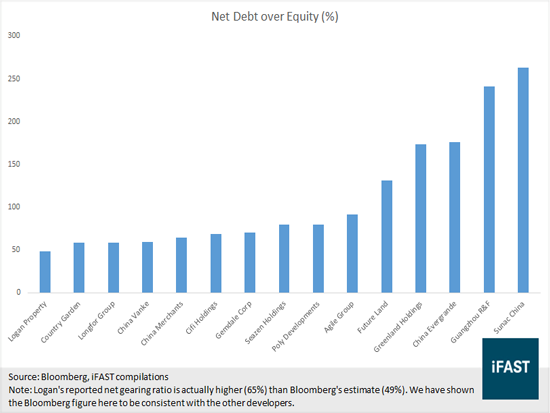
China’s deleveraging campaign could actually benefit developers with healthier credit profile, such as Logan, by squeezing the capacity of their more-leveraged peers to compete for land acquisitions and development funding. With its comfortable liquidity position—cash and cash equivalents stood at RMB34.46 billion as at 30 Jun 19, more than three times the short-term borrowings of RMB11.11 billion—Logan also faces less short-term pressure to resort to fire sales of its projects. At the end of June, Logan’s reported net gearing ratio (net debt over equity) was 65.4%, substantially lower than the industry average (see Figure 3).
Figure 3: Leverage comparison of Chinese developers
Although the LOGPH 6.125% 16Apr2021 Corp (SGD) has appreciated strongly since we put forth our investment thesis to highlight its attractiveness in August last year (see the related article below), it is still one of our favorite SGD-denominated developer bonds. At their ask YTM of 4.74%, we think the LOGPH 6.125% ‘21s are appealing compared to other SGD high-yield alternatives in the property sector, given Logan’s large operating scale and high earnings visibility.
Related article: Looking for High Yield Real Estate SGD Bonds? Logan Property Could Be Your Best Bet
5. ESRCAY 6.750% 01Feb2022 Corp (SGD) Available on Bond Express
- According to the prospectus of the company’s initial public offering (“IPO”), ESR Cayman Limited is one of the largest Asia Pacific-focused logistics real estate company by gross floor area (“GFA”), value of portfolio assets, and development pipeline as measured by GFA. The firm develops and manages modern logistics facilities across China, Japan, South Korea, Singapore, Australia, and India.
- Established in 2011 through the merger between e-Shang Cayman Limited and Redwood Group Asia Pte Ltd, ESR Cayman has grown leaps and bounds over the years. Following recent transactions such as the acquisition of the remaining 80.1% interest in ASX-listed Propertylink for AUD398m, the group boasted total assets under management of USD20.2 billion.
- Post-IPO, ESR Cayman’s major shareholders would include Warburg Pincus, the Redwood group, APG Asset Management, The Shen Trust (controlled by ESR Cayman co-CEO Jeffrey Shen), SK Holdings, JD.com, and OMERS Administration Corporation.
Amid unprecedented political strife in Hong Kong, ESR Cayman in June pulled plug on its HKEX listing application, citing market conditions. Fast forward five months later, the company is looking to sell shares worth up to USD 1.45 billion in its second IPO attempt, which would be Hong Kong’s second-largest IPO this year.6
We see the IPO, assuming it is completed, as credit positive for ESR Cayman. After listing on the stock exchange, the company would have to comply with additional disclosure requirements, bringing much higher transparency and timely updates of its financials and business.
In addition, ESR Cayman has shared that it intends to use 72% or USD403.9m of estimated net IPO proceeds (USD563.3m) to repay debt. The remaining 28% (USD159m) will be used to develop logistics properties and for other co-investment opportunities.
As at 31 Aug 19, ESR Cayman had total borrowings of USD3.04 billion, of which USD589.5m (19.4%) were short-term debt. Total borrowings doubled from USD1.46 billion at the end of June 2018, following the drawdown of debt for the Propertylink acquisition and consolidation of Propertylink’s balance sheet. The company also had outstanding around USD288m in notional amount of redeemable convertible preference shares—USD60m of these preference shares were expected to be converted to ordinary shares upon completion of ESR Cayman’s IPO—and USD100m of perpetual securities.
ESR Cayman had a comfortable liquidity position with USD1.16 billion of cash and bank balances and USD85.4m of unutilized banking facilities in August. Net gearing (net debt over equity) was 74% at the end of June, while we estimated adjusted net gearing (including preference shares and perpetual securities in debt) at 93%.
ESR Cayman’s IPO has a price range of HKD16.20-17.40 per share, putting the company’s market capitalization between USD6.3 billion and USD6.7 billion, which provides ample equity cushion behind its USD3.04 billion of debt. Furthermore, based on the disclosed intended use of proceeds from the share offering, we estimated pro forma adjusted net gearing to fall significantly to approximately 61% post-IPO.
We think the ask YTM of 5.90% (Z-spread: 445bps) on the ESRCAY 6.750% 01FEB2022 CORP (SGD) compensates generously for ESR Cayman’s credit risk. As a pricing reference, the ARASP 4.15% ‘24s of ARA Asset Management Limited (adjusted net gearing as of end-June: 1.0x) were indicating at an ask YTM of 3.62% (Z-spread: 208bps) on 30 Oct 19.
We will be releasing a research initiation report on ESR Cayman in the following weeks. In the meantime, you might want to check out our previous report in January covering the issuance of the ESRCAY 6.75% ‘22s for more information on the bond and its issuer.
Related article: ESR Cayman Launches SGD 3-Year Notes at 6.75% IPG
6. CTRAIJ 4.850% 20Sep2021 Corp (SGD)
- PT Ciputra Development Tbk (“CTRA”) is one of Indonesia’s largest developers with a diversified product offering, sizeable land bank and established track record.
- Since the establishment of the Ciputra Group (now the holding company of CTRA) as a family business in 1981, the group has accumulated more than 30 years of project development experience. As of 2Q19, it manages more than 75 projects in 33 cities across Indonesia.
- The company engages in two main activities—residential project development and the management of commercial property.
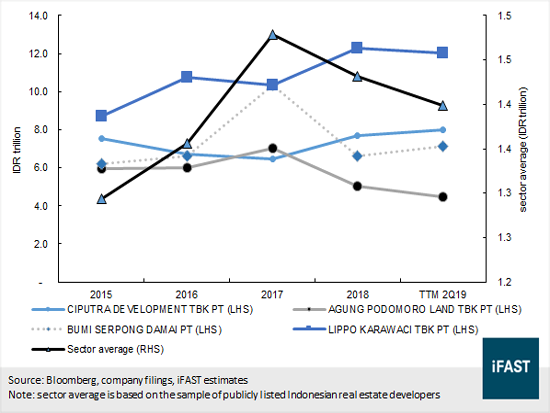
Top-line results have been on an upward trend as CTRA registered revenue gains in 2018 and in the trailing twelve months (“TTM”) to June 2019. In terms of revenue growth, CTRA ranked first among the top-three developers by assets—the two other firms were PT Bumi Serpong Damai Tbk (“Bumi Serpong”) and PT Lippo Karawaci Tbk (“Lippo Karawaci”)—registering sales growth of 24% between 2017 and TTM 2Q19 (see Figure 4).
Figure 4: Peer comparison of revenue
Additionally, the proportion of recurring income has generally increased from 2014 to TTM 2Q19 and remained at 23% in the past three TTM quarterly periods. CTRA recognized revenue on its income statement through the sale of properties and recurring income from real estate assets such as rentals from commercial properties.
In addition to its above-average revenue growth rate, CTRA’s revenue-to-debt ratio of 91% exceeded peers in TTM 2Q19. The ratio was slightly above Lippo Karawaci’s 89%, and significantly larger than Bumi Serpong’s 44%. Earnings before interest and taxes were 2.8 times interest expense in TTM 2Q19, which was also higher than Bumi Serpong (2.6x) and Lippo Karawaci (0.4x).
On the other hand, CTRA’s debt over total capital was 34% in 2Q19, which was slightly higher than Lippo Karawaci (31%) and Bumi Serpong (29%). Besides that, the company’s entire long-term loan portfolio was secured by real estate, and there were only a few short-term unsecured loans.
Balancing the above factors, we prefer CTRA’s credit profile over Lippo Karawaci and Bumi Serpong for its healthy revenue growth and higher interest coverage ratio. We initiated research coverage on CTRA in September with a positive credit outlook, and expected the company’s credit profile to be steady over the coming year, supported by the good quality and location of its assets in the Greater Surabaya and Greater Jakarta regions.
We like the CTRAIJ 4.850% 20Sep2021 Corp (SGD), as we think its ask YTM of 4.86% (~9.8% if swapped to IDR) is attractive compared to other Indonesian developer credits. The current macro environment could also provide additional potential upside for bondholders, given that falling interest rates in Indonesia are likely to benefit interest rate-sensitive sectors such as property development.
Note: this section is primarily an edited and summarized version of our earlier article on CTRA, “Ciputra Development’s 4.85% 2021 notes offer a promising SGD high-yield choice”
Footnotes
1. A polite way of saying a company is in financial trouble and unable to pay its lenders. Or to put it more accurately, the company is under court protection that prevents creditors from taking legal actions against it.
2. More technically, these bonds are known as collateralized fund obligations in the industry, or securities backed by a portfolio of funds—in the case of the Astrea series of bonds, private equity funds.
3. Development sales that are yet to be recognized in revenue. Real estate companies may refer to this in different terms, such as “pre-sold revenue” in the case of FPL.
4. Profit before corporate expenses, interest, fair value change, taxation, and exceptional items.
5. Excluding mergers and acquisitions and urban renewal projects.
6. The largest HKEX IPO this year is the USD5 billion deal of Budweiser Brewing Company APAC Ltd.
Declaration:
For specific disclosure, at the time of publication of this report, IFPL (via its connected and associated entities) has a principal position in OHLSP 5.000% 05Nov2019 Corp (SGD) - Retail, OHLSP 5.150% 18May2020 Corp (SGD) - Retail, OHLSP 6.375% 21Apr2021 Corp (USD), LOGPH 6.125% 16Apr2021 Corp (SGD), ESRCAY 6.750% 01Feb2022 Corp (SGD), and ARASP 5.200% Perpetual Corp (SGD). The analyst who produced this report owns shares in City Developments Limited.