Highlights:
- Revenue and net income recouped at varying degrees in 2021, but are expected to have limited room for further growth due to increasingly intense competition. In comparison to internet peers, the overall regulation risk is manageable.
- Credit-wise, Weibo’s leverage saw a plummet in 2021, and the liquidity will likely remain decent for a long time given by its small-scale capital expenditures resulting from a conservative business strategy.
- Bond due July 2024 is yielding roughly 4.5%, making it a good investment choice among investment grade (IG) bonds.
With US stepping into the interest rate hike cycle, investment grade bonds generally see raising in yield to maturity. In today's “Idea of the Week”, we would like to introduce the BBB-rated bonds issued by Weibo Corporation (“Weibo”).
Company Background
Weibo is formed by Sina Corporation as a social media platform in 2009. The Monthly Active Users (MAU) reached 570 million as of December 2021, making it the fourth-largest social media platform in China, trailing behind WeChat, Douyin, and QQ.
Weibo became a Nasdaq-listed company in 2014 with the stock code WB.US. The company returned to Hong Kong for secondary listing (9898. HK) in 2021. The current market capitalisation is around USD 6 billion.
Looking into the ownership structure, Sina Corporation owned 41.3% share and was the largest shareholder of Weibo as at end of January 2022. Alibaba is the second-largest shareholder with 28.7% ownership on Weibo.
Revenue Rebounded in 2021 with Decent Profitability
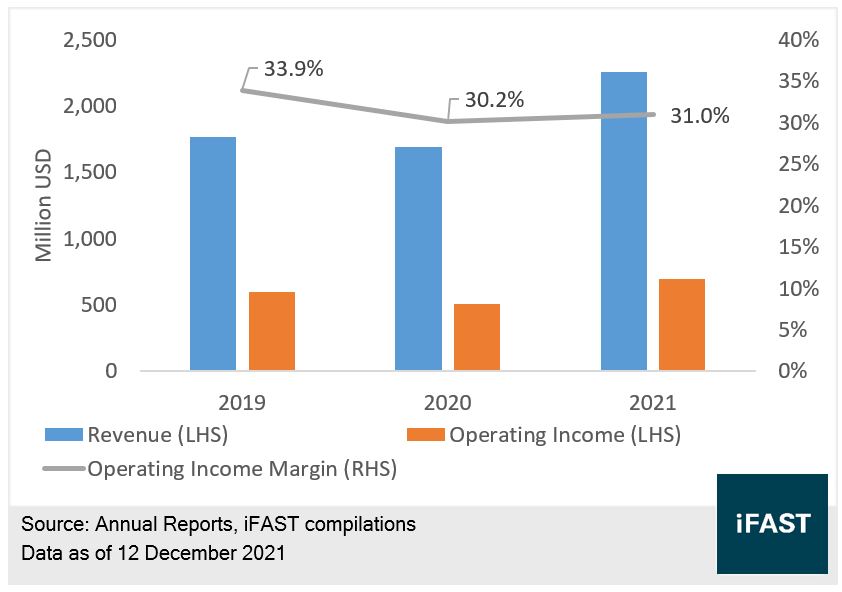
Weibo reported a revenue of USD 2.3 billion in 2021, up around 34% from a year ago (see Chart 1). Operating income achieved USD 700 million, surging by 37.3%. It is noteworthy that the company recognises rather good profitability with gross margin standing over 30% over the past three years.
Chart 1: Weibo’s Profitability
In terms of the revenue breakdown, the source of revenue is rather concentrated, as 87.6% of total revenue in 2021 came from the advertisement sector, and the remaining focus is on live streaming and online gaming.
High Users Stickiness, But Growth Potential is Limited
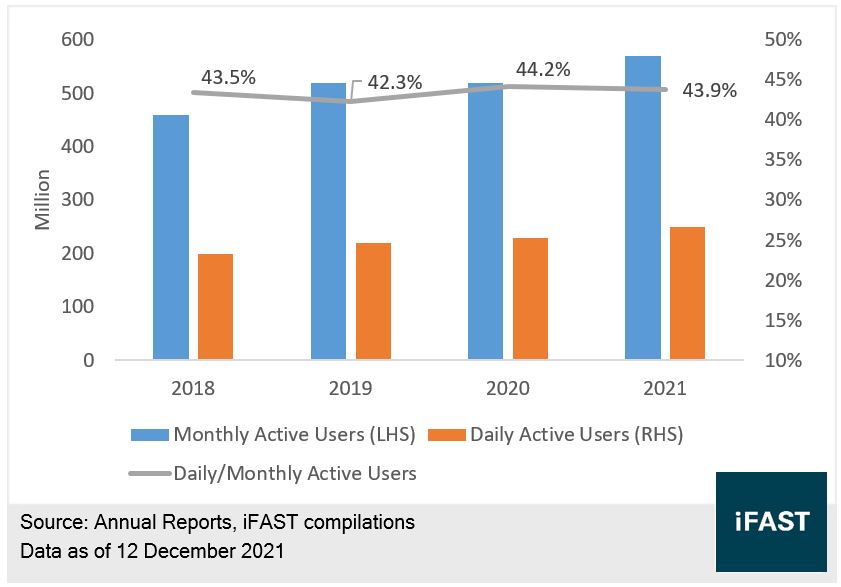
The advertising business that Weibo highly relies on is notably correlated with the number of Weibo users. That being said, the number of users undoubtedly determines the scale of its future business growth. As seen in Chart 2, from 2018 to 2021, the monthly and daily active users totaled 500 million and 200 million respectively. In fact, the user penetration rate is almost saturated because Weibo started operating a long time ago. Although the company tried to explore the overseas market and the market of tier-three and tier-cities in China, the result is weaker than expected, as the number of users did not significantly increase.
Nevertheless, the ratio of daily active users/monthly active users has been around 40% for the long term, suggesting a high stickiness and low churn rate for users.
Chart 2: Daily/Monthly Active Users
The high user stickiness could mainly be contributed to the feature of being relatively open and real-time. Weibo is still regarded as one of the most efficient information-sharing platforms so far in China. Also, Weibo is remarkably linked with the entertainment industry and is used as a preferential channel for release of information, thereby assuring users’ stickiness to a certain extent.
Regardless of the stable ratio of daily active users/monthly active users, its advertisement revenue might face larger competition. Data from Iresearch depicts that E-commerce platforms and short videos will gradually be the main carrier of online advertisement, leaving limited room for upside potential in Weibo’s case. We expect its advertisement revenue or total revenue to only increase at a single-digit rate.
Manageable Regulation Risk
Over the past few years, Chinese authorities strengthen the regulation for internet companies. A portion of big tech has been stuck in regulation risk and so does Weibo. It's easy for Weibo to become a headstream and epicenter of public opinions or rumors due to the features of social media. As a consequence, relevant authorities maintain close monitoring of Weibo. For example, Cyberspace Administration of China imposed a fine of RMB 500,000 on Weibo for failing to discover and remove user violating posts at a timely manner. The regulation tightened in 2021, as Cyberspace Administration of China had serval talks with Weibo on revamping violating information, like soft pornography and malicious marketing. It is worth mentioning that Weibo received 44 penalties with a total amount of RMB 14.3 million from January 2021 to November 2021.
Furthermore, Weibo is not only exposed to regulation risks in China. SEC included Weibo on the tentative list of the “Holding Foreign Companies Accountable Act”, and would delist it if the company fails to meet auditing requirements.
However, Weibo still aligns with government regulations in spite of numerous penalties. Firstly, Weibo plays a vital role in public opinion controlling, for example, Weibo terminated relevant accounts shortly after the announcement of the “unethical celebrities” list by Chinese authorities. Also, Weibo is the main platform for the Chinese government to speak out, given from the State Council to the local governments, major information is usually released through Weibo, making it irreplaceable thus far. More importantly, differing from other Chinese big techs, Weibo rarely stretches its business to industries that are social wellbeing-related and have notable interest conflicts with a traditional business. We thus think that Weibo’s regulation risk will principally concentrate on public opinions controlling.
In terms of regulation risk from the US side, given that nearly all businesses of Weibo operate in China and the company has completed its secondary listing in Hong Kong, it means the influence on the operation and financial strength in case of a delisting from the US stock exchange is limited. Additionally, recent news has pointed out that China and the US are negotiating an audit plan to avoid the delisting of Chinese stocks. All in all, we believe that the regulatory risks of Weibo are generally manageable.
High-quality Credit Profile with Insignificant Repayment Stress
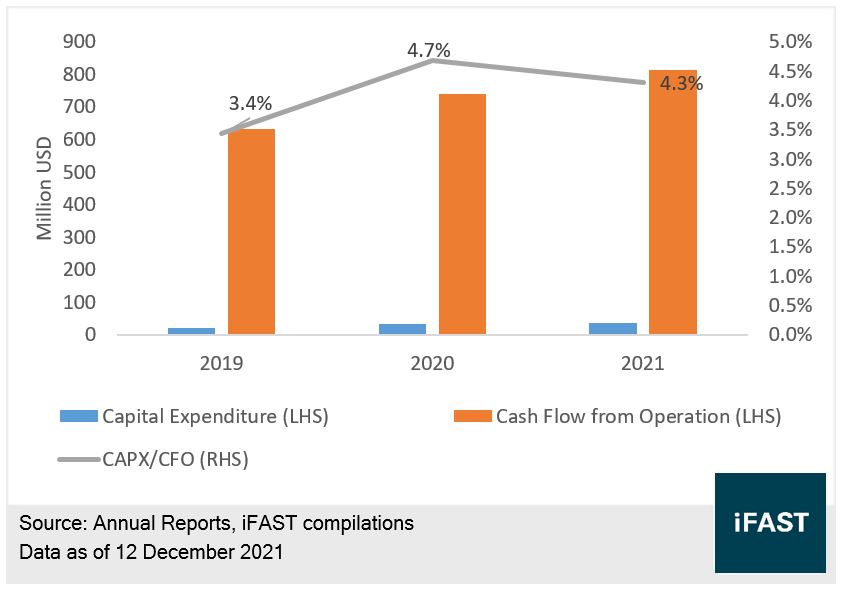
From the perspective of business strategies in recent years, Weibo exhibits conservatism in business sectors other than social media. As result, the company manages capital expenditure at a pretty low level. From 2019 to 2021, it totaled USD 200 million, USD 300 million, and USD 400 million respectively, accounting for 3.4%, 4.7%, and 4.3% of cash flow from operation, suggesting that Weibo's business strategies have almost matured and it no longer pursues aggressive growth. Concurrently, the cash flow from operation is adequate to cover its capital expenditure. Weibo's conservative business model might weaken its competitiveness with the rise of new forces such as Kuaishou and ByteDance, but such model is good for its credit profile.
Chart 3: Capital Expenditure and Cash Flow from Operation
For the credit indicators, in view of the low reliance on external refinance, Weibo reports a small-sized interest-bearing debt, among which short-term debt and long-term debt amounted to USD 970 million and USD 1,540 million respectively. The fact that the total debt amount approximates cash balance suggests that liquidity looks at a decent level. Net gearing was about 2.5%, and total debt/EBITDA saw a plummet from 4.5x in 2020 to 3.2x in 2021, showing very low leverage and debt repayment stress. The overall credit profile is of high quality.
Table 1: Credit Metrics
|
(Million USD) |
2021 |
2020 |
|
Short-term Debt* |
970.0 |
60.0 |
|
Long-term Debt |
1540.0 |
2430.0 |
|
Cash and Cash equivalents |
2420.0 |
1810.0 |
|
Current Ratio |
2.2x |
5.0x |
|
Total Debt/EBITDA |
3.2x |
4.5x |
|
Net Gearing Ratio |
2.5% |
24.0% |
|
Source: Annual Report *, Redeemable non-controlling interests are looked at as short-term debt Data as of 31 December 2021 |
||
2024 USD is Worthy of Consideration
So far the two bonds issued by Weibo are available on our platform. The credit rating is BBB by S&P, and the investment horizon ranges from 2 to 8 years. The specifications are as follow:
Table 2: Bonds of Weibo
|
Bond |
Ask Price |
Years to Maturity |
YTM |
|
WB 3.500% 05Jul2024 Corp (USD) |
98.1 |
2.1 |
4.5% |
|
WB 3.375% 08Jul2030 Corp (USD) |
84.7 |
8.1 |
5.8% |
|
Sources: Bondsupermart, Data as of 10 June 2022 |
|||
We favour its investment opportunity given by its decent credit profile and its rather low regulation risk. Particularly, interest rate hikes make the bonds more attractive. Investors who are interested in Weibo could consider the bond due 2024, which is currently yielding 4.5% with 2.1 years to maturity.
Corporate Risk
Investors should be aware of the following risks. Firstly, the regulation risk is expected to be at a manageable level, but we cannot rule out the likelihood of policy tightening. If so, the operation performance and solvency might be weakened.
Secondly, Weibo is highly associated with the entertainment industry, which is facing continuous supervision and intervention for the past few years. For example, in June 2021, the Cyberspace Administration of China launched the "Fan Group Chaos Rectification" special action, followed by the issuance of the “Notice on Further Strengthening the Management of Chaos in Fan Groups” in August 2021. These measures may result in a higher churn rate on Weibo, in return the advertisement revenue and operation stability might be adversely affected.
Conclusion
Revenue and net income recouped at the varying degree in 2021, but are expected to have limited room for further growth due to increasingly intense competition. In comparison to peers, the overall regulation risk is manageable.
Credit-wise, Weibo’s leverage saw a plummet in 2021, and the liquidity will likely remain decent for a long time given by its small-scale capital expenditures resulting from a conservative business strategy.
The bond due July 2024 is yielding roughly 4.5%, making it a good investment choice among IG bonds.
For specific disclosure, at the time of publication of this report, IFPL (via its connected and associated entities) and the analyst who produced this report hold a NIL position in the abovementioned securities.
Our podcast series, Yield Hunters, is available on Spotify, iTunes Podcasts and Google Podcasts. We share our thoughts on new bond issues and hold discussions on
the fixed income space. Listen to our latest episode below and follow us!