Highlights:
- Icahn Enterprises (IEP) is a conglomerate and investment company. Its earnings structure can be broadly divided into two parts: the segment results of the subsidiaries and the investment return on the portfolio. The company shares could be seriously overvalued, with the possibility of high dividend yield being unsustainable.
- IEP was accused by Hindenburg of being a classic Ponzi scheme. However, this is different from the nature of a Ponzi scheme. IEP's subsidiaries have real business segments. Its assets and investment portfolios do have value. The source of the dividends can be attributed to asset disposal, where the assets were generated from the early years.
- Investors can treat the bond sell-off as an investment opportunity. IEP can be considered a net cash company. The solvency is strong. Its bond is yielding at 9.0%. It is hard to find a company with a net cash position that offers over 9% yield in the bond market.
Who are Carl Icahn and Icahn Enterprises?
Icahn Enterprises (IEP) is a conglomerate and investment company. The company has a stake in several subsidiaries. The company’s most proprietary capital is invested as Carl Icahn’s investment idea. Therefore, the company's earnings structure can be broadly divided into two parts: the segment results of the subsidiaries and the investment return on the portfolio. IEP is listed on the NASDAQ (stock code: IEP.US) and currently has a market capitalisation of approximately USD 10.8 billion. Carl Icahn currently holds approximately 85% of IEP's shares.
Carl Icahn and IEP specialise in buying undervalued shares and exercising shareholder rights in an attempt to change the company’s operation and management decisions. Usually, they seek to create shareholder value through corporate actions, such as M&A, spin-offs, management changes, cutting costs, share buybacks and tender offers. The ultimate goals include balance sheet restructuring, operational improvements, strategic initiatives and corporate governance changes. Thus, Carl Icahn is known as the "Corporate Raider".
IEP’s subsidiaries include energy, automotive and food packaging businesses. Except for the energy segment, all of them have little impact on IEP’s earnings and can be largely ignored. IEP engages in the energy business through its ownership of CVR Energy. IEP holds around 71% of CVR Energy’s shares. CVR currently has a market value of approximately USD 2.79 billion.
As for the investment portfolio, Carl Icahn and IEP are the only contributors to the investment funds. As of the end of March 2023, the investment fund had a net asset value of around USD 8.6 billion. IEP accounted for 46.5% (around USD 4 billion).
It is noted that IEP's financial statements consolidated the results of its subsidiaries and the whole investment funds. It might be necessary to exclude Carl Icahn's attributable part of the investment funds when we consider the IEP’s operating and credit positions.
Company Shares could be Seriously Overvalued, with Possibility of High Dividend Yield Being Unsustainable
In early May, Hindenburg Research pointed out that IEP shares were overvalued by at least 75% and had significant downside potential, due to (1) IEP's market cap premium to NAV of over 200%, much higher than its peers (such as Bill Ackman's Pershing Square and Dan Loeb's Third Point Investors) (see Table 1), (2) the valuation inflation in IEP's private assets, (3) IEP's poor investment performance and (4) unsustainable high dividend distributions.
Table 1: IEP and Peers’ Valuation
| Icahn Enterprises | Third Point Investors | Pershing Square | |
| Ticker | IEP.US | TPOU.LN | PSH.LN |
| Key Person | Carl Icahn | Dan Loeb | Bill Ackman |
| Net Asset Value | Around USD 5.6 billion | Around USD 700 million | Around USD 10.1 billion |
| Net Asset Value Per Share | $15.96 | $23.06 | $53.88 |
| Share Price | $50.82 | $19.83 | $34.75 |
| Premium (discount) to NAV per share | 218% | -14% | -36% |
| Price to Book | 3.18x | 0.86x | 0.64x |
Sources:
Hindenburg Research, Bloomberg Finance L.P., iFAST compilations Data as of 1 May 2023 |
|||
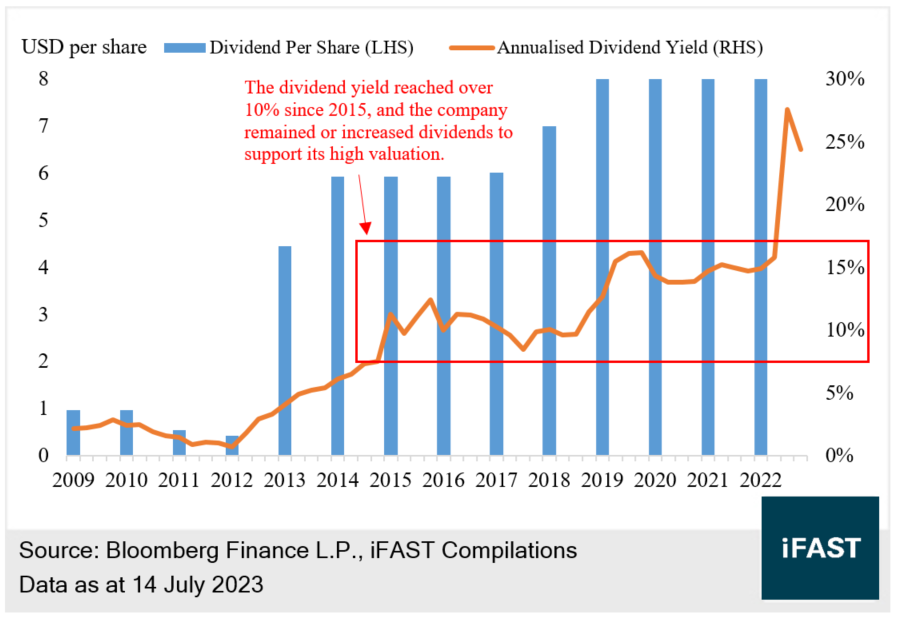
We agree with some of Hindenburg's points: IEP's high valuation is supported by the company's high dividend and dividend yield (Chart 1). Besides Carl Icahn's reputation, IEP is the only way to participate in Carl Icahn's investment fund indirectly. These attracted some retail investors to pursue IEP shares.
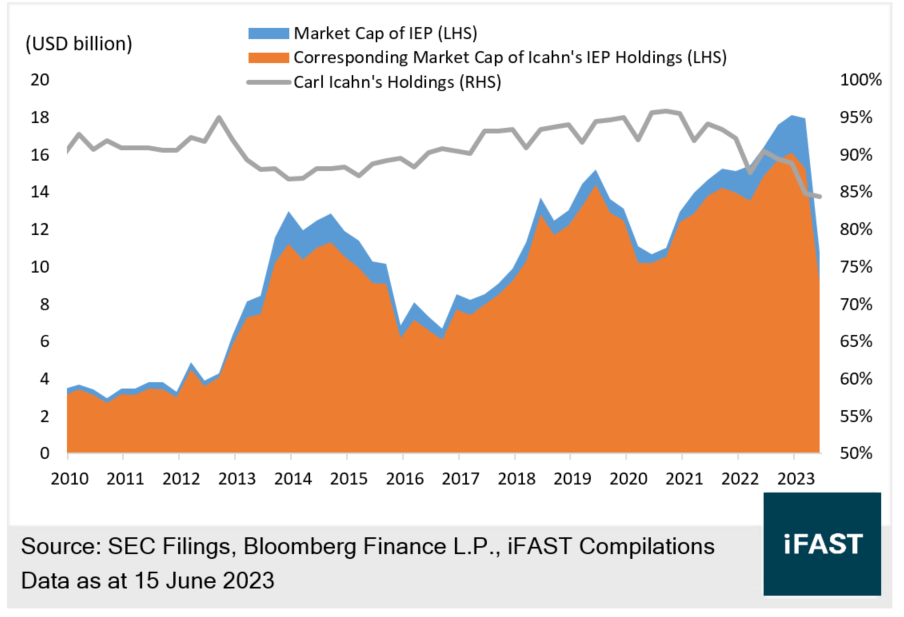
In addition, Carl Icahn holds IEP shares up to 85% to 96% (Chart 2), under the situation of most shares held by the same party, the valuation might likely be distorted. The market capitalization cannot reflect the company’s reasonable valuation.
Chart
2: IEP’s Market Capitalisation, Carl Icahn’s IEP Holdings in terms of Market
Value and Shareholdings
So, how does IEP continue to pay high dividends? In fact, Carl Icahn, the major shareholder, has more often than not opted for scrip dividends (IEP has offered the option of scrip dividends since 2013, with script dividends as the default option). It allows IEP to pay cash only to some shareholders who opt for cash dividends, significantly reducing the cash expenses related to dividends.
These actions result in an unusually high valuation (with the price to book over three times for a long time) and the ability to pay a high dividend in the form of new share issuance. The company's market capitalisation was reasonably inflated (Chart 2), together with Carl Icahn’s fortune, until Hindenburg’s allegations led to a precipitous fall.
It is true that if all shareholders (together with the major shareholder, Carl Icahn) opted to receive the cash dividends, the current annual dividend of $8 per share would be impossible to sustain. The dividend per share of $8 is already 50% of IEP’s net asset value per share (about $16). Together with the weak investment performance in recent years, it would be difficult to sustain a high dividend in the face of consecutive losses.
Is IEP a Ponzi scheme?
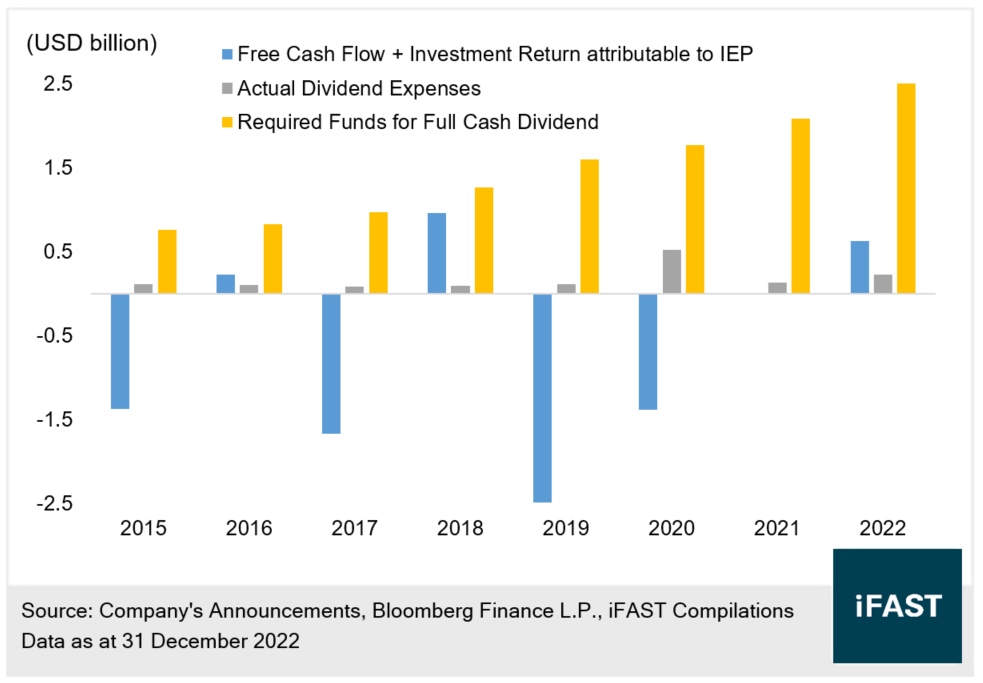
IEP had irregular fundraising activities, where the amount raised is indeed higher than the cash dividends. The company continued to pay dividend amounts well above the company's cash generating ability (refer to Free Cash Flow and Investment Return) (Chart 3), which does have some features of a Ponzi scheme.
Chart 3: IEP’s Free Cash Flows, Investment Return, Actual Dividend Distribution and All Cash Dividend Distribution
However, we believe that this is different from the nature of a Ponzi scheme, where the new money from later entrants is used to pay the returns of early investors. There is no economic activity in the process.
IEP's subsidiaries have real business segments. Its assets and investment portfolios do have value. The source of the dividends can be attributed to the asset disposal, where the assets were generated from the early years. Therefore, we can only point out that Carl Icahn takes advantage of special means to inflate the valuation of IEP to an unreasonable level. It is not likely that IEP is a Ponzi scheme.
Going forward, IEP's ability to maintain a high dividend payment is largely at the discretion of its major shareholder, Carl Icahn. This might involve some risk of dividend suspension or reduction since he could opt for scrip dividends in most cases in order to maintain high dividends.
Bond Investors could Treat it as An Investment Opportunity
Regardless of whether the unusually high dividend can be sustained, at the bond level, we believe that investors can treat the bond sell-off as an investment opportunity, due to IEP's strong credit profile. As shown in Table 2, if we consider its investment portfolio as cash equivalents, IEP can be considered as a net cash company with a net cash position of USD 570 million. The solvency is strong.
Table 2: The Credit Indicators at IEP’s Holding Company Level
| (USD billion) | Dec 22 | Mar 23 |
| Total Debt | 5.31 | 5.31 |
| Total Cash | 1.72 | 1.87 |
| Net Asset Value of Investment Portfolio | 4.18 | 4.01 |
| Net Cash (Total Cash + Net Asset Value of Investment Portfolio – Total Debt) | 0.6 | 0.57 |
| CVR Energy’s Attributable Market Cap | 2.23 | 2.33 |
| Valuation of Other Subsidiaries | 2.8 | 2.54 |
| Other Net Assets | 0.02 | 0.13 |
| IEP’s Net Asset Value | 5.64 | 5.58 |
| Sources: Company’s
Announcements, iFAST compilations Data as of 31 March 2023 |
||
Considering that IEP also has a stake in CVR Energy and other subsidiaries (valued at around USD 4.9 billion), IEP's asset portfolio provides a buffer for the future, even if the investment portfolio might incur losses or if the company continues to pay high dividends. Investors might consider IEP's bonds, with a yield to maturity of 9.0% (see Table 3). It is hard to find a company with a net cash position in the bond market that offers around 9% yield.
Table 3: IEP’s 2027
Bond
| Bond Name | Years To Mature | Issuer Credit Rating (S&P) |
Ask Price (Investors Buy) |
Yield To Maturity |
| IEP 5.250% 15May2027 Corp (USD) | 3.8 | BB | 88.4 | 9.0% |
| Sources:
Bondsupermart, iFAST compilations Data as of 14 July 2022 |
||||
Related Risks
IEP’s investment fund has a large number of long and short positions. If market conditions or the movement of individual stocks fall significantly short of the investment team's expectations, this could expose the fund to huge losses, which could affect its credit performance.
Carl Icahn (the major shareholder of IEP and the primary fund manager of the investment fund) is already 87 years old. There is a degree of key person risk that if he has some health issue or negative condition, it could affect IEP's operations and investment performance.
CVR Energy's performance has an impact on IEP's earnings and net assets. CVR Energy is primarily engaged in oil refining and nitrogen fertiliser production. The revenues and earnings are highly cyclical, which could impact IEP's performance and net assets if they are in a downward cycle.
Conclusion
Icahn Enterprises (IEP) is a conglomerate and investment company. Its earnings structure can be broadly divided into two parts: the segment results of the subsidiaries and the investment return on the portfolio. The company shares could be seriously overvalued, with the possibility of high dividend yield being unsustainable.
IEP was accused by Hindenburg of being a classic Ponzi scheme. However, this is different from the nature of a Ponzi scheme. IEP's subsidiaries have real business segments. Its assets and investment portfolios do have value. The source of the dividends can be attributed to the asset disposal, where the assets were generated from the early years.
Investors can treat the bond sell-off as an investment opportunity. IEP can be considered as a net cash company. The solvency is strong. Its bond is yielding at 9.0%. It is hard to find a company with a net cash position that offers around 9% yield in the bond market.
Declaration: For specific disclosure, at the time of publication of this report, IFPL (via its connected and associated entities) holds a NIL position and the analyst who produced this report holds a NIL position in the abovementioned securities.