- Net gearing rose to 56% following active share buybacks and the issuance of new debt. Notwithstanding the higher leverage, we view credit risk as manageable at this stage.
- Liquidity remains adequate to meet upcoming maturities. Unbilled sales of approximately RM2 billion provide earnings visibility, while its sizeable landbank underpins longer-term development prospects.
- Sizeable project launches and the property overhang remain the key risks to monitor
- Given that gearing has improved since 2024 and operating fundamentals continue to stabilise, we maintain a constructive view on the credit. We believe the forthcoming Tropicana Mar2031 issuance, offering a YTM of 6.10% (about 280bps pickup from 5Y MGS), presents an attractive opportunity for investors. It is also backed by a 1.5x of security cover.
Tropicana Corporation Berhad is a premier Malaysian conglomerate and a pioneer of the "resort-style" living concept. Established in 1979 and subsequently listed on Bursa Malaysia in 1992, the group has successfully evolved from a niche developer of golf resorts into a major diversified real estate powerhouse. As of today, the group’s market capitalisation stands at approximately RM3.12 billion.
Property Industry Outlook
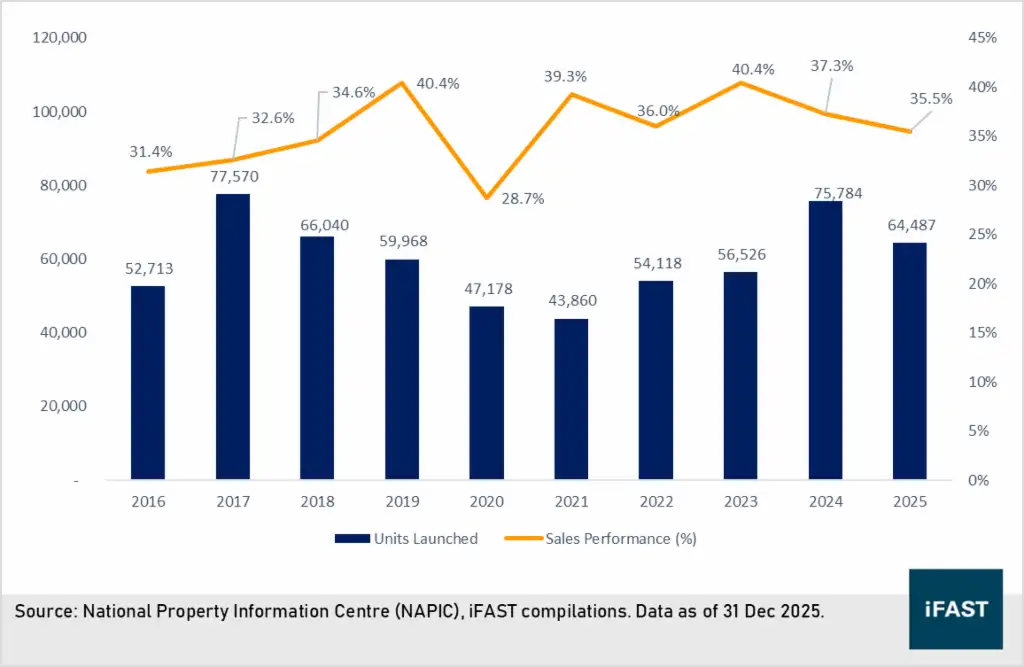
As illustrated in Chart 1, the Malaysian property market softened throughout 2025, characterised by a decline in new launches and sales volumes alongside an uptick in overhang units. This contraction occurred despite a 25-basis point (bps) reduction in the Overnight Policy Rate (OPR).
According to the National Property Information Centre (NAPIC), the slowdown in new launches is largely attributable to cautious developer sentiment amidst a challenging global economic environment, marked by rising input costs and a growing inventory of unsold units.
Chart 1: New units launched and sales performance, express in % (as of 31 December 2025)
The volume of overhang units rose to 30,471 in 2025, representing a 31.6% YoY increase. This significant surge was primarily driven by sluggish sales in Perak, Johor, Selangor, and Pulau Pinang. Notably, the majority of these unsold units fall within the affordable price bracket of below RM300,000, suggesting an oversupply in this segment. Consequently, buyers have become increasingly discerning, prioritising projects with superior connectivity, strategic locations, and established developer track records.
This flight to quality is further evidenced by a 1.3% increase in transaction value despite a 1.5% decline in transaction volume, indicating that buyers are picking-up with the higher-quality assets.
Chart 2: Overhang units and YoY percentage change
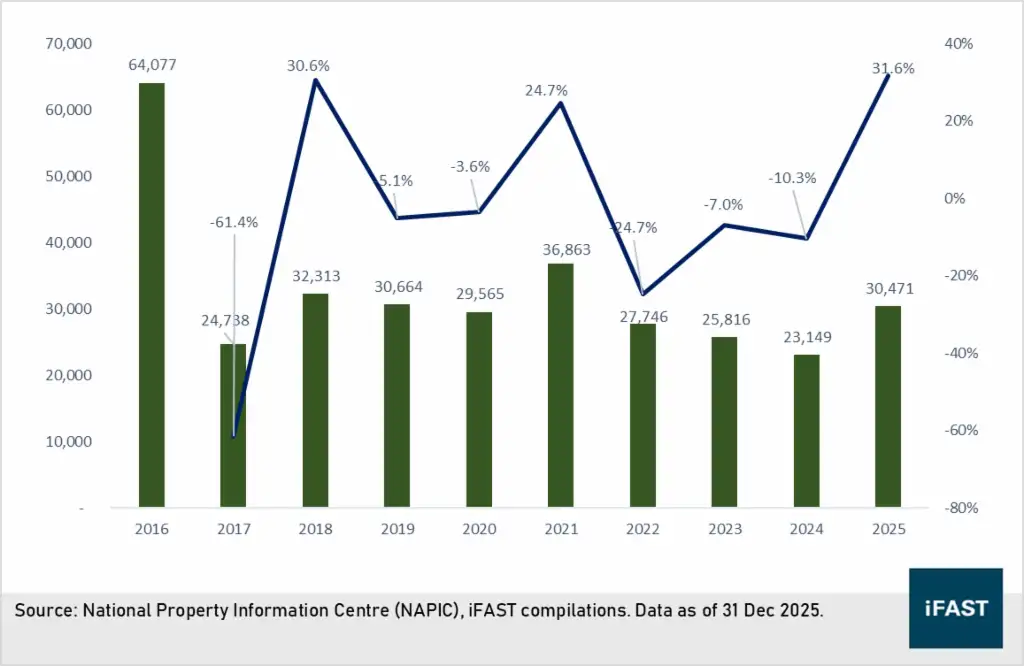
While the level of overhang remains a point of concern, the property market is expected to remain resilient, particularly for projects backed by reputable developers. Market stability is likely to be underpinned by robust domestic demand and various government initiatives outlined in Budget 2026. These include the extension of the full stamp duty exemption for first-time homebuyers on properties priced up to RM500,000, as well as the introduction of step-up financing schemes.
Financial Highlights
In FY2025, Tropicana reported a modest revenue increase of 6% YoY to RM1,491.4 million. This growth was primarily underpinned by higher progress billings from key development projects across the Klang Valley, Southern and Northern regions.
The group’s operating profit surged by approximately 157%, a significant improvement largely attributed to a leaner cost structure. Administrative expenses declined following ongoing asset-monetisation initiatives, while other operating expenses fell by roughly 95%, primarily due to the absence of the heavy provisions recorded in FY2024.
While the group remains in a loss-making position, the bottom has seen a notable improvement. The loss before tax (LBT) narrowed significantly to RM15.5 million, compared to RM117.1 million in the previous year. Furthermore, finance costs declined, consistent with management’s stated strategy to reduce debt levels and improve the group's gearing profile.
Overall, while profitability remains under pressure and aligned with our previous updates, we expect the group to maintain its deleveraging trajectory through the disposal of non-core assets. Looking ahead, earnings should continue to be supported by a healthy pipeline of ongoing developments and a solid buffer of unbilled sales.
Table 1: Profitability indicator (RM million)
|
2020 |
2021 |
2022 |
2023 |
2024 |
2025 (unaudited) |
|
|
Revenue |
1,062.6 |
876.0 |
942.6 |
1,493.1 |
1,407.6 |
1,491.4 |
|
Operating profit |
380.0 |
118.1 |
(296.3) |
149.6 |
44.4 |
114.1 |
|
(Loss)/profit before tax |
238.4 |
(36.0) |
(472.4) |
(100.0) |
(117.1) |
(15.5) |
|
Operating profit margin (TTM) |
35.8% |
13.5% |
- |
10.0% |
3.2% |
7.7% |
Source: Company’s Reports, iFAST Compilations. Data as of 31 Dec 2025.
Credit highlights
The credit position of Tropicana remained generally stable in 2025 relative to the previous year. The group net gearing ratio saw a marginal increase to 56%, primarily driven by active share buyback programmes throughout the year which consequently reduced the equity base. Furthermore, the group issued new debt to provide capital for its various ongoing development projects.
Despite the rise in leverage, the interest coverage ratio improved slightly to 0.82x on the back of stronger earnings during the period.
While operating cash flow was negative in 2025, this was largely due to movements in working capital, specifically within trade and other receivables. We interpret this as a positive indicator of the group operational momentum, as it likely reflects high project completion and take up rates. Given that the typical cash conversion cycle for property buyers ranges from 30 to 90 days, this temporary mismatch is expected.
Overall, the group credit position remains at a healthy level. We maintain our view that credit risk is manageable, supported by the group demonstrated ability to meet its debt obligations.
Table 2: Credit metrics (RM million, unless otherwise stated)
|
|
2020 |
2021 |
2022 |
2023 |
2024 |
2025 |
|
Cash and bank balances |
622 |
639 |
650 |
501 |
696 |
652 |
|
Short-term borrowings |
519 |
545 |
1,353 |
1,353 |
1,275 |
1,056 |
|
Long-term borrowings |
3,078 |
3,371 |
2,420 |
1,808 |
1,036 |
1,691 |
|
Net gearing ratio (%) |
59% |
70% |
74% |
65% |
43% |
56% |
|
Interest coverage ratio (x) |
2.31 |
0.59 |
- |
0.72 |
0.25 |
0.82 |
|
Operating cash flow |
(747) |
(533) |
(25) |
136 |
34 |
(488) |
Source: Company’s Reports, iFAST Compilations. Data as of 31 Dec 2025.
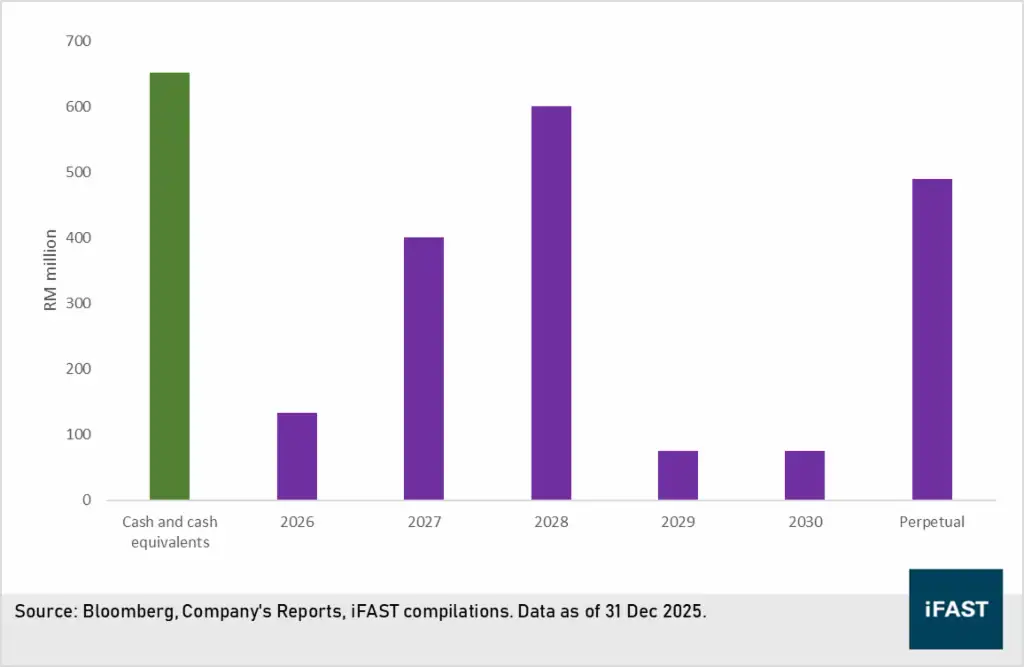
Cash remains supportive to the debt maturity profile
As of 31 December 2025, the group cash position remains sufficient to comfortably meet its short term bond obligations. This liquidity cushion is further bolstered by a sizeable landbank and a steady pipeline of ongoing developments, which should provide additional financial buffers against upcoming debt maturities.
Chart 3: Debt Maturity Profile (bonds and perpetuals, in RM million)
Unbilled sales and ongoing property developments provide strong earnings visibility
As of 31 December 2025, Tropicana reported unbilled sales of approximately RM2.0 billion, which provides the group with strong earnings visibility over the coming years.
Furthermore, the group ongoing property development projects are strategically located in prime areas such as the Klang Valley, Johor, Genting Highlands, and Langkawi. These projects represent a total Gross Development Value (GDV) of roughly RM6.4 billion (assuming an average take up rate of 80%).
Tropicana is poised to benefit from the developments in Johor; Lido Waterfront is expected to be the key revenue driver.
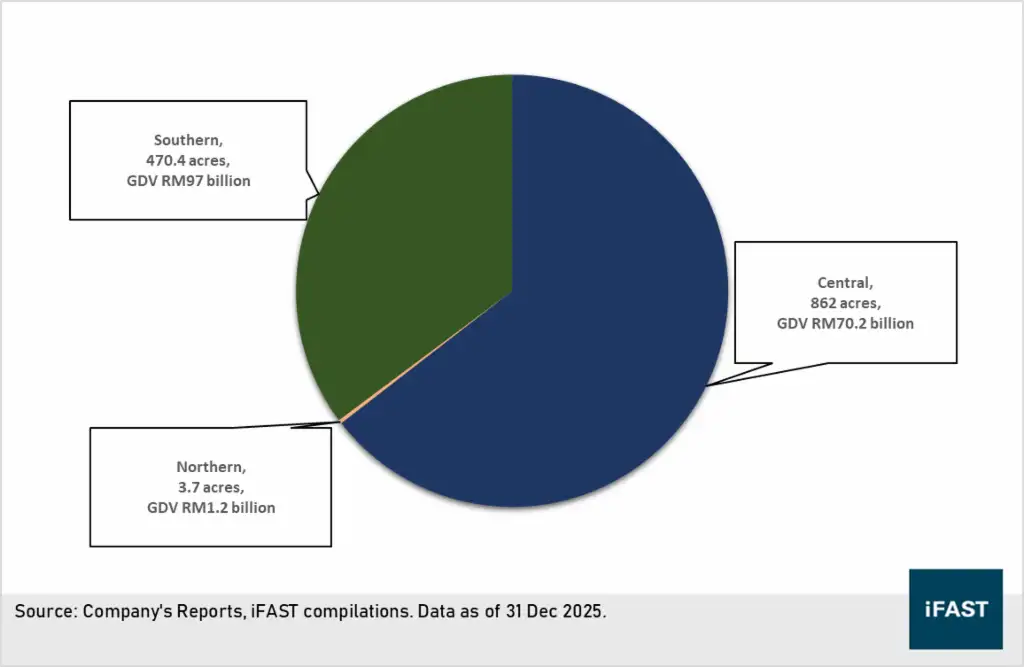
As of 31 December 2025, Tropicana had a total landbank of 1,336.1 acres across Malaysia, of which 470.4 acres are located in the southern region, with an estimated GDV of RM97 billion. Owing to this, we are of the view that Tropicana is well positioned to benefit from its proximity to the Rapid Transit System (RTS) and the economic growth potential arising from the Johor–Singapore Economic Zone (JS-SEZ). The sizeable landbank also provides ample opportunities for future developments.
Lido Waterfront, one of the most impressive and innovative townships with an estimated GDV of around RM80 billion, is poised to become the new pulse of Johor. In July 2025, the first branded residence was launched with an expected GDV of RM1.5 billion.
Given its strategic location with less than 15 minutes driving distance from the upcoming Rapid Transit System (RTS) link connecting Johor’s Bukit Chagar Station and Singapore’s Woodlands North Station, we believe the completion of the RTS will significantly boost footfall in Johor, positioning the township as an attractive investment destination in Malaysia.
Chart 4: Available landbank and potential GDV (as of 31 Dec 2025)
Risks
Sizeable project launches – A large number of developments are currently ongoing. If the group does not manage its working capital properly, it could potentially face a capital shortfall.
Property market overhang – Given the current government initiatives which prioritise affordable housing, there is a risk of increased inventory and softening demand for medium to high end properties. Furthermore, sales at Lido Waterfront may face challenges as the project specifically targets the higher income group, a segment that remains sensitive to the prevailing economic climate and evolving buyer preferences.
Upcoming issuance – Tropicana Mar2031
Key characteristics of the proposed issuance:
- Tenure: 5 years
- Indicative yield guidance: 6.10%
- Issue Rating: “A” by MARC
- Issue Size: Up to a Nominal Amount of RM200 million
- Security Cover: 1.5x
- Target Book Open: Week of 9 March 2026 (Subject to market conditions)
Table 3: Indicative Market Value of assets pledged to the issuance
|
Location |
Indicative Market Value (RM million) |
|
1) Johor Bahru ("Lido Land") |
300 |
Our view
Although the group earnings remained in the red during the latest financial year, we maintain a positive stance. Our rationale is primarily centered on its ongoing developments in strategic locations such as Genting, Johor, and the Klang Valley. Furthermore, the group possesses a sizeable landbank that offers significant flexibility for future development opportunities and potential refinancing exercises.
It is also worth noting that the group has achieved a marked improvement in both its top and bottom-line performance. Finance costs have declined, which aligns with the management ongoing strategy to reduce absolute debt levels through successful asset monetisation initiatives.
We understand that past liquidity concerns might still be on some investors' minds. But it’s important to look at how much the ground has shifted: the 'current Tropicana' is in a much better place than the 'Tropicana of 2024.' Thanks to a steady focus on reducing debt and improving their gearing ratio, the group’s financial health has seen a major improvement. We remain positive because the credit position seems to be more stable and promising.
Overall, we anticipate continued strengthening of the group profitability and balance sheet, with potential economic growth in Johor acting as a pivotal revenue driver. Regarding the upcoming issuance, we view the 5-year sukuk with an indicative yield guidance of 6.1% as an appealing proposition within the current economic climate. In our view, the risk reward profile is well justified considering about 280bps pickup from the 5Y MGS.
Table 4: Recommended Bond
|
Bond |
Indicative Yield Guidance |
Credit Rating (MARC) |
Issue Size |
|
6.10% |
A |
Up to RM200 million |
Source: BSM, iFAST Compilations. Data as of 03 Mar 2026.
- This sukuk listed on Bond Express with a min / sub investment amount of: MYR 25,000 / 5,000
Declaration: For specific disclosure, at the time of publication of this report, IFPL (via its connected and associated entities) holds DJCMK 5.800% 14Nov2028 Corp (MYR) and the analyst who produced this report hold NIL positions in the abovementioned securities.