Key Points
- LBBW has maintained a broadly stable earnings profile. In FY25, LBBW recorded a 7.0% YoY increase in operating income, supported by stronger contributions from net interest income (+3.8% YoY) and net fee and commission income (+8.5% YoY).
- As the largest state-owned bank in Germany, LBBW has consistently maintained strong and stable credit metrics with CET1 ratio of 16.9%, an LCR of 180%, and an NSFR of 115%, all comfortably exceeding the regulatory minimum requirements of 10.53%, 100% and 100% respectively.
- In terms of asset quality, LBBW's Non-Performing Exposure (NPE) ratio increased modestly to 1.0% in FY2025 (FY2024: 0.6%), primarily due to the deterioration of its Commercial Real Estate (CRE) portfolio. Nevertheless, we do not view this as a significant concern as Stage 3 financing (defaulted loans) represents only a negligible proportion of the overall portfolio.
- Considering LBBW's significant presence in Germany as a state-owned bank, its relatively stable earnings profile and strong balance sheet, we maintain a positive view of the bank. Investors may consider LBBW's 5.000% 17 May 2028 Corp (AUD), which is currently yielding around 5.83%.
Overview
Landesbank Baden-Württemberg, commonly known as LBBW, is the largest state-owned bank (Landesbank) in Germany. Headquartered in Stuttgart, it serves a broad range of customers, including corporations, small and medium-sized enterprises (SMEs), institutional clients, public-sector organizations, and private banking customers.
LBBW was established in 1999 through the merger of several regional banks, creating a financial institution with a strong presence in southern Germany. Today, it operates both domestically and internationally.
LBBW plays an important role in supporting the German economy, particularly the country's export-oriented industrial sector and the well-known Mittelstand (small and medium-sized businesses). It also acts as the central bank for many local savings banks (Sparkassen) in the state of Baden-Württemberg.
LBBW is structured under shared public ownership, with the Savings Bank Association of Baden-Württemberg holding 40.5%, the State of Baden-Württemberg holding 25.0% directly, the City of Stuttgart holding 18.9%, and Landesbeteiligungen Baden-Württemberg holding 15.5%. As Landesbeteiligungen Baden-Württemberg is itself an entity of the State of Baden-Württemberg, the State of Baden-Württemberg has both direct and indirect ownership of LBBW.
Operating segments and geographic breakdown:
We have summarised the operating segments and geographic breakdown as below.
Table 1: Operating segments:
|
Operating Segment |
Description |
|
Corporate Customers |
Provides lending, transaction banking, and advisory services to corporate and SME clients. |
|
Real Estate and Infrastructure Financing |
Offers financing for commercial real estate, infrastructure, and project finance. |
|
Capital Markets Business |
Delivers trading, capital markets, foreign exchange, and risk management solutions. |
|
Private Customers / Savings Banks |
Provides retail banking, private banking, wealth management, and services to the Sparkassen network. |
|
Corporate Items / Reconciliation / Consolidation |
Includes central treasury, Group functions, and consolidation adjustments not allocated to business segments. |
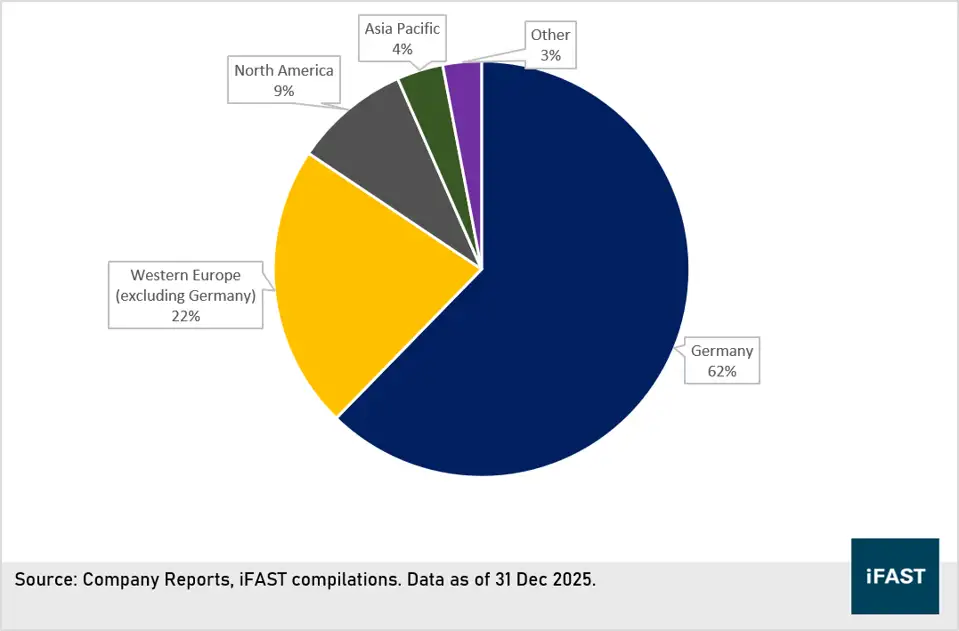
LBBW business portfolio is predominantly in Germany (62%) and the remaining is spread across Western Europe and North America in particular.
Chart 1: Geographic breakdown
Financials – stable earnings growth despite ECB rate cuts in 2025
Historically, LBBW has maintained a broadly stable earnings profile. As shown in Table 2, both operating income and profit before tax have grown steadily over the years.
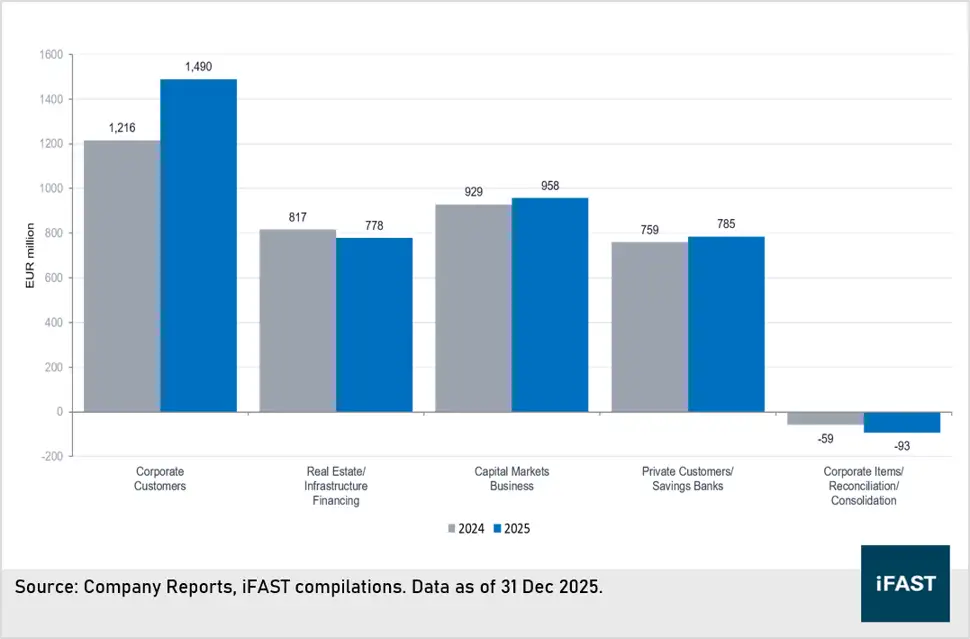
In FY2025, despite the ECB's lower interest rate environment, LBBW recorded a 7.0% YoY increase in operating income, supported by stronger contributions from net interest income (+3.8% YoY) and net fee and commission income (+8.5% YoY).
The growth in net interest income was primarily driven by the strong performance of the Corporate Customers business, supported by higher lending volumes, increased financing and commitment fees, expansion in infrastructure financing, and continued deposit growth. These factors more than offset the impact of the ECB's interest rate cuts.
Meanwhile, the increase in net fee and commission income was underpinned by stronger sales across the Private Customers/Savings Banks and Capital Markets businesses, alongside higher income from wealth management, institutional asset management, securities and syndication, pension products, real estate transactions, and lending-related fees.
On the cost side, LBBW's cost/income ratio increased to 62.0% in FY2025 from 60.4% in FY2024. This was mainly attributable to one-off costs associated with the integration of Berlin Hyp, including transformation expenses, IT system migration costs, restructuring provisions, and higher personnel expenses incurred as part of the acquisition.
Overall, profit before tax increased by 4.2% YoY to EUR1,284 million. Considering the challenging environment, the management expects profit before tax to be slightly below the previous year’s level, but it is likely to remain higher than EUR 1.1 billion.
Table 2: Profitability indicators (EUR million)
|
2021 |
2022 |
2023 |
2024 |
2025 |
|
|
Net interest income |
2,031 |
2,305 |
2,826 |
2,631 |
2,730 |
|
Net fee and commission income |
598 |
628 |
589 |
635 |
689 |
|
Total operating income |
2,757 |
4,048 |
3,781 |
3,662 |
3,918 |
|
Consolidated profit before tax |
817 |
1,873 |
1,374 |
1,232 |
1,284 |
|
Cost/income ratio |
64.7% |
65.6% |
59.6% |
60.4% |
62.0% |
Source: Company Reports, iFAST Compilations. Data as of 31 Dec 2025.
Chart 2: Operating Income – breakdown by segment (EUR million)
Solid liquidity and credit position
As the largest state-owned bank in Germany, LBBW has consistently maintained strong and stable credit metrics. The bank continues to demonstrate a solid capital and liquidity position, as reflected in the three key prudential metrics under the Basel III regulatory framework—the Common Equity Tier 1 (CET1) ratio, Liquidity Coverage Ratio (LCR), and Net Stable Funding Ratio (NSFR).
In FY2025, LBBW reported a CET1 ratio of 16.9%, an LCR of 180%, and an NSFR of 115%, all comfortably exceeding the regulatory minimum requirements of 10.53%, 100% and 100% respectively. These metrics underscore the bank's strong loss-absorbing capacity, ample liquidity buffer, and stable long-term funding profile.
LBBW's CET1 ratio improved significantly to 16.9% in FY2025, driven by stronger internal capital generation through retained earnings and the transition from the Capital Requirements Regulation (CRR) II to CRR III, which resulted in a notable reduction in risk-weighted assets (RWAs).
As CRR III is an EU-wide regulatory framework applicable across all EU member states, we believe other EU banks are also likely to be benefited by the transition, particularly through changes in risk-weighted assets (RWAs) and capital requirements.
***CRR III: replaced the previous "one-size-fits-all" approach to real estate risk weights with an LTV-based system, where loans secured by properties with lower LTVs receive lower risk weights and loans with higher LTVs receive higher risk weights, making capital requirements more risk-sensitive. (Note: LBBW average portfolio by LTV is <60%).
Overall, we view LBBW's credit profile as solid, underpinned by its strong capitalisation (CET1 ratio of 16.9%) and ample liquidity buffers (LCR of 180%).
Table 3: Credit metrics (EUR million, unless otherwise stated)
|
2021 |
2022 |
2023 |
2024 |
2025 |
|
|
CET1 ratio (%) |
14.6% |
14.1% |
14.6% |
14.40% |
16.90% |
|
Liquidity Coverage Ratio (LCR) (%) |
141.1% |
144.2% |
150.5% |
149% |
180% |
|
Net stable funding ratio (NSFR) (%) |
108.5% |
111.3% |
109.7% |
113.40% |
115.00% |
|
Gross loans and advances |
166,319 |
227,825 |
235,124 |
246,553 |
237,166 |
Source: Company Reports, iFAST Compilations. Data as of 31 Dec 2025.
Slight Increase in NPE, but Asset Quality Remains Sound
In terms of asset quality, LBBW's Non-Performing Exposure (NPE) ratio increased modestly to 1.0% in FY2025 (FY2024: 0.6%), primarily due to the deterioration of its Commercial Real Estate (CRE) portfolio. This reflects the challenging operating environment in Germany, where elevated interest rates and weaker property market conditions have continued to weigh on the CRE sector.
Chart 3: Non-performing exposure (%)
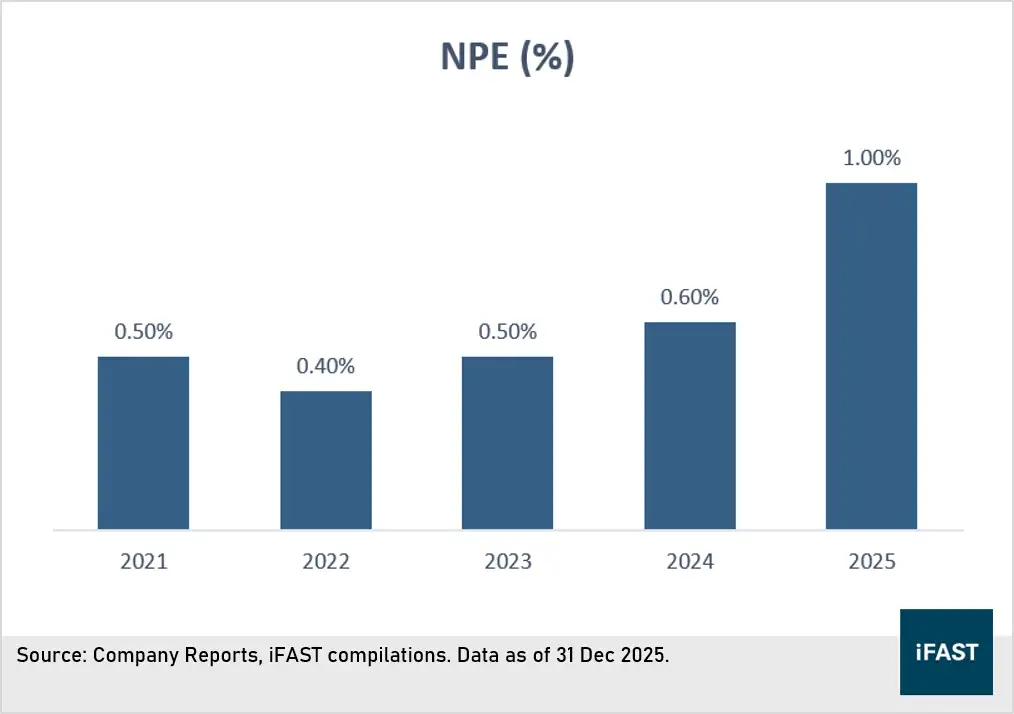
Nevertheless, we do not view this as a significant concern as Stage 3 financing (defaulted loans) represents only a negligible proportion of the overall portfolio. Furthermore, the bank's NPE ratio of 1.0% remains well below the Eurozone industry average of approximately 2.2%. The Commercial Real Estate (CRE) portfolio is also well secured by physical collateral, with a conservative average loan-to-value (LTV) ratio of around 55%, providing a substantial buffer and indicating that the underlying collateral value is sufficient to cover the outstanding principal.
Balanced Sectoral Loan Exposure
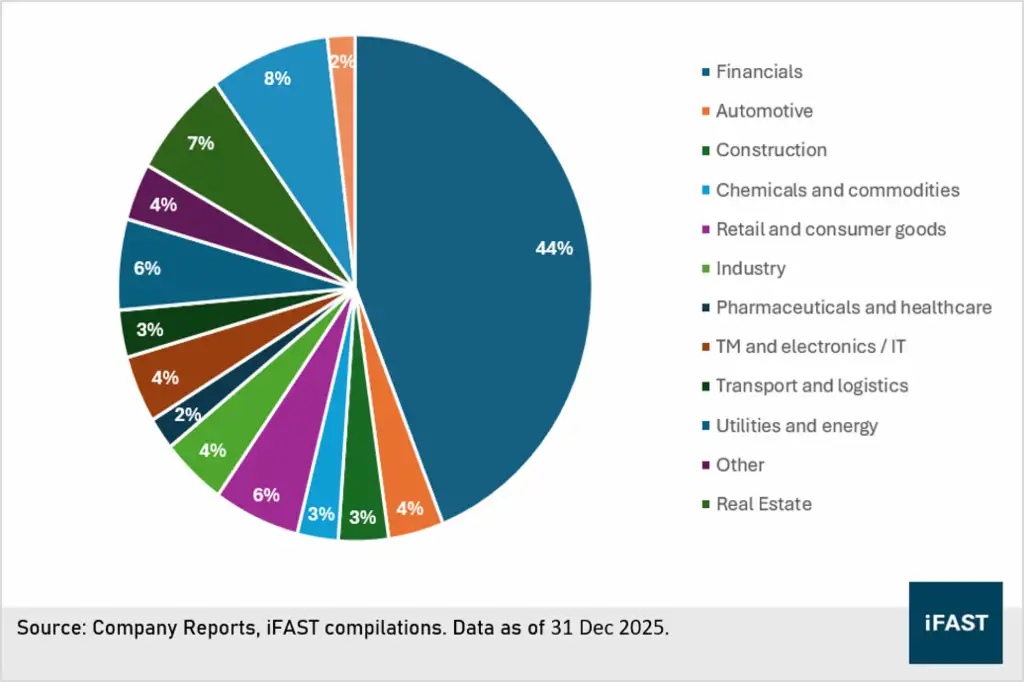
LBBW's loan portfolio is well diversified across various sectors, which has significantly mitigated concentration risk. As shown in Chart 4, LBBW has a relatively high loan exposure to the financial sector. We consider this to be reasonable given LBBW's role as a "central bank" for local savings banks.
Accordingly, we are of the view that LBBW's concentration risk remains manageable.
Chart 4: Loan exposure by sector
Risk
Elevated Exposure to Commercial Real Estate: CRE is LBBW's most significant asset-quality risk factor, further amplified by its acquisition of Berlin Hyp. Structural shifts in office space (remote work), higher borrowing costs, and valuation declines in core German and international metropolitan markets.
It is also worth noting that CRE sector represents over 40% of the bank’s Stage 3 defaulted assets – EUR1.537 billion out of the group total defaulted assets of EUR3.838 billion.
Nonetheless, at this juncture, the bank is adopting a conservative underwriting that keeps the portfolio’s average Loan-to-Value (LTV) at around 55% (over 64% of exposures are below 60% LTV), providing a substantial physical collateral buffer.
Our view
Considering LBBW's significant presence in Germany as a state-owned bank, its relatively stable earnings profile and strong balance sheet, we maintain a positive view of the bank. In addition, given LBBW's systemic importance to the German financial system, we believe the bank is likely to receive government support in the event of severe financial distress.
Hence, we advocate investors to consider LBBW 5.000% 17May2028 Corp (AUD), which is currently yielding around 5.83%, as it offers an attractive yield level relative to its remaining tenure.
Table 4: Recommended bonds
|
Bonds |
Years to maturity |
Yield to maturity |
Credit rating (Fitch) |
Min / Subs |
|
1Y9M |
5.83% |
A- |
AUD 200k / 200k |
|
|
LBBW 5.250% 02Aug2029 Corp (AUD) |
3Y |
5.47% |
AA- |
AUD 200k / 200k |
|
4Y2M |
5.10% (YTC) |
- |
EUR 200k / 200k |
Source: BSM, iFAST Compilations. Data as of 21 Aug 2026.
Declaration: For specific disclosure, at the time of publication of this report, IFPL (via its connected and associated entities) and the analyst who produced this report hold a NIL position in the abovementioned securities.