


Highlight
- Defensive Regulated Revenue Base: Approx. 85% of revenue is generated from AER-regulated electricity and gas network businesses, providing stable, predictable cash flows under five-year regulatory frameworks.
- Core Network Ownership and Perpetual Licences: AusNet owns its core electricity transmission, electricity distribution, and gas network assets, with perpetual distribution licences providing long-term control over its essential infrastructure.
- Stable Profitability Despite Higher Interest Costs: Operating margins have remained around 34% over the past five years. Although finance costs increased due to higher interest rates, 92% of debt is fixed-rate, limiting interest rate risk.
- Manageable Leverage and Debt Profile: Total debt of AUD 12 billion is supported by AUD 14 billion in PPE, AUD 1.1 billion in cash and credit facilities and strong operating cash flow of AUD 869 million, with ample refinancing capacity.
- Recommendation: Investors may consider AusNet's AUD-denominated conventional bonds and hybrid bond, which offer attractive yields ranging from 5.0% to 5.9%.
Background
Ausnet is an Australian energy delivery services company headquartered in Southbank, Victoria. and operates a significant portfolio of energy infrastructure, with property, plant, and equipment valued at $13.8 billion as of 31 December 2025 (FY25). Currently, Ausnet is owned by Brookfield Asset Management after being taken private in February 2022.
Its assets include the majority of Victoria’s electricity transmission network, an electricity distribution network serving eastern Victoria and Melbourne’s eastern metropolitan region, as well as a gas distribution network covering central and western Victoria.
For a more comprehensive introduction, please refer to the previous article via the link: Idea of the week: Ausnet, delivering electricity across Victoria, Australia | Bondsupermart
Stable and Predictable Revenue Business Model
As a provider of essential services, Ausnet operates in a highly regulated environment, with approximately 85% of total revenue subject to periodic price resets by the Australian Energy Regulator (AER), typically occurring every five years, providing stable and predictable earnings. In addition, the electricity distribution and transmission segments benefit from regulatory mechanisms that allow recovery of certain costs, including customer defaults, further enhancing earnings visibility.
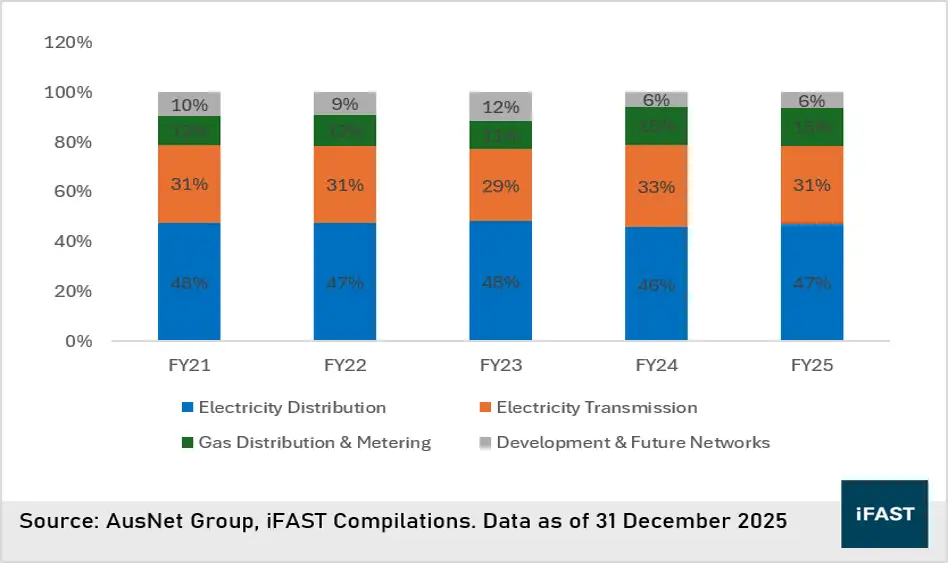
The remaining 6% of revenue is derived from the unregulated Development & Future Networks business, which focuses on renewable energy and data centre infrastructure projects. Revenue is supported by directly negotiated long-term annuity-style contracts, providing recurring income that complements the group's regulated revenue base.
While regulated revenue is largely fixed during each five-year regulatory period, AusNet may apply for AER-approved cost pass-throughs for eligible unforeseen events. For example, the AER approved AUD30.1 million and AUD12.9 million in cost recoveries for restoration costs arising from the February and September 2024 Victorian storms, respectively. These mechanisms help mitigate the financial impact of extraordinary events, although recovery remains subject to AER approval and specified regulatory criteria.
Overall, AusNet's predominantly regulated revenue base and regulatory cost recovery mechanisms, provides strong earnings visibility and supports its resilient credit profile.
Table 1: AusNet Revenue Breakdown by Service Type and Regulatory Framework
|
Revenue Segment |
% of Revenue |
Regulation Type |
Determination of Revenue |
Examples |
|
Electricity Distribution |
47% |
Revenue Cap (AER-regulated) – determined over a five-year regulatory period |
Revenue is determined using a building-block approach*. |
Core electricity distribution services provided to customers across the network. |
|
Electricity Transmission |
32% |
1. Prescribed Services (Regulated) – determined over a five-year regulatory period.
|
Prescribed
Services:
Revenue is determined using a building-block approach*. Revenue is generated through customer-specific fixed-fee contracts for assets outside the regulated asset base (RAB). |
Shared network charges from AEMO; easement tax pass-throughs; South Morang Terminal Station rebuild. |
|
Gas Distribution & Metering |
15% |
Gas Access Arrangement (GAA) – establishes the five-year regulatory pricing framework |
Revenue is primarily based on gas volumes transported through the network and regulated metering charges. |
Gas distribution to end users; contestable and non-contestable metering services. |
|
Development & Future Networks |
6% |
Unregulated / Commercial |
Revenue is generated through directly negotiated, long-term annuity-style agreements, with revenue typically recognised over the contract period (e.g., 30 years). |
Renewable energy connections (e.g., Golden Plains Wind Farm); Microsoft Francis Street Data Centre. |
|
* Based on the regulated asset base (RAB), which includes returns on and of capital, operating costs, taxes, and regulatory adjustments with any under-or over-recoveries reconciled, making earnings stable and predictable. Source: AusNet Group, iFAST compilations. Data as of 31 December 2025 |
||||
Predictable Revenue Supported by Regulatory Framework and Perpetual Asset Ownership
AusNet's core operational assets, including its electricity transmission, electricity distribution and gas distribution networks, are owned by the Group, with distribution licences held in perpetuity. This ownership and perpetual licensing structure ensures long-term control of the essential network infrastructure required for the Group's operations.
Revenue from the electricity transmission, electricity distribution and gas distribution businesses is regulated under five-year regulatory determinations by the Australian Energy Regulator (AER), providing a clear and predictable revenue path. As shown in Chart 1, AusNet's revenue composition has remained broadly stable over FY21–FY25, demonstrating the resilience and predictability of its earnings under the AER's regulatory framework.
Chart 1 AusNet Revenue Breakdown FY21-FY25
Stable Earnings Despite Higher Financing Costs
Earnings stability is reflected in Ausnet’s operating margin, which has remained average 34% over the past five years. However, finance costs increased by 11% YoY to AUD 500 million, primarily due to higher market interest rates. The average interest rate on the Group’s outstanding borrowings rose marginally from 4.5% in the prior year to 4.6% in FY25 and total debt has increase 5% YoY to AUD 11.5 billion. Therefore, the interest coverage ratio dome in slightly lower at 1.68 times, But the bright side is that approximately 92% of its debt is fixed rate which minimises the exposure to interest rate risk. We opine that the finance cost is reined.
Table 2: Ausnet Profitability Indicators
|
FY24 |
FY25 |
YoY |
|
|
Revenue (AUD Million) |
2291 |
2464 |
7.6% |
|
Operating profit (AUD Million) |
758 |
841 |
11.0% |
|
Operating profit Margin (%) |
33% |
34% |
3.2% |
|
Finance Cost |
451 |
501 |
11.0% |
|
Interest Coverage Ratio (Times) |
1.68 |
1.68 |
- |
|
Source: Ausnet Group, iFAST compilations. Data as of 31 December 2025. |
|||
Steady rise in operating cash flow; capital-intensive nature elevates overall leverage ratio
Operating cash flow has steadily increased, in line with continued investment in utility infrastructure and expansion of the asset base. However, given the capital-intensive nature of the business, a substantial portion of assets is financed through debt, as reflected in a debt-to-asset ratio of 0.83 times. This is also evident in leverage metrics such as debt-to-operating cash flow of approximately 13 times. While leverage is relatively high, this is typical for regulated utilities given their stable cash flow generation and infrastructure financing requirements. Overall, we view the current debt level as manageable and within an acceptable range.
Table 3 AusNet’s Credit Metrics
|
FY24 |
FY25 |
YoY |
|
|
Operating cash flow (AUD mil) |
830.2 |
868.5 |
5% |
|
Property, plant and equipment |
13,051.2 |
13,808.4 |
6% |
|
Total debt |
10,963.5 |
11,495.3 |
5% |
|
Debt to regulated asset ratio (times) |
0.84 |
0.83 |
-1% |
|
Debt to operating cash flow (times) |
13.2 |
13.2 |
- |
|
Source: Ausnet Group, iFAST compilations. Data as of 31 December 2025. |
|||
Manageable Refinancing Risk Supported by Regulated Revenue Framework
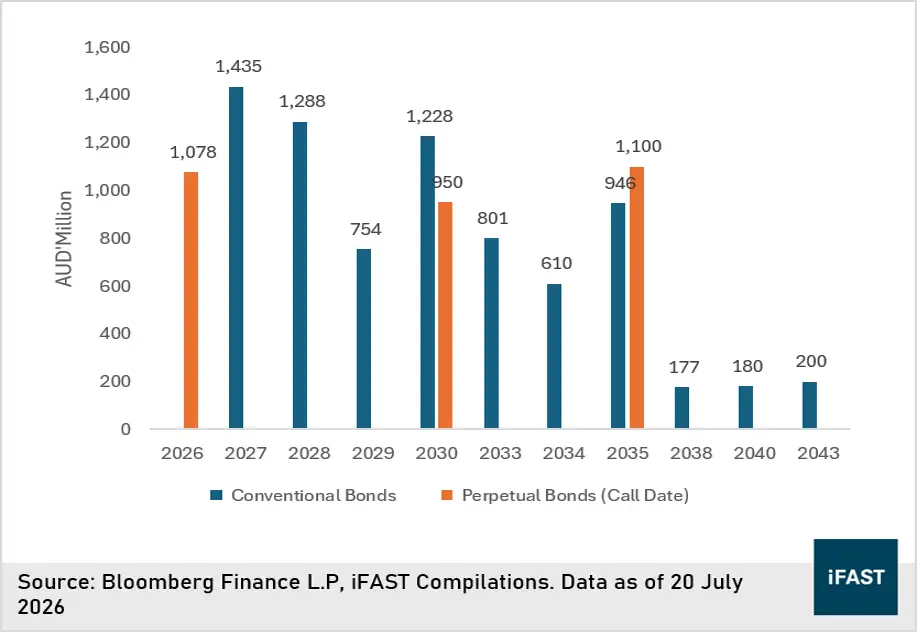
AusNet’s debt maturity profile, illustrated in Chart 1, is relatively front-loaded, with higher maturities concentrated between 2026 and 2030, averaging approximately AUD 1.3 billion per year. While committed credit facilities of AUD 1.1 billion and cash balances of AUD 7.4 million as at FY2025 are insufficient to fully cover upcoming maturities, the company is expected to refinance them in the near term and not forgetting that AusNet will also be riding on the credibility of its controlling company, Brookfield.
Refinancing risks are expected to be mitigated by AusNet’s substantial property, plant, and equipment base of approximately AUD 13.8 billion and strong operating cash flow AUD 869 million, combined with its regulated revenue framework, which provides stable and predictable cash flows under the AER-approved revenue recovery mechanism. Together, these factors support manageable leverage and adequate debt-servicing capacity.
Chart 1 AusNet’s Debt Maturity Profile
Recommendation
Overall, AusNet is a regulated electricity distributor with ownership of essential energy infrastructure, providing stable and predictable revenue through long-term AER regulatory frameworks. Its strength lies in its stable, regulated cash flows, which support robust financial performance and manageable leverage. We view its bonds as a worthy consideration for investors seeking exposure to high-quality Australian utility bonds. Investors may consider the short- to medium-term bonds, which currently offer yields to maturity in the range of 5.0% to 5.9% (Table 4).
However, investors should note that ANVAU 6.134% 31 May 2033 Corp (AUD) carries an issuer call option, allowing the issuer to redeem the bond before maturity. In addition, the bond includes a Change of Control Event provision, which provides additional protection to bondholders by allowing them to require redemption if Brookfield’s control of TopCo falls below 40%, another party gains control, or TopCo ceases to control the Issuer and Guarantors, subject to certain exceptions. If triggered, the Issuer must redeem the notes within 15 Business Days; otherwise, the interest rate will increase once by 5.00 per cent. per annum. For more information, please refer to the bond features.
Table 4: Ausnet’s Bonds
|
Bond name |
Year to Call/Maturity |
Yield to Call/Maturit |
Min / Sub investment |
Credit Rating (S&P) |
|
-/3Y |
-/5.0% |
AUD 50,000 /10,000 |
BBB+ |
|
|
6Y8M/6Y10M |
5.9%/5.9% |
AUD 10,000 /10,000 |
BBB+ |
|
|
Source: Bloomberg and FSMONE, iFAST Compilation. Data as of 24 July 2026 |
||||
Table 5 (additional AUD selections available for self-directed trading on RMO)
|
Bond name |
Year to Call/Maturity |
Yield to Call/Maturit |
Min / Sub investment |
Credit Rating (S&P) |
|
9Y 4M |
6.5%/6.7% |
AUD 1,000 /1,000 |
BBB+ |
|
|
Source: Bloomberg and FSMONE, iFAST Compilation. Data as of 24 July 2026 |
||||