Introduction
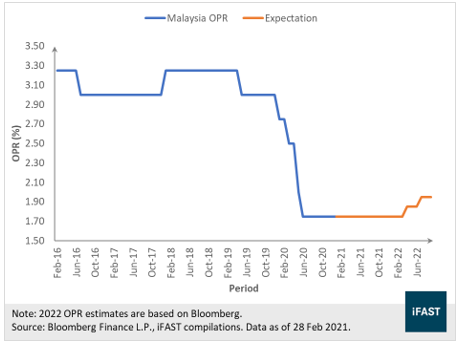
In 2020, central banks across the world moved to cut interest rates in attempt to lower borrowing costs in attempt to buttress the repercussions of a global economic shutdown. In Malaysia, Bank Negara Malaysia (BNM) introduced a series of liquidity injection via the cutting of Overnight Policy Rate (OPR) by 125 basis points (“bps”) to bring the OPR down to a historical low of 2%.
This proved to be a bane to banks as the previously locked-in fixed deposit rates remained higher (bank’s liability) while the longer duration loans (bank’s asset) – a majority of which are variable in nature - are adjusted to reflect the lower interest rate, eating up into their net interest margin (NIM) in the process. In addition to that, the slow down in economy due to various social distancing measures meant that banks had to set aside a higher portion loan loss provisions in anticipation of higher delinquency. The 6-month moratorium introduced by BNM to ease the burden of the people also meant that the opportunity cost lost from accrued interest – booked in as a modification loss – added to the already worsening net interest margin.
Fast forward to 2021. A faster-than-expected economic re-opening on the back of global vaccination roll-out and the 1.9 trillion USD stimulus introduced in the US has seen market participants pricing in an inflationary environment which has seen bond yields rising in the US with the UST 10Y at 1.73% at the time of this writing. The spillover also witnessed the local government bond, MGS 10Y rising to 3.45% as of 19th of March 2021. With rising yields, how does these dynamics affect the banking sector?
Net Interest Margin to soar
On the flip side of a low yielding environment, a rising yield environment will benefit banks in a few different ways. For one, a steeping yield curve will see the longer-dated variable loans given out by banks repriced at a higher rate to reflect economic conditions while the shorter-dated deposits would still be anchored by the relatively lower short-term rates which will see net interest margins to soar.
Figure 1: OPR to remain flat in the near future
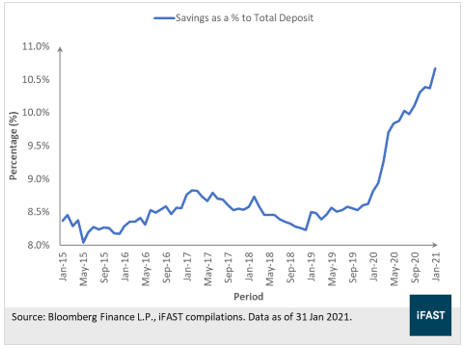
With banks offering low fixed deposit rates, the public appears to prefer holding cash for liquidity in light of pandemic challenges. The additional support provided by the Malaysian government via fiscal stimulus and retirement funds withdrawals has also caused savings as a percentage to total deposits to rise. Such a scenario is beneficial for banks as savings deposit receives even lower percentage than its fixed deposit counterpart, thus reducing the cost to banks even further.
Figure 2: Increasing proportion of savings as percentage of total deposits
Pent-up demand to spur loan growth
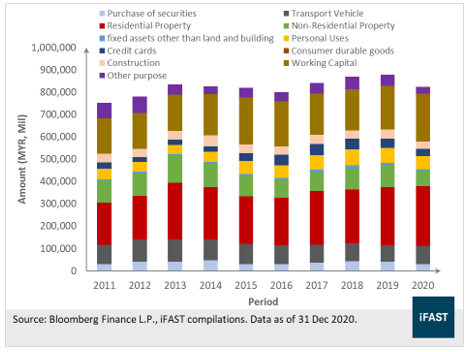
Over the past year, total loan applied declined by 6.2% year-on-year (YoY). Much of this is on the back of a decline in appetite in the non-residential property loan applications as business confidence in the non-residential property remain tepid. That being said, other components such as loan application for transport vehicles and residential property saw an uptick. Much of this is likely due to government-induced policies such as the introduction of vehicle sales tax exemption and the re-introduction of the Home Ownership Campaign (HOC).
Given the gradual reopening of the economy following the second round of Movement Control Order (“MCO”) that was implemented from early January 2021 which saw the closure of several sectors of the economy, we foresee the demand for high-ticket items to lead the spur for loan growth moving forward.
Figure 3: Properties, vehicles, and working capital needs are the majority of total loan applied
Banks balance sheets are robust
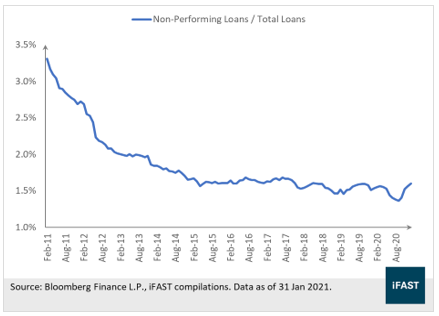
Despite an uptick in gross impaired loans (GILs) in 4Q2020 following the expiry of loan moratoriums, the GIL coverage ratio improved to 118% from 107% from the preceding year in anticipation of the credit challenges[1]. In addition to that, the non-performing loans (NPLs) metrics were not as bad as anticipated despite the challenging year. The NPL as a percentage of total loans clocked in at 1.6% as at 31 December 2020, a mere 10 basis points increase from 1.5% the preceding year.
Figure 4: Non-performing loans as a percentage to total loans
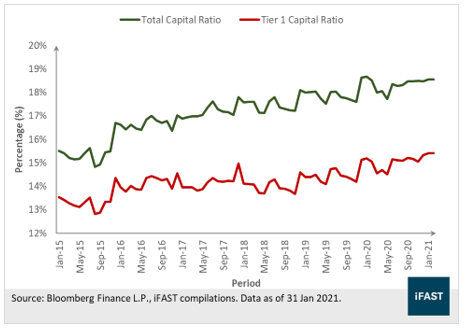
Providing an additional security to the banks buffer are the robust capital buffer of local Malaysian banks in the form of both their Total Capital ratio and Tier 1 Capital ratio. Both of these metrics exceeded beyond their regulatory requirements of 8.0% and 10.5% respectively.
Figure 5: Adequate capital ratios a buffer for unforeseen circumstances
Perpetuals are a good bet
With improving conditions on the back of rising yields, we feel that perpetual bonds provide an attractive opportunity to invest in. With improving credit conditions and sufficient capital buffers, investors can take comfort in putting their money in a riskier product such as a perpetual bond. One such perpetual bond that we like is Affin Bank’s AHBMK 5.800% Perpetual Corp (MYR).
Despite a challenging year, Affin Bank Berhad clocked in a net income of RM 2.26 billion for the Financial Year End 2020 (FY20), an increase of 18.3% from the preceding year. According to official filings on Bursa Malaysia, this increase is on the back of higher non-interest income, particularly from gains on financial instruments. The growth is current and savings account (CASA) of 14%, the gradual repricing of fixed deposit rates, and an increase in loan growth of 0.7% to RM 46.3 million from RM 46.0 million a year ago, meant that Affin Bank’s net interest income grew by 3.9% to RM 772 million from RM 743 million a year ago.
The
strong capital adequacy ratios also should provide investors with resounding
confidence. Their Tier 1 capital ratio and total capital ratio remained well
above regulatory requirement at 16.29% (vs regulatory requirement of 8%) and
22.24% (vs 10.5% regulatory requirement) respectively.
Investors who would like to invest in AHBMK 5.800% Perpetual Corp (MYR) can visit Bond Express where we offer bonds in bite-sizes as low as RM 1,000 in nominal value withAHBMK 5.800% Perpetual Corp (MYR) currently yielding 3.80% at the time of this writing.
[1] Source: RAM’s Banking Quarterly Roundup (4Q2020)