Bloomberg reported last week that Chinese regulators issued informal guidance instructing insurance companies to refrain from increasing their investment in the logistics giant GLP. This news sparked investor anxiety regarding the stability of GLP’s operations in China, causing bond prices to plummet by as much as 23% (see Table 1).
Bonds | Issue Size | 17 March 2026 | 26 March 2026 | Change in % |
1,000 | 96.4 | 83.1 | -14% | |
850 | 64.2 | 51.2 | -20% | |
300 | 61.4 | 47.5 | -23% | |
Sources : Bondsupermart | ||||
GLP's CFO, Nicholas Johnson, promptly stated during an investor meeting on March 18 that the company had not received such guidance and that liquidity remained unaffected. However, GLP is currently in a blackout period ahead of its May earnings release, preventing the disclosure of fresh financial data to reassure investors. Consequently, bond prices remained at depressed levels following the meeting.
GLP's Debt Levels Continue to Improve
As of the 1H of 2025, GLP recorded total revenue of approximately US$1 billion, a 3% YoY decrease. Within this, the highly watched data centre business saw revenue jump 39% YoY to US$120 million, while rental income rose 14% to US$370 million (see Chart 1). However, the US$3.7 billion sale of its fund management business, GCP International, in March 2025 led to a 40% drop in management fees to US$270 million, offsetting the growth in other sectors.
Chart 1: GLP’s Revenue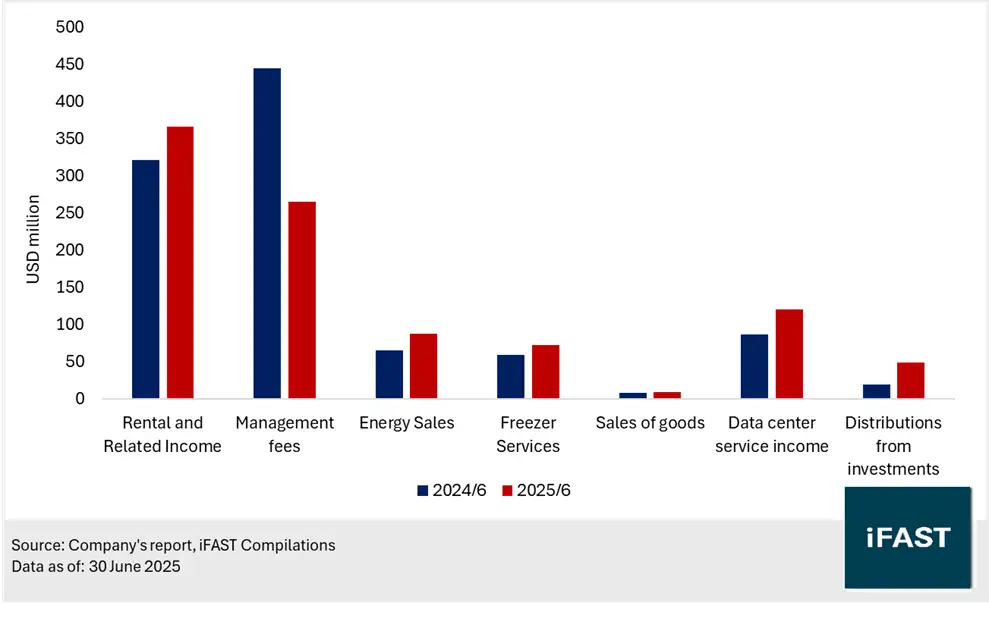
GLP’s interest payment capacity has historically been weak, with an interest coverage ratio of just 1.3x. Its core EBITDA is barely sufficient to cover cash interest expenses, making the company highly dependent on the sale of investment properties to maintain liquidity. Selling assets to its own managed funds remains an effective recycling strategy; given that these funds hold nearly US$7 billion in dry powder (unallocated capital), they possess the capacity to acquire GLP's assets.
Furthermore, following the sale of GCP International, GLP used a portion of the cash to repay debt. Total debt fell 13.4% YoY to US$8.78 billion, and interest expenses are expected to decrease in the second half of the year. Therefore, GLP’s ability to service interest remains within an acceptable range.
GLP’s net gearing ratio improved to 47% in 1H2025 (compared to 53% in 1H2024). In February this year, the company also issued additional USD bonds maturing in 2028 to refinance upcoming debt. While efforts have been made to extend the debt maturity profile, the overall distribution remains relatively short, with most debt concentrated within the next three years. Meanwhile, GLP holds nearly US$13 billion in investment properties; although these assets have lower liquidity, they serve as potential debt-repayment tools. Furthermore, the US$1.5 billion capital injection from the Abu Dhabi Investment Authority (ADIA) in August 2025 has provided a buffer against short-term repayment pressures.
GLP Bond Price Decline: The Impact of China Concentration Risk
China operations accounted for 70% of GLP’s total revenue in 1H2025, a concentration that increased after the divestment of its non-China fund management business. In mid-2025, GLP secured a 2.5 billion RMB investment from the state-backed Quzhou Industrial Group for its domestic data centers.
As the company’s most promising growth engine, the data center segment currently has only 0.4 GW of operational capacity in China, while another 1 GW of contracted capacity is still under construction. Data from China Talk indicates that the capital expenditure for building 1GW of data center capacity in China is between US$5 billion and US$7 billion. Thus, GLP requires significant follow-on investment from mainland investors. Furthermore, GLP is preparing for an Initial Public Offering (IPO) in Hong Kong this year, a move aimed at injecting new capital into its China operations.
If the regulatory rumors prove true, they will undoubtedly hinder its China operations—particularly the upcoming IPO and the capital-intensive data center projects—potentially dragging down revenue growth.
Moreover, with 58% of its total debt denominated in RMB, these rumors could impair the company’s ability to refinance within mainland China, increasing the difficulty of debt repayment. Consequently, the combination of regulatory uncertainty and heightened China concentration risk are the primary factors weighing on GLP’s bond prices.
Bond prices have already undergone a certain degree of adjustment. Holders may consider a wait-and-see approach until further updates clarify the situation, particularly following the company's expected release of financial reports in May, which will provide clearer fundamental guidance.
Perpetual bond investors should pay close attention to the 'optional deferral of interest' clauses; these allow the issuer to suspend interest payments without triggering a default. Furthermore, the subordinated nature of these bonds means they rank lower in the repayment hierarchy than senior debt, presenting a potential risk that should not be underestimated.
Declaration: For specific disclosure, at the time of publication of this report, IFPL (via its connected and associated entities) and the analyst who produced this report holds a NIL position in the abovementioned securities.
RISK DISCLOSURE STATEMENTS FOR BONDS
Key risks of investing in bond
|
Key risks of investing in high-yield bonds
|
| Bonds with special features Some bonds may contain special features and risks that warrant special attention. These include bonds:
|
Remarks
|