Cathay Pacific Group (stock code: 293.HK, hereinafter referred to as "Cathay Pacific") is a household name in Hong Kong and a renowned international air transport brand and a founding member of the Oneworld alliance. Thanks to its excellent operational strategies, Cathay Pacific has maintained profitability for three years post-pandemic, standing out among numerous airlines. We previously analysed Cathay Pacific bond investments; for details, please see "Idea of The Week: Cathay Pacific bond worth Your Attention thanks to its Unprecedented Performance!"
Driven by passenger and cargo, Cathay Pacific's profitability has significantly improved.
In the first half of 2026, Cathay Pacific's total revenue surged 25.3% YoY to HKD 68.1 billion, with passenger service revenue increasing by 27.2% YoY to HKD 47.3 billion (see Chart 1). In passenger traffic, available seat kilometres (ASK) increased by 11.8% year-on-year, and load factor rose by 2.7 percentage points to a post-pandemic high of 87.5%—the increase in load factor reflects strong demand rather than a price-for-volume strategy. The situation in the Middle East led some passengers to change routes, increasing transit traffic in Hong Kong and further strengthening its hub status. In cargo traffic, segment revenue increased by 23.0% YoY to HKD 15.7 billion. Although available cargo ton-kilometres only increased by 4.0%, cargo yield (i.e., the average revenue generated per kilometre flown) surged by 18.1%, mainly driven by demand for high-value cargo related to data centres and artificial intelligence.
Chart 1: Cathay Pacific's Revenue Performance in the First Half of the Year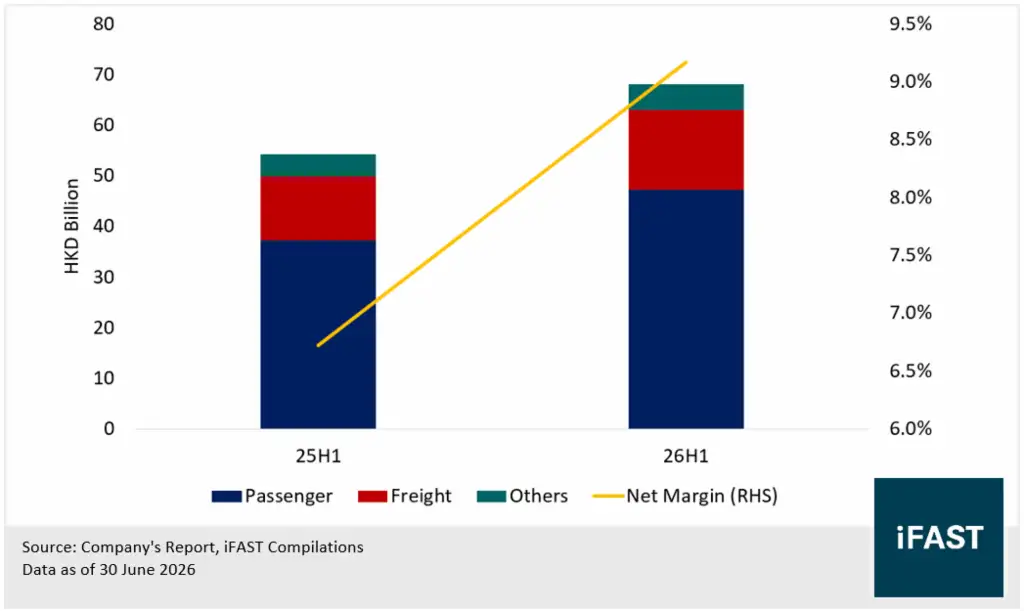
On the cost side, fuel remained the biggest drag. The Group's fuel costs (including hedging) surged 58.5% YoY to HKD 23.2 billion, mainly due to the Middle East situation leading to a 53.2% increase in average fuel prices and a 9.0% increase in fuel consumption. However, Cathay Pacific recorded a fuel hedging gain of HKD 880 million in the first half of the year (compared to a hedging loss of HKD 220 million in the same period last year). We believe this precisely reflects the effectiveness of Cathay Pacific's strategy of locking in some fuel costs through futures contracts; coupled with its strong position in the Hong Kong market, which allowed for smooth transmission of fuel surcharges, Cathay Pacific's profit stability remained superior to its peers despite volatile oil prices. Consequently, Cathay Pacific's net profit recorded an astonishing 71.0% YoY increase to HKD 6.2 billion, with a net margin of 9.2%.
Cathay Pacific's future fleet investment is substantial, but management has confirmed sufficient funding to support it.
As of the end of June 2026, the Group's fleet consisted of 235 aircraft with an average age of 12.3 years; it had an order backlog of 105 aircraft (8 in 2026, 21 in 2027, and 76 in 2028 and beyond) and held options for an additional 87 aircraft. It has also committed approximately HKD 150 billion to invest in the fleet, cabins, lounges, and digital innovation. This scale is undoubtedly noteworthy for bondholders; however, we believe its impact on short-term liquidity is manageable for three reasons.
Firstly, payments are made in instalments, with advance payments and final payments upon delivery, rather than a one-time large outflow. In the first half of the year, payments for property, plant and equipment, and intangible assets decreased by 9.5% YoY to HKD 3.7 billion. Secondly, as we mentioned last time, Cathay Pacific can mitigate its financial pressure through aircraft financing, export credit, and sale-leaseback arrangements. Sale-leaseback can transform the large one-off aircraft purchase expenditure into periodic rental payments, while simultaneously recovering funds immediately. Currently, HKD 3.4 billion of its other borrowings are related to such arrangements. Thirdly, and most importantly, management has clearly stated in the results announcement that, based on its available liquidity and access to the loan and bond capital markets as of the end of June, the Group has sufficient financing capacity to support this fleet investment.
Cathay Pacific's slight increase in leverage is due to equity optimization, while interest protection has actually improved.
As of the end of June 2026, the Group's net debt increased slightly by 1.0% to HKD 47.3 billion, and the net debt ratio rose from 0.78 times at the end of 2025 to 0.81 times; excluding leases without asset transfer elements, it was 0.65 times, which is still far below the 2.0 times borrowing covenant limit (see Table 1).
Table 1: Cathay Pacific Credit Metrics
HKD Billion | FY24 | FY25 | FY26H1 |
Unrestricted Liquidity | 19.1 | 25.4 | 23.6 |
Net gearing (times) | 1.10 | 0.78 | 0.81 |
Operating Cash Flow | 23.5 | 25.4 | 27.9(TTM) |
EBITDA | 26.4 | 26.6 | 26.3(TTM) |
Interest Coverage Ratio* (times) | 8.7 | 9.9 | 12.8 |
Data Source: Company’s Report, iFAST compilations Data As Of 30 June 2026 *Note: Calculated by EBITDA divided by net financial expenses | |||
It is worth noting that the increase in Cathay Pacific's leverage is not mainly due to debt expansion. In the first half of 2026, funds attributable to shareholders of the group fell 3.5% YoY to HKD 58.0 billion, mainly due to the completion of the buyback and cancellation of all Qatar Airways shares held in February. We believe that the slight increase in leverage is actually the result of active optimization of the equity structure, and investors should not regard it as a deterioration in credit quality.
Cathay Pacific's cash flow performance is also quite impressive. In the first half of 2026, operating cash flow increased 22.6% YoY to HKD 13.7 billion, which was enough to cover capital expenditures of HKD 3.7 billion and dividends of HKD 3.9 billion, leaving a balance of HKD 6.1 billion. After including the share repurchase of 6.99 billion, a slight funding gap of about 900 million appeared, which explains why net borrowings rose slightly. At the same time, net financial expenses decreased by 26.3% YoY to 1.1 billion, causing the interest coverage ratio to increase from 9.9 times to 12.8 times (still 11.9 times after excluding one-time items), and credit risks were clearly controlled.
Bond Investments
Cathay Pacific's publicly traded bonds have not yet received formal ratings from major rating agencies. However, considering its excellent operating performance, solid market position, and clear deleveraging measures, we believe the credit quality of Cathay Pacific bonds is equivalent to a sound investment grade.
Our platform currently offers a Cathay Pacific Hong Kong dollar bond with a maturity of 2.7 years (see Table 2). Given Cathay Pacific's current favourable operating and credit conditions, its good relationship with the Hong Kong government, and its significant influence on Hong Kong's economic development as an international city, the government will not hesitate to aid Cathay Pacific when necessary, offering it financing advantages. Investors seeking stable returns may consider locking in a 3.5% net yield to maturity early; compared to other Hong Kong dollar bonds with similar maturities, this Cathay Pacific bond is quite attractive.
Table 2: Cathay Pacific HKD Bond
Bond | Tenor | Net Ask YTM |
2.7 | 3.5% | |
Data Source: FSM Global Data As Of 11 August 2026 | ||
Declaration: For specific disclosure, at the time of publication of this report, IFPL (via its connected and associated entities) and the analyst who produced this report hold NIL positions in the abovementioned securities. This research report was prepared with the assistance of artificial intelligence (AI) tools. iFAST Financial Pte Ltd does not rely exclusively on AI for content generation; the content of this report – including all investment theses, ratings, price targets and conclusions – has been independently reviewed and verified by the research analyst(s) to ensure accuracy and professional integrity.