Note: This article was first published on bondsupermart.com on 10 May 2021.
- Cathay Pacific Group is looking at monthly losses of about HKD 1.3-1.9b after restructuring and new quarantine measures.
- The group should have enough liquidity to meet this year’s liabilities. The new issue can help refinance bonds maturing in the near-term.
- At 5.2% IPG, the new note is priced at 435.5bps above US Treasuries which seems fair considering its gearing.
After more than a year of travel restrictions, hopes of seeing Cathay Pacific Group (“Cathay”) turning in profits seem to be dissolving recently. Singapore is said to be re-assessing its planned travel bubble with Hong Kong after the recent flare-up in Covid-19 cases, which is no good news for Cathay.
About the new issue
The airline is looking to issue 5.25-year senior unsecured USD notes under the USD 2 billion guaranteed medium term note programme dated 17 Aug 2020. Cathay Pacific MTN Financing (HK) Limited is the bond issuer while Cathay Pacific Airways Limited is the guarantor of the bonds. The new notes are not expected to have any credit ratings.
Financial highlights
In 2020 (“FY20”), Cathay only flew 13.1% of the passengers that they carried in 2019. They introduced a skeleton passenger schedule which resulted in a monthly passenger capacity that was 10% less than pre-COVID-19 levels for most of 2020. Revenue for passenger services thus decreased by 83.8% YoY to HKD 11.95 billion in 2020. Revenue from cargo services was much more resilient – increasing by 17.1% YoY due to higher demand for medical supplies and higher yields from lower cargo capacity.
However, the loss from passenger services was too much for the company as the Group turned in a pre-tax loss of HKD 22.32b for 2020, of which HKD 2.38b was attributed to restructuring costs. The Group retrenched 5900 jobs and renewed contracts (most likely of lower pay) for more than 90% of their Hong Kong-based pilots and cabin crew. Cathay Dragon also ceased operations on 21 October 2020 to save costs. The Group projects these restructuring to save about HKD 500m per month.
Nonetheless, Cathay has recently announced that new quarantine measures have resulted in a reduction of their passenger capacity and cargo capacity by about 60% and 25% respectively, as compared to January 2021 levels, which the management estimated to add about HKD 300-400m in monthly losses. We thus estimate a pre-tax adjusted loss of about ~HKD 9-11b for 1H21 (half-year period ending 30 Jun 2021).
Table 1: Selected 2020 income statement items
|
HKD millions |
2020 |
1H20 |
2H20 |
|
Revenue |
|||
|
Passenger services |
11950 |
11056 |
894 |
|
Cargo services |
27890 |
12692 |
15198 |
|
Other services and recoveries |
7094 |
3921 |
3173 |
|
Total revenue |
46934 |
27669 |
19265 |
|
Operating expenses |
-58639 |
-33939 |
-24700 |
|
Gross profit |
-11705 |
-6270 |
-5435 |
|
Restructuring costs |
-2383 |
-2383 |
|
|
Impairment and related charges |
-4056 |
-2465 |
-1591 |
|
Operating (loss)/profit |
-18144 |
-8735 |
-9409 |
|
Net finance charges |
-2895 |
-1652 |
-1243 |
|
Share of (losses)/profits of associates |
-1282 |
-526 |
-756 |
|
(Loss)/profit before taxation |
-22321 |
-10913 |
-11408 |
|
Taxation |
674 |
1049 |
-375 |
|
(Loss)/profit for the period |
-21647 |
-9864 |
-11783 |
Source: Company reports, iFAST compilations
Credit profile
In addition to high net losses, Cathay also has relatively low current assets compared to its current liabilities. Most of its assets are in its property, plant and equipment (“PPE”) which may be difficult to divest in this environment. Most of its borrowings are bank loans which are secured by underlying airline assets.
Table 2: Cathay’s current assets and liabilities
|
HKD millions |
2020 |
|
Current assets |
|
|
Stock |
1719 |
|
Trade and other receivables |
6469 |
|
Assets held for sale |
38 |
|
Liquid funds |
19341 |
|
Total |
27567 |
|
Current liabilities |
|
|
Interest-bearing liabilities |
24249 |
|
Trade and other payables |
12376 |
|
Contract liabilities |
8122 |
|
Taxation |
1977 |
|
Total |
46724 |
Source: Company’s annual report, iFAST compilations
Figure 1: Debt maturity profile
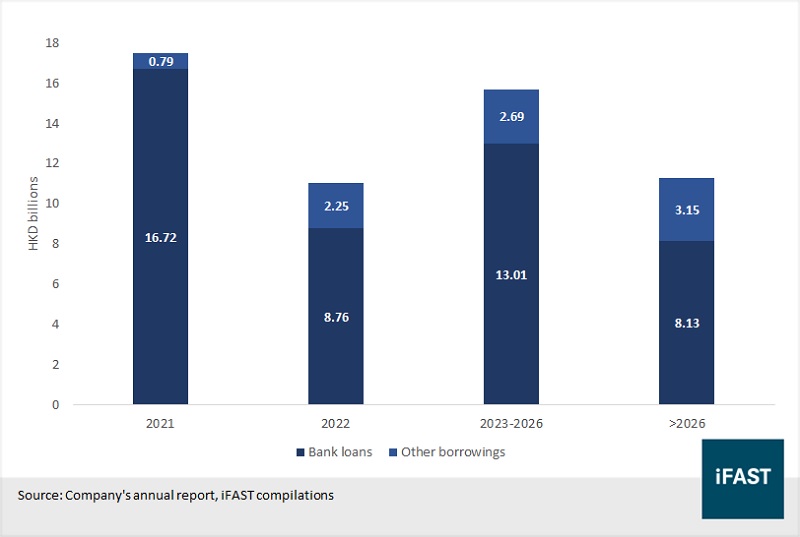
If Cathay runs into trouble refinancing its loans, it is still likely able to meet its near-term liabilities. Cathay also owns 18.13% of Air China Limited (“Air China”). Based on its market capitalization on 7 May 2021, Cathay’s stake in Air China amounts to about HKD 23.5b.
As at 31 Dec 2020, Cathay has a net book value of HKD 75.73b in owned aircraft and related equipment, of which 118 are owned aircrafts. On 16 Mar 2020, they entered into a sale and leaseback transaction with BOC Aviation, selling six Boeing 777-300ER aircrafts to BOCA and leasing them back for a total consideration of USD 703.8m (~HKD 5.47b). Singapore Airlines (“SIA”) also recently completed sale and leaseback transactions for 11 aircrafts, comprising seven Airbus A350-900s and four Boeing 787-10s, raising about SGD 2.0b. Cathay owns 19 A350-900 and 23 Boeing 777-30ER aircrafts that may be used to raise funds if needed in the future.
On 28 Jan 2021, Cathay issued HKD 6.74b of convertible bonds at a coupon rate of 2.75%. As the activity happened after their reporting period, it was not on their 2020 balance sheet. Adding this item and their trade receivables, the group has about HKD 41.80b in liquid assets.
Table 3: Cathay’s sources of liquidity
|
HKD millions |
|
|
Proceeds of convertible bonds |
6740 |
|
Cash and cash equivalents |
12906 |
|
Short-term deposits maturing beyond 3 months |
195 |
|
Funds with investment managers |
12836 |
|
Other liquid investments pledged as long-term financing |
144 |
|
Liquid funds |
26081 |
|
Committed undrawn facilities |
9396 |
|
Available unrestricted liquidity to the Group |
35333 |
|
Trade and other receivables |
6469 |
|
41802 |
|
|
Investments in associates |
26489 |
|
Accounting for projected FY21 losses |
50291 |
|
Owned property, plant and equipment |
84598 |
|
Current liabilities |
46724 |
|
Non-current liabilities |
84589 |
Source: Company’s annual report, iFAST compilations
Unfortunately, due to the volatility of the restriction measures and spread of COVID-19, it is difficult to forecast Cathay’s income for 2022. However, its 2H20 income should give us a fair idea of what its future income will be like if travel restriction measures do not ease. We should see slightly higher losses for 1H21 if the situation does not improve. If travel bubbles were to not come to fruition by end of 2021, Cathay may witness a deterioration in its credit profile. However, its new issue should help to alleviate liquidity problems in the meantime.
Cathay and SIA bonds
While there are many airlines out there, not many offer SGD or USD bonds. The best comparison would be SIA but SIA has much healthier credit ratios as compared to Cathay. SIA boasts a debt-equity ratio of 78% while Cathay’s debt-to-equity ratio is at 127% while their net gearing ratios (net debt-to-total equity) are at 32.5% and 101% respectively. The two airlines have also received substantial support from their respective governments and shareholders.
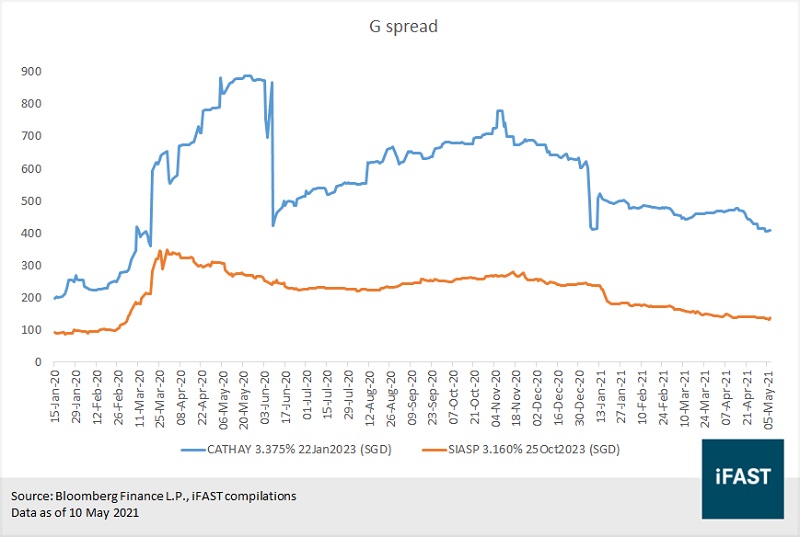
Looking at their SGD bonds, the CATHAY 3.375% 22Jan2023 Corp (SGD) reflect Cathay’s weaker credit ratios, trading at higher yields and a higher credit spread (“G-spread) compared to the SIASP 3.160% 25Oct2023 Corp (SGD).
Figure 2: SGD bonds of Cathay and SIA
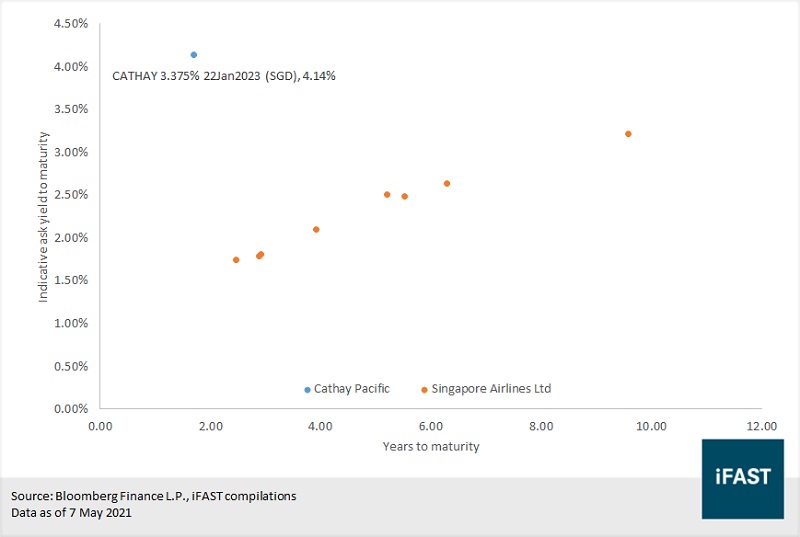
Figure 3: G-spread of 2023 Cathay and SIA bonds
Cathay
is launching a new USD bond with a tenor of 5.25 years at an initial price guidance
of 5.2%, about 100 basis points (“bps”) premium (in equivalent SGD terms) over
the CATHAY 3.375% 2023 SGD bond. We think that the 5.2% IPG pricing is fair
given that the 5.25-year Treasury yield is 84.5bps, and the new note is priced
at 435.5bps above US Treasuries. The notes are also fairly priced considering
that the CATHAY 3.375% 2023’s have a G-spread of 406bps.
An issue size of about USD 250m will allow Cathay to refinance its 2021 and 2022 bonds while a USD 1.5b issue size will give them enough liquidity for a full year of losses in 2021. However, the USD bonds will cost Cathay higher interest and currency fluctuations if unhedged. A higher issue amount will help Cathay in the near-term and its interest expense will be manageable if Cathay tides over the pandemic.
Declaration: For specific disclosure, at the time of publication of this report, IFPL (via its connected and associated entities) has a position in the CATHAY 3.375% 22Jan2023 (SGD) bond. The analyst who produced this report hold a NIL position in the abovementioned securities.
Our podcast series, Yield Hunters, is available on Spotify and iTunes Podcasts and Google Podcasts. We share our thoughts on new bond issues and hold discussions on the fixed income space. Listen to our latest episode below and follow us!