Highlights:
- The Group has defaulted on the January USD Bonds. Even though the Group’s repayment ability seemed fair and the cash balance on the book looked sufficient, it still went into default.
- Multiple factors led to the Group’s liquidity dry-up, including its complex debt structure, the tightening of the regulatory pre-sales proceeds requirement and the credit rating downgrades by rating agencies.
- The current bond prices are around 20, which should be close to the expected value from liquidation. The next step would be SOE buying its stake or a debt restructuring proposal.
The Group Has Defaulted on the January USD Bonds
On 19 January, China Aoyuan (“Aoyuan” or “the Group” hereafter) announced that it would not repay the principals of two bonds due on 20 January and 23 January and the interests due on January, in a total amount of around USD 1.09 billion. This means the Group has defaulted, and might trigger the cross default of other bonds.
Aoyuan appointed Admiralty Harbour Capital as the financial advisor to estimate the Group’s liquidity and cash flows, so as to prepare for future debt restructuring. Simultaneously, the Group might also consider asset disposals and bring in new strategic investors.
At the end of January, according to CLS, a Chinese media, a Chinese SOE-backed healthcare real estate company might buy Aoyuan’s stake and become its controlling shareholder. Taking reference from the case of China South City (Shenzhen SEZ Construction and Development Group Co. bought its stake), if the rumor is true and eventually the deal is closed, it could improve Aoyuan’s financing ability and liquidity. It could also support the Group’s future debt restructuring.
The Group Attempted to Self-Rescue, but Failed to Get Rid of the Liquidity Crunch
Since November 2021, Aoyuan has disposed multiple assets, including the property project at Robinson Road in Hong Kong and the three properties in Canada, worth around HKD 900 million and CAD 215 million respectively. The Group also performed rounds of issuing and allotting 270 million shares, raising around HKD 1 billion in total.
Meanwhile, the Group proactively discussed loan maturity extension with trust companies, including trust loans matured in November 2021 (amounted to RMB 1.5 billion in total), which were all approved. As such, the Group proactively made several self-rescue attempts.
Regrettably, the Group still failed to get rid of the liquidity crunch and defaulted on some loans at the beginning of December 2021, which amounted to a total of USD 650 million. Among these, Citibank and related parties filed to court for the debt in the amount of USD 130 million. Then, the Group again failed to repay the USD bond principals and interests in January, in a total of USD 1.09 billion, meaning Aoyuan has officially defaulted in the bond market.
The Group’s Repayment Ability Seems to Be Fair, and the Cash Balance on Book Looks Sufficient
Referring to the financial data as of the end of June 2021, at that moment, the Group’s credit indicators seems to be fair (table 1), with a net gearing ratio of 79% and cash to short-term debt of 1.35 times. These two credit indicators fulfilled the requirements of the Three Red Lines.
Table 1: China Aoyuan’s Credit Indicators
|
2021 1H |
|
|
Adjusted assets to liabilities ratio (%) |
78.9% |
|
Net gearing ratio (%) |
79.0% |
|
Cash to short-term debt (times) |
1.35 |
|
Non-restricted cash to short-term debt (times) |
1.20 |
|
Short-term debt (RMB billion) |
51.9 |
|
Long-term debt (RMB billion) |
60.2 |
|
Source: Company Reports, iFAST Compilations Data as at 30 June 2021 |
|
During the investor meeting in October 2021, the Group disclosed their cash balance of RMB 58 billion (as at the end of September 2021), of which 60% is at the Group level. In theory, it was estimated that the Group has around RMB 34.8 billion cash held at the Group level and RMB 23.2 billion held by the project subsidiaries. Therefore, the Group should have sufficient cash to repay the debts to be due in the next few months, no matter on the Group level or the project subsidiary’s level.
Nevertheless, since October 2021, due to Aoyuan’s negative rumors, its USD bond prices fell from 90 to around 30. Afterwards, as all the negative rumors were verified, the Group fell into a serious liquidity crisis, including some loan maturity extensions as mentioned.
So, why did the Group still seek maturity extension and even ended up in default, even if it had enough cash on the book?
Multiple Factors Leading to the Group’s Liquidity Dry-Up
Firstly, Aoyuan has a complex debt structure (see Table 2). Its common equity to total equity was low at 34.5%. The difference between guided consolidated ratio and common equity to total equity was very large at 38%, which was just behind Evergrande’s 49% amongst peers. It showed that Aoyuan could utilise a lot of “disguise equity”. To a certain extent, the Group’s actual debt level on the balance sheet would be underestimated. Meanwhile, we notice that Aoyuan usually raised funds through wealth management products, which could explain its huge minority interest to total equity (65%).
Table 2: Aoyuan’s Debt Structure Indicators
|
2021 1H |
|
|
- Common equity to total equity |
34.5% |
|
- Guided consolidated ratio |
72.6% |
|
Difference |
38.1% |
|
Source: Company Reports, CRIC, iFAST Compilations Data as at 30 June 2021 |
|
Besides, due to Evergrande’s debt crisis, in order to ensure housing delivery, the regional government tightened the regulatory pre-sales proceeds requirement. Taking reference from its peer, Shimao Group, as at the end of November 2021, Shimao has up to 80% cash being restricted due to the regulatory pre-sales proceeds requirement. We believe that Aoyuan is facing the same issue. A large part of the Group’s cash on the book cannot be freely used due to the regulatory requirement, leading to liquidity tightening.
Lastly, according to Aoyuan’s statement, starting from Evergrande’s debt crisis at the beginning of July 2021, rating agencies have downgraded the credit ratings of several developers including Aoyuan’s. In November of last year, three leading rating agencies (S&P, Moody’s and Fitch) downgraded Aoyuan’s rating from BB or B to CCC within one month. Because of this, some loans trigger the clauses related to the acceleration of maturity. Aoyuan had to repay these loans immediately, resulting in a huge short-term repayment pressure. In addition, the downgrade made it difficult for Aoyuan to do refinancing, so the Group’s liquidity was under further pressure.
The Group Should Continue to Dispose of Assets, and the Next Step Would Be Selling Its Stakes to SOE or a Debt Restructuring Proposal
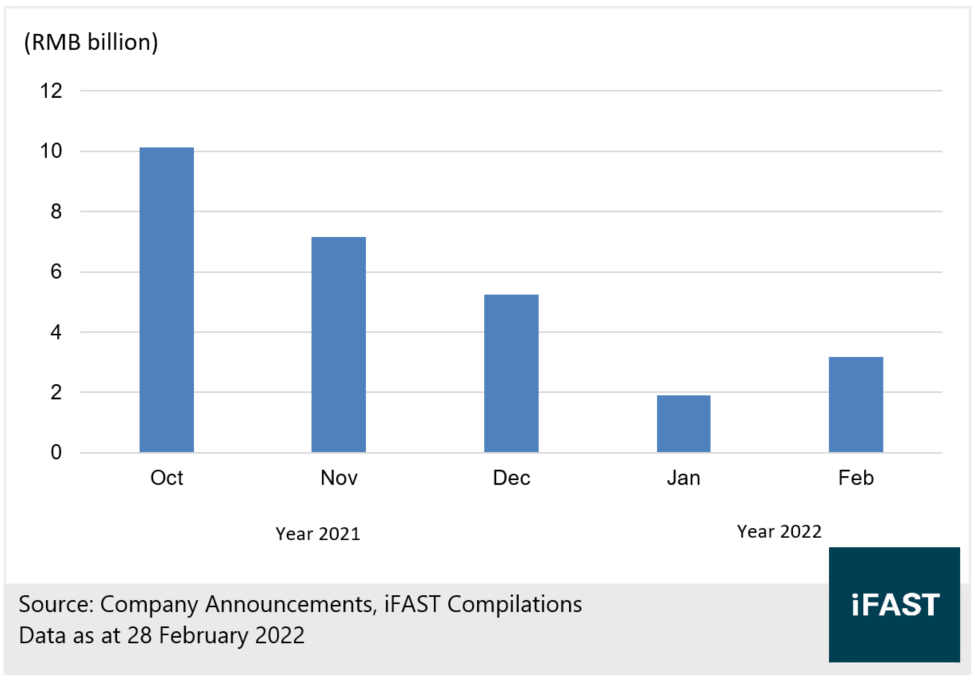
As for sales (see Chart 1), since Aoyuan got into the debt crisis in October last year, the Group had a significant decline in sales. However, its current sales situation is not very poor. Based on the latest sales in February of around RMB 3 billion, we estimate that the Group could still generate RMB 30 to 40 billion contracted sales, which should strengthen the Group’s cash flows and liquidity.
Chart 1: China Aoyuan’s Total Contracted Sales
in Recent Months
Going forward, the Group should continue to dispose of its onshore and offshore assets, in a bid to lower liabilities and increase liquidity. As of today, assuming the Group’s total amount of cash is required for housing delivery (as regulatory pre-sales proceeds requirement), the Group’s valuable assets include a 54.5% stake in Aoyuan Healthy (the market capitalisation of around HKD 1.56 billion), a 29.3% stake in Aoyuan Beauty Valley (the market capitalisation of around RMB 6.87 billion), estimated 48,000 thousand sq. meter land bank, as well as the around 50,000 to 60,000 thousand sq. meter urban renewal projects (which are not included in the land bank).
Given the nature of urban renewal projects and the ownerships possibly retaken by the regional government, it could be difficult to liquidate these projects. On the other hand, the Group’s land bank can be liquidated through property sales, or be disposed to its peers at a discount price.
Assuming the Group will undergo liquidation and dispose of its assets at a discount price, we expect bondholders could get back a small amount of bond principals. Aoyuan’s current bond prices are at around 20, which should be close to the expected value from liquidation. However, if the Group succeeds in introducing some SOE investors to acquire its stake, there is a large room for its bond price to rebound.
Considering that the Group is willing to undergo debt restructuring, we believe that the recovery value under the debt settlement proposal will be larger than the price from directly selling the bond in the market. Yet, investors should be aware that, under normal circumstances, it is likely to take at least half a year for the Group to formulate a debt settlement proposal, so they should take the waiting time into consideration.
Declaration: For or specific disclosure, at the time of publication of this report, IFPL (via its connected and associated entities) and the analyst who produced this report hold a NIL position in the abovementioned securities.
Our podcast series, Yield Hunters, is available on Spotify, iTunes Podcasts and Google Podcasts. We share our thoughts on new bond issues and hold discussions on the fixed income space. Listen to our latest episode below and follow us!