Highlights
· Yield-seeking investors able to maintain a well-diversified portfolio should consider the DB 6.250% Perpetual Corp (USD).
· The DB 6.250% Perpetual Corp (USD) is first callable in April 2020 and has a yield to call of 33.3%.
When change arrives
“Look at the world around you. It may seem like an immovable, implacable place. It is not. With the slightest push—in just the right place—it can be tipped.”
― Malcolm Gladwell, author of “The Tipping Point: How Little Things Can Make a Big Difference”
Change comes when we least expect it. And so it was when the Berlin Wall fell in the evening of 9 November 1989, shortly after Communist spokesman Günter Schabowski proclaimed the end of travel restrictions to West Germany. It would be the end of a universally loathed symbol, a grim and poignant reminder of an era following the fall of Nazi Germany, when Germany was divided into two separately administered territories — East Germany and West Germany — under the control of the Soviets and Western forces, the latter consisting of France, the United Kingdom and the United States.
The Berlin Wall had been built by the Soviets on East German soil. In the years following the division of the German motherland, it quickly became apparent that significant numbers were rushing to flee the impoverished East Germany to seek greener pastures in the capitalist West. To nip the exodus in the bud, a massive physical barrier was erected without any warning along the border of East Germany in 1961, effectively trapping East Germans within the Soviet-controlled territory.
The destruction of the Berlin Wall did not come overnight. Rather, it was the product of a series of protests organized in various East German cities, which culminated in a defining demonstration in Leipzig on 9 October 1989. After that, there was no turning back.
In the hours and minutes after the Berlin Wall collapsed, East Germans flooded across the border into West Germany. It was a moment of pure euphoria. Champagne bottles were uncorked. Complete strangers locked in embrace. The German motherland was no longer divided.
One of the first things East Germans did on stepping foot in freedom-loving West Germany was to claim their “welcome money”. At that time, it was prevailing West German policy to grant each East German citizen 100 deutsche marks (“DM”) on entry into the Federal Republic. And all at once the country saw tens of millions of people rushing to claim their share.
As the pre-eminent German bank with branches all over the territory, it was Deutsche Bank that stepped into the breach. The early days were nothing short of turbulent. A branch in Rudow opened on Sunday to find an extended queue that seemed to stretch to nowhere, with customers some of whom had arrived at two in the morning. Despite working feverishly and taking no breaks, the Deutsche Bank staff realized that they were making little headway, with the queues growing longer and customers losing their patience.
Then one particularly bright employee had an epiphany: why not transport the customers to other branches instead? So a call was made to the American forces, who dispatched vehicles to transport the hoards to the nearby Kurfürstendamm and Neukölln branches.
Almost everyone collected their “welcome money”, from doctors and artists, to a young Angela Merkel — a physicist residing in East Berlin — who would later become Chancellor of the Federal Republic. Flush with their newly acquired bounties, people flooded the glitzy shopping boulevard of Kurfürstendamm to spend. Deprived East Germans, who until then had little access to imported luxuries such as chocolate and cigarettes, wandered into the renowed KaDeWe store to ogle at the sheer abundance of shelves bulging with all manner of delectable goods. And with their newly acquired DM, few could resist the temptation to spend.
History was made a second time when East and West Germany entered into a monetary union on 1 July 1990. A Deutsche Bank branch in Berlin’s Alexanderplatz was the first to open its doors, at the stroke of midnight, with a huge crowd in waiting. East German ATMs were not equipped to dispense the DM, and every note would have to be issued over the counter. In just a few hours after its opening, the Deutsche Bank Alexanderplatz branch had issued some 10 million DM.
In the long history of the German Republic, Deutsche Bank has been at the forefront. In many respects, Germany would not be what it is without Deutsche Bank. In this article, we invite our readers to join us as we explore Deutsche Bank in detail, starting from the next section.
About Deutsche Bank
Deutsche Bank AG is a financial services company headquartered in Frankfurt, Germany. Founded in 1870 with a long and rich history accompanying the development of modern Germany, the bank has developed a solid base in all major emerging markets in the world, which complement its dominant position in its home market. Deutsche Bank is listed on the Frankfurt stock exchange and carries a market capitalization of EUR 16.1 billion.
The Deutsche Bank franchise comprises four divisions. Firstly, Corporate Bank serves as a hub for corporate and commercial clients. At the center of this division is the bank’s Global Transaction Banking (“GTB”) arm, which occupies a market-leading presence in Europe. The GTB arm serves treasurers and finance departments of corporate clients and financial institutions, providing a range of cash management, trade finance and securities lending and custody services.
Deutsche Bank is also known for its Investment Bank segment, which combines the bank’s Fixed Income and Currencies, Corporate Finance and Research functions. In addition to providing advice to corporate clients, the division also provides customized trading and structuring services. The division’s Research function undertakes macro and microanalysis work, and provides insights on the financial markets to the bank and its clients.
Deutsche’s Private Bank division focuses on individual clients across all segments. In its home market of Germany, Deutsche Bank receives deposits and provides a wide range of banking services to retail clients. On the international front, the bank provides customized wealth management solutions for high-net-worth clients.
Like any major multinational financial institution, Deutsche Bank has an asset management arm: DWS. Formally known as DWS Group GmbH & Co. KGaA, DWS is billed as one of the world’s leading asset managers. The division is well-versed with many, if not all, modern portfolio management strategies such as active and passive investing, and investing in alternatives. With staff from 35 nationalities speaking more than 75 languages, DWS is clearly regarded as a global division within the Deutsche Bank franchise.
Jarring headlines
“Deutsche Bank shares sink 8% after third-quarter loss” (Reuters, 30 October 2019)
“Deutsche Bank Reports Consecutive Loss in Q3 of €832 Million” (Finance Magnates, 30 October 2019)
It is no secret that Deutsche Bank has been, in recent times, the subject of unabating speculation in retail and institutional circles alike. Media outlets have carried news of the bank’s apparently disastrous results, which caused its stock to sell off and engendered much speculation about the future of the bank.
Indeed, Deutsche Bank’s third-quarter results have not been encouraging. The bank reported a net loss of EUR 832m, reversing the EUR 229m profit reported during the same period the previous year. Even though a loss was reported, it was substantially lower than the net loss of EUR 3.15 billion for the second quarter of 2019.
Probably the most glaring issue, or question, is why Deutsche Bank is struggling to generate a profit, while other banks in Europe appear to be doing better.
Back in 1998, Deutsche Bank paid USD 10.1 billion to acquire Bankers Trust, a US investment banking franchise. It was reportedly the largest foreign acquisition of an American bank, a purchase that transformed Deutsche Bank into the world’s largest bank by assets. In an ominous sign of what was to come, Deutsche Bank reportedly doled out USD 400m to retain key staff at Bankers Trust, with employees receiving up to USD 10m each.
In the subsequent years, gripped by its ambition to become the world’s most influential investment bank, Deutsche Bank rapidly expanded its operations. A hiring frenzy ensued. In fact, it was estimated that at one point in 2007, the bank was increasing its headcount at an annualized rate of 20% and assets by nearly 50%. All these came just before the 2008 financial crisis, a development that affected most institutions but hit Deutsche Bank especially hard, given its bloated workforce and billions in assets.
Its problems were compounded by the shenanigans of some of its employees during the pre- and post-crisis periods. Deutsche Bank had always been known for its prowess in fixed income trading and structuring, selling an inordinate amount of junk bonds and collateralized debt to its clients. Shockingly, even as the bank peddled these securities, its own traders were disparaging them in private, with one trader calling some bonds “crap” and “pigs” in internal correspondence.
In the subsequent years, the bank was hit by a series of fines. USD 2.5 billion for its role in a LIBOR rigging scandal. USD 1.93 billion for the sale of subprime mortgage-backed securities. USD 425m for Russian money-laundering.
In the past five years, Deutsche Bank has set itself on “deleveraging” mode, selling assets and cutting staff. As of end-2017, the bank had 97,535 full-time equivalent employees. By the third quarter of 2019, total headcount had declined to 89,958. The restructuring continues and is expected to accelerate under latest reform efforts promulgated by the current Chief Executive Christian Sewing.
Strategic transformation and restructuring plans
On 7 Jul 19, Deutsche Bank announced its intention to undertake a broad restructuring effort in order to improve the bank’s long-term profitability and enhance returns to shareholders.
Deutsche Bank announced its intention to exit the Equities Sales and Trading business, while retaining its equity capital markets operations. According to Deutsche Bank, its Fixed Income business, in particular its Rates operations, would also be resized. Risk-weighted assets allocated to these divisions would decline by approximately 40%.
To this end, Deutsche Bank created a new Capital Release Unit to efficiently dispose non-strategic or low-return assets related to these businesses. Assets related to business activities that the lender is in the midst of reducing or exiting were worth some EUR 74 billion in risk-weighted terms and EUR 288 billion in terms of leverage exposure at the end of 2018. Leverage exposure measures a bank’s total assets and a collection of off-balance sheet items that include derivatives, repurchase agreements, standby letters of credit and trade finance exposure.
To complement the divestment initiative, Deutsche Bank also embarked on an extensive cost reduction program designed to reduce its adjusted costs to EUR 17 billion and cost-to-income ratio to 70% in 2022. In 3Q19, Deutsche Bank reported a cost-to-income ratio of 110%.
According to Deutsche Bank, the restructuring effort will be funded from existing capital without requiring additional capital. In view of this, management does not intend to recommend for the payment of any common equity dividend for the financial years of 2019 and 2020. However, the bank emphasized that it retained sufficient capacity to make the necessary payments on its additional tier 1 (perpetual) securities throughout the strategic transformation phase.
What the headlines fail to tell us
Clearly, the headlines surrounding Deutsche Bank paint a decidedly damning, disastrous picture of a company embroiled in scandal and mismanagement. However, we think that the rational reader might agree that sound financial analysis entails relying on financial data at the source, as opposed to second-hand opinions and analysis.
As mentioned earlier, even though Deutsche Bank reported a net loss of EUR 832m for the third quarter of 2019, the losses narrowed significantly from the net loss of USD 3.15 billion reported for 2Q19. Given the staggering loss in 3Q19, it might seem incongruous to the reader that all four core businesses of Deutsche Bank were actually profitable.
Corporate Bank had profit before tax of EUR 254m, reversing the EUR 258m loss recorded in the previous quarter but declining 27% YoY (3Q18: EUR 347m). Investment Bank reported a profit before tax of EUR 64m in the third quarter of 2019, down 73% YoY (3Q18: EUR 234m). Private Bank recorded a profit before tax of EUR 92m for the same period, a decline of 22% YoY (3Q18: EUR 117m). Lastly, Asset Management saw its profit before tax for the third quarter increase 17% QoQ to EUR 105m, but 27% lower on a year-on-year basis (3Q18: EUR 144m).
Even though the third quarter saw the four divisions firing on all cylinders, group profitability was weighed down by the bank’s legacy assets housed in the Capital Release Unit. This unit recorded a pre-tax loss of EUR 1.0 billion, as the bank continues to incur costs associated with exiting businesses and selling assets. Net revenue for this division was a negative EUR 223m, which as noted by Deutsche Bank was principally due to EUR 100m of specific items including debt valuation adjustments and an update to a valuation methodology.
According to Deutsche Bank, the bank succeeded in reducing risk-weighted assets in the Capital Release Unit by EUR 9 billion to EUR 56 billion and was on track to reach its year-end target of EUR 52 billion. We think that this is a realistic target, based on the current rate of disposal.
Since we have determined that the ongoing and future expected losses are likely to be linked to the unwinding efforts associated with the Deutsche’s “Bad Bank” or Capital Release Unit, let us embark on a thought experiment. The bank reduced its risk-weighted asset pool by EUR 9 billion and recorded a pre-tax loss of EUR 1 billion in 3Q19. Its other banking units were profitable during the period. Since Deutsche Bank had EUR 56 billion of “bad” assets (risk weighted) left to dispose, we could argue that expected future losses from the Capital Release Unit could reach up to EUR 6 billion, on a plus-minus basis, assuming that the assets were of similar quality.
While this might appear to be a large number, Deutsche Bank reported shareholders’ equity of EUR 58 billion for the third quarter of 2019. To the extent that our estimate of future losses linked to the Capital Release Unit is correct, there is more than enough equity to absorb the same losses. An estimated cumulative hit of EUR 6 billion would erode just one-tenth of the bank’s total shareholders’ equity: from a credit perspective, this seems to be a sufficiently robust buffer.
Asset quality
The next point that we would like to address is Deutsche Bank’s underlying asset quality. The overall health of any bank boils down to two factors in our view: asset quality and capital adequacy. When we made reference to shareholders’ equity in the preceding section, we were examining the capital adequacy aspect, on which we will elaborate in the next section. For now, let us consider Deutsche Bank’s asset quality. In Figure 1, we list Deutsche Bank’s gross carrying amounts of assets that are subject to impairment and measured at amortized cost.
Figure 1: Financial assets carried on amortized cost basis subject to impairment (as of end-Sep 2019)
|
Category |
Gross Carrying Amount (in USD Million) |
% of Total |
|
Stage 1 |
688,844 |
94.7% |
|
Stage 2 |
28,511 |
3.9% |
|
Stage 3 |
7,537 |
1.4% |
|
Stage 3 POCI |
2,264 |
|
|
Total |
727,158 |
100.0% |
|
Source: Company filings, iFAST estimates |
||
In addition to the assets listed in Figure 1, Deutsche Bank also carries some assets through off-balance sheet vehicles. These are detailed in Figure 2.
Figure 2: Off-balance sheet financial assets subject to impairment (as of end-Sep 2019)
|
Category |
Gross Carrying Amount (in USD Million) |
% of Total |
|
Stage 1 |
256,942 |
97.3% |
|
Stage 2 |
5,961 |
2.3% |
|
Stage 3 |
1,066 |
0.4% |
|
Stage 3 POCI |
0 |
|
|
Total |
263,969 |
100.0% |
|
Source: Company filings, iFAST estimates |
||
For completeness, apart from assets carried on Deutsche Bank’s balance sheet on an amortized cost basis and those carried through off-balance sheet vehicles, the bank also has assets measured at fair value through other comprehensive income. As these assets form a small part of its balance sheet, we will not be discussing them in this article.
In the two tables above, Deutsche Bank’s financial assets are classified according to expected credit losses. For banking assets, expected credit losses of the aggregate asset pool go to the heart of asset quality. The most common asset on the books comprises of loans, such as overdrafts, residential and commercial mortgages. While these loans are a liability from the customer’s point of view, they are considered an asset from the bank’s point of view, since the loans have to be paid back in the future and generate income for the lender.
Evidently, some borrowers are less credit-worthy and some loans might not be repaid. From the bank’s perspective, credit loss provisioning needs to be undertaken to varying degrees, depending on factors like how risky the loan is or whether the borrower has already defaulted.
Under previous accounting standards, banks were required to make credit provisions only if there was objective evidence that the loans were impaired. With the latest IFRS standards, banks are now required to classify loans into three categories: 1) Stage 1, or performing loans — credit provisions are made on a 12-month expected loss basis; 2) Stage 2, or underperforming loans that have experienced a significant rise in credit risk — credit provisions are made on a lifetime expected loss basis; and 3) Stage 3, non-performing loans — credit provisions are made on a lifetime incurred and expected loss basis.
In the case of Deutsche Bank, out of its assets carried on an amortized cost, 94.7% were classified as Stage 1. Stage 2 assets — performing assets that have a heightened credit risk — accounted for 3.9% of assets. Stage 3, or non-performing loans, accounted for a mere 1.4%.
Taking Stage 1 and Stage 2 together, we see that about 98.6% of the bank’s financial assets (accounted on an amortized cost basis) were performing exposures. At the same time, of assets carried off-balance sheet, some 99.6% were performing, while a mere 0.4% were classified as Stage 3 assets. The observant reader would note that the value of purchased or originated credit impaired (“POCI”) assets as of end-September 2019 was minimal.
The credit exposures that we have alluded too would have little significance or utility in interpretation if we did not have a basis of comparison. To this end, let’s look at UBS Group AG’s exposures (Figure 3 and Figure 4).
Figure 3: UBS Group AG — financial assets carried on amortized cost basis subject to impairment (as of end-Sep 2019)
|
Category |
Gross Carrying Amount (in USD Million) |
% of Total |
|
Stage 1 |
545,577 |
96.4% |
|
Stage 2 |
7,792 |
3.2% |
|
Stage 3 |
2,411 |
1.4% |
|
Total |
565,780 |
100.0% |
|
Source: Company filings, iFAST estimates |
||
Figure 4: UBS Group AG — off-balance sheet financial assets subject to impairment (as of end-Sep 2019)
|
Category |
Gross Carrying Amount (in USD Million) |
% of Total |
|
Stage 1 |
76,948 |
97.1% |
|
Stage 2 |
2,109 |
2.7% |
|
Stage 3 |
179 |
0.2% |
|
Total |
79,236 |
100.0% |
|
Source: Company filings, iFAST estimates |
||
Insofar as asset quality is measured by the amount of assets in Stage 3, the astute reader would notice that Deutsche Bank’s proportion of non-performing assets is largely around the same level as UBS. This is an important observation, because much has been made about the underlying health of Deutsche Bank, with the headlines creating the perception of some ongoing catastrophe and a bank replete with rotten assets. The numbers show us that Deutsche Bank’s loans are largely performing, contrary to popular perception.
Of course, we do not go as far as to argue that Deutsche Bank’s asset quality is higher than UBS’. In fact, the reader would also note that for assets accounted on an amortized cost basis, UBS had 96.4% of assets classified in Stage 1. Deutsche Bank, in contrast, had 94.7% of debt instruments measured at amortized cost classified in Stage 1.
The primary takeaway is this: While it is true that Deutsche Bank has a weaker asset quality if we were to insist on distinguishing between Stage 1 and Stage 2 assets, we need to remember that these are accounting classifications. If we were to focus on the assets that were strictly non-performing i.e. in Stage 3, we could see that Deutsche Bank had a comparably decent asset base, from this perspective.
Capital adequacy
One area that has been neglected by media headlines is Deutsche Bank’s excellent capital position. In Figure 5, we list the Common Equity Tier 1 (“CET1”) ratios of various European banks.
Figure 5: 3Q19 CET1 ratio comparison of European banks
|
Bank |
CET1 Ratio |
|
Deutsche Bank |
13.4% |
|
UBS Group AG |
13.1% |
|
Credit Suisse Group |
12.4% |
|
Societe Generale |
12.5% |
|
Source: Company filings |
|
It might come as a surprise to the reader to observe that contrary to what media headlines could led us to believe, Deutsche Bank’s capital position was even stronger than that of the much-vaunted Swiss banks, in terms of CET1 capitalization. In respect to other European banks such as Societe Generale, Deutsche Bank appeared to be way ahead.
Liquidity
In Figure 6, the reader will see how Deutsche Bank’s loan-to-deposit and liquidity coverage ratios have evolved over time.
Figure 6: Deutsche Bank’s loan-to-deposit and liquidity coverage ratios
|
4Q17 |
4Q18 |
3Q19 |
|
|
Loan-to-deposit ratio |
69.7% |
71.7% |
73.7% |
|
Liquidity coverage ratio |
140% |
140% |
139% |
|
Source: Company filings |
Starting with the loan-to-deposit (“LTD”) ratio, the reader would observe that this metric has crept up slightly over the years but has hovered well below the 80% level. The LTD ratio is important because it compares the bank’s total loans to its client deposits for any given period. If the ratio is excessively high, it might prompt concerns about the bank’s ability to meet short-term funding requirements (such as a spike in deposit withdrawals).
A lower LTD ratio is not always better, however, as banks need to extend a sufficient number of loans to achieve profitability. We would be concerned if a bank had an abnormally low LTD ratio, because it would mean that it might be overly conservative.
As of the second quarter of 2019, supervisory data from the European Central Bank indicated that European banks had an average LTD ratio of 117.03%. Whilst we might interpret Deutsche Bank’s 3Q19 LTD of 73.7% as reflective of the bank’s more conservative lending practices — something that we might also criticize as being a barrier to profitability — we cannot deny that from a liquidity perspective, it does bode well. This is particularly so for bond investors who need to be particularly attentive to credit and liquidity risks.
Liquidity can also be assessed through the lens of the liquidity coverage ratio (“LCR”) — a Basel III metric. Essentially, this ratio looks at the proportion of highly liquid assets held by the financial institution, in relation to its cash flow requirements. The calculation is technical in nature, but fundamentally, it is calculated by determining the value of a bank’s high quality liquid assets and dividing the said figure over the institution’s total net cash outflows over a 30-day stress period. The current regulatory requirement is 100%, which implies that banks have to hold an amount of liquid assets sufficient to fund cash outflows for a month.
The higher the LCR, the better the liquidity position of the bank. From Figure 7, the reader would observe that after Credit Suisse, Deutsche Bank had the highest LCR in the comparison group.
Figure 7: 3Q19 LCR comparison of European banks
|
Bank |
Liquidity Coverage Ratio |
|
Deutsche Bank |
139% |
|
UBS Group AG |
138% |
|
Credit Suisse Group |
189% |
|
Societe Generale |
135% |
|
Source: Company filings |
|
Should bond investors be led by the headlines?
It is generally accepted that Deutsche Bank’s acquisition of Bankers Trust was ill-conceived and ultimately the cause of the bank’s present woes. The losses are real, and from our preceding analysis, come largely from the bank’s downsizing initiatives. These facts notwithstanding, the likely ephemeral nature of current losses should not distract us from keeping to the core tenet of credit analysis, which is underlying credit soundness and quality.
We have established in previous sections that 1) Deutsche Bank’s asset quality remains respectable; 2) Deutsche Bank’s CET1 ratio (and hence capitalization) is at the high-end of its international peer group; and 3) the bank’s liquidity profile is strong vis-à-vis its peers. Since what really matters in evaluating a bank is its capital (solvency) and liquidity positions, we respectfully suggest that the headlines might have obscured the underlying fundamentals — which we think have been underappreciated at best and misunderstood at worst — of the German multinational.
While retail investors might have been distracted by the negative headlines, it does appear that credit rating agencies continue to recognize the underlying strength of the Deutsche Bank franchise. Deutsche Bank is rated BBB+ (long-term issuer credit rating) i.e. investment grade by S&P. Interestingly, Credit Suisse Group AG — untroubled by much controversy — has the same credit rating of BBB+ by S&P.
Incidentally, it might be the case that the negative media coverage of Deutsche Bank has created interesting opportunities for bond investors. Negative sentiment has meant that some of its bonds have been sold down, and we think that now might be an opportune time to take advantage of attractive valuations on some of the Deutsche Bank bonds. We propose a few ideas in the next section.
Deutsche Bank bond opportunities
We are of the opinion that some of the most attractive opportunities for investing in Deutsche Bank are in the perpetual bond space, primarily because of wide spreads over the lender’s fixed-term bonds. Illustrative of this is the DB 6.250% Perpetual Corp (USD), a perpetual bond that is first callable in April 2020 and bears a yield to call of 33.3%.
Should the bond not be called on that date, the coupon rate would reset to the 5-year USD swap rate plus 4.358%, which is the initial credit spread when the bond was first issued. The 5-year USD swap rate is currently 1.65%. On the assumption that the reference rate remains the same on reset, the coupon would reset to 6.00% should the perpetual not be called on the first call date in April 2020. The issue size is relatively large at USD 1.25 billion; investors should enjoy deep trading liquidity and a relatively tight spread.
TheDB 6.250% Perpetual Corp (USD) is an Additional Tier 1 (“AT1”) security with the usual regulatory bail-in and write-down provisions. In this case, should Deutsche Bank’s CET1 ratio fall below the threshold of 5.125%, a write-down would be effected pro-rata with all the other AT1 instruments issued by the bank, to restore its CET1 ratio to the minimum level of 5.125%. Given that Deutsche Bank’s CET1 ratio is in excess of 13%, the gap between the current level and the threshold trigger is one of the widest among European AT1 bonds, making the likelihood of a write-down quite low.
(Note: readers who would like a refresher on how contingent convertibles work are invited to consult “Contingent convertibles: when 'vanishing' bonds make good investments”.)
Another USD-denominated perpetual note of interest is the DB 7.500% Perpetual Corp (USD), which is first callable in April 2025 (about 5.3 years’ time) and has a yield to call of 8.03%. The DB 7.500% Perpetual Corp (USD) issue has similar bail-in and write-down provisions as the DB 6.250% Perpetual Corp (USD). The issue size is USD 1.5 billion.
To get a view of how an option-free fixed-term (non-perpetual) Deutsche Bank bond of equivalent tenure (assuming redemption on first call in the perpetual’s case) is trading, we reference theDB 4.500% 01Apr2025 Corp (USD), a subordinated (Tier 2) note with a similar issue size of USD 1.5 billion. This issue matures in 5.2 years and carries a yield to maturity of 4.41%.
Without substantiating our assertion, we alluded to how Deutsche Bank’s perpetuals were more attractive compared to its fixed-term notes. Focusing our analysis to just the DB 7.500% Perpetual Corp (USD) — the perpetual callable in April 2025 — and DB 4.500% 01Apr2025 Corp (USD), we see that the yield gap between the two bonds is currently 3.62%.
We find this gap to be very wide, implying that the perpetual notes are much more attractive compared to the fixed terms. We do not make this determination sans foundation. As a reference, the gap between the UBS 6.875% Perpetual Corp (USD) callable in August 2025 and the UBS 4.125% 24Sep2025 Corp (USD) maturing later in the same year is just 2.26%.
Having ascertained that Deutsche Bank’s perpetuals are a significantly more compelling choice compared to its fixed-term notes, the next task at hand is to determine which perpetual would be more appropriate at the current juncture. In Figure 8, we present two USD-denominated Deutsche Bank perpetuals.
Figure 8: Selected Deutsche Bank perpetual bonds
|
Bond |
Next Call Date |
Year(s) to Next Call |
Ask Price |
YTC |
|
DB 6.250% Perpetual Corp (USD) |
30 Apr 2020 |
0.31 |
92.09 |
33.3% |
|
DB 7.500% Perpetual Corp (USD) |
30 Apr 2025 |
5.31 |
97.70 |
8.04% |
|
Source: Bloomberg, iFAST compilations (data as of 9 Jan 2020) |
||||
It might appear incongruous to the perceptive reader that two bonds of the same type, i.e. perpetual and having similar bond provisions, might have such a great yield disparity, with one bond yielding 33.3% and the other 8.04%. Since both bonds are similar in their terms with the exception of the earlier call date (the coming April) of the DB 6.250% Perpetual Corp (USD), the only real relative risk for buyers of the DB 6.250% Perpetual Corp (USD) is not default but rather a non-call event, which would turn it into a bond next callable in April 2025, largely comparable to the DB 7.500% Perpetual Corp (USD). Given that DB 7.500% Perpetual Corp (USD) is not callable next year and that the 6.25% issue has a higher yield, we think the DB 6.250% Perpetual Corp (USD) is the better relative choice.
Of course, the next questions that surface are what happens should the DB 6.250% Perpetual Corp (USD) not be called in April 2020 and the risk of capital loss if the investor chooses to sell the bond in the secondary market, assuming a non-call materializes.
To evaluate this risk, we rely on the following assumption: Should the 6.25% perpetual not be called, we think its yield to next call (April 2025) would likely revert to less than 8.04%, holding factors like Deutsche Bank’s credit profile and the macro environment constant. Recall that 8.04% is the yield to call of the 7.5% perpetual.
Why less than 8.04% and not at 8.04%? Remember that theDB 7.500% Perpetual Corp (USD)’s yield to call of 8.04% is based on a “maturity” term of 5.3 years and not 5 years. If the corporate yield curve is upward sloping, then we would expect the yield to April 2025 on the DB 6.25% perpetual, in the event of a non-call in April this year, to be just under 8.04%, ceteris paribus.
As credit analysts, we have done the heavy lifting for our readers. Based on the abovementioned assumptions, we estimate the price of the DB 6.250% Perpetual Corp (USD) to go to around 91.85 should the bond not be called in April 2020. The current ask price is 92.09. Thus, based on assumptions described above and even in the event of a non-call, investors of the DB 6.25% perpetual would most likely not suffer material capital loss, even if we ignore the effect of interest accrued in the intervening period.
Will the DB 6.25% perpetual bond be called in April 2020?
The million-dollar question is whether the said bond will be called on the first call date in April 2020. If a call occurs, investors walk away with a very attractive yield of 33.3%. This outcome is by no means guaranteed. However, we would like to reiterate that even if the call event does not materialize, the very decent yield (to April 2025) in the 8 percent region is reason enough to invest in the bond, particularly since we believe that the price risk of a non-call event is low.
On the likelihood of the bond being redeemed in April 2020, we start with the arguments against a call. The bank might consider issuing another USD AT1 security to fund the redemption of the DB 6.25% perpetual. However, it would not be economical to do so, given that the bonds would cost the bank just 6.00% to service after the reset date, based on prevailing rates.
Taking reference from the DB 7.5% perpetual security, issuing a new perpetual for refinancing might incur interest expense in the range of 8% per annum. Thus from this perspective, one might reasonably argue that Deutsche Bank would be incentivized not to call the bond in April 2020.
However, we would be remiss if we neglected to consider other options available to Deutsche Bank for refinancing. The bank might not be constrained to issuing a new perpetual to replace the 6.25% perpetual. It might, for instance, take advantage of comparatively low fixed-term bond yields to issue straight debt to refinance the DB 6.25% perpetual. From this angle, it might be economical for the bank to call the perpetual bond.
The astute reader would quite rightfully enquire if capital requirements would prevent Deutsche Bank from doing so. Let’s take a look at Deutsche Bank’s capital structure in Figure 9.
Figure 9: Elements of Deutsche Bank’s capital structure (as of 30 Sep 19)
|
Category |
Amount (in EUR Million) |
|
Common Equity Tier 1 (CET1) capital |
46,044 |
|
Additional Tier 1 capital instruments |
7,699 |
|
Tier 2 capital requirements |
6,128 |
|
Total regulatory capital elements |
59,872 |
|
Source: Company filings |
|
As of 30 Sep 19, Deutsche Bank’s disclosed CET1 ratio was 13.4%. Thus, we estimated that Deutsche Bank’s AT1 ratio (over total risk-weighted assets) was 2.2% and the total Tier 1 ratio was about 15.6%, which was significantly above the regulatory minimum of 13.32%. From this perspective and given that the size of the DB 6.250% Perpetual Corp (USD) is just USD 1.25 billion (~EUR 1.13 billion), issuing fixed-term debt to redeem the DB 6.25% perpetuals should bring Deutsche Bank’s Tier 1 capital ratio by just some 0.4 ppt lower, while keeping its total capital ratio stable (assuming that the fixed-term notes qualify as Tier 2 capital).
Furthermore, one might reason that Deutsche Bank might be inclined to call the DB 6.25% perpetuals if it wishes to give its other AT1s in circulation a boost and lower yields across the curve. Also in favor of a call is the common motivation to protect or improve the bank’s reputation in the marketplace.
These views are given further credence as we examine how Deutsche Bank’s 5-year credit default swap (“CDS”) contracts have evolved over the past year.
Figure 10: Deutsche Bank 5-year EUR subordinated CDS premium
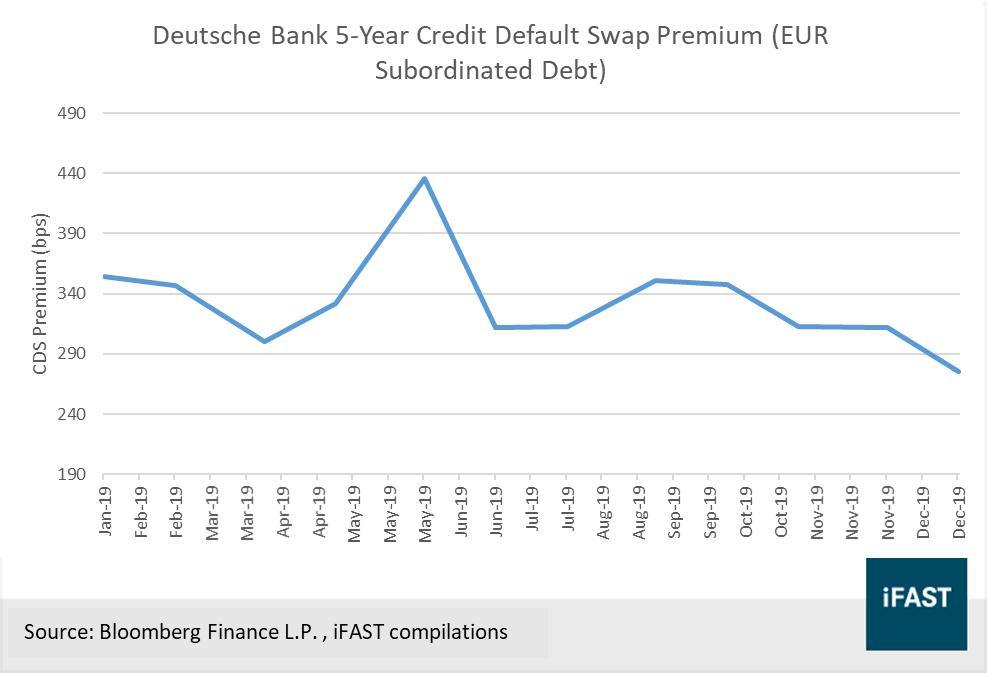
The reader would note that the CDS premium on Deutsche Bank’s subordinated EUR debt has fallen sharply over the past year, indicating that the bank’s perceived credit quality has improved. This should not be misinterpreted to mean that it is more creditworthy than other banks. In fact, it costs less to insure the debt of the likes of UBS and Credit Suisse.
Although CDS would only pay out if a borrower defaults, they tend to move in line with the risk of an AT1 coupon suspension. From Deutsche Bank’s lower CDS premium, we might also infer — from the market’s perspective — that it has a lower likelihood of a liquidity crunch or credit issues. This of course, is a factor that gives us some confidence that a call of the DB 6.250% Perpetual Corp (USD) lies within the realm of possibility.
Conclusion
Ignoring the tumultuous array of passions that have engulfed Deutsche Bank, it does seem to us that even though the bank continues to be hobbled by some legacy assets, the underlying business is sound, as evidenced by the continuing profitability of its core segments. We think too little credit has been given to Deutsche Bank for its strong capital position and the fact that its long association with the German state might make it a possible candidate for state support in times of need.
Notwithstanding these observations, Deutsche Bank bonds are indubitably a high-yield play and probably suitable for less risk-averse investors able to maintain a well-diversified portfolio. For these individuals, we strongly recommend the DB 6.250% Perpetual Corp (USD) for its significant upside potential, with a yield to call of 33.3%.
Our recommendation is not premised on the assumption of a call event occurring in April 2020. Rather, our investment thesis is founded on the idea that even if the said event does not materialize, there is a good chance for some degree of yield capture, underpinned by the fundamentals of the issuer.
Appendix: What is call optionality worth?
One of the major factors that separates the DB 6.250% Perpetual Corp (USD) and DB 7.500% Perpetual Corp (USD) — in terms of investment return — is the fact that the DB 6.25% perpetual might or might not be called on its first call date in April 2020. In other words, when an investor buys the DB 6.25% perpetual, he also buys the “hope” that the option would be exercised.
As rational investors, we know that few things in life are free. In all likelihood, a nagging thought remains as to the value of this optionality.
A heuristic we can employ is to consider that if we chose to buy the DB 7.500% Perpetual Corp (USD), the bond with a first call date of April 2025 (which is the second call date of the DB 6.25% perpetual), we could reap a yield to first call of 7.88%. If we were to buy the DB 6.250% Perpetual Corp (USD) instead, and if we assumed that the bond was only called on its second call date in April 2025, the bond would carry a yield to call of 7.89%. The logical conclusion then is that the value of a potential call in April 2020 must be priced extremely cheaply by the market, if it is even priced in at all.
Declaration:
For specific disclosure, at the time of publication of this report, IFPL (via its connected and associated entities) has a principal position in UBS 5.875% Perpetual Corp (SGD). The analyst who produced this report hold a NIL position in the abovementioned securities.
References
Deutsche Bank AG (2015) United – 25 Years of Deutsche Bank in East Germany, Historical Association of Deutsche Bank, No. 32A, September 2015, retrieved from http://www.bankgeschichte.de/en/docs/Historische_Rundschau-32-engl-web.pdf.
Jack, M. (2019), East Germans Were Welcomed to the West With Free Money. Here’s What They Bought After the Berlin Wall Fell, Time, 31 Oct 2019, retrieved from https://time.com/5714252/berlin-wall-east-germans-money/.
Braithwaite, T. (2018). Deutsche Bank - 20 years after the deal that sealed its fate, Financial Times, 30 Nov 2019, Retrieved from https://www.ft.com/content/d7a012a2-f3d1-11e8-ae55-df4bf40f9d0d.
Jenkins, P. & Noonan, L. (2017) How Deutsche Bank’s high-stakes gamble went wrong, Financial Times, 9 Nov 2017, Retrieved from https://www.ft.com/content/60fa7da6-c414-11e7-a1d2-6786f39ef675
Perryer, S. (2019) Deutsche Bank’s fall from grace: how one of the world’s largest lenders got into hot water, World Finance, 17 Oct 2019, Retrieved from https://www.worldfinance.com/banking/deutsche-banks-fall-from-grace-how-one-of-the-worlds-largest-lenders-got-into-hot-water
European Central Bank (2019) Publication of supervisory data, European Central Bank, Retrieved from https://www.bankingsupervision.europa.eu/banking/statistics/html/index.en.html