Receive first-hand news on the latest bond issues, credit updates and special events when you join us on our Telegram channel at https://t.me/bondsupermart!
Chart 1: Suning Group’s Simplified Organization Chart (Pre July 2021, Suning.com’s controlling shareholder is Jindong Zhang)
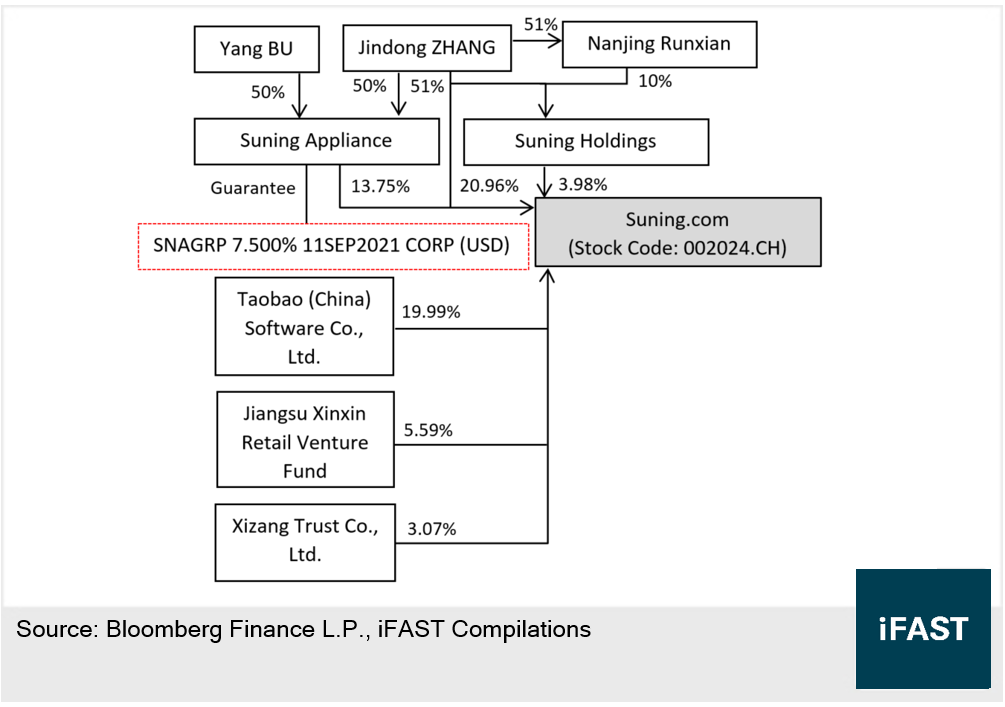
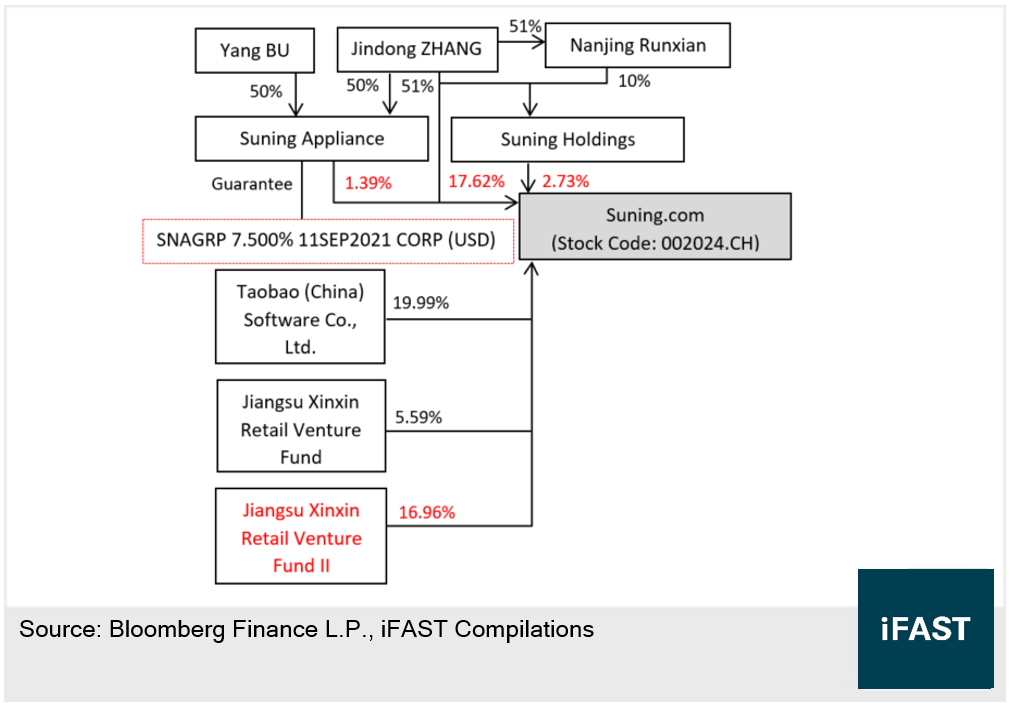
Chart 2: Suning Group’s Simplified Organization Chart (Post July 2021, Suning.com has no controlling shareholder)
Credit Event Overview
Early Warning Signals in the Debt Crisis
Ever since Suning Group was said to be in financial distress in August 2020, their bond yields rose sharply. In September 2020, Suning Appliance chose to convert their maturing strategic investments of RMB 20 billion into Hengda Real Estate Group’s shares, instead of collecting RMB 200 million proceeds of the investments from the group. As such, Suning Appliance’s cash flow became a concern for the market.
Later in December 2020, Zhang Jindong, Suning Appliance’s major and controlling shareholder, pledged all of his Suning Appliance’s shares and part of Suning Real Estate’s shares to secure a loan from Alibaba. Then in February 2021, he tried to sell 23% of Suning.com (Stock Code: 002024.CH) to Shenzhen International at RMB 6.92 per share for RMB 14.82 billion, but was faced with a deal retraction in early July.
Early June saw Zhang’s 5.9% stake in Suning.com frozen by the court for three years due to Suning Real Estate’s financial dispute. Suning Appliance’s shares in Suning.com was subsequently force sold as they violated an agreement of stock pledged repo transactions. The company is expected to continue selling its shares in the next six months.
The CNY onshore bond issued by Suning Appliance, “16 Suning 02” (issue size: RMB 4.2 billion), should have matured on 16 June 2021. However, after negotiations with their bondholders, the maturity date was extended by two years (to June 2023) at the same coupon rate of 7.3%.
The above show that there are some early warning signals in Suning Group’s liquidity crisis.
State-owned Enterprises tried to Rescue, but Suning was still Sued by Creditors
Suning Group tried again to liquidate its assets to save itself, where the highlight was still its retail platform, Suning.com.
On 5 July 2021, Jiangsu Xinxin Retail Venture Fund II, funded by Jiangsu Provincial Government, Alibaba, Midea Group, Haier Group, Xiaomi etc., acquired 17% stake in Suning.com at a cost of RMB 8.8 billion. Suning Appliance, Zhang Jindong and Suning Holdings accounted for 12.4%, 3.3% and 1.3% stakes respectively. In addition, Jiangsu Provincial Government and Nanjing Municipal Government promised to provide a credit facility for Suning.com, in order to assist the company in overcoming its adversities.
Even so, Suning Group’s liquidity crisis persisted. At the beginning of August, as a creditor representative, China Construction Bank sued Suning Appliance for recovery of approximately USD 250 million debts (including USD 165 million loans matured at July and USD 85 million bonds matured at 2021) and an extra interest payment of USD 5 million.
USD Bond Proposal to Prevent Default
Currently, there are 15 bonds issued or guaranteed by Suning Appliance, amounting to around RMB 29.2 billion (equivalent to USD 4.5 billion). Out of which, the bond closest to the maturity date is “SNAGRP 7.500% 11SEP2021 CORP (USD)”, due on 11 September 2021, with an issue size of USD 600 million.
On 27 August, Suning Appliance proposed an offer for its bondholders, which affirms that the company is facing a liquidity issue and does not have enough capitals to repay the bond. The company sought their USD bondholders’ consent to extend the maturity date by 18 months.
Besides, the company also requested that bondholders give up the change of control put. After the above-mentioned July acquisition about 17% stake in Suning.com, Suning.com was no longer a subsidiary of Suning Appliance. This event would have triggered the change of control clause, giving investors the right to request for redemption of the bond.
If bondholders accept the above offer (which requires a 90% approval vote to pass), Suning Appliance might escape defaulting on the USD bond for a moment. However, if Suning Appliance defaults on their other debts (for example, the above-mentioned credit event between China Construction Bank and Suning Appliance), it is possible that the USD bond’s cross default clause may be triggered.
Insiders claimed that two Chinese banks formed a creditor committee and hired Addleshaw Goddard as their legal advisor. The two Chinese banks collectively hold USD 130 million (in principal amount) of Suning Appliance’s USD 600 million bond due on 11 September.
Now, bondholders have the right to vote, accept or reject the offer by 16 September. Apart from that, investors will receive a consent fee of 1% of the principal amount (a bond with a principal amount of USD 200,000 will receive USD 2,000), if they accept the offer by 10 September.
Uncertain Recovery Value of Assets
According to Bloomberg’s estimate, as of the end of 2020, Suning Appliance’s (excluding its subsidiaries) core liabilities stood at RMB 95 billion, including bank loans and bill payables of RMB 64.8 billion (which have higher priority for repayment) and unsecured onshore and offshore bonds of RMB 29.2 billion.
Assuming a default in the USD bond, its recovery value depends on whether the company is able to liquidate its real estate projects (RMB 87 billion, in book value) and the company’s 4.7% stake in Hengda Real Estate Group (RMB 20 billion, in book value). Bloomberg estimates that these two assets account for around 70% of Suning Appliance’s total assets.
It is difficult to estimate the recovery value of these two assets as it depends on how the situation develops. At the very least, we believe that their true value must be much lower than their book value. However, Suning Appliance’s current cash position remains unknown to us. With this in mind, it is tough for investors to make decisions.
Considering the current low bond price of around USD 30, the market-expected recovery value has been priced in. Hence, unless investors believe that liquidation can help them earn more, otherwise, accepting the offer or selling it at the current price might be better options. If the bond proposal fails, the settlement process for the debt default events might be a long one. Investors should also take the time value into the consideration.
Declaration: For specific disclosure, at the time of publication of this report, IFPL (via its connected and associated entities) and the analyst who produced this report hold a NIL position in the abovementioned securities.