- SOCGEN did not manage to see great improvements in its Net Interest Income despite rising interest rates.
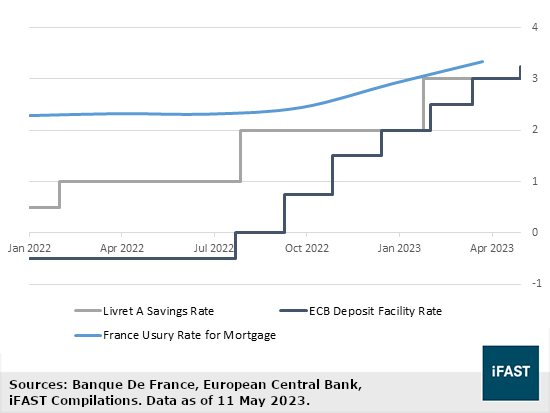
- France’s legislation on mortgage and savings prevents their banks from benefitting much.
- While it might still be profitable after writing down its Russian assets, SOCGEN still requires more time to stabilise.
- SOCGEN 8.250% Perpetual Corp (SGD) might have a high initial margin and a good yield, but the risk to take for SOCGEN might not be worthwhile.
A key French bank
Societe Generale (“SOCGEN”) primarily operates through its three business segments – French Retail Banking (“FRB”), International Retail Banking & Financial Services (“IRB”) and Global Banking & Investor Solutions’ (“GBI”). Under FRB, SOCGEN saw a legal merger of its two French branch networks – Societe Generale and Credit du Nord – into a new, single entity branded as SG targeting a regional presence beyond France. Its fully-online banking brand, Boursorama, remains operational as a separate entity. For IRB, it focuses on business outside of the Eurozone and also in Africa.
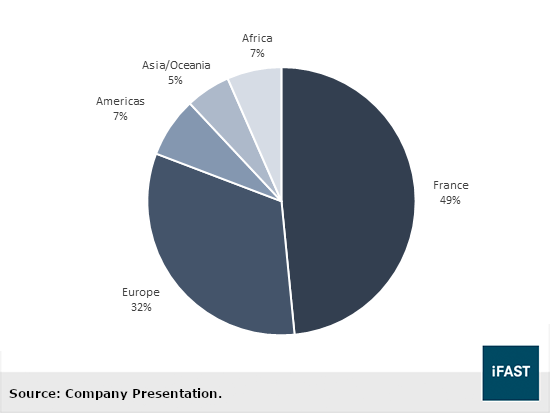
Despite its seemingly diverse operations, SOCGEN with roots in France still sees much of its operations based in its home country. In 2022, France and other parts of Europe are responsible for a large majority of SOCGEN’s net banking income at 49% and 32% respectively as observed in Chart 1.
Chart 1
Geographical Breakdown of Net Banking Income for SOCGEN
On the brighter side of things, SOCGEN had effectively withdrawn its operations from Russia. It was previously finalised in May 2022 to dispose of Rosbank, a subsidiary bank operating in Russia, alongside other Russian insurance subsidiaries. While the turmoil brought about short-term pain for SOCGEN due to the write-down of Russian assets, it is likely a better decision in the long term for them.
Looking into the development plans outlined till 2025, SOCGEN sets out to achieve an average annual revenue growth of at least 3%, an improved cost-to-income ratio equal to or lower than 62% and a Return on Tangible Equity of 10% based on a targeted CET1 ratio of 12% under Basel IV. It also highlighted further digital transformation and improved management of assets among other things in its intended future developments.
A disappointing 2022
France is the limitation in SOCGEN’s outlook
Chart 2
Livret A Savings Rate, Usury Rate and ECB Deposit Facility Rate since 2022
Credit Quality
SOCGEN’s CET1 ratio is at 13.49% as of 31 December 2022, falling from 13.71% as of 31 December 2021 due to the write-down of Russian assets. It indicated that its CET1 remains well above the required amount by 420 basis points. The liquidity coverage ratio stands at 141% in 2022, a drop from the 149% recorded in 2021 but still sufficient over the regulatory requirement. Its liquidity reserves increased to EUR 279b as of December 2022, from EUR 229b as of December 2021.
The cost of risk for SOCGEN was at 28 basis points in 2022, in which it anticipates the cost of risk to normalise between the range of 30 to 35 basis points moving forward. Non-performing loans (“NPL”) ratio had seen an overall falling trend across the past five years, where the NPL ratio fell slightly to 2.8% as of December 2022 as compared to 2.9% as of December 2021.
Overall, SOCGEN remains well-capitalised even after it decides to exit Russia. It continues to sustain a substantial buffer over the respective regulatory limits placed on its capital. While the cost of risk is expected to increase slightly, SOCGEN’s careful management of non-performing assets should minimise the impact of the cost of risk.
Recommendations
Table 1
SGD AT1 issuances from various banks
|
Issue |
Ask Price |
Current Yield |
Yield to next call/ reset |
First call date/ reset date |
Years to first call/ reset |
Reset rate |
Bond Credit Rating (S&P/ Fitch) |
|
90.51 |
9.11% |
11.16% |
15 Dec 2027 |
4.18 |
Prevailing 5-Year SORA OIS + 5.600% |
BB/BB+ |
|
|
79.65 |
7.69% |
39.55% |
16 Apr 2024 |
0.93 |
Prevailing 5Y SGD SOR + Initial Margin (4.207%) |
BB/BB+ |
|
|
96.00 |
8.65% |
9.54% |
15 Dec 2027 |
4.35 |
5-year SORA-OIS + the Margin (5.641%) |
N.R./BBB- |
|
|
91.00 |
8.02% |
9.66% |
15 Sep 2028 |
5.10 |
5Y SORA OIS + Initial Margin (3.929%) |
N.R./BBB- |
|
|
94.63 |
6.24% |
7.25% |
28 Feb 2028 |
4.80 |
5-year SORA OIS Rate + Initial Margin [2.674%] |
BBB-/BBB |
|
|
Source: Bondsupermart, Bloomberg Finance L.P., iFAST Compilations. |
|||||||
SOCGEN offers two SGD AT1 issuances, both of which saw fluctuations in their prices as a result of the recent banking crisis. Between the two, if we had to choose, SOCGEN 8.250% Perpetual Corp (SGD) would be the preferred one considering the higher initial margin at 560 basis points.
For SOCGEN 6.125% Perpetual Corp (SGD), it appears that the market priced in a non-call resulting in the ask price being severely below par. Looking at the initial margin on the reset rate at 4.207%, the cost of new issuance for SOCGEN is much higher. If SOCGEN were to issue a new perpetual, considering its most recent issuance SOCGEN 8.250% Perpetual Corp (SGD), it is likely to be within the range of 8~9%. In comparison, if allowed to reset, SOCGEN 6.125% Perpetual Corp (SGD) based on a 5Y SGD Swap-Offer Rate (“SOR”) at 2.9625% as of 12 May 2023 will likely see a reset rate of 7.1695% instead. Given the impending situation of a rate pause, and potential rate cuts in the following year, interest rates are expected to stabilise from here and a decreasing 5Y SGD SOR will only further drive the case of a non-call.
As such, the market has likely priced in a call on the following reset date for SOCGEN 6.125% Perpetual Corp (SGD) on 16 April 2029. Based on this call date, the yield to call is estimated at 12.18% (assuming it resets with a coupon of 7.1695%), closer to the yield to next reset seen on SOCGEN 8.250% Perpetual Corp (SGD). Years to the following reset date is estimated at 5.93 years.
Comparing against other SGD AT1 issuances of similar years to next call, we prefer BACR 8.300% Perpetual Corp (SGD). Previously we had noted a preference for a higher initial margin on the reset rate, raising the likelihood of redemption of the perpetual notes – and BACR 8.300% Perpetual Corp (SGD) has a relatively similar initial spread as SOCGEN 8.250% Perpetual Corp (SGD). Between the two, Barclays’ outlook is much more optimistic alongside a stronger credit profile. While SOCGEN 8.250% Perpetual Corp (SGD) offers a higher yield to next call at 11.16%, the additional risk might not be worth the additional yield it provides over BACR 8.300% Perpetual Corp (SGD).
Reiterating several important points on AT1 bonds – 1) these are capital instruments designed to absorb losses upon the trigger of an insolvency event and 2) it remains at the bank’s sole discretion to call back the bonds and it should not be assumed that the bond will be called back on its first date. In SOCGEN’s case, investors have to be clear of the non-call risk associated with its AT1 bonds, particularly since SOCGEN 6.125% Perpetual Corp (SGD) has potentially priced in a non-call.
Overall, as it continues to remain profitable, SOCGEN likely requires more time to stabilise amidst this changing interest rate environment for them. While it would be ideal if it could capitalise on the net interest margin outside of France, there is little reason to be optimistic about SOCGEN’s future performance for now. Investors might want to wait and see how the legislation might change for the French banks in 2023, before taking the risk in SOCGEN’s SGD AT1 issuances.
Declaration: For specific disclosure, at the time of publication of this report, IFPL (via its connected and associated entities) holds a position in BACR 8.300% Perpetual Corp (SGD) and the analyst who produced this report holds a NIL position in the abovementioned securities.
Our podcast series, Yield Hunters, is available on Spotify, iTunes Podcasts and Google Podcasts. We share our thoughts on new bond issues and hold discussions on the fixed income space. Listen to our latest episode below and follow us!