Receive first-hand news on the latest bond issues, credit updates and special events when you join us on our Telegram channel at https://t.me/bondsupermart!
Highlights:
- With a national presence accompanied by its large number of urban renewal projects in the Greater Bay Area, Fantasia’s larger-than-peers land bank could lead to a promising growth outlook.
- The Group recorded impressive contracted sales growth this year. Despite the drop in gross profit margin, its credit status remains sound, and their frequent bond repurchases are indication of decent liquidity.
- However, considering the Group’s limited financing ability, investors can look at the bonds due on or before 2022; some of its near-term bonds offer attractive total returns.
Since early 2021, the Chinese real estate market has had to overcome many challenges. B-rated bonds have suffered a severe setback in the last two months due to the Evergrande incident. As issuers’ bond yields spike to new highs, investors wonder if they are traps or opportunities.
In this article, we will analyze Fantasia’s latest credit profile to determine if it is a good time to buy their bonds now.
Nationwide Footprints; With Strong Growth Prospect in Greater Bay Area
Established in 1998 and headquartered in Shenzhen, Fantasia was listed on the HKEX in 2009 (Stock Code: 1777.HK). Its core business includes real estate development and property management, and has a current market capitalization at approximately 4.16 billion HKD.
Contrary to popular belief that Fantasia’s key development focus is in Shenzhen and Greater Bay Area, the Group and is quite geographically diversified and covers a lot of first- and second-tier cities across the country.
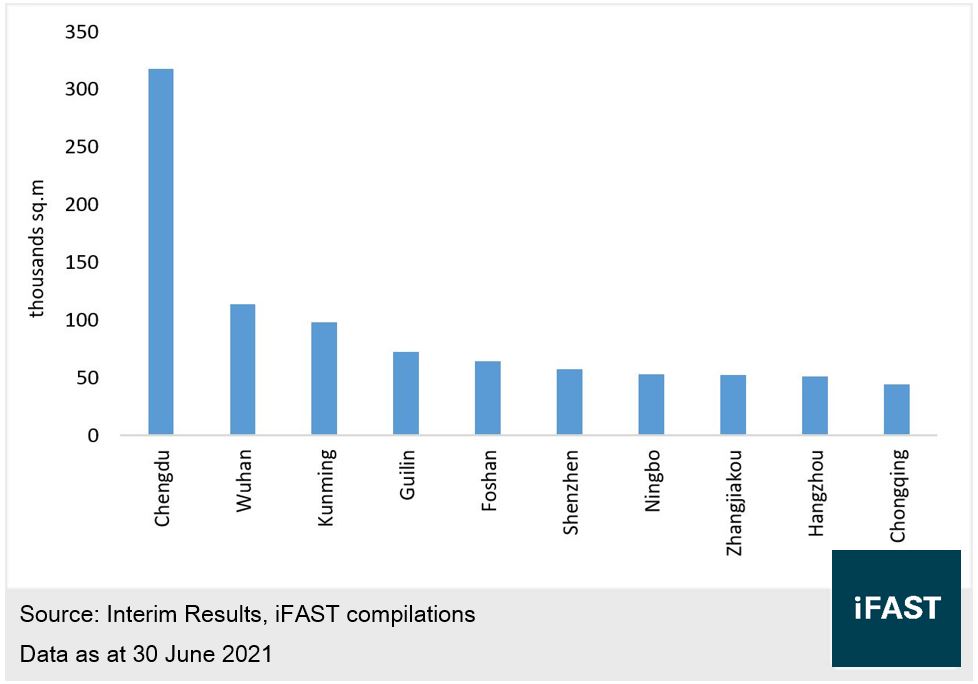
Looking in detail, the Group’s total land bank reached 11.86 million sq.m as of end-June, with a concentration in the Chengdu-Chongqing metropolitan area. Among them, Chengdu alone accounted for 3.18 million sq.m (approximately 27%) of the total lank bank, nearly twice the size of the land bank in Wuhan (Chart 1). Meanwhile, Greater Bay Area only accounted for around 11% of the total land bank, and the whole Southern China region, including the Greater Bay Area, contributed about 18% of total sales in the first half of 2021.
Chart 1: Land Bank by Top 10 Cities
However, Fantasia has successfully secured its development opportunity in the Greater Bay Area through urban renewal projects, as the Group was ranked fourth in China Index Academy’s "2020 China Leading Real Estate Brands in Urban Renewal”. Fitch estimated that these projects will bring in more than 400 billion RMB sales in the future, and add 500,000 sq.m of land bank to the Group each year.
The Group’s current land bank to sales ratio of 5.1 times combined with the new addition from its urban renewal projects allows their total land bank size to outperform its peers. This allows the management to put forth a promising sales target of 20% growth per year.
Impressive Sales Growth; But the Use of Joint Ventures is Increasing
In 2020, Fantasia’s total contracted sales was 49.2 billion RMB, up 37% YoY - a growth rate that beats the industry average. Sales remained strong in the first seven months of 2021 and further increased 49% YoY to 33.2 billion RMB.
However, according to CRIC statistics, the Group’s attributable sales ratio in 1H21 was only 65%, a significant reduction from the past two years. Fantasia is expanding its joint ventures as seen from the continuous increase in ‘Interests in associates and joint ventures’ (Table 1).
Table 1: Fantasia’s Attributable Sales Ratio and Joint Venture Scale
|
(in RMB) |
Attributable sales ratio |
Interests in associates and joint ventures |
|
1H21 |
64.9% |
83.5 billion |
|
2020 |
74.3% |
69.3 billion |
|
2019 |
76.4% |
34.4 billion |
|
Source: Interim Results, iFAST Compilations Data as at 30 June 2021 |
||
In fact, the minority interests of the Group accounted for as much as 46% of the total equity. It is no wonder people worry about the ‘disguised debt into equity’ issue that developers use to hide their actual debt level.
One should note that the proper use of joint ventures can indeed bring huge growth opportunities to the company. Moreover, in the past two years, the difference between the ratios of minority interests and profit attributable to minority shareholders is reasonable (within 5%). Compared with other developers, we believe that the Group has a better debt structure.
Credit Status Remains Sound Despite Declining Gross Margin
In the first half of 2021, Fantasia’s revenue and profit attributable to shareholders were 11 billion RMB and 150 million RMB respectively, representing an increase of 18.5% and 58.7% YoY. Despite the seemingly fast growth, the overall profit margin has declined significantly. The gross profit margin in particular has dropped to 20.8% (2020: 33.6%), while joint venture projects can only contribute a profit margin of 0.4%. The return is thus very low despite the Group’s continuous investments.
During the result announcement, Chen Xinyu, the CFO of Fantasia, stated that the drop in gross margin is mainly a result of the low selling price of areas where the historical projects are located. The average selling price of these projects is only 8,700 RMB per sq.m. Chen believes that the gross margin for entire 2021 will not drop below 20%. Indeed, if we consider that the average selling price in 1H21 is 16,200 RMB per sq.m, we think that the Group’s gross margin has room for future recovery.
Credit wise, as of end-June, Fantasia’s key indicators were similar to those at the end of last year (Table 2). With reference to the Three Red Lines, it belongs to the "yellow light" tier and is considered healthy compared to other B-rated peers.
Table 2: Fantasia’s Key Credit Indicators
|
June 2021 |
December 2020 |
Three Red Lines Requirements |
|
|
Total Debt (billion RMB) |
51.5 |
46.9 |
/ |
|
Cash and Cash Equivalents (billion RMB) |
27.2 |
24.9 |
/ |
|
Restricted Cash (billion RMB) |
3.9 |
3.1 |
/ |
|
Net Gearing (%) |
76% |
77% |
< 100% |
|
Cash to Short Term Debt (times) |
1.44 |
1.54 |
> 1.0x |
|
Non-restricted Cash to Short Term Debt (times) |
1.40 |
1.37 |
/ |
|
Adjusted Liabilities to Assets (%) |
73% |
72% |
< 70% |
|
Source: Interim Results, iFAST Compilations Data as at 30 June 2021 |
|||
Although the net gearing ratio remains unchanged, its minority interests have increased by 25% from the end of last year, so the actual leverage level may have deteriorated. Fortunately, we saw that the amount of external guarantees was only about 2.9 billion RMB, which is not large compared to the scale of total debt. Therefore, we find that the overall credit risk is still manageable.
Large Amount of Offshore Debts; Frequently Repurchase Bonds
Recently, Fantasia’s bond yields have risen sharply. Apart from being affected by the broad market sell-off in the Chinese real estate sector, one other reason may be that the market is concerned about the Group's relatively heavy reliance on offshore debts. Currently, there are 11 outstanding USD bonds issued by Fantasia, with a total size of US$3.33 billion (approximately 21.6 billion RMB).
Chen Xinyu said that after repaying three USD bonds due in the remainder of the year, onshore and offshore debts should account for 50% each. The Group will try to control the total debt size below 50 billion RMB in the future, of which 25% are bank loans. This should help balance the entire debt structure.
When repaying offshore debts, mainland issuers usually convert RMB into other currencies using different methods such as outbound guarantee and RMB fund pools, but most methods still require approval from the State Administration of Foreign Exchange, and other risk factors may be involved in the process. Despite so, generally speaking, if the money is used to repay the debt principal and interest, it should not be too difficult to obtain the approval.
Besides, Fantasia is one of the issuers in the market that frequently buys back its bonds. It submitted a tender offer in early June to redeem its $400 million USD bond due in October this year (of which 47% of holders accepted the offer). In addition, the Group repurchased its 2023 and 2024 bonds several times (May-present: 43.6 million USD), and its key shareholder Zeng Jie also bought the 2021 and 2024 bonds in the open market. This is an indication of the management’s confidence in the Group’s liquidity status.
With Limited Financing Ability, Should Only Consider Near-term Bonds
As mentioned at the start of this article, Fantasia’s bond yields has risen to an unusual level, elevating the difficulties to conduct further refinancing for its offshore debts. The Group has issued a 3-year bond with 14.5% coupon rate during the start of recent Chinese real estate bonds sell-off in Mid-June.
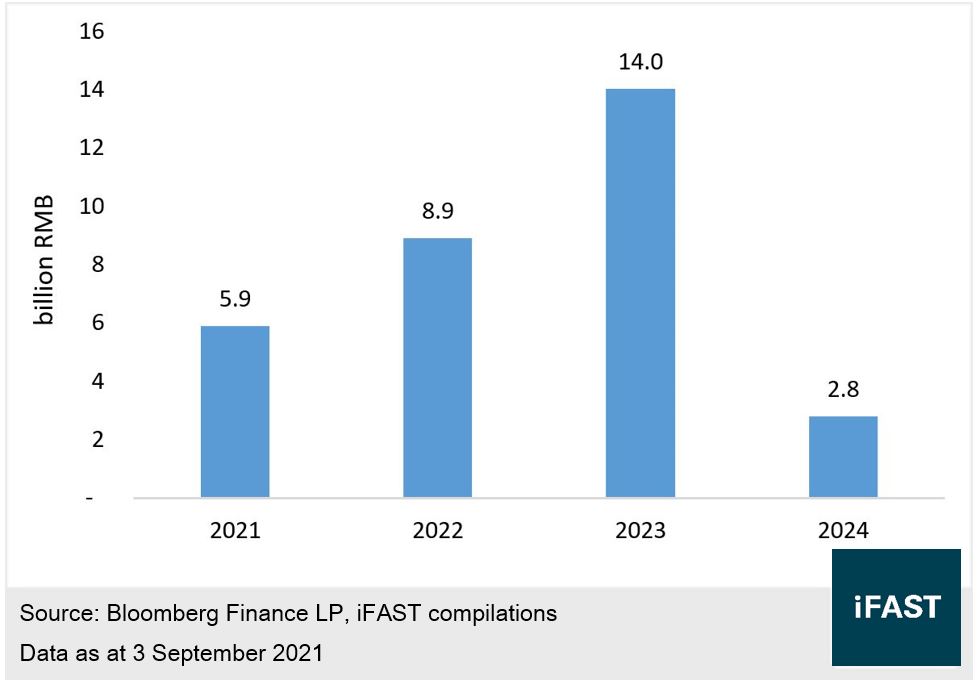
Considering current market sentiment, it is even harder to issue any USD bonds. Looking into the maturity profile of its bonds (Chart 2), we think investors are better off considering shorter-term bonds, including those with a maturity date on or before 2022.
Chart 2: Fantasia’s Onshore and Offshore Bonds Maturity Profile
On 2 Sep, market rumoured that Fantasia has missed its coupon payment for “ FTHDGR 10.875% 02MAR2024 CORP (USD) ”, leading to a landslide for all its USD bonds. At the night of the same day, the Group issued an announcement to confirm that they have paid interest payment to the trustee on 31 Aug. However, the bond prices are yet to rebound at this moment.
Generally, not many investors will pay attention to the bonds with less than one year to maturity because of the high fluctuation of their annualized yields, and typically limited investment returns. However, as of 3 Sep afternoon, Fantasia’s near-term bonds are yielding at over 100% (see Table 3) and offering very attractive potential total return, we think they could appeal to aggressive investors who are looking for short-term profits.
Do keep in mind that the actual price may be different from the indicative price, given that the transaction liquidity of these near-term bonds are usually low.
Table 3: Fantasia’s USD Bonds Due on or before 2022
|
Bond Name |
Years to Maturity |
Indicative Ask Price |
YTM |
|
FTHDGR 7.375% 04OCT2021 CORP (USD) |
0.083 |
97.210 |
39.671% |
|
FTHDGR 6.950% 17DEC2021 CORP (USD) |
0.286 |
80.210 |
131.195% |
|
FTHDGR 15.000% 18DEC2021 CORP (USD) |
0.288 |
77.210 |
176.514% |
|
FTHDGR 11.750% 17APR2022 CORP (USD) |
0.617 |
60.210 |
118.205% |
|
FTHDGR 7.950% 05JUL2022 CORP (USD) |
0.834 |
63.5 |
73.329% |
|
FTHDGR 12.250% 18OCT2022 CORP (USD) |
1.121 |
60.210 |
68.145% |
|
Source: BSM Data as at 3 September 2021 |
|||
Corporate Risks
More than half of Fantasia's debts are denominated in USD. Investors should note that the company is exposed to significant exchange rate risk when the USD/RMB moves quickly.
The refinancing risk is another huge concern. Since it is difficult to predict when the sentiment of the Chinese real estate bonds will recover, the Group may be unable to refinance if bond yields remain high, which puts pressure on its liquidity status.
Conclusion
With a national presence accompanied by its large number of urban renewal projects in the Greater Bay Area, Fantasia’s larger-than-peers land bank could lead to a promising growth outlook.
The Group recorded impressive contracted sales growth this year. Despite the drop in gross profit margin, its credit status remains sound, and their frequent bond repurchases are indication of decent liquidity.
However, considering the Group’s limited financing ability, investors can look at the bonds due on or before 2022; some of its near-term bonds offer attractive total returns.
Our podcast series, Yield Hunters, is available on Spotify, iTunes Podcasts and Google Podcasts. We share our thoughts on new bond issues and hold discussions on the fixed income space. Listen to our latest episode below and follow us!
Declaration:
For specific disclosure, at the time of publication of this report, IFPL (via its connected and associated entities) holds a position in the FTHDGR 7.95% 05Jul2022. The analyst who produced this report holds a NIL position in the abovementioned securities.