Highlights:
- KWG’s contracted sales plunged by 53.0% for the first five months of this year to RMB 21.6 billion.
- Major credit indicators weakened at varying degrees. A large portion of cash on presale proceeds accounts could not be freely used, leading to extraordinarily tight liquidity.
- KWG proposes to repay two bonds due September through two property projects in Hong Kong. But we think the likelihood of repayment is pretty low, and the company will likely extend the maturity date of these bonds.
The pick-up of the Chinese property market was not shown up in the past March and April. Instead, the market furthers deteriorated, with nationwide commercialized property sales for the first four months of this year slumped by 29.5% from one year ago, a decline of 6.8 percentage points greater than 1Q2022. Property developers are having a tougher time, as the liquidity crisis continues. Among the first and second-tier Non-SOE developers, only a few developers such as Country Garden, Seazen, CIFI, Roshine, Agile, and KWG have not stepped into distress.
However, two USD bonds of KWG will mature in September with a total principal of USD 900 million. How certain is the company repaying the bonds? Will KWG be the next distressed developer?
Poor Sales performance
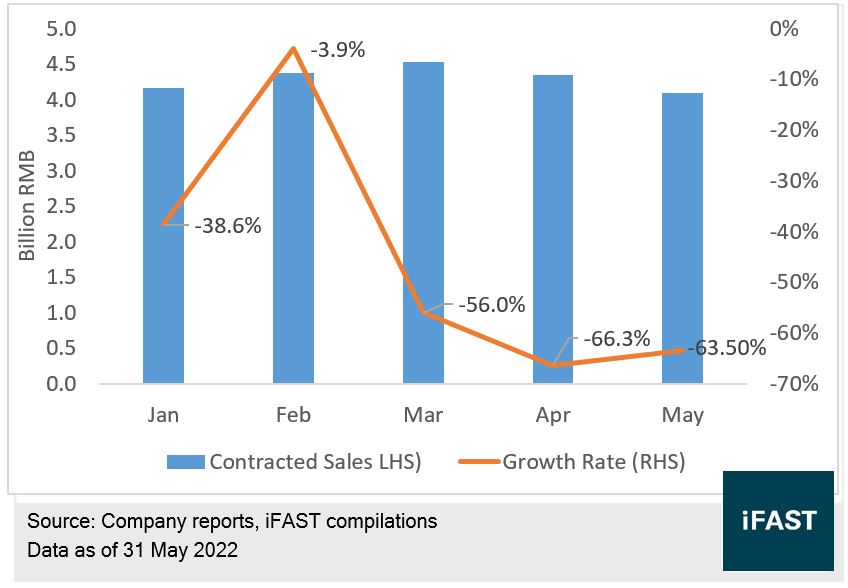
Given that the majority of property projects situate in tier-one and tier-two cities, KWG delivered rather good results with full-year contracted sales rising slightly by 0.2% to RMB 103.8 billion. But, the situation turns bleak this year with contracted sales for the five months amounted to RMB 21.6 billion, (see Chart 1), slumped over 50% YoY. Objectively speaking, KWG's sales still exhibits resilience, as the monthly sales amount stands over RMB 4 billion.
Chart 1: Contracted Sales of KWG
Credit Metrics Weakened with Extraordinarily Tight Liquidity
KWG maintained a decent credit profile over the past few years. However, major credit metrics weakened at varying degrees last year (see Table 1).
Table 1: Credit Metrics
|
(Billion RMB) |
2021 |
2020 |
|
Short-term Debt |
20.33 |
25.26 |
|
Cash Balance |
29.45 |
44.58 |
|
Restricted Cash |
21.73 |
3.94 |
|
Cash after removing restricted part |
7.72 |
40.64 |
|
Adjusted Ratio of Cash to Short-term Debt |
0.40 |
1.60 |
|
Net Gearing Ratio |
79.2% |
61.7% |
|
Adjusted Liability to Asset Ratio |
71.6% |
75.1% |
|
Source: Annual report, iFAST compilations Data as of 31 December 2021 |
||
As of December 2021, the total cash balance KWG owned amounted to RMB 29.5 billion, significantly downsized from that of RMB 44.6 billion in 2020. Worse still, a large portion of cash on presale proceeds accounts that totaled RMB 21.7 billion could be not freely used after authority tightened policy for presale proceed regulation in 2H2021. The free cash declined to RMB 7.7 billion, and adjusted cash after removing restricted cash was just 0.4x as its short-term debt, indicating that the current liquidity looks extraordinarily tight and the solvency is not decent enough under the environment of halted financing.
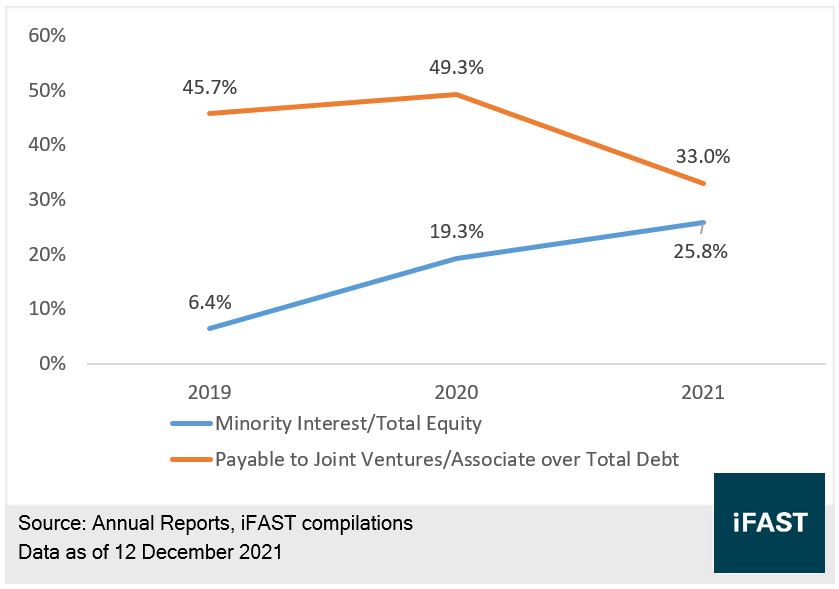
Off-balance-sheet credit metrics have also experienced deterioration (see Chart 2). The minority interest/ total equity ratio rose from 6.4% in 2019 to 25.8% in 2021, signaling an increase in joint ventures/ associates and the likelihood of off-balance-sheet debt. Payable to joint ventures over total debt ratio saw a dip in 2020, whereas is still above the average, suggesting that the company faces a significant amount of off-balance-sheet debt.
As observed, the number of external guarantees KWG offers for joints reached RMB 20.2 billion as of December 2021. The ratio of cash to short-term debt contracts to 0.2x if we look at all external guarantees as short-term debt, and it depicts that the liquidity is nearly exhausted.
Chart 2: Off-balance-sheet Credit Indictors
Low possibility of Repayment in September
In view of current liquidity, KWG might be underfunded for bonds repayment in September. Alternatively, the company proposes to raise funds through overseas property projects. The detailed scheme is shown below (see Table 2):
Table 2: Proposed Schemes for Refinancing
|
Project |
Proposed Schemes |
KWG's Ownership |
Theoretical Cash Inflow |
|
Hong Kong Kai Tak project |
Sales of properties with total sources of HKD 7 billion |
50% |
HKD 3.5 billion |
|
Hong Kong Ap Lei Chau project |
Increase the LTV ratio to get an additional fund of HKD 10 billion |
50% |
HKD 5.0 billion |
|
Source: Investor Conference of KWG, iFAST compilations Data as of 27 April 2022 |
|||
Firstly, KWG plans to collect cash by sales of the Hong Kong Kai Tak project (Upper Riverbank), which is a collaborative property with Longfor Group. The sellable resource of the project is roughly HKD 7 billion and could bring KWG with HKD 3.5 billion cash inflow based on the 50% interest KWG owns. Secondly, the LTV ratio (Loan to Value) for Hong Kong Ap Lei Chau project jointly developed with Logan Group is less than 30%, and KWG proposed to move up the LTV ratio to acquire additional refinancing of HKD 5 billion. Weigh the two schemes above, Theoretically, KWG is estimated to get a total cash inflow of HKD 8.5 billion (about USD 1.08 billion), which is ample for the repayment of bonds due September.
However, we don't think that the two schemes will process as expected. For Kai Tak project, a luxury residential project with a low sell-through rate. It started to sell in 2019, while averages few sales per month. It indicates that the company is unlikely to monetize all the projects in a short period, and there would not be a cash inflow of HKD 3.5 billion. Ap Lei Chau project-wise, the proposed scheme has yet to make substantial progress, but we could not rule out the possibility of successful refinancing. It's important to note that collateral loans from a bank usually are embedded with some covenants, like the restriction on the use of proceeds. We are thus unsure whether the additional fund is allowed to repay USD bonds. On the whole, KWG will be having a low capacity to repay the bonds due September in spite of its strong willingness. As a consequence, exchange offer might be a potential option for the company. It would be preferable for bondholders to wait for a further update before making any decisions.
Conclusion
KWG’s contracted sales plunged by 53.0% for the first five months of this year to RMB 21.6 billion.
Major credit indicators weakened at varying degrees. A large portion of cash on presale proceeds accounts could not be freely used, leading to extraordinarily tight liquidity.
KWG proposes to repay two bonds due September through two property projects in Hong Kong. But we think the likelihood of repayment is pretty low, and the company will likely extend the maturity date of these bonds.
For specific disclosure, at the time of publication of this report, IFPL (via its connected and associated entities) and the analyst who produced this report hold a NIL position in the abovementioned securities.