In an exchange filing on 18 March, Hyflux Ltd (HYF SP) gave notice that the company will hold scheme meetings in April for its creditors to vote on its restructuring proposal, or the Hyflux Scheme. The meeting for Unsecured Scheme Parties (“USP”), comprising of Hyflux’s senior unsecured debtors including contingent claimants, bank lenders, and senior noteholders, will take place at 12 noon on 22 April. The meeting for P&P Scheme Parties, comprising of holders of the company’s S$900m perpetual securities and preference shares (“P&P”), will be held at 7 pm on the same day.
According to the indicative schedule in Hyflux’s explanatory statement, the firm is targeting to hold the extraordinary general meeting for its shareholders (to approve the restructuring proposal) by 15 May. The long-stop date of Hyflux’s restructuring agreement with Utico is 26 May, which is the deadline for the company to complete its restructuring and emerge from debt moratorium.
Back in January, we attended Utico FZC’s townhall meeting for P&P investors. The meeting was hosted by Richard Menezes, CEO of Utico, and the company’s advisors, who together presented Hyflux’s restructuring plan and took questions regarding the restructuring scheme. We also attended SIAS’s webinar for Hyflux P&P securityholders in late March. Our discussion of Hyflux’s scheme of arrangement (“SOA”) in this article is based on Utico’s presentation in January’s townhall meeting, SIAS’s webinar, and Hyflux’s scheme documents.
A quick recap: the Hyflux-Utico restructuring agreement
In April 2019, Utico issued a letter of intent (“LOI”) to Hyflux for a potential investment into the latter. According to Menezes, back then the Utico team was unaware of the situation surrounding Hyflux’s creditors, especially the P&P holders. After getting themselves informed about the background of Hyflux’s debt restructuring, Menezes—who owned 17% of Utico—and his fellow Utico shareholders decided that their restructuring proposal had to be holistic and include the P&P group in their considerations. Menezes emphasized that if the P&P Scheme Parties reject the scheme, Utico would walk away from the deal regardless of how the other creditor classes voted.
Seven months after the LOI announcement, Utico and Hyflux finally entered into a restructuring agreement. Menezes mentioned during the January meeting that protracted negotiations on the deal took his team beyond three internal deadlines, and yet the value of Utico’s proposal had remained the same, something that he highlighted was notable as a company under debt moratorium typically lost value over time. Menezes also stressed that the current restructuring plan represented Utico’s final effort to get the deal done.
The proposed investment from Utico would be in the form of S$300m in equity, in exchange for a 95% stake in Hyflux, and S$100m of shareholder’s loan. From these proceeds, the parties have earmarked S$250m for USPs. Another S$40m will be used to pay the fees for professional advisors, namely the advisors of Hyflux and the company’s creditors. Hyflux will also retain S$10m for working capital purposes.
Finally, Hyflux has allocated S$50m (from the S$100m shareholder’s loan) to fund the Base P&P Claim Cash Payout (explained below) that will be received by P&P holders. In addition, Utico will fork out a minimum of another S$50m in cash, which is not part of its S$400m investment, for the payment of the Optional P&P Claim Cash Consideration to P&P holders.
In explaining why it took them so long to execute the restructuring agreement with Hyflux, Utico’s representatives pointed out that the deal was highly complicated with the numerous stakeholders involved. They also suspected Hyflux was at the same time soliciting bids from other potential investors.
At the end, and after speaking with various parties including other bidders, the Utico team is confident that their proposal provides ample value to Hyflux’s stakeholders, and is likely the best deal available to Hyflux. They noted during the meeting that Hyflux had had plenty of time to consider proposals from other potential investors. Furthermore, based on their valuation work, Utico’s professional advisors actually felt that the company was paying too much for Hyflux. Menezes and his team of advisors emphasized that for them to be able to extract any value from Utico’s S$400m of investment, it is imperative for Hyflux’s existing liabilities to be extinguished through the restructuring scheme.
In justifying their valuation of Hyflux, Utico’s representatives showed in the January meeting a slide that laid out Hyflux’s financial liabilities, which totaled S$4.5 billion according to their calculations.1 Given the vast amount of debt and contingent liabilities, an analysis by Ernst & Young (“EY”) dated July 2019 determined that Hyflux would fetch only around S$63-133m in a liquidation scenario. That would translate to an estimated recovery range of 2.8-6.1% for USPs, and zero recovery for P&P investors.
Hyflux’s scheme of arrangement
Essentially, scheme creditors will have to decide whether to vote for or against the scheme. P&P holders who are in favor of Hyflux’s SOA will also have to choose between one of two payout options, as explained below.
Option 1
P&P holders who select Option 1 will receive the Base P&P Claim Cash Payout (“BPPCCP”), an upfront cash payment that is equivalent to the lesser of S$1,500 or 50% of the nominal amount of their debt securities.2
Option 2
P&P holders who select Option 2 will receive the BPPCCP in five equal instalments over two years instead. A simple interest of 1.25% p.a. will accrue on such amounts of the BPPCCP that remain outstanding, and will be paid together with each instalment.
In addition to the BPPCCP, P&P holders who opt for Option 2 will receive the Optional P&P Claim Cash Payout (“OPPCCP”), which is a cash payment equivalent to the below formula.

The OPPCCC in the above formula is referring to the Optional P&P Claims Cash Consideration, which in turn is determined in the following manner.

The OPPCCP will be paid in five equal instalments as well, over the third and fourth years after the restructuring effective date. Again, an interest rate of 1.25% p.a. will be applicable on the outstanding amounts of the OPPCCP.
We noted that in addition to the cash payouts described above—which were already laid out when the Hyflux-Utico restructuring agreement was announced in November—Hyflux and Utico also sweetened Option 2 by adding an Optional P&P Claims Share Consideration (“OPPSC”). P&P holders who choose Option 2 will receive 3.5% of Hyflux’s enlarged share capital post-restructuring, on a pro rata basis.4 These shares will be taken from the 95% stake agreed to be issued to Utico for its S$300m investment.
Taking Hyflux’s implied equity value of ~S$316m, based on Utico’s investment, we estimated the OPPSC to be worth around S$11m. This would translate to an additional recovery rate of ~1.2% for P&P holders.
Illustrations of the scheme consideration
USP
The payout mechanism for the USP class of creditors is relatively straightforward (as compared to P&P). If the scheme goes through, USPs will receive a pro rata distribution of S$250m over two years, with half of the consideration to be paid upfront.
The actual recovery rate for USPs is negatively proportionate to the amount of Hyflux’s contingent liabilities that crystallizes. According to Hyflux’s explanatory statement to its SOA, the total amount of USP claims is approximately S$1.66 billion, of which S$532.8m comprises of contingent liabilities. Based on these figures, we estimate that the recovery rate for USPs will range between 15.1% and 22.2%.
On 25 March, Hyflux released the adjudication results of proofs of claims submitted by scheme creditors. Based on the document, we counted total USP claims of S$1.67 billion. The amount of contingent claims admitted by EY (chairman of Hyflux’s SOA) was smaller at S$399.7m. According to our estimates, the adjudication results should translate to a lower recovery range of 14.9-19.6% for USPs.
P&P
It is obviously difficult to pin down the recovery value for individual P&P investors, as that value is dependent on 1) how much debt securities they own, and 2) whether they choose Option 1 or 2. It should also be apparent that the recovery rate for P&P holders of larger amounts would be lower, once the investment amount crosses S$3,000—the point that 50% is equivalent to the maximum BPPCCP of S$1,500.
Nonetheless, we have compiled in the below table our estimates illustrating the recovery values of P&P investors holding S$2,000, S$20,000, S$500,000, and S$1m respectively, across both Option 1 and 2. The estimates assumed the minimum S$50m for the Optional P&P Claims Cash Consideration in Option 2, and excluded the 1.25% interest component. The recovery values also excluded the Optional P&P Claims Share Consideration, which as mentioned earlier could translate to an additional recovery rate of ~1.2%.
Illustrative returns to P&P investors holding different investment amounts (in S$)
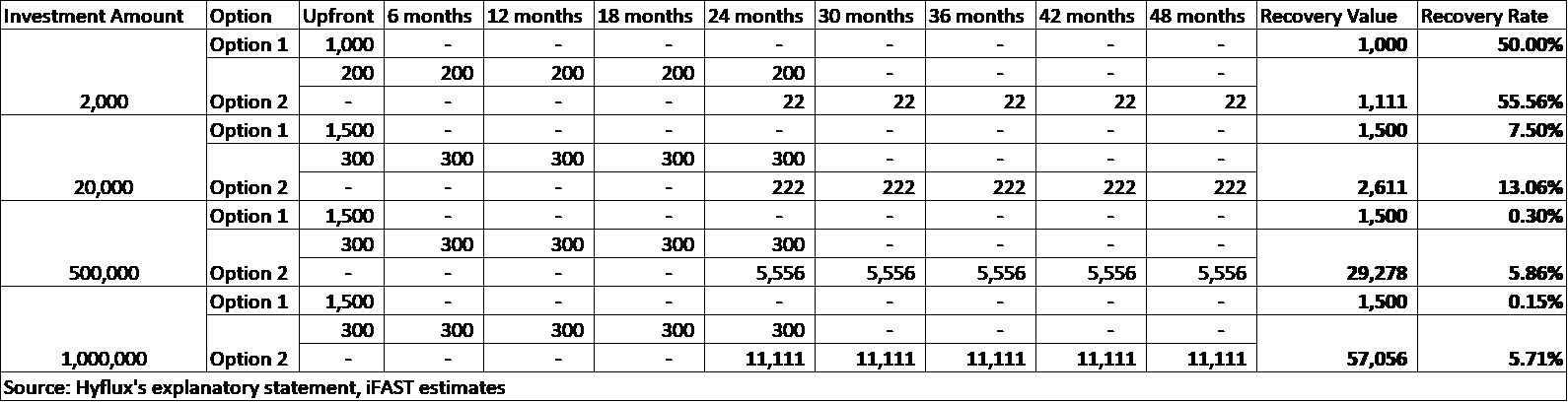
A simple calculation (deducting the recovery rate of Option 1 from that of Option 2) would confirm that as the additional cash amount from Option 2 is to be paid on a pro rata basis among P&P holders who elect this option, the recovery rate from this component is the same—5.56%—for all these claimants. It is the fixed ceiling of S$1,500 per P&P holder of the base component that skews the payout to the disadvantage of larger P&P investors. As can be seen from the table above, the recovery rate from the base payout corresponds inversely to the investment amount, dropping from 50.00% for a S$2,000 investor to 0.15% for someone who invested S$1m.
Our views
Several factors add to the difficulty of our providing a recommendation to Hyflux’s scheme creditors. Since Utico executed the restructuring agreement with Hyflux, several potential investors have entered the fray, namely Aqua Munda, Longview International Holdings, and most recently FCC Aqualia. However, there is currently insufficient information of these potential investors for us to have a sense of their proposals as compared to Utico’s.
Also, the structure of the deal for P&P, specifically the maximum base payout of S$1,500 per P&P scheme party, yields uneven payouts for individual investors depending on how much they had invested. More importantly, there is a scarcity of information about Utico, particularly about the company’s ability to meet its financial obligations under Hyflux’s SOA.
The last point is important for both USPs and P&Ps considering Option 2, because a big part of their payouts will be paid over two to four years. To our understanding, the deferred scheme consideration for both the USP and P&P scheme parties will be secured by a guarantee by Utico FZC and a share pledge representing 50.1% of Hyflux’s share capital. Claims of the USP class of creditors under the Utico guarantee and share pledge will rank senior to those of P&Ps.
There is little financial information available about Utico at the moment, and Hyflux has also stated in its explanatory statement that it is unable to assess the financial standing of the investor. Among the few things we know about the company, Utico was founded in 2004 by Menezes, and the shareholder group comprises mostly of sovereign and quasi-sovereign institutions. The firm has three water plants currently, with one more expected to commence operations later this year. It is part of the privately-held conglomerate RMB Group, based in Abu Dhabi.
On the other hand, based on how Hyflux’s previous restructuring deal with SM Investments Pte Ltd (“SMI”) panned out5, and the long period of time before the company struck an agreement with Utico, we are pessimistic on Hyflux’s chances to secure a better overall package for creditors, should the current deal fall through. It has been nearly two years since Hyflux filed for court protection. Due to the P&P securities being retail investments held by tens of thousands of small investors, both Utico and SMI had lamented of the highly complex restructuring negotiations that they had to go through.
The process, as well as the sometimes virulent criticisms of the proposed restructuring deals (of both Utico and SMI) by Hyflux’s retail investors, has been highly publicized. Under these circumstances, we are doubtful that other potential investors would want to get themselves involved for Hyflux’s third attempt at getting a restructuring done, unless perhaps if they are paying a low enough price for the company, which would translate to worse terms for creditors.
Weighing the above factors, we think scheme creditors should support Hyflux’s SOA. P&P holders in favor of the scheme will also have to choose between Option 1 and 2. For investors holding small amounts of the securities, we think Option 1 is preferable, providing the certainty of most of their recovery value without having to bear Utico’s credit risk for four years. Conversely, we think Option 2 makes more sense for large investors, whose recovery value from the base payout is trifling relative to the optional cash and shares consideration.
Before we end this article, however, we have to emphasize that our recommendation is based on the assumption that the BPPCCP to be paid to each P&P holder would be based on a “per individual” basis. In other words, each P&P investor, regardless of whether he or she owns both the perpetual securities and preference shares and the number of accounts holding these investments, would receive just one payment of the BPPCCP.
We think the per-individual distribution mechanism of the BPPCCP means that Hyflux will have to find out the identity of each P&P holder, or at least the number of unique beneficial securityholders. However, there is a substantial number of P&P investors holding the securities at financial intermediaries (which may in turn hold the securities via a nominee company) instead of directly with CDP. As we understand, CDP records will reflect only the identity of the nominee companies, but not the beneficial securityholders on behalf of whom they are holding the securities. We are therefore unsure how Hyflux would be able to correctly identify the number of beneficial P&P holders.
We have sent multiple inquiries to both Hyflux and SIAS asking for a clarification on this matter. As of this writing, we have not received a definitive answer to this question. However, to our understanding, Hyflux has started the process of collating the list of beneficial P&P holders, and the BPPCCP payout mechanism remains to be on a per-individual basis. The official deadline for P&P holders to submit their proxy forms (with their voting instruction) is 19 April, and financial intermediaries will have different (earlier) deadlines for their clients. We think P&P securityholders should hold their votes until closer to their relevant deadline, after Hyflux is able to address the issue of the BPPCCP payout mechanism.
Notes
1. Hyflux subsequently clarified that the amount of S$4.5 billion was incorrect, claiming the total estimated liabilities that fall under its SOA to be approximately S$2.8 billion, which included USP and P&P. Based on the explanatory statement to the SOA, we estimate this amount to be close to S$2.7 billion. We think the discrepancy between Utico’s and Hyflux’s figures were probably due to Utico referencing the latter’s consolidated financial statements, while Hyflux was referring to its standalone numbers.
2. There is actually a possibility that each P&P holder may receive the BPPCCP of less than S$1,500 (or less than 50% for P&P holders with less than S$3,000 investment amounts). This would happen if the number of P&P securityholders exceeds 33,333 individuals. In that scenario, the BPPCCP for each P&P holder will be subject to a pro rata reduction.
3. In the event that the shares of Utico, or its affiliate, are listed on a stock exchange within two years after Hyflux’s restructuring effective date.
4. In terms of the number of shares, P&P holders who choose Option 2 will receive 0.6 ordinary shares of Hyflux per S$1 nominal amount of P&P securities owned.
5. It ended on a sour note, with the two parties suing each other for a S$38.9m deposit paid by the Salim-Medco consortium for the deal.
Declaration:
For specific disclosure, at the time of publication of this report, IFPL (via its connected and associated entities) has a principal position in HYFSP 8.000% Perpetual Pref (SGD) - Retail and HYFSP 6.000% Perp/Callable 2020 Corp (SGD) - Retail. The analyst(s) who produced this report holds a NIL position in the abovementioned securities.