- 3Q22 earnings for CS were lacklustre as the bank took CHF
4.0b of losses from the impairment of deferred tax assets due to its
transformation plan.
- CS plans to transform the bank
by restructuring its IB division, shifting capital to WM and SB businesses and
lastly execute cost reduction in its businesses.
- The restructuring plan is large
and complex but it addresses most of the issues of CS.
- However, the implementation of the plan may lead to
execution risks.
- We maintain our ‘buy’ rating on the CS 5.625%
Perpetual Corp (SGD) with a cautious outlook.
It has been a tumultuous 2022 for Credit Suisse as its stock fell to an all-time low in 2022 and negative rumours surrounding its insolvency led to huge spikes in credit default swaps for its debt. On 27 Oct 2022, Credit Suisse announced their 3Q22 earnings as well as their strategic plan to turnaround the bank.
Credit Suisse unveiled plans to transform the bank by restructuring its Investment Bank division, shifting capital to Wealth Management and Swiss Bank businesses and lastly execute cost reduction in its businesses. Can Credit Suisse Chief Executive Officer, Ulrich Korner, former UBS executive and restructuring expert turn the troubled bank around?
3Q22 financial highlights
In the third quarter ending 30 September 2022 (“3Q22”), Credit Suisse (“CS”) recorded net revenues of CHF 3.80b, a 30% decrease from 3Q21. The challenging market condition resulted in lower revenues from their Investment Bank and Wealth Management segments. CS reported a large net loss of CHF 4bn due to the CHF 3.7b impairment of deferred tax assets due to its transformation plan.
Wealth Management (“WM”) division saw a decline of 14% yoy in adjusted net revenues due to lower commissions and fees from a decline in assets under management (“AuM”). For the first 2 weeks of Oct, CS saw outflows in AuM due to the negative press it received in October. We expect AuM outflows to stabilise and reverse as CS executes its transformation plan.
Investment bank (“IB”) division continues to be affected by the slowdown in capital markets activity as all of its segments within this division saw declines in revenue. On a whole, IB saw a decline of 58% yoy in adjusted net revenue.
Looking ahead, management from CS have provided a profit warning in 4Q22. The full disposal of Allfunds Group plc will realise a loss of CHF 75m and restructuring charges and impairments will result in additional costs of approximately CHF 250m. Due to the large restructuring plans from CS, we do not expect CS to turn around in the near term. The restructuring costs is expected to be approximately CHF 2.9b from 4Q22 to 2024. CS expects the increased cost of restructuring to be offset by its cost savings of CHF 2.5b over 3 years. In the near term, we expect CS profits to be impacted by its restructuring plans and this will weigh down on capital generation and its net income.
Large scale restructuring plan
In conjunction with its earnings on 27 Oct 2022, CS also announced its strategic plan to turn the bank around. CS plans to transform the bank by restructuring its IB division, shifting capital to WM and SB businesses and lastly execute cost reduction in its businesses.
Restructuring of IB
Currently, IB makes up 32% of total risk-weighted assets (“RWA”) in CS. CS plans to reduce IB RWA to less than 20% through exits in its securitised products group (“SPG”) as well as reviving back CS First Boston (“CSFB”) as an independent bank to provide capital markets and advisory services. This would remove approximately 9% of RWA from its balance sheet while still providing revenue back to CS. Not much information have been revealed on CSFB but we assume CS will hold majority stake in the new entity while seeking eternal capital. So far, CS CEO Ulrich Koerner revealed USD 500m have been committed by an undisclosed investment company into CSFB.
CS also announced the transfer of its Securitised Products Group (“SPG”) to an investor group led by Apollo Global Management and PIMCO. Apollo would acquire majority of SPG’s assets while managing the remaining assets on CS’ behalf. This would reduce USD 22b of RWA and achieve significant risk reduction from the group. The transaction is expected to be completed in 1H23.
A non-core unit will be set up to wind-down various assets of CS. CS will wind-down assets that have a history of poor or volatile returns. CS hopes to reduce USD 18b of RWA by 2025. If executed correctly, IB RWA will reduce by ~40% in 2025 from the wind-down of the non-core unit as well as the transfer of SPG.
Shifting focus to WM and SB businesses
Other than reducing IB RWA exposure and exits, CS moving forward intends to focus more on capital light divisions like WM, SB and AM. These segments require less capital and have good track record of growth. From 2018 to 3Q22, WM, SB and AM had a return on regulatory capital (“RoRC”) of 14%, 12% and 43% respectively. Currently, 57% of revenue is from WM, SB and AM. By 2025, CS hopes to increase revenues from these 3 segments to 86% of total revenue.
Execute cost reductions
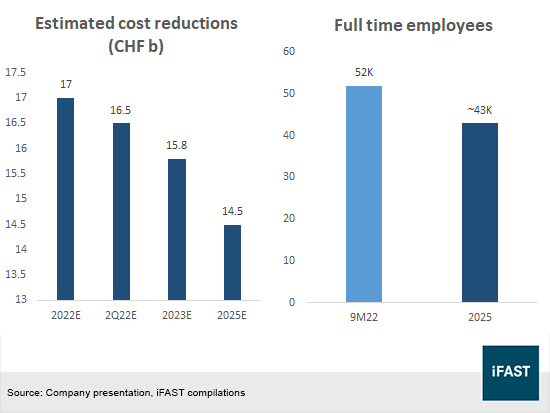
Lastly, CS plans to reduce cost by winding-down unprofitable businesses, simplifying its businesses, reducing manpower cost and third-party cost. By 2025, CS hopes to reduce cost by 15% to CHF 14.5b (2022 guidance: CHF 17b). Cost reduction have already been underway in 2H22. CS is in the midst of cutting 5% (equivalent to 2,700 full time employees) of its headcount, reducing 50% on consultancy spend, reducing 30% in contractor spend and ~CHF 200m savings from technology and operations exits. CS expects cost savings to offset the cost required in its restructuring. CS estimates cost savings of CHF ~2.5b by 2025 to offset ~CHF 2.9b of restructuring costs.
Chart 1: Cost reductions from 2022 - 2025
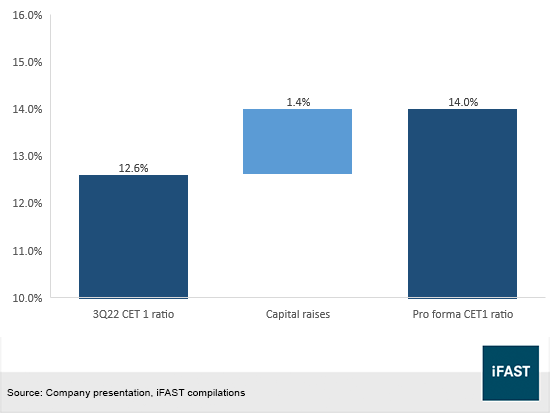
Additionally, CS also proposed to raise CHF 4b through a rights issue. CHF 1.5b of which had been committed by the Saudi National Bank and will hold 9.9% stake in CS when completed. The equity raising will inject capital into CS, resulting in approximately 140 basis points increase to CET1 ratio. CS estimates CET1 ratio to be ~14% on a pro forma basis. The rights issue is subject to approval at the forthcoming Extraordinary General Meeting scheduled to be on 23 Nov 23.
Chart 2: CET1 ratio to improve to 14% following capital raises
Overall, the strategic review announced by CS is complex. This may lead to execution risks as exits may not be favourable to CS. The downsizing of its IB division as well as additional litigation costs from CS’ various litigation cases may incur additional unexpected costs that may hamper CS’ turnaround. However, we feel a large and radical restructuring is needed to push CS in the right direction and send confidence in the markets and to its investors. In terms of CS’ solvency, we do not expect CET 1 ratio to fall close to dangerous levels (i.e. close to regulatory requirements or trigger level for AT1 write-down). The capital raising will inject CHF 4b of capital and expected to boost CET1 ratio to ~14%. Cost reductions will offset restructuring costs, barring any unforeseen additional cost which will help to mitigate net losses from the restructuring. If executed successfully, CS will have a capital light model concentrated in the less volatile WM, AM and SB segments. The shift from IB to WM will allow CS to be capital-light and ensure stable revenues. The shift to WM, AM and SB will result in ~55% of revenues deriving from net interest and recurring income.
Credit profile
In 3Q22, CS reported CET 1 ratio of 12.6%, which was a decrease from 13.5% in 2Q22. The bank still maintains ~240 bps above regulatory requirements. The bank maintains CHF 15.2b of CET1 buffer over the 7.0% trigger for write-down / conversion and CHF 20.7b buffer over the 5.0% write-down trigger.
Liquidity coverage ratio (“LCR”) for 3Q22 was 192% while net stable funding ratio was 136%, above regulatory requirements of 100% for both. One point to note was that from 1 Oct to 25 Oct, daily LCR was 154%. This was due to the negative rumours surrounding CS in the first two weeks of October. Looking at CS funding sources, 52% of CS’ funding is from customer deposits while 30% is from long-term debt and equity and 18% from other liabilities such as short-term borrowings and commercial papers.
In order to mitigate the liquidity outflows, CS would need to access the public and private markets and execution of its strategic plan will generate liquidity and reduce funding requirements. CS can also access central bank funding sources if needed. One point to note is that from 22 November 2022 onwards, targeted longer-term refinancing operations (“TLTRO”) from the ECB will be indexed to the applicable key ECB interest rates. This would mean funding sources from ECB would be relatively more expensive going forward for banks in the Eurozone.
We find CS credit profile to be decent with adequate buffers over regulatory requirements and AT1 trigger levels. Its liquidity outflows are somewhat concerning but we should see liquidity stabilise from the execution of its strategic plan.
Recommendation
We maintain our ‘buy’ rating on the CS 5.625% Perpetual Corp (SGD) with a cautious outlook. The CS 5.625% Perpetual Corp (SGD) as of 4 Nov 2022 has an indicative yield to next call of 24.57% with around 1.59 years to its call date on 06 June 2024. If not called, the perp will reset at the 5-year SGD Swap Offer Rate + initial spread of 3.767%. At an ask price of 76.38, the perp has a current yield of 7.36%.
We may review our rating if client outflows continues to decrease in the next few quarters which would lead to the weakening of its WM, AM and SB divisions. Details on the transfer of SPG and the spin-off of CSFB have not yet been revealed by the bank. The failure to execute the exit of these assets may also lead us to reconsider the rating.
We think the restructuring plan presented by CS is large and complex but it addresses most of the issues that led to the position of CS today. A radical restructuring is needed to push CS in the right direction. Revenues from its IB division had been volatile and carries too much risk for the amount of capital. A capital-light model with a focus on WM will allow the bank to have more stable revenues moving forward which would make its model akin to its Swiss counterpart, UBS. The radical downsizing of its IB division may lead to execution risks and the continued negative AuM outflows may weaken the position of its WM and AM divisions. In the near term, we do not expect net income from CS to turnaround as restructuring costs will impact its profits. In the long term, the successful restructuring will allow CS to be capital-light and generate stable revenues from its businesses.
Table 1: Relative valuation of comparable SGD AT1 bonds
|
Bond Name |
Issuer |
First Call Date |
Years to First Call date |
Ask price |
Yield to Next Call (%) |
|
UBS 5.875% Perpetual Corp (SGD) |
UBS Group AG |
28 Nov 2023 |
1.07 |
98.38 |
7.47 |
|
SOCGEN 6.125% Perpetual Corp (SGD) |
Societe Generale SA |
16 Apr 2024 |
1.45 |
93.43 |
11.19 |
|
CS 5.625% Perpetual Corp (SGD) |
Credit Suisse Group AG |
06 Jun 2024 |
1.59 |
76.38 |
24.57 |
|
UBS 4.850% Perpetual Corp (SGD) |
UBS Group AG |
04 Sep 2024 |
1.83 |
95.89 |
7.31 |
|
Source: Bloomberg Finance L.P., iFAST compilations. Data as of 4 Nov 2022. |
|||||
Declaration: For specific disclosure, at the time of publication of this report, IFPL (via its connected and associated entities) holds a position in CS 5.625% Perpetual Corp (SGD) and UBS 5.875% Perpetual Corp (SGD) and the analyst who produced this report holds a NIL position in the abovementioned securities.
Our podcast series, Yield Hunters, is available on Spotify, iTunes Podcasts and Google Podcasts. We share our thoughts on new bond issues and hold discussions on the fixed income space. Listen to our latest episode below and follow us!