- Pivot into longer-stay lodging along with recovery in travel demand allowed for a strong recovery
- It has a stable liquidity position coupled with a good credit profile
- Travel demands are likely to recover further in 2023
- We are positive on the longer-dated ARTSP 5.000% 18May2026 Corp (SGD) and ARTSP 3.630% 20Apr2027 Corp (SGD) for their yield pick up over SGS of similar maturity
- Perps have a chance to be called but investors ought to consider the extension risk
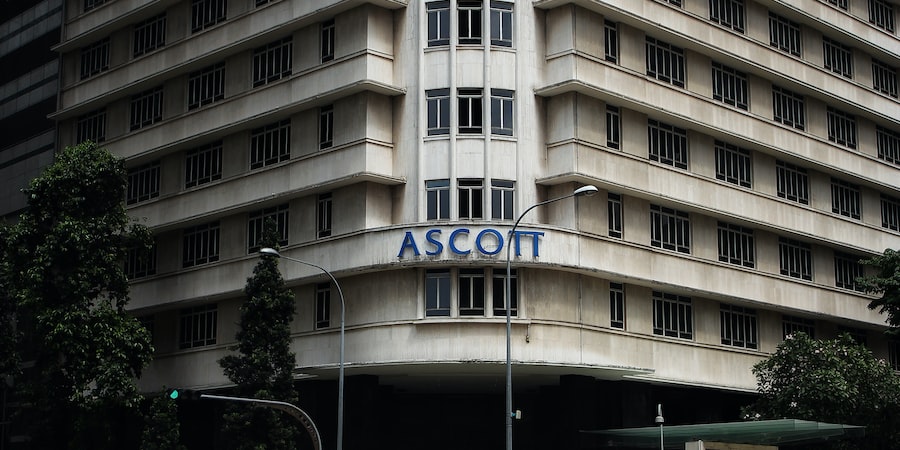
From Ascott Residence Trust to CapitaLand Ascott Trust
After a renaming exercise from Ascott Residence Trust, CapitaLand Ascott Trust (“ARTSP”) has seen itself expanding rapidly amidst the resurgence of travel demand in 2022. With COVID-19 slowly taking a backtrack in our daily lives, travel has partially returned to the old days of pre-pandemic tourism levels.
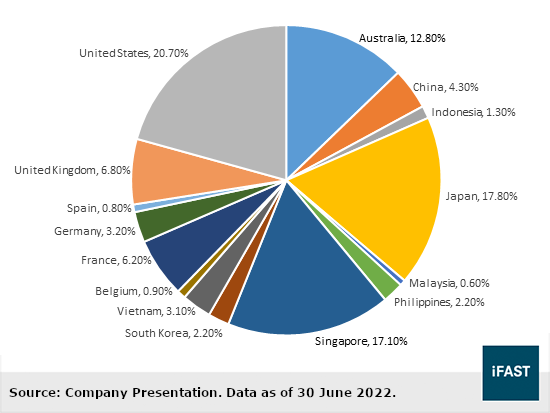
ARTSP is currently the largest lodging trust in Asia Pacific, with a total holding of approximately SGD 7.6b as of 30 June 2022. Spanning 44 cities in 15 countries, it holds a total of 95 properties. The bulk of the properties is in Asia Pacific region at 61.4%, with relatively substantial positions in the USA at 20.7% and Europe at 17.9%.
Chart 1
Portfolio allocation by geographical locations
Since the inclusion of student accommodations into the investment mandate in 2021, ARTSP has been rapidly increasing the student accommodations portfolio – with 6 properties acquired in 2021, 2 acquired in 2022, and 1 more in development. In 2021, it reflected a large focus on the long-stay lodging portfolio, with only 39% of the portfolio into short stays of 1 week or less. Of the 95 properties currently, the bulk of it is 54 serviced residences, 18 hotels/business hotels, 14 rental housing properties and 9 student accommodations.
The pivot into longer-stay lodging has proved to be beneficial for ARTSP so far, providing greater stability and confidence in their revenue. ARTSP targets to further increase the proportion of longer-stay lodging to 25~30% in the medium term, which had grown from the 5% in 2020 to 16% in 2021.
Financial Highlights
From its third quarter business update (“3Q22”), the portfolio RevPAU grew to SGD 132, an 88% increase year-on-year (“YoY”) from 3Q21 and at 87% of the pre-pandemic 3Q19 pro forma portfolio RevPAU. The total gross profit in 3Q22 had recovered to about 90% of the pre-pandemic pro forma levels, where properties in China and Singapore contributed most to the quarter-on-quarter (“QoQ”) growth, while performance by properties in Australia and USA continued to remain high, close to the pre-pandemic period.
As of the first half of 2022 (“1H22”), revenue grew significantly by 45% to SGD 267m, from SGD 185 in 1H21. However, there had been a substantial loss attributed to foreign exchange, which had been unavoidable due to ARTSP’s highly diversified portfolio. Foreign exchange saw a loss of SGD 6.2m in 1H22, as opposed to the SGD 13.6m gain in 1H21. Consequentially, arising from the fluctuations of foreign exchange observed in 2022, a net decrease was observed in the investment properties to SGD 6,291m from SGD 6,297m in 1H21, in which the translation difference contributed a decrease of SGD 192m to the investment properties.
All things considered, the highly diversified portfolio was likely the driver for the strong recovery. The shift into longer-stay lodging had provided greater stability and confidence in their baseline revenue – a critical and necessary pivot amidst the volatile hospitality outlook arising from the pandemic. On the other hand, their substantial growth income portfolio into the serviced residences and hotels enabled them to take advantage of the recovery in travel demand as seen in 2022. With further travel demand growth ahead in 2023, it is likely for ARTSP to have further room to grow from here, albeit with the impending global economic slowdown.
Liquidity and Credit Profile
As of 30 September 2022, ARTSP has cash and cash equivalent of an estimated SGD 375m. Additionally, their credit facility of SGD 820m allows for SGD 1.2b total available funds to tap onto. Gearing has improved as a result of the acquisition funded by the issuance of units – to 35.8% as of 30 September 2022, down from the previous 37.5% as of 30 June 2022. On the other hand, with profits recovering, interest cover similarly improved to 4.3 times as of 30 September 2022, rising from 3.9 times as of 30 June 2022.
ARTSP has been known to tap into both debt and equity as their source of funding, which in 2022 it has seen several rounds of issuance of debt alongside raising of capital through the issuance of units. ARTSP 3.630% 20Apr2027 Corp (SGD) was issued earlier as part of the sustainability-linked notes, which required at least 50% of the total gross floor area of the portfolio be awarded or certified with green build standards; and ARTSP 5.000% 18May2026 Corp (SGD) was issued to refinance the matured ARTSP 5.000% 18May2026 Corp (SGD). On the other hand, ARTSP raised SGD 170m through the private placement of its units, primarily intended for the acquisition of several properties valued at a total of SGD 318.3m.
Chart 2
Debt Maturity Profile
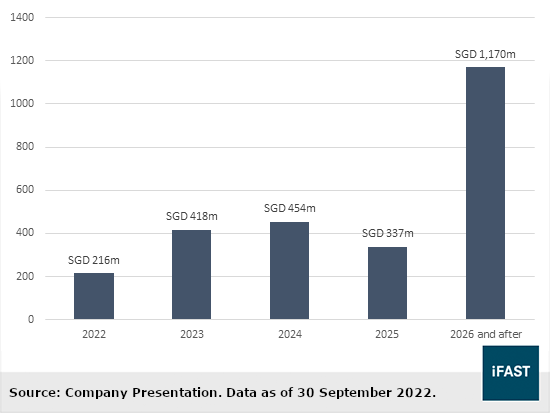
With a total outstanding debt of SGD 2595m, approximately 70% are bank loans and interest rates on 76% of the debt are fixed. With an estimated 24.4% of the debt set to be refinanced by 2023, ARTSP’s effective borrowing cost might be impacted as a result of the rise in interest rates, which is currently at an estimated 1.7% as of 30 September 2022.
Given an interest coverage ratio well above the required 2.5 times for the 50% gearing ratio limit, ARTSP has an estimated headroom of approximately SGD 2.0b. Considering their mandate to further expand into longer-stay lodging in the medium term, ARTSP has more than sufficient means, whether through borrowings or unit issuance, to acquire more properties should the opportunities arise. Although increasing their borrowings amidst this high financing cost period would likely further increase their cost of borrowing, alongside the impending refinancing required, ARTSP’s ability to repay debt is likely to remain stable given the strong liquidity profile.
Travel demand taking flight
ARTSP’s strong recovery had been an indicator that travel had recovered to a substantial extent. Moving ahead to 2023, most still expect a further recovery in tourism across the globe. In a report by Economist Intelligence (“EIU”), it highlighted that global tourism arrivals had grown by 60% in 2022, and expects for it to continue rising in 2023. However, it maintained the position that travel is unlikely to return to pre-pandemic levels.
With China being a key contributor to the global tourism industry, particularly the Asia-Pacific region, the absence of Chinese travellers is likely to delay the full recovery of tourism. Although there has been somewhat of a pivot away from the zero-COVID strategy in China, the borders are expected to remain closed at least until the middle of 2023. Further aggravating the situation is the tight labour market, where tourism-related operations had laid off staff during the pandemic to cut costs. Considering the tourism industry to be a labour-intensive one, the lack of staff coupled with increasing wage pressure may see a delay before the positions are sufficiently filled.
According to World Travel & Tourism Council (“WTTC”), it expects the global tourism sector to return to pre-pandemic levels around the end of 2023, based on the preliminary data in the first half of 2022. The travel & tourism GDP is forecasted to reverse the past years’ position, and for most regions to increase from 2019’s tourism GDP level, only except for Africa.
In the longer term, WTTC sees an average annual growth rate of 5.8% across 2022 to 2032, with the possibility of adding 126 million new jobs across the entire tourism industry. Overall, both reports agree on the continuously growing tourism in 2023, riding on the strong recovery seen in 2022, which should ideally provide for tailwinds in the hospitality sector as well.
ARTSP’s Fixed Dated Notes
Table 1
ARTSP
Fixed Dated Notes
|
Issue |
Years to maturity |
Ask Price |
Yield to Maturity |
|
ARTSP 3.523% 09Nov2023 Corp (SGD) |
0.88 |
99.45 |
4.22% |
|
ARTSP 4.000% 22Mar2024 Corp (SGD) |
1.25 |
99.81 |
4.21% |
|
ARTSP 5.000% 18May2026 Corp (SGD) |
3.40 |
101.58 |
4.55% |
|
ARTSP 3.630% 20Apr2027 Corp (SGD) |
4.33 |
96.07 |
4.70% |
|
Sources: Bondsupermart, iFAST Compilations. Data as of 22 December 2022. |
|||
Compared to its distribution yield over the trailing twelve months of 4.38%, the longer-dated notes slightly edge over its units – despite the likely growth situation arising from the recovering tourism sector, possible yield compression might occur with the increased interest expenses from the upcoming refinancing of debt. With the 6-months and 1-year T-bills yielding 4.26% and 4.13% respectively as of 22 December 2022, investors might want to consider risk-free rates instead over ARTSP’s shorter-dated bonds.
As such, we hold a positive view on ARTSP 5.000% 18May2026 Corp (SGD) and ARTSP 3.630% 20Apr2027 Corp (SGD) – both providing a considerable yield pick up over the Singapore Government Securities of similar maturity. ARTSP 3.630% 20Apr2027 Corp (SGD) would be a better consideration given the current price below par, which the “pull-to-par” effect would allow potential investors to actualise their returns earlier as the interest rates continue to stabilise.
ARTSP’s Perpetual Securities
Table 2
ARTSP Perpetual Securities
|
Issue |
Ask Price |
Current Yield |
Next call date |
Yield to Call |
|
ARTSP 3.070% Perpetual Corp (SGD) |
91.00 |
3.41% |
30 June 2025 |
7.16% |
|
ARTSP 3.880% Perpetual Corp (SGD) |
95.57 |
4.08% |
4 September 2024 |
6.71% |
|
Sources: Bondsupermart, iFAST Compilations. Data as of 22 December 2022. |
||||
However, we must also caution investors who are looking into investing in perpetual bonds as extension risks in perps have risen due to higher interest rates. Across the past 2 years, we have seen 3 out of 6 perps not calling in 2021 and 4 out of 13 perps not calling in 2022. If we look specifically at perps that have the first call date and first reset date on the same date, in 2021, 3 out of 6 perps did not call, while in 2022, 2 out of 9 perps did not call. In these 2 years, we have seen extension risk rising given the economic environment, whereby issuers that did not call mostly experienced a deteriorating credit and liquidity profile in the same period. While there remains a possibility for ARTSP to call on its issue, investors should consider the extension risk and whether in such an event, the perps still have a position in their portfolio upon reset.
Conclusion
ARTSP recovered stronger than expected, exceeding the forecasts set for it at the start of the year. We have confidence that with the diversified portfolio, and capability in expanding its portfolio that improves its balance sheet, ARTSP is likely to, at the very least, sustain if not grow amidst this recovery in tourism albeit the global economic headwinds. The longer-dated issues are highly attractive over the SGD SGS for investors considering a longer period, while investors should remain cautious looking at the perps.
Declaration: For specific disclosure, at the time of publication of this report, IFPL (via its connected and associated entities) holds a position in ARTSP 3.070% Perpetual Corp (SGD), and the analyst who produced this report holds a NIL position in the abovementioned securities.
Our podcast series, Yield Hunters, is available on Spotify, iTunes Podcasts and Google Podcasts. We share our thoughts on new bond issues and hold discussions on the fixed income space. Listen to our latest episode below and follow us!