Key Features
- Cathay Pacific (CX) has shown strong recovery momentum post-pandemic, with passenger business continuing to recover in 2025. Coupled with more effective cost management, the company's operational performance over the past year and a half has been its best ever.
- Leveraging ample operating cash flow and active deleveraging, Cathay Pacific has successfully reduced debt and improved its shareholder structure, leading to a stable and improving credit profile.
- Currently, the net yield to maturity of Cathay Pacific's Hong Kong dollar (HKD) bonds is 3.5%. Given Cathay Pacific's sound financial condition and debt repayment capability, these bonds are suitable for HKD bond investors seeking stable returns.
Cathay Pacific Group (stock code: 293.HK, hereinafter referred to as Cathay Pacific), established in 1946, is a household name in Hong Kong and an internationally renowned air transport brand, as well as a founding member of the Oneworld airline alliance. While most airlines are still struggling on a slow recovery path post-pandemic, and mainland airlines are generally still reporting losses, Cathay Pacific has achieved steady profits for three consecutive years, with accumulated profits fully covering the losses incurred during the pandemic. Earlier, on its 80th anniversary, Cathay Pacific announced its full-year 2025 results, with profits reaching a ten-year high, making it a standout among major global airlines. This article will analyze Cathay Pacific's latest operational and credit performance and explore the investment value of its related bonds.
Cathay Pacific's largest shareholder is the long-established British-owned Swire Group, holding 45.12%, making it the controlling shareholder of the listed company. The second largest shareholder is Air China, holding 29.97%. The two parties have been deeply bound through cross-shareholding for over two decades. This equity tie-up and network synergy form the group's long-term strategic foundation. Cathay Pacific operates with a structure primarily focused on passenger transport, supported by cargo, and supplemented by other businesses. Its operations include the main line Cathay Pacific, low-cost airline HK Express, and the independently operated cargo fleet Air Hong Kong (see Chart 1).
Chart 1: Cathay Pacific Business Segments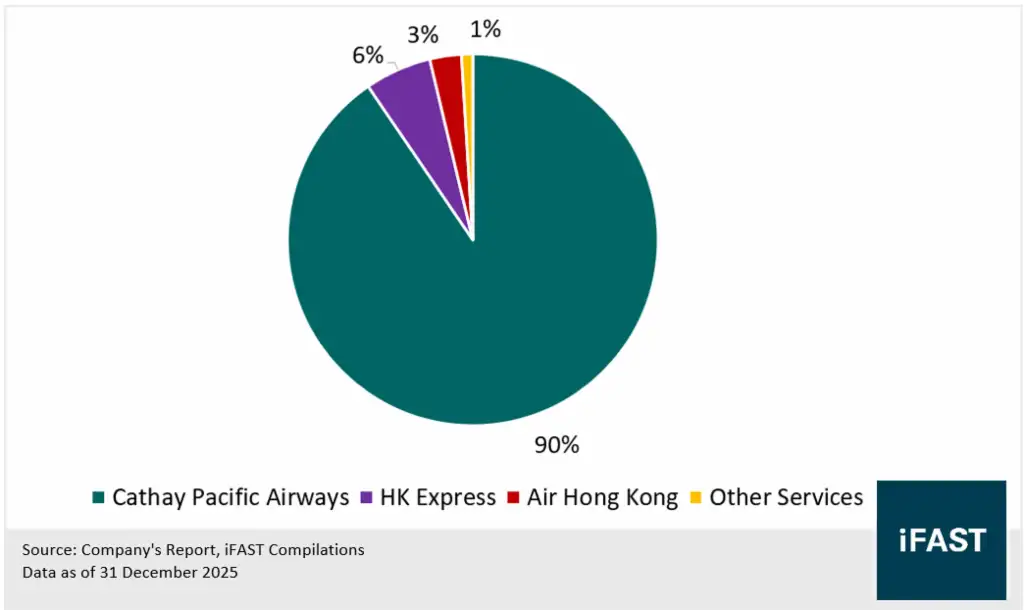
Cathay Pacific's Revenue and Profit Rise Together, Reflecting Capacity Recovery and Pricing Resilience
In 2025, Cathay Pacific's total revenue increased by 11.9% year-on-year to HKD 116.77 billion (same currency hereinafter). Among this, passenger service revenue increased by 15.0% year-on-year to HKD 78.85 billion, surpassing pre-pandemic levels. It is worth noting that this profit includes a one-off income of approximately HKD 880 million related to a settlement with Hong Kong Aircraft Engineering Company Limited (HAECO) aircraft parts management joint venture, listed under other income. However, even excluding this one-off item, Cathay Pacific's core profitability still saw a solid improvement. In 2025, Cathay Pacific's net profit increased by 9.5% year-on-year to HKD 10.83 billion, with a net profit margin of 9.3% (see Chart 2), roughly on par with levels after Hong Kong's tourism recovery. Cathay Pacific's post-pandemic performance has been remarkably strong.
Chart 2: Cathay Pacific Revenue and Net Profit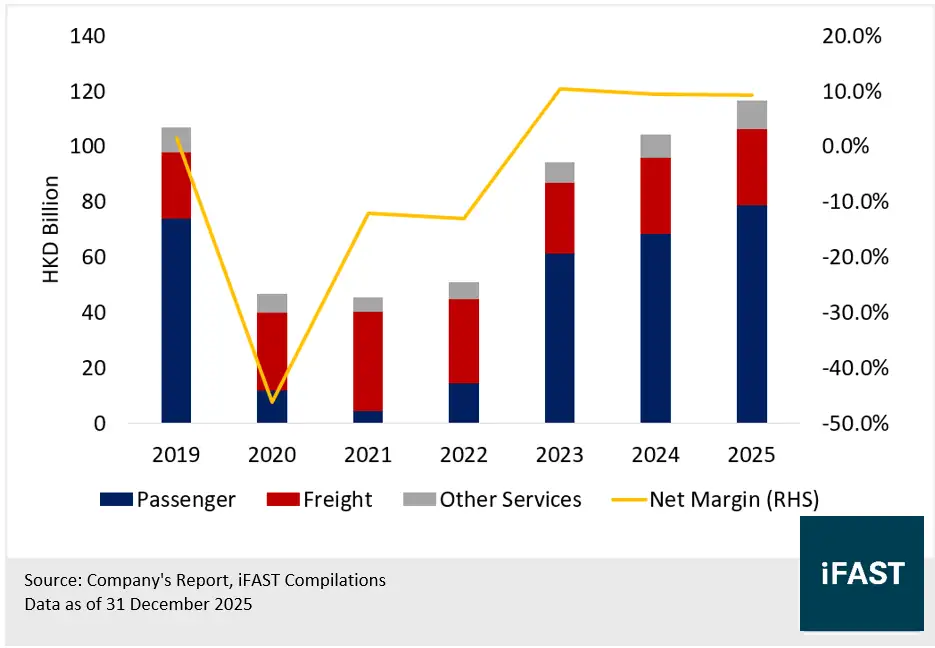
In terms of cargo, the group's full-year cargo volume increased by 9.5% year-on-year to 1.677 million tonnes. Cargo service revenue remained at HKD 27.57 billion, a slight increase of 0.6% year-on-year. In a challenging global trade environment, the independent cargo fleet continues to provide stable profit contributions, effectively hedging against the cyclical fluctuations of the passenger business.
As Cathay Pacific's primary source of revenue is passenger services, the following section will focus on this aspect.
Cathay Pacific's Ideal Load Factor Guarantees Profitability
Cathay Pacific's passenger business continued its strong momentum in 2025. Available Seat Kilometres (ASK) and Revenue Passenger Kilometres (RPK) increased by 26% and 28% year-on-year, respectively (see Chart 3). ASK measures passenger carrying capacity by multiplying the number of available seats by the flight distance, while RPK calculates passenger volume by multiplying the number of paying passengers by the flight distance. Concurrently, the passenger load factor increased by 2.0 percentage points year-on-year to 85.2%, and the number of passengers carried increased by 26.5% to 28.87 million, reflecting the sustained recovery in travel demand. As Cathay Pacific expands to more destinations and resumes routes affected by conflicts in the Middle East, such as Riyadh and Dubai, we anticipate further growth in both ASK and RPK. The passenger business will continue to support the company's revenue performance.
Chart 3: Cathay Pacific Passenger Operations Status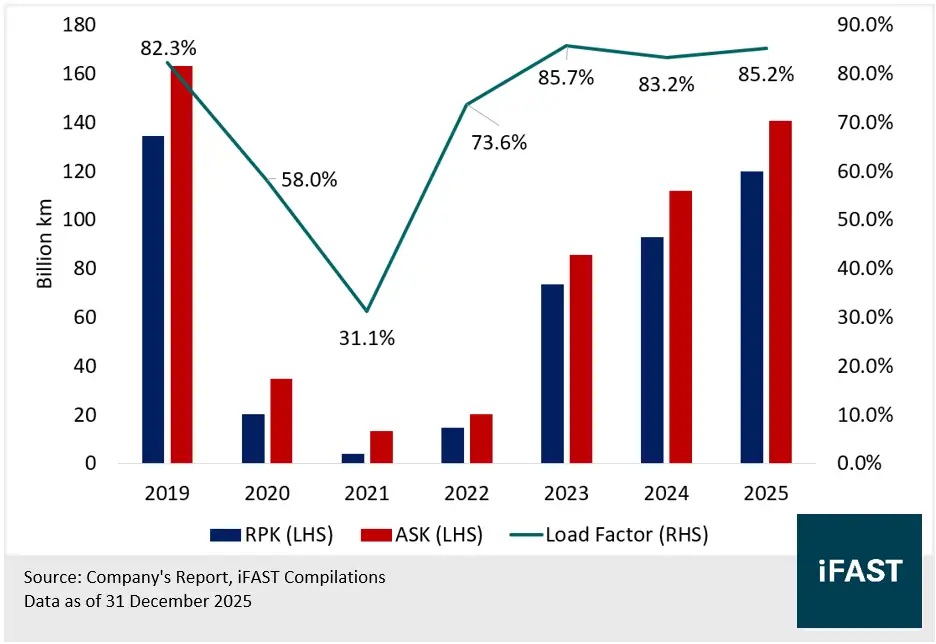
Cathay Pacific Leverages Regional and Long-Haul Routes with Transfer Advantages to Build a High-Coverage Network
The core support for Cathay Pacific's credit lies in its difficult-to-replicate operational moat. Firstly, its strong monopoly in the Hong Kong market. Through acquisitions over the years, including the full acquisition of Dragonair in 2006 and HK Express in 2019, Cathay Pacific has established its dominant position in the Hong Kong market. In 2024, Cathay Pacific and HK Express combined accounted for approximately 64% of passenger traffic at Hong Kong Airport, and their fleet size represented over 80% of local airlines, giving the group superior bargaining power compared to its peers. Compared to single-hub airlines in the Asia-Pacific region, Cathay Pacific's ample hardware facilities support its competitive route network (see Table 1).
Table 1: Comparison of Fleet and Destinations for Single-Hub Airlines in Asia-Pacific
Airline | Number of Narrow-body Aircraft | Number of Wide-body Aircraft | Number of Aircraft Orders | Number of Destinations |
Cathay Pacific including HK Express | 60 | 143 | 97 | 110 |
Hong Kong Airlines | 12 | 19 | 0 | 30 |
Starlux Airlines | 13 | 21 | 32 | 40 |
Malaysia Airlines including Firefly Airlines | 56 | 33 | 67 | 73 |
Singapore Airlines including Scoot | 55 | 155 | 65 | 120 |
Source: Public disclosures by major companies, compiled by iFAST Financial Data as of 27 July 2026 | ||||
Cathay Pacific has recently begun updating its fleet, deploying various aircraft including the short-haul Airbus A321neo narrow-body aircraft (Hong Kong Express also has orders for these), medium-haul Airbus A330neo wide-body aircraft, and intercontinental Boeing 777-9 wide-body aircraft. Simultaneously, it is optimizing its cabin products, with the progressive installation of Aria Premium Economy and Business Class starting from 2024, and the future introduction of Aura Regional Business Class and Alta First Class, enabling it to maintain its competitiveness in international travel.
Secondly, Hong Kong's unique status as a special administrative region (SAR) transit hub. Since 2023, the recovery of long-haul international routes from mainland China has been relatively slow, with travel demand gradually spilling over to the Hong Kong market. Local transit passenger traffic increased by 21% year-on-year to 12.8 million passengers (see Chart 4). Coupled with Hong Kong's role as a bridge connecting China and the rest of the world, Cathay Pacific's share of transit passenger traffic has significantly increased, becoming a key driver for its earnings recovery. Looking ahead, the Hong Kong International Airport Three-runway System, costing over HKD 100 billion, was activated by the end of 2024, significantly increasing the airport's hourly take-off and landing capacity. In 2025, Cathay Pacific's slot allocation achieved a pleasing year-on-year increase of 16.8%, demonstrating that the development of the hub is providing ample support for the group's medium-to-long-term capacity expansion.
Chart 4: Number of Transit Passengers in Hong Kong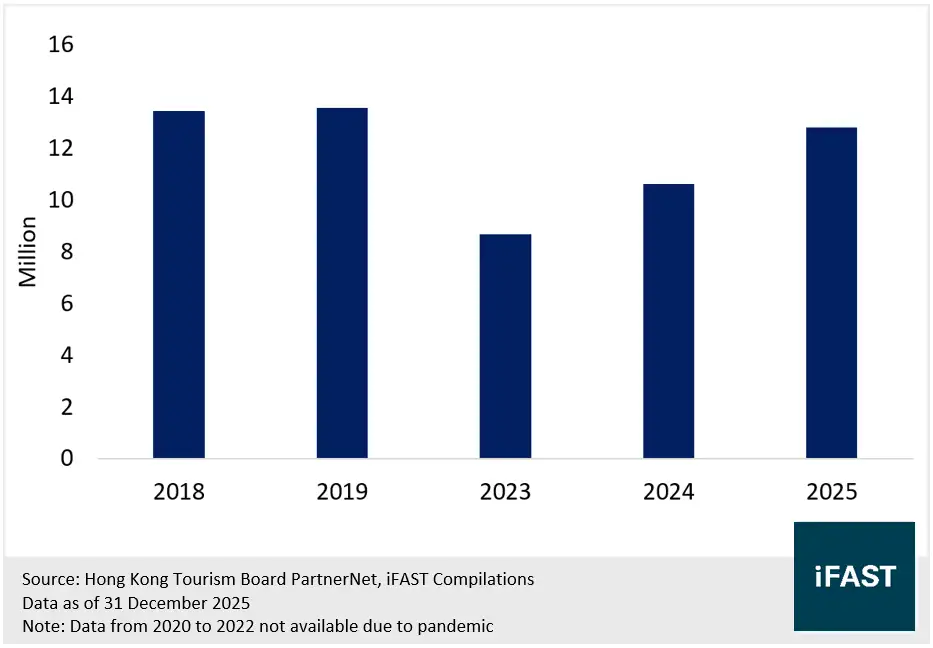
Cathay Pacific's Effective Cost Control Mitigates Geopolitical and Price Risks
Thirdly, business diversification and risk hedging. In addition to traditional passenger transport, the group independently operates 34 wide-body cargo aircraft. Hong Kong Airport is the world's busiest international cargo airport, with a cargo throughput of approximately 5.07 million tonnes in 2025, of which Cathay Pacific accounted for about 35%. Cargo operations provide an important business defense during passenger traffic fluctuations. Although Cathay Pacific recorded a fuel hedging loss of HKD 710 million in 2025 (see Chart 5), it hedges fuel price risks through fuel hedging and announced that the fuel hedging ratio would increase to approximately 35% by the end of 2026, having also locked in some fuel costs at approximately USD 70 per barrel in advance. Given the current situation where conflicts have not yet ended, and oil prices remain volatile in the short term, Cathay Pacific's measures make its earnings stability superior to its peers.
Chart 5: Cathay Pacific's Historical Fuel Hedging Performance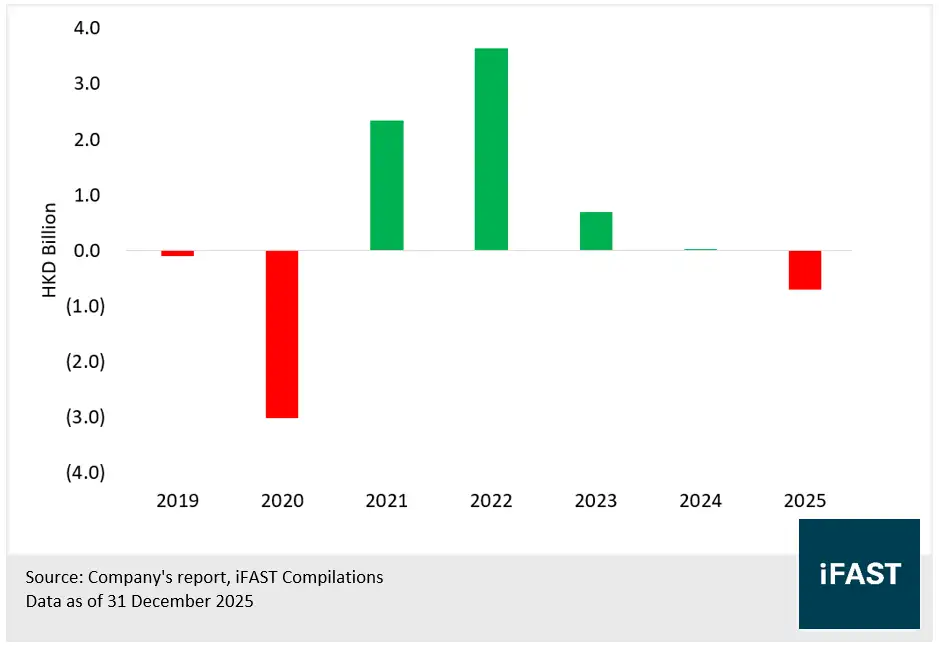
Facing the progressive delivery of nearly a hundred new aircraft and a massive fleet renewal investment plan, Cathay Pacific effectively utilizes sale-and-leaseback arrangements to manage capital expenditure. This means selling new aircraft to lessors after delivery and then leasing them back for operation. This approach, on the one hand, converts large one-off aircraft purchase expenditures into periodic lease payments, preventing capital expenditure from significantly ballooning during peak delivery periods. On the other hand, selling aircraft immediately recovers funds, replenishing the group's liquidity. In fact, approximately HKD 10.46 billion in leases on the group's balance sheet, excluding elements of asset transfer, are related to such arrangements.
Cathay Pacific's Good Credit Quality and Continuous Improvement in Leverage
Cathay Pacific's financial position rapidly recovered in the three years following the pandemic, providing confidence to bond investors. As for cash reserves, as of the end of 2025, the group's cash and cash equivalents increased by 46.8% year-on-year to HKD 7.99 billion. Together with undrawn credit facilities, available unrestricted liquidity increased by 33.4% year-on-year to HKD 25.44 billion.
Concurrently, Cathay Pacific has actively pursued deleveraging. Benefiting from retained earnings and proactive debt repayment, the group's total debt decreased by 13.7% year-on-year to HKD 59.10 billion, and net debt further decreased by 19.2% to HKD 46.81 billion. This led to a significant reduction in the net debt-to-equity ratio from 1.1x in 2024 to 0.8x, and the interest coverage ratio rebounded to 9.9x (see Table 2). For the airline industry, a typical high fixed-cost, high-leverage sector, Cathay Pacific's financial condition can be considered quite robust.
Table 2: Cathay Pacific Credit Metrics
billion HKD | 2023 | 2024 | 2025 |
Cash Reserves | 199.9 | 190.7 | 254.4 |
Net gearing (times) | 0.9 | 1.1 | 0.8 |
Operating Cash Flow | 264.1 | 235.4 | 253.8 |
EBITDA | 275.6 | 264.4 | 265.6 |
Interest Coverage Ratio (times) | 10.1 | 8.7 | 9.9 |
Source: Group Report, Compiled by iFAST Financial Data as of December 31, 2025 *Note: Calculation method is EBITDA divided by net finance costs | |||
In terms of liquidity, net cash inflow from operating activities increased by 7.8% year-on-year to HKD 25.38 billion. This cash flow is sufficient to cover approximately HKD 9.83 billion in net capital expenditure for fleet and equipment, approximately HKD 11 billion in debt repayment, and HKD 4.49 billion in ordinary share dividends paid during the year.
Cathay's sustained profitability over the past three years has also enabled it to complete a series of capital structure strengthening arrangements, including the handling of preference shares, warrants, and convertible bonds, as well as the repurchase and cancellation of Qatar Airways' 9.56% stake for approximately HKD 6.97 billion in February 2026, further optimizing its equity structure. Overall, we believe Cathay's default risk is low, making it noteworthy for Hong Kong dollar (HKD) investors seeking stable returns.
Bond Investment
Cathay's public bonds currently do not have formal ratings from major rating agencies, but considering its financial condition is comparable to unrated blue-chip peers in Hong Kong, its solid market position, and clear deleveraging initiatives, we believe the credit quality of Cathay's bonds is equivalent to a solid investment-grade level.
Our platform currently features a Cathay Hong Kong dollar (HKD) bond with a tenor of 2.8 years (see Table 3). Given Cathay's current favorable operating and credit conditions, as well as its strong relationship with the Hong Kong government, the company has a certain influence on Hong Kong's economic development as an international city. The government would not hesitate to offer assistance to Cathay if necessary, providing it with a financing advantage.
Table 3: Cathay Hong Kong Dollar (HKD) Bonds
Bond | Tenor | Yield to Maturity |
2.8 | 3.8 | |
Source: Bondsupermart Data as of 6 August 2026 | ||
Related Risks
Cathay Pacific faces geopolitical and air traffic rights changes, capital expenditure execution risks, and Hong Kong dollar (HKD) exchange rate fluctuation risks. The Russia-Ukraine and US-Iran conflicts, respectively, force Cathay Pacific to reroute flights, increasing costs and exposing it to oil price risks, which could threaten its operations.
Cathay Pacific has ordered a large number of narrow-body and wide-body aircraft. These aircraft are scheduled for delivery starting in 2027. Although the outstanding payment of over HKD 50 billion can be repaid in installments, it will, to some extent, pose challenges to its cash flow and repayment ability.
Summary
Cathay Pacific Airways has shown strong recovery momentum post-pandemic. With continued recovery in passenger business in 2025 and more effective cost management, the company's operational performance over the past year and a half has been its best ever.
Leveraging ample operating cash flow and active deleveraging, Cathay Pacific has successfully reduced its debt, and its credit profile is steadily improving through an enhanced shareholder structure.
Currently, the net yield to maturity for Cathay Pacific's Hong Kong dollar (HKD) bonds is 3.5%. Given Cathay Pacific's sound financial position and repayment capability, these bonds are suitable for Hong Kong dollar (HKD) bond investors seeking stable returns.
Declaration: For specific disclosure, at the time of publication of this report, IFPL (via its connected and associated entities) and the analyst who produced this report hold NIL positions in the abovementioned securities. This research report was prepared with the assistance of artificial intelligence (AI) tools. iFAST Financial Pte Ltd does not rely exclusively on AI for content generation; the content of this report – including all investment theses, ratings, price targets and conclusions – has been independently reviewed and verified by the research analyst(s) to ensure accuracy and professional integrity.