Highlights:
- The Henan Provincial Government intended to take a stake to rescue Central China. This allows Central China to get extra capital and regain market confidence. Its financing ability is expected to improve significantly.
- The property sales for the first five months were relatively depressed but a notable rebound in sales is expected in the second half year. Although it has average credit profile, its credit risk is lower than its peers. Its asset monetisation plan might relieve its liquidity pressure.
- Central China has a high chance of repaying the August USD bond on time, offering a total return of around 20% within a short investment horizon of only one month. This bond is worth investors’ attention. For more aggressive investors, they might consider the bond due in April 2023 as a “turnaround investment” choice. The bond offers up to 70% in total return for a roughly ten-month investment horizon.
After the Chinese real estate crisis that lasted for half a year, only a few non-stated-owned developers did not default (including actual and technical defaults). Central China, one of the survivors, is still actively arranging the repayment of its USD bond due in August. It has also induced a state-owned enterprise to boost the market confidence whereas some non-stated-owned developers already “lied flat”.
Henan Provincial Government Intended to Take Stakes to Rescue Central China; Its Financing Ability is Expected to Improve Significantly
On 1 June, Central China’s major shareholder, Joy Bright Investments (its ultimate controller is WU Po Sum) intended to sell its 860 million shares (29% issued shares of Central China) to Henan Railway Construction & Investment Group Co., which is owned by the Henan Provincial Government. The sales proceeds of HKD 690 million would be used for providing a shareholder’s loan for Central China.
Meanwhile, Central China also intended to issue at most HKD 710 million worth of two-year convertible bonds to Henan Railway Construction & Investment Group Co., with a coupon rate of 5% and convertible price of up to HKD 1.2 per share. In order words, Central China can get around HKD 1.4 billion liquidity.
As shown in Table 1, WU Po Sum’s stake in Central China will be lowered to 41% but he remains the largest shareholder of Central China. However, if all the convertible bonds are eventually exercised, the Henan Provincial Government will become the largest shareholder of Central China, with a stake in Central China of 41%. WU Po Sum will then step down to be the second largest shareholder.
Table 1: Central China’s Shareholders Structure
Before Sales of Shares | After Sales of Shares | After Sales of Shares + Exercised All Convertible Bonds | |
WU Po Sum | 70% | 41% | 34% |
Henan Provincial Government | 0% | 29% | 41% |
Other shareholders | 30% | 30% | 25% |
Total issued shares (billion) | 2.96 | 2.96 | 3.55 |
Sources: Company’s announcements and reports, iFAST compilations Data as of 1 June 2022 | |||
It allows Central China to get extra capital. More importantly, Central China regains market confidence, especially of homebuyers and borrowers (including banks, financial institutions and bond investors). Not only will this boost property sales performance, but also this will raise funds through issuing bonds and loaning. Its financing ability is expected to be significantly improved.
Depressed Sales in the First Five Months; Expecting Significant Rebound in Second Half Year
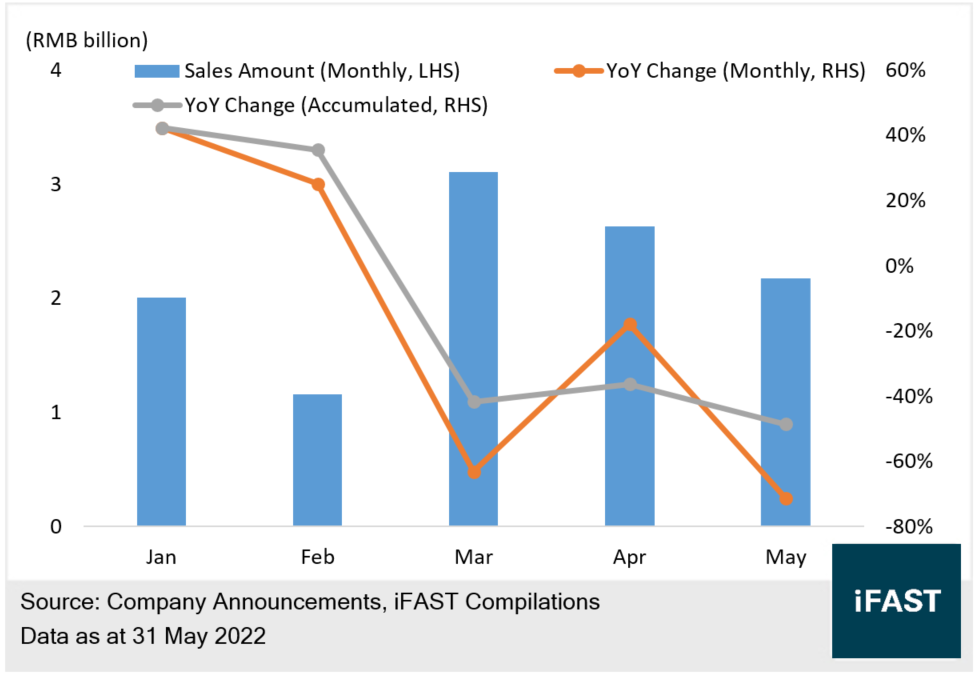
Central China’s property sales was relatively depressed (see Chart 1). Its total contracted sales for the first five months is RMB 11.1 billion, sharply dropped by 49% YoY. The decline rate was close to other peers. The sales were far from reaching the target of RMB 53 billion for the year. Nevertheless, the cash collection from sales rebounded to 89%, which might improve its liquidity. The monthly total contracted sales in May plunged 71% YoY to RMB 2.2 billion due to the COVID pandemic and the related lockdown measures.
However, as the pandemic is getting under control, a wide range of rescue measures are being introduced. For example, reducing the five-year loan prime rate and down payment ratios in a number of cities in Henan Province, increasing housing provident fund loan quotas and provision of housing subsidies, as well as the Henan Provincial Government’s step-in. We believe that the darkest time for property sales is gone and we expect the property sales to significantly rebound in the second half of this year. The company might reach 80% of their sales target (i.e. around RMB 42 billion) by the end of this year.
Chart 1: Central China’s Total Contracted Sales since this year
It is highlighted that as of the end of 2021, Central China’s unrecognised property sales revenues were around RMB 74.1 billion (including around RMB 14.5 billion from JVs and associates). The corresponding gross margin was around 14.8%, similar to that of 2021 (15.2% gross margin). These unrecognised sales will be converted into revenues and gross profits over the next one to three years, which could support the future results.
Fair Credit Profile but Lower Credit Risk than Peers
By the end of 2021, Central China’s total debt was around RMB 21.9 billion, a huge drop of around 42.7% comparing to the end of 2020, showing notable progress in debt reduction. However, its net gearing ratio remained high (94.9%), mainly owing to a significant decrease in its cash on hand and a reduction in total equity caused by the spin-off of its project management business. Its unrestricted cash to short-term debt ratio also dropped to 0.87 times. The short-term liquidity is under pressure. Overall, the credit profile is quite fair.
Table 2: Central China’s Credit Indicators
December 2020 | June 2021 | December 2021 | |
Total Debts (RMB billion) | 31.3 | 28.3 | 21.9 |
Non-restricted Cash (RMB billion) | 22.6 | 10.9 | 5.9 |
Restricted Cash (Including Regulatory Pre-sales Proceeds) (RMB billion) | 6.7 | 5.6 | 3.9 |
Net Gearing Ratio (%) | 14.6% | 92.6% | 94.9% |
Adjusted Liability to Asset Ratio (%) | 85.5% | 87.2% | 86.4% |
Cost of Borrowing (%) | 7.4% | 7.8% | 7.7% |
Cash to Short-term Debt (%) | 1.93 | 1.92 | 1.46 |
Non-restricted Cash to Short-term Debt (%) | 1.48 | 1.28 | 0.87 |
Sources: Company’s reports, iFAST compilations Data as of 30 December 2021 | |||
It is worth mentioning that Central China has better quality in terms of non-restricted cash levels in the statements—it is one of the few developers who classify the regulatory pre-sales proceeds as restricted cash. The company successfully and timely released its audited 2021 results by PwC, who previously resigned from a number of auditor roles of Chinese developers, on March 31 with no “material uncertainty of going concern” opinion in the result, indicating a relatively lower credit risk.
Asset Monetisation Plan might Relieve its Liquidity Pressure
Since the beginning of the year, Central China have been actively engaging in its asset monetisation plan (i.e. different methods to strengthen the asset liquidity), including:
- Cooperating with the Wanda Group: Central China transferred parts of its commercial real estate projects’ operating rights to the Wanda Group. The initial upfront fees was around RMB 700 million. In addition, it can charge the Wanda Group for recurring fees (the actual amount and execution details are still uncertain).
- Proposing to allow the Henan Provincial Government to take a stake in its culture and tourism projects: Partial ownerships of two culture and tourism projects, namely “Jianye Huayi Brothers Movie Town project” and “Unique Henan Land of Dramas”, have been transferred to the Henan Culture Industry Investment Co. (which is entirely owned by the Henan Provincial government).
The progress of this asset monetisation would be the key to its ongoing development. If the asset monetisation plan can be completed within a short-term, Central China’s liquidity pressure will be relieved.
As the details of the asset monetisation plan are still under negotiation, no official announcement from Central China is heard so far. Yet, it is expected that they will formally announce the details on HKEXnews once the plan is finalised. Investors could pay attention to the ongoing development.
A Total Return of 20% within Just One Month Investment Horizon
Central China’s management said their top priority at the moment is to repay the August USD bond on time. The bond issued size is USD 500 million (around RMB 3.35 billion).
With the above-mentioned interference of the Henan Provincial Government, newly issued convertible bond and shareholder's loan, bringing in about RMB 1.2 billion, plus the RMB 0.7 billion to be collected from the transfer of commercial real estate project operating rights to Wanda, Central China only needs another RMB 1.5 billion from internal capitals to repay this bond on time, showing there is a good chance that Central China can repay the August USD bond on time.
The August bond is currently traded at around $83 (Table 3). This is an attractive bond that offers a total return of around 20% within one-month investment horizon. It is worth investors’ attention.
Aggressive investors might consider the bond due in April 2023. It offers a good risk to reward ratio, which is a “turnaround investment” choice. The bond offers a total return of up to 70% for a roughly ten-month investment horizon. Nevertheless, investors have to pay attention that the bond is traded at around $62 level, implying that the market expects a certain credit risk.
Table 3: Central China’s bonds due in August 2022 and April 2023
Bond Name | Years to Maturity | Ask Price (Investor Buys) | YTM | Potential Total Return |
0.12 | 82.5 | 444.0% | 21.4% | |
0.83 | 60.7 | 105.4% | 73.0% | |
Source: Bondsupermart Data as of 24 June 2022 | ||||
Regarding the longer-term bonds, we believe that investors should keep the “wait-and-see” attitude because the industry environment is still weak and the company is unable to refinance by issuing USD bonds. When the significant rebound of the industry’s sales arrives, refinancing channels relaxes and the Central China’s asset monetisation plan completes, investors could reconsider it.
Related Risk
If the Henan Provincial Government does not buy a stake in Central China, or WU Po Sum does not provide a shareholder’s loan to Central China, it might need to make an exchange offer (usually maturity extension) for the USD bond, which would put pressure on bond prices.
Central China’s commercial paper is still one of its greater hidden risks. If there is a large scale of refused repayments of its commercial paper, its turnover in its property sales will be affected.
Central China’s current key financing channel is through issuing USD bonds but it is impossible to refinance right now. If the market confidence is not recovered soon, it might affect the company’s liquidity.
Conclusion
The Henan Provincial Government intended to take a stake to rescue Central China. This allows Central China to get extra capital and regain market confidence. Its financing ability is expected to improve significantly.
The property sales for the first five months were relatively depressed but a notable rebound in sales is expected in the second half year. Although it has average credit profile, its credit risk is lower than its peers. Its asset monetisation plan might relieve its liquidity pressure.
Central China has a high chance of repaying the August USD bond on time, offering a total return of around 20% within a short investment horizon of only one month. This bond is worth investors’ attention. For more aggressive investors, they might consider the bond due in April 2023 as a “turnaround investment” choice. The bond offers up to 70% in total return for a roughly ten-month investment horizon.
Declaration: For specific disclosure, at the time of publication of this report, IFPL (via its connected and associated entities) and the analyst who produced this report hold a NIL position in the abovementioned securities.
Our podcast series, Yield Hunters, is available on Spotify, iTunes Podcasts and Google Podcasts. We share our thoughts on new bond issues and hold discussions on the fixed income space. Listen to our latest episode below and follow us!