Highlights:
- Country Garden’s sales performance has declined. The Group is expected to generate over RMB 400 billion attributable contracted sales this year. The Group’s gross margin is expected to recover due to the acquisition of peers’ projects.
- The credit profile is improving gradually. The Group has proactively disclosed its regulatory pre-sales proceeds amount in the financial statement over the past years, led to a relatively higher transparency in financial statements compared to its peers. Besides, its off-balance-sheet debt indicators are good, with probably lesser contingent liabilities. Its refinancing ability is still better than the peers’.
- The recent bond prices have been volatile, which offers a great investment opportunity for aggressive investors. Investors could also consider holding the Country Garden’s bond until maturity. The bonds due within two years are quite attractive. Their credit risks are under control. These bonds have a yield to maturity ranging from 11.7% to 19.6%.
In China's biggest builder is on Bond Express, we introduced Country Garden’s business and financial situation. The Group recently announced the 2021 annual result and the latest sales situation. Let us analyse its updated credit profile.
A Decline in Recent Sales Performance; the Expected Sales Amount is RMB 400 billion this year
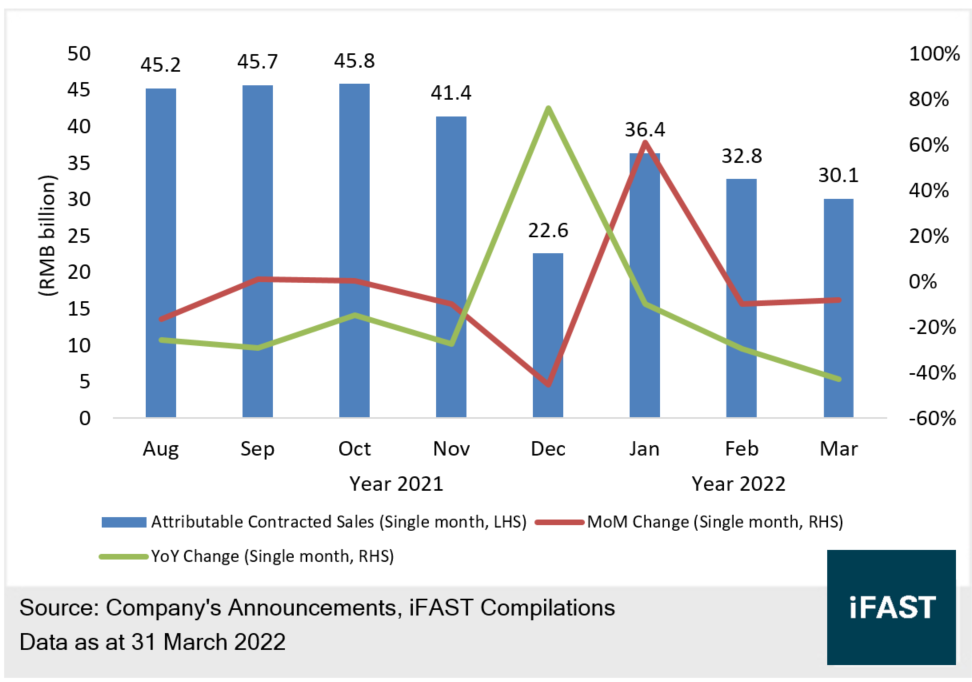
As shown in Chart 1, since the Chinese real estate debt crisis last year, it has been a decline in the Group’s attributable contracted sales. Except for December, the Group recorded an attributable contracted sales of around RMB 30 billion to RMB 45 billion every month last year. The overall YoY decline rate was similar to its peers’. Meanwhile, the Group did not set its sales target this year. The management explained that as the industry situation is still quite volatile, setting a sales scale is no longer the Group’s first priority. They expected that the real estate sales would be open low high close, then gradually stabilised.
Chart 1: The Group’s Sales Performance in Recent Months
Making a conservative estimate, we expect the Group can generate over RMB 400 billion attributable contracted sales this year. The Group put an emphasis on cash collection rate from sales and cash flow management. Its cash collection rates from sales were high at 90% or above for consecutive six years (including 2021). These cash collection from sales would become the key factors to support its liquidity and repayment ability.
The Gross Margin is expected to Improve due to the Acquisition of the Peers’ Projects
Based on the 2021 financial result, the Group’s total revenue was RMB 523.1 billion, increased by 13.0% YoY. Yet, its net profit to shareholders decreased 16.8% YoY to RMB 26.93 billion, mainly due to a decrease in the gross margin from 21.8% in 2020 to 17.7%. Taking reference from other developers with a similar scale, the decline in gross margins is a normal phenomenon in the industry. It is caused by high-cost land obtained from 2017 to 2018, and the poor property sales performance in the second half of 2021. Developers thus need to offer price reductions on some completed projects.
Nonetheless, the Group pointed out that there are more land acquisition opportunities in the current market. Since the fourth quarter of last year, the Group has acquired 35 land bank projects from its peers and the project partners. This alternative way allows the Group to replenish its land bank at a lower cost, which may improve the project’s future gross margin.
As of the end of December 2021, the total attributable saleable resources are around RMB 1,820 billion, including acquired attributable saleable resources of around RMB 1,480 billion and potential saleable resources of around RMB 340 billion. According to the estimation based on the 2021 contracted sales and the land bank, the Group’s land bank to sales ratio is 3.8 times (by area), which could sufficiently support its future development for three to four years.
With the Credit Profile Improving Gradually, its Relatively High Transparency in Financial Statements helps Gain Market Confidence
As of the end of December 2021, the Group’s net gearing ratio decreased further to 45.4%, and its adjusted liability to asset ratio was also improved to 75.7% (see Table 1). The credit profile is improving gradually. The management expressed that the Group will be upgraded from “yellow light” to “green light” under the Three Red Lines requirements by the end of June 2023. This implies that the Group’s adjusted liability to asset ratio would decrease further to below 70%.
Table 1: Country Garden’s Credit Indicators
|
2021 |
2021 1H |
2020 |
Three Red Lines Requirement |
|
|
Adjusted Liability to Asset Ratio (%) |
75.7% |
78.5% |
80.5% |
< 70% |
|
Net Gearing Ratio (%) |
45.4% |
50.0% |
55.8% |
< 100% |
|
Cash To Short-term Debt (times) |
2.49 |
2.14 |
1.90 |
> 1.0 times |
|
Adjusted Cash to Short-term Debt (times)* |
1.26 |
1.25 |
1.20 |
/ |
|
Total Debt (RMB billion) |
317.9 |
334.4 |
347.2 |
/ |
|
Total Cash (RMB billion) |
181.3 |
186.2 |
183.6 |
/ |
|
Cost of Borrowing (%) |
5.2% |
5.4% |
5.6% |
/ |
|
Short-term Debt to Total Debt (%) |
24.9% |
26.8% |
29.5% |
/ |
|
*Excluded restricted cash and regulatory pre-sales proceeds Sources: Company’s reports, Bloomberg Finance L.P, iFAST compilations Data as at 31 December 2021 |
||||
Under the current situation, the market might suspect whether the developer’s cash on book could be used for repaying debts or not, because many developers cannot use their cash on hand due to the regulatory pre-sales proceeds requirement. However, the Group proactively disclosed its regulatory pre-sales proceeds amount in the financial statement over the past few years. The Group’s financial statement has a better transparency compared to the peers’ and thus gains the market confidence.
As shown in Table 1, the Group’s adjusted cash to short-term debt was 1.26 times, reflecting its good short-term liquidity. The Group has actively lowered its cost of borrowing and optimised the debt structuring. The cost of borrowing gradually dropped to 5.2%. The short-term debt to total debt was also declined. The Group was able to get a better interest rate and longer tenor from the repayment period during refinancing. This reflected its outstanding refinancing ability.
Additionally, according to the Group’s disclosure, it had an equity portfolio up to RMB 20 billion, where the majority is private equity. Only 18% of the portfolio (in terms of investment project amounts) was successfully listed. Even though the liquidity of these assets might not be too high, the equity value has certain upside potential, not to mention to have better liquidity after listing. The industries of these private equities are mostly uncorrelated to the real estate industry. We believe these could, to certain extent, support the Group’s liquidity and repayment ability.
The Group’s Off-balanced Sheet Debt Indicators are Good, probably with Few Contingent Liabilities
Another advantage of the Group is that its off-balance-sheet debt indicators are still good. The off-balanced sheet debt risk is relatively low. As shown in Table 2, these indicators (the low single digit of the difference between consolidated ratios, a higher contracted liabilities to attributable contracted sales and a positive return on JVs and associates) show that the Group should have few off-balance-sheet projects and debts. The overall situation was close to that in the first half of 2021.
Table 2: Country Garden’s Key Off-balanced Sheet Debt Indicators
|
2021 |
2021 1H |
|
|
Difference between Consolidated Ratios |
3% |
4% |
|
Contracted Liabilities / Attributable Contracted Sales |
141% |
84%^ |
|
Return on JVs and Associates |
7.4% |
11.0% |
|
Minority Interests / Total Equity |
34% |
34% |
|
^Attributable contracted sales in the first half * 2 Sources: Company’s reports, CRIC, iFAST compilations Data as at 31 December 2021 |
||
It is highlighted that some developers missed a deadline (on or before 31 March) to report their annual results, some developers also only announced their unaudited annual results. As a result, the market raised concerns about the authenticity of the financial figures (especially for the cash level and debt amounts). However, Country Garden successfully reported the audited financial result on 30 March (The auditor, PwC, which quit its auditing roles at some property developers, still continued to be the auditor for Country Garden). This means the Group has a relatively better corporate governance, and the financial data tends to show the fact. Meanwhile, there should be also lesser contingent liabilities.
The Group’s Refinancing Ability Weakened but still Better than its Peers
Under the Chinese real estate debt crisis, most non-SOE-backed developers are unable to refinance through bond issuances. Even quite a lot developers have mentioned that refinancing bank loans is more difficult than before, which made their liquidity even tighter.
We believe that Country Garden was also affected by this debt crisis, resulting in a weaker refinancing ability compared to its past. For example, the HKD 3.9 billion convertible bond issued in 2022 has a coupon rate of 4.95%, which is higher than 2.7% to 3.3%, the coupon rate of issuing offshore bond in the last year. In order to successfully issue this bond, the Group also added a clause about being convertible to shares. This showed an increasing difficulty in the Group’s refinancing.
Nevertheless, under such a difficult period for non-SOE-backed developers’ financing (since October last year), the Group is still actively exploring new financing channels. The Group successfully issued an RMB 1 billion onshore bond and the above-mentioned HKD 3.9 billion convertible bond, and also raised RMB 1.53 billion funds via the issuance of asset-backed security products. Furthermore, in March, China’s National Association of Financial Market Institutional Investors (NAFMII) approved the Group to issue medium-term note of up to RMB 5 billion. After that, the Group entered into a strategic cooperation agreement in relation to the merger and acquisition with China Merchants Bank and Agricultural Bank of China, secured a loan facility of RMB 15 billion and RMB 40 billion respectively. Hence, the regulatory authorities, banks and the capital market have a greater confidence in the Group’s credit profile, showing that its refinancing ability is better than its peers’.
Recent Bond Prices have been Volatile, which offers a Great Opportunity for Aggressive Investors
Currently, Country Garden’s bond rating remains BB+ / BBB- (S&P / Fitch), which is on the threshold of investment grade. It was also one of the few non-SOE-backed developers whose ratings have not been downgraded, showing that rating agencies have a greater confidence in the Group’s credit status.
To summarize, Country Garden has a resilient fundamental. The off-balance-sheet debt risk remains under control. The refinancing ability is relatively higher. In addition to the successive introduction of incoming relaxation policies related to the Chinese real estate industry, we believe the credit risks of the Group’s short- and medium-term bonds is under control.
However, the bond prices have been volatile. For example, the Group’s Apr 2024 bond (see Chart 2) declined to the USD 50 level in mid-March, but significantly rebounded to around the USD 90 level within two weeks. It shows the market’s weak confidence in Chinese real estate bonds. The bond prices are easily affected by some rumours or news related to real estate policies or the industry peers.
Chart 2: COGARD 6.500% 08APR2024 CORP (USD) Past Half Year Prices

We believe that the volatile market offers a great opportunity for aggressive investors. Investors could buy the dips in high-quality bonds when the bad news spread. Country Garden’s credit quality is much higher than other non-SOE-backed developers, so it is worth considering.
Besides, investors could also consider holding the Country Garden’s bond until maturity, and ignore the price fluctuation during the period. The bonds due within two years are quite attractive (see Table 3), with a yield to maturity ranging from 11.7% to 19.6%.
Table 3: Country Garden USD bonds due within two years
|
Bond Name |
Years to Maturity |
Indicative Ask Price (Investor Buys) |
Yield to Maturity |
|
COGARD 4.750% 25JUL2022 CORP (USD) |
0.3 |
98.2 |
11.7% |
|
COGARD 4.750% 17JAN2023 CORP (USD) |
0.8 |
93.1 |
15.0% |
|
COGARD 8.000% 27JAN2024 CORP (USD) |
1.8 |
85.2 |
19.6% |
|
(Bond Express Member)
|
2.0 |
82.0 |
17.7% |
|
Source: Bondsupermart Data as at 14 April 2022 |
|||
We have introduced the bond due in 2024, COGARD 6.500% 08APR2024 CORP (USD), to Bond Express for investors to enter at a lower cost.
Related Risk
The Group’s contracted sales have declined to a certain extent. If the situation continues or even worsens, it will put pressure on the company’s cash flow.
Although only 50% of the group’s cash is currently used as regulatory pre-sales proceeds and restricted cash, and the remaining part of the cash could be freely available for use, the Group might still face the liquidity risk related to the cash trapped at the project level. It could not transmit these cash for repaying the debts.
Taking the case of Logan Group and Zhenro Properties as references, their loan quotas could be tightened within two months, and trigger a domino effect. While Country Garden still has a broad range of financing sources, if there is negative news about the Group that affects the lender’s desire and confidence to finance Country Garden, its financing channels could be tightened immediately. Thus, it would increase the Group’s liquidity risk.
Conclusion
Country Garden’s sales performance has declined. The Group is expected to generate over RMB 400 billion attributable contracted sales this year. The Group’s gross margin is expected to recover due to the acquisition of peers’ projects.
The credit profile is improving gradually. The Group has proactively disclosed its regulatory pre-sales proceeds amount in the financial statement over the past years, led to a relatively higher transparency in financial statements compared to its peers. Besides, its off-balance-sheet debt indicators are good, with probably lesser contingent liabilities. Its refinancing ability is still better than the peers’.
The recent bond prices have been
volatile, which offers a great investment opportunity for aggressive investors.
Investors could also consider holding the Country Garden’s bond
until maturity. The bonds due within two years are quite attractive. Their
credit risks are under control. These bonds have a yield to maturity
ranging from 11.7% to 19.6%.
Declaration: For specific disclosure, at the time of publication of this report, IFPL (via its connected and associated entities) holds positions in COGARD 6.500% 08Apr2024 Corp (USD), and the analyst who produced this report holds a NIL position in the abovementioned securities.