- SGD AT1 perps from local banks observed smaller changes to their spreads as compared to the foreign banks
- DBS, OCBC and UOB had a record year in 2022, while CS continued to be marred by poor performance
- CS experienced a severe loss in confidence, while confidence in local banks is likely higher than ever
- Prices on the SGD AT1 perps from the local banks do not justify the risk on AT1 bonds
- We recommend investment-grade SGD T2 issuances instead
Bonds from the local banks were less affected
Movement in the prices of AT1 perps from DBS, OCBC and UOB saw minimal changes if any, which comes across as a jarring difference against the AT1 perps from the foreign banks moving drastically right after the Credit Suisse (“CS”) AT1 write-down. From Table 1, we can see that change in the spread for SGD AT1s was much wider for issuances from foreign banks as compared to the issuances from the three local banks.
Table 1
Average change in spread over one-month
period for SGD AT1 issuers
|
Issuer |
No. of SGD AT1 Issuances |
1-month change in spread(bps) |
|
Oversea-Chinese Banking Corp Ltd |
3 |
71.6 |
|
United Overseas Bank Ltd |
5 |
94.0 |
|
DBS Group Holdings Ltd |
1 |
151.6 |
|
BNP Paribas SA |
1 |
294.8 |
|
Barclays PLC |
2 |
368.1 |
|
Standard Chartered PLC |
1 |
625.8 |
|
UBS Group AG |
2 |
805.2 |
|
Societe Generale SA |
2 |
954.5 |
|
Sources:
Bloomberg Finance L.P., iFAST Compilations. |
||
It might seem surprising – especially with MAS attempting to calm the situation then with four consecutive media notices (MAS' Statement on Additional Tier 1 Instruments Issued by Singapore Banks, MAS' Response to Queries on Credit Suisse, Credit Suisse Continues Operating Without Interruption in Singapore and Singapore's Banking System Remains Sound and Resilient). In reality, it probably is much less of a surprise than one would think. The stability observed in the SGD AT1 perps from the local banks can largely be attributed to the banks’ stellar showing in 2022, a stark contrast to Credit Suisse. We see increased investors’ confidence in the three banks, resulting in smaller price movements despite the AT1 bonds write-down affecting the whole market.
‘Record’, ‘record’ and ‘record’
In the year 2022 marked by a surge in inflation and interest rates, DBS saw its “full-year net profit rises 20% to record SGD 8.19b”, while OCBC has its “full year 2022 net profit rose 18% to a record SGD 5.75b” and lastly, UOB had its “FY22 core net profit up 18% to a record SGD 4.8b”. More than just a surge in interest rates, 2022 was a year marked by records for the local banks.
For the year ended 31 December 2022 (“FY22”), the trends were mostly similar across the banks – with net interest margin soaring for the banks and all three saw their net interest income rising considerably. Net interest income rose by 40% for DBS in FY22, 31% for OCBC and 53% for UOB. Similarly, due to the general downturn in the markets, all the banks saw drops in net fee and commission income due to lesser wealth management fees, and also a drop in other income.
Chart 1
Revenues across the local banks in FY21
and FY22 (SGD m)
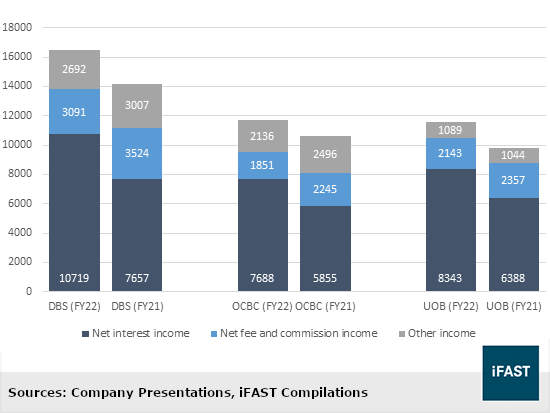
Between CS and the local banks, a key difference is that commissions and fees have been the significant contributor to income for CS. The proportion of commissions and fees among the net revenue by CS had been 52.9% in FY20, 58.0% in FY21 and 59.3% in FY22. The situation is reversed for the local banks, which have had their net interest income being more than 50% contribution of their total income, and all the banks had >60% contribution from net interest income in FY22.
With most of the profitability limited by its commissions and fees, and being plagued by scandals over the years, CS had been loss-making since 2021 – and even more so in 2022 as the market sentiments unwound from the rising interest rates. Return on tangible equity was at negative 17.4% for CS in FY22.
In contrast, the local banks faced lesser headwinds despite still having a substantial part of their operations in wealth management. More importantly, they were able to leverage on the elevated interest rates by passing on the funding cost through the floating-rate loans – and as a result, leading to the record profits observed by all three banks. While we are unlikely to continue seeing record profits again with operational costs rising faster than their net interest margins, the current interest rate environment that is expected to stay for a while should continue to allow the local banks to observe strong performances in these recent years.
Can the same happen for the local banks?
Table 2
Balance sheet ratios across the banks
|
DBS |
OCBC |
UOB |
CS |
|
|
Common Equity Tier 1 Ratio |
14.60% |
15.20% |
13.30% |
14.10% |
|
Non-performing Loans Ratio |
1.10% |
1.20% |
1.60% |
1.29% |
|
Customer Deposits |
SGD 527b |
SGD 350b |
SGD 369b |
CHF 233b |
|
Net Stable Funding Ratio |
117% |
117% |
116% |
117% |
|
Liquidity Coverage Ratio |
146% |
152% |
147% |
144% |
|
Sources: Company Presentations, iFAST Compilations. |
||||
A quick look at the ratios on the banks’ assets suggests that there might not be much difference between the local banks and CS. Converting to SGD (at CHF 1.485508 = SGD 1 as of 12 April 2023), even CS’s customer deposit is lower than that of the local banks at approximately SGD 346b. But the same situation is quite unlikely to happen to the local banks.
The case for CS was that it was constantly plagued by negative news alongside poor performances. Recording negative losses with the collapse of Archegos Capital in 2021, followed by a market downturn in 2022, losses were so significant that they had been in the midst of restructuring to de-risk its business model. And the final straw that proved too difficult for them to rebound from: its largest shareholder decided to announce it would not increase its stake in CS even if it required more capital, right after the fall-out of the Silicon Valley Bank.
With shares falling almost 28% from the news alone, followed by massive client fund outflows, the crisis for CS began. The Swiss Financial Market Supervisory Authority (“FINMA”) and Swiss National Bank (“SNB”) initially stepped in with additional liquidity and tried to assure the markets, but FINMA decided to force the merger upon UBS, bypassing its shareholders, in order to protect the confidence of the Swiss Banking Sector.
Asset quality was not the issue for CS, but rather due to poor investors’ confidence and its inability to regain confidence, the excess outflows in client funds led to its forced merger to ensure continued operations. There is no guarantee that the same will not happen to the local banks, though currently, the situation is probably the opposite of CS where confidence in the local banks is higher than ever.
Beyond having their record performances plastered all over the media, overall, we feel that the local banks operate with a different business profile from Credit Suisse. Particularly, the local banks have their primary banking operations concentrated in Singapore. Monetary and financial regulations imposed by MAS are one of the most stringent in the world to provide for a stable financial environment, and the stability proved to be beneficial for the local banks.
SGD AT1 perps from the local banks
Does that mean that it is a good time to buy into SGD AT1 perps from the local banks since they were mostly unaffected? We are skewed towards a ‘no’, as yields on these perps have yet to adjust sufficiently to become attractive – although we do like the local banks for their stability amidst the current economic environment.
The CS AT1 write-down highlighted a key risk likely overlooked by investors since the introduction of such a capital instrument, i.e. the loss absorption feature of AT1 bonds. As previously mentioned in the article “What is the future for Additional Tier 1 bonds?”, we would like to reiterate that AT1 bonds are ultimately capital instruments that banks issue in order to have bondholders absorb losses during an insolvency event. Since the write-down, most AT1 bond spreads widened considerably with more investors starting to account for the “suddenly significant” risk of loss absorption.
Table 3
SGD AT1 Perps from DBS, OCBC and UOB
|
Credit Rating (S&P/ Fitch) |
Ask Price |
Next Call /Reset Date |
Current Yield |
Yield to Call |
Reset Rate |
|
|
N.R/ BBB+ |
99.00 |
12 September 2025 |
4.02% |
4.41% |
Prevailing 7-year Singapore Dollar Swap Offer Rate plus the Initial Spread (1.650%) |
|
|
BBB-/BBB+ |
88.53 |
30 September 2030 |
3.39% |
4.84% |
SGD 10Y Successor Rate + 2.190% |
|
|
BBB-/BBB+ |
97.15 |
8 June 2027 |
3.59% |
4.66% |
5-year SORA-OIS benchmark rate + (1.416%) Initial Spread (No step-up) |
|
|
BBB-/BBB+ |
99.83 |
24 August 2023 |
4.01% |
4.49% |
5YR SGD SOR + Initial Spread (1.811%) |
|
|
BBB-/BBB+ |
103.93 |
19 January 2028 |
5.05% |
4.33% |
5Y SORA-OIS + Initial Spread (2.393%) |
|
|
BBB-/BBB+ |
97.50 |
4 October 2027 |
4.36% |
4.88% |
Prevailing five-year SORA-OIS rate + 1.810% |
|
|
BBB-/BBB+ |
96.76 |
17 July 2026 |
3.70% |
4.66% |
5-year SORA-OIS + Initial Spread (1.470%) |
|
|
BBB-/BBB+ |
93.51 |
15 January 2026 |
2.41% |
4.80% |
Prevailing 7-year SGD Swap Offer Rate + the Initial Spread (1.795%) |
|
|
BBB-/BBB+ |
88.37 |
22 June 2028 |
2.89% |
5.15% |
Prevailing 7-year SORA-OIS benchmark rate + the Initial Spread (1.551%) |
|
|
Sources:
Bloomberg Finance L.P., Bondsupermart, iFAST Compilations. |
||||||
For the SGD AT1 bonds from local banks, the overall returns remain low even after such an adjustment. We believe the risk on the loss absorption feature remains insufficiently priced into the issuances, which might have been due to the confidence investors have in these banks – especially given that these issuances are at investment-grade ratings.
Investors have to consider whether the AT1 bonds are adequately priced against its equity. Between AT1 bonds and equity, it is only during an insolvency event that equity will absorb losses first. But under viability events, brought to the spotlight by the merger of CS where regulators may just direct the bank to write down AT1s, such a clause may ultimately provide no benefits in terms of risk for AT1 bondholders.
Consider investment-grade SGD Tier 2 subordinated bonds
For investors considering alternatives to the SGD AT1 perps, we would like to highlight safe corporate bond recommendations from a previous article. These Tier 2 (“T2”) subordinated bonds are similarly at investment-grade ratings, while at the same time, structural risk on the bonds is much lesser due to lower priority to CET1 and AT1 capital before getting written down.
Table 4
Issuers with strong credit ratings
|
Issues |
Issuer Rating (S&P/ Fitch) |
Bond Rating (S&P/Fitch) |
Ask Price |
Ask Yield to Call/ Maturity |
Years to call/ maturity |
Reset Rate |
|
AA-/AA- |
NR/A |
99.17 |
4.55%/ 4.29% |
0.88/5.88 |
5Y SGD SOR + Initial Spread (1.08%) |
|
|
AA-/A+ |
BBB+/A- |
98.50 |
4.86%/ 4.70% |
4.64/9.65 |
5Y SORA OIS + Spread (1.743%) |
|
|
A/A |
A-/BBB+ |
99.21 |
4.84%/ 4.69% |
4.41/9.41 |
5YR SORA OIS + Initial Spread (1.751%) |
|
|
Sources:
Bloomberg Finance L.P., Bondsupermart, iFAST Compilations. |
||||||
Despite ranking above AT1 bonds, these investment-grade T2 issuances are providing similar yields to the SGD AT1 perps from the local banks. At the same time, these issuances provide a known maturity date and are very likely to get called on their first call date as there is an incentive for the banks to call back on their T2 issuances. T2 issuances that remain uncalled past the first reset date will have to be amortized in the balance sheet of the company, so banks generally would consider to re-issue new T2 securities to ensure capital remains sufficient on their balance sheet.
Once again, we would like to highlight the risk of loss absorption on the AT1 bonds, which the Credit Suisse write-down brought forth closer comparisons of AT1 bonds to equity, rather than being a class on its own. With AT1 bonds repriced closer to reflect its risk, perhaps a good time to purchase SGD AT1 perps from the local banks will come after the market stabilises from the repercussions of the banking crisis.
Declaration: For specific disclosure, at the time of publication of this report, IFPL (via its connected and associated entities) holds a position in UOBSP 4.250% Perpetual Corp (SGD), UOBSP 2.550% Perpetual Corp (SGD), OCBCSP 3.900% Perpetual Corp (SGD), ANZ 4.500% 02Dec2032 Corp (SGD) and the analyst who produced this report holds a NIL position in the abovementioned securities.
Our podcast series, Yield Hunters, is available on Spotify, iTunes Podcasts and Google Podcasts. We share our thoughts on new bond issues and hold discussions on the fixed income space. Listen to our latest episode below and follow us!