- While Ford's wholesale volume declined, its revenue continued to grow steadily, primarily driven by strong performance in its gasoline and commercial vehicle businesses, as well as one-off tariff rebates, enabling the group to successfully return to profitability.
- Although Ford's debt level remains at a certain level, its credit pressure is not significant due to improved operations, positive cash flow guidance, and its high-quality assets and renewed credit lines.
- Ford's US dollar bonds have maturities ranging from 0.4 to 5.6 years, with a net yield to maturity of up to 5.9%, making them suitable for investors seeking stable returns.
As one of the Big Three automakers in the United States, Ford boasts a long history and extensive experience in the industry, offering a diverse range of vehicles including gasoline, hybrid, and electric cars, while also expanding into financial services, software subscriptions, and commercial solutions. Within its automotive business, Ford Blue focuses on the design and production of traditional internal combustion engine (ICE) and hybrid vehicles, serving as the group's core manufacturing division; Ford Model e is the group's electric vehicle and software division, responsible for developing electric platforms, battery technologies, and digital experiences; Ford Pro provides commercial vehicle and fleet management solutions for enterprise customers, serving as a profit growth engine for the group. Ford Credit, Ford's subsidiary focused on financial services, provides vehicle financing, leasing, and retail credit, generating stable interest income for the group.
We previously analysed Ford's bond investments; for details, please see "IOTW: Ford Motor Company Faces Rising Costs, but Are Their Bonds Worth to Invest?". Recently, Ford announced its first-quarter 2026 results, far exceeding market expectations. This article will provide an in-depth analysis of Ford's latest financial performance, the dynamics of its various business segments, changes in credit metrics, and their impact on bond investments.
Ford's revenue and profit both rose in the first quarter, showing a clear rebound
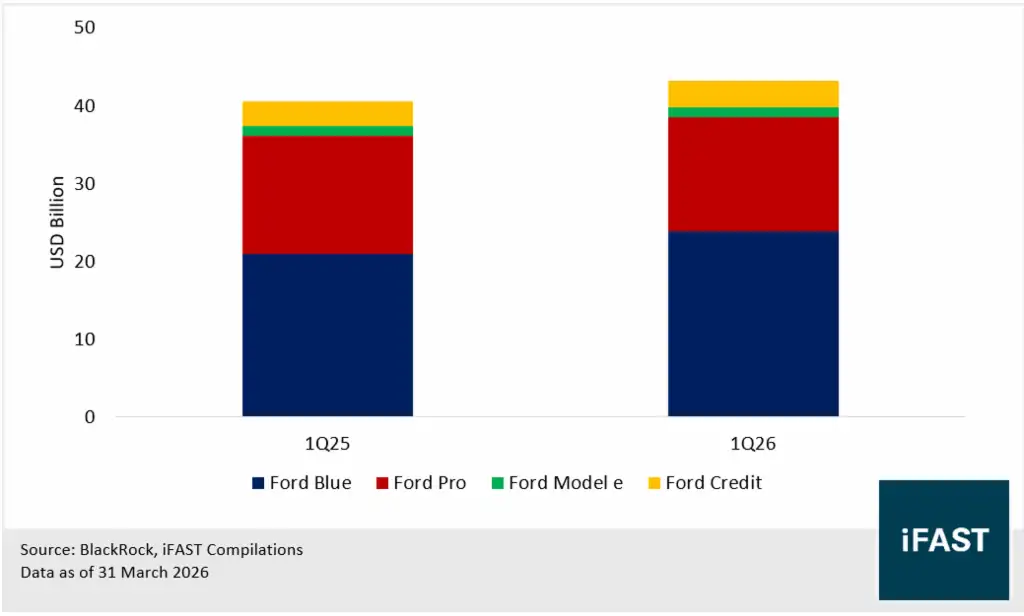
Ford's revenue has steadily increased in recent years. In the first quarter of 2026, the group's revenue reached USD43.3 billion, a year-on-year increase of 6.0%, exceeding market expectations. The Ford Blue business generated USD23.9 billion in revenue in the first quarter, a year-on-year increase of 14% (see Chart 1). Popular models such as the F-Series, Bronco, Explorer, and Expedition boosted the product mix and net pricing, leading to an increase in the group's retail market share in the United States. The Ford Pro business generated USD14.7 billion in revenue, a year-on-year decrease of 3%, mainly due to supply constraints from aluminium supplier Novelis (analysed further below).
It is worth noting that the results included a one-off IEEPA tariff rebate of USD1.3 billion, primarily benefiting the Blue and Pro businesses. Excluding this non-recurring item, core operating performance remained robust. The group stated that a strong product mix (popular models such as the F-Series and Bronco), improved net pricing, growth in software and physical services (with a year-on-year target of 8%), and cost control were the main reasons for the significant rebound in profits. Even though sales declined by 4% year-on-year, the increased proportion of high-margin models and higher contributions from software subscriptions offset some of the pressure.
We believe that the Q1 2026 performance reflects improved execution of the Ford+ plan, with the Blue and Pro businesses entering a positive profit cycle, and Model e losses gradually narrowing, laying a solid foundation for full-year results.
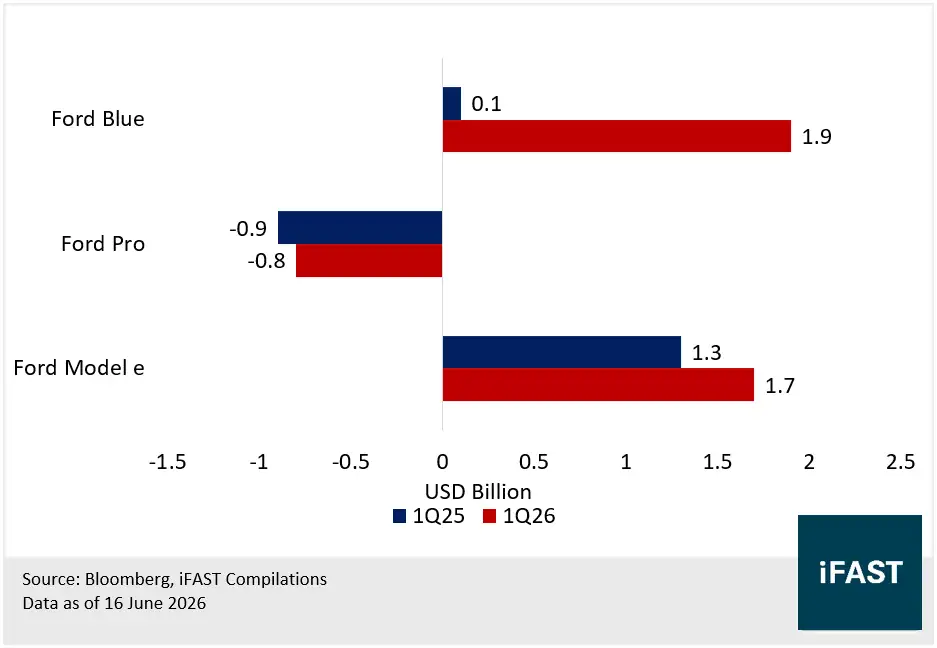
Ford’s manufacturing division reported EBIT of USD 2.9 billion, a significant increase from USD 460 million in the same period last year (see Chart 2). The Blue business is the core profit engine of the group, which boosted the segment EBIT margin by 7.7 percentage points to 8.1%. Management has also raised its full-year EBIT guidance to USD 4.5 to 5 billion, far exceeding market expectations.
Despite supply chain challenges, Ford Pro's adjusted EBIT still grew year-on-year to USD 1.7 billion. The group's leading position in the US commercial vehicle market remains solid, with a market share of approximately 40% in small to medium-sized vans. Encouragingly, software subscriptions grew by 30% year-on-year to 879,000, and fleet management services contributed stable recurring revenue to the group. This demonstrates that the Pro business combines growth and defensive characteristics, with a full-year EBIT guidance of USD 6.5 to 7.5 billion.
As for the electric vehicle business, Ford Model e, revenue was USD1.2 billion, roughly flat year-on-year, with an adjusted EBIT loss of USD780 million, narrowing from a loss of USD850 million in the same period last year. Wholesale volume increased by 10% year-on-year, but the discontinuation of F-150 Lightning production affected some revenue. The Group is optimizing its first-generation electric vehicle products and preparing for the next-generation electric vehicle platform and Ford Energy's energy storage business. We expect losses to gradually narrow, with a full-year loss guidance of USD 4 billion to USD 4.5 billion. Overall, the Blue and Pro businesses contributed over 90% of the Group's adjusted EBIT, and the Model e investment's phased losses are manageable.
Ford Constrained by Supply Chain, but Strategic Adjustments are Kicking In
Ford's shipments fell 4% year-on-year, primarily due to Novelis aluminium supply restrictions affecting models such as the Super Duty. Continued uncertainty surrounding tariff policies means the Group expects a net impact of approximately USD 2 billion on commodity prices and tariffs for the full year (higher than previously anticipated). However, the aforementioned one-off tax rebate has partially offset the pressure, and Novelis plant recovery is expected to contribute USD 1 billion in profit in the second half of the year.
The Group continued to push forward with the Ford+ program around December, including cost reductions, quality improvements, and software service expansion. Capital expenditure guidance for 2026 is USD 9.5 to 10.5 billion (including USD 1.5 billion for Ford Energy). Ford Model e's future key business, Energy Storage Systems (ESS), secured a 4 gigawatt-hour (GWh) order from energy giant EDF Energy in the first quarter of 2026, and plans to exceed 20 GWh of ESS production capacity from the fourth quarter of 2027.
We believe that the Group's decisive reform of the Model e business is the biggest factor leading to the turnaround in operating performance; the "short-term pain is better than long-term ones" EV transformation strategy is proving effective. With Blue and Pro offering strong defensive capabilities, the continued revenue from the software business is expected to become a long-term growth engine.
Ford’s Liquidity remains Ample while Credit Pressure under Control
As of the end of March 2026, Ford's cash and cash equivalents reached USD 25.8 billion. Although marketable securities decreased by USD 2.3 billion, this was due to the Group selling some holdings to repay debts, and overall cash reserves remained at USD 38.64 billion. The Group also successfully renewed its USD 18 billion corporate credit line, demonstrating ample financing flexibility (see Table 1). Although operating cash flow declined by 11.1% to USD 18.92 billion in the first quarter, and adjusted free cash flow also recorded an outflow, this was mainly due to seasonal capital expenditure factors. The Group's full-year adjusted free cash flow guidance remains at USD 5-6 billion, indicating that the Group still has considerable capacity to convert revenue into cash.
Focusing on the automotive manufacturing business itself, excluding Ford Credit, the company's debt is only about USD 16.3 billion. Relative to its cash reserves, the industrial business is in a net cash position, with a sound financial structure.
|
USD Billion |
1Q26 |
FY25 |
FY24 |
|
Cash and Cash Equivalent |
17.7 |
23.4 |
22.9 |
|
Marketable Securities |
12.8 |
15.1 |
15.1 |
|
Short-term debt |
50.8 |
57.3 |
55.5 |
|
Interest Coverage Ratio(x) |
8.1 |
-7.3* |
4.7 |
|
Operating Cash Flow |
18.9 (TTM) |
21.3 |
15.4 |
|
Data Source: Company’s Report, iFAST compilations Data as of 31 March 2026 *Note: Interest Coverage Ratio negative due to the one-time write-off from exiting EV battery project in FY25 |
|||
Bond Investment
Since last year, Ford's issuer and bond credit ratings have remained investment grade (BBB- range), indicating continued market confidence in the group. Currently, Ford's three USD bonds have maturities ranging from 0.4 to 5.6 years. In addition, Ford Credit also offers shorter-term bonds with similar ratings and net yields to maturity between 4.2% and 5.3%.
Ford's manufacturing business is fundamentally sound, particularly its Blue and Pro businesses, which demonstrate strong profitability and relatively low credit risk. Considering its signs of operational improvement, positive cash flow guidance, and strong refinancing capabilities, investors seeking stable returns may continue to consider "F 7.450% 16Jul2031 Corp (USD)" and "F 3.250% 12Feb2032 Corp (USD)," which offer net YTM as high as 5.9%, outperforming most peers (see Table 2).
|
Bond |
Issuer |
Tenor |
Ask Price |
Ask YTM |
|
Ford |
0.4 |
99.6 |
3.6% |
|
|
Ford |
5.0 |
106.4 |
5.6% |
|
|
Ford |
5.6 |
86.3 |
5.9% |
|
|
Ford Credit |
0.9 |
99.9 |
4.2% |
|
|
Ford Credit |
1.3 |
102.3 |
4.8% |
|
|
Ford Credit |
2.8 |
98.4 |
5.3% |
|
|
Data Source: Bondsupermart Data As of 15 Jul 2026 |
||||
Related Risks
Ford faces market and demand risks, which are typically linked to global economic cycles, fuel prices and consumer purchasing power, competition from electric vehicles and autonomous driving technologies, and changes in cross-border market share. Declining new car sales, compressed revenue and profits, and inventory buildup may necessitate accelerated technology investment to avoid losing market share.
The Group's supply chain risks are significant, including semiconductor and aluminium shortages, raw material price fluctuations, and geopolitical impacts (tariffs, Novelis recovery progress). These factors could damage production capacity, leading to reduced revenue. The Group's product recall and warranty costs also require attention.
Conclusion
While Ford's wholesale volume declined, its revenue continued to grow steadily, primarily driven by strong performance in its gasoline and commercial vehicle businesses, as well as one-off tariff rebates, enabling the group to successfully return to profitability.
Although Ford's debt level remains at a certain level, its credit pressure is not significant due to improved operations, positive cash flow guidance, and its high-quality assets and renewed credit lines.
Ford's US dollar bonds have maturities ranging from 0.4 to 5.6 years, with a net yield to maturity of up to 5.9%, making them suitable for investors seeking stable returns.
Declaration: For specific disclosure, at the time of publication of this report, IFPL (via its connected and associated entities) and the analyst who produced this report hold NIL positions in the abovementioned securities. This research report was prepared with the assistance of artificial intelligence (AI) tools. iFAST Financial Pte Ltd does not rely exclusively on AI for content generation; the content of this report – including all investment theses, ratings, price targets and conclusions – has been independently reviewed and verified by the research analyst(s) to ensure accuracy and professional integrity.
RISK DISCLOSURE STATEMENTS FOR BONDS
Key risks of investing in bond
|
Key risks of investing in high-yield bonds
|
| Bonds with special features Some bonds may contain special features and risks that warrant special attention. These include bonds:
|
Remarks
|