- PARAGON REIT sees recovery in footfall and tenant
sales, but negative rental reversion resulted in minimal growth in its gross
revenue.
- It has a resilient credit profile, mitigating interest
rate risk while having a low gearing ratio.
- We like SPHRSP 4.100% Perpetual Corp (SGD) because of its
good chance to get redeemed, and its shorter years to call as compared to other
perpetuals.
- While we are still concerned with the non-call risk on perpetuals, PARAGON REIT is well-position to further benefit from the retail demand, and for the resiliency in its credit profile to continue.
Introduction
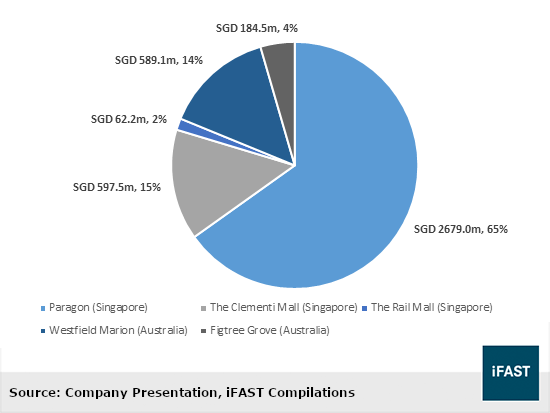
PARAGON REIT is a real estate investment trust in Singapore and Asia Pacific investing in income-producing real estate used primarily for retail purposes. As at 31 December 2022, its portfolio comprises five retail malls – 3 located in Singapore and 2 in Australia – with Paragon Shopping Centre (“Paragon”) being the largest of its assets, accounting for 65% of the SGD 4.2b assets under management as shown in Chart 1.
Chart 1
Assets under Management as of 31
December 2022
In 2022, the previously-named SPH REIT entered its new phase of life as its new Sponsor, Cuscaden Peak Investments Private Limited (“Cuscaden Peak”) bought over Singapore Press Holdings’ (“SPH”) non-media assets. The renaming exercise to PARAGON REIT reflects the management’s focus on their key property, Paragon. Under the new Sponsor, it was previously highlighted that Cuscaden Peak intends for PARAGON REIT to continue with its existing activities and there are no plans to make any material changes to PARAGON REIT’s existing business. However, PARAGON REIT indicates that it will continue to seek opportunities with suitable yield accretive growth – as long as these are primarily retail properties.
With the focus on retail malls, PARAGON REIT was yet another victim of the COVID-19 lockdowns. On the brighter side of things, it has been seeing recovery – especially with the return of tourism driving high footfall in the touristy Orchard area housing Paragon – although still pummelled by the rising interest rates and inflation. With Paragon being the star player of PARAGON REIT, it remains well-positioned during this period of uncertainty.
Financial Highlights
Due to the change in Sponsor, PARAGON REIT has shifted its financial year end from 31 August to 31 December. As a result, the official reported financial year 2022 (“FY22”) indicates a 16-month period from 1 September 2021 to 31 December 2022 instead of the usual 12 months ending on 31 August. For comparison purposes, it has provided figures for a 12-month period ending 31 December 2022 and 31 December 2021 respectively, which will be utilised below.
Chart 2
Gross Revenue and Net Property Income
since FY19 (SGD m)
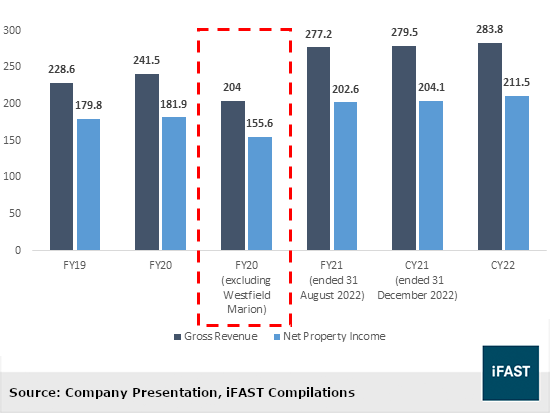
At first glance, the overall performance since 2019 (as shown by Chart 2) might suggest that PARAGON REIT was not affected by the COVID-19 pandemic. But looking closer at FY20 (red dotted box), excluding results from Westfield Marion which was only acquired in December 2019, gross revenue and net property income on the existing assets fell instead – an unavoidable impact due to the COVID-19 lockdowns especially affecting the retail sector. To date, looking at the individual retail malls, only Australian assets saw their performance recovering to pre-COVID-19 levels.
For the 12-month period ended 31 December 2022 (“CY22”), PARAGON REIT saw a slight increase in both its gross revenue and net property income to SGD 283.8m and SGD 211.5m respectively, from SGD 279.5m and SGD 204.1m in CY21. While the hospitality and retail sectors saw huge growth from the tourism rebound, PARAGON REIT saw a disappointing ~1.5% growth in its gross revenue, and a measly ~3.6% growth in net property income.
Table 1
Growth in Tenant Sales and Footfall, and
Occupancy Rates
|
Property |
Year-on-year growth observed in CY22 (%) |
Occupancy Rate as at 31 December 2022 |
|
|
Footfall |
Tenant Sales |
||
|
Paragon (Singapore) |
+29.2% |
+44.8% |
99.9% |
|
The Clementi Mall (Singapore) |
+35.2% |
+11.9% |
100% |
|
The Rail Mall (Singapore) |
Not collected |
Not recorded in CY21 for comparison |
100% |
|
Westfield Marion (Australia) |
+1.6% |
+8.1% |
97.4% |
|
Figtree Grove (Australia) |
+6.0% |
+15.4% |
99.4% |
|
Sources: Company Presentations, iFAST Compilations. |
|||
The results had been surprising given the growth in footfall and tenant sales across its retail malls observed in Table 1, especially for its assets in Singapore recording 33% year-on-year growth for overall footfall and 35% year-on-year growth for overall tenant sales. The easing of COVID-19 restrictions had been beneficial for the retail sector, as observed in the overall rise in footfall and tenant sales. However, it appears that PARAGON REIT remains affected by negative rental reversion since the pandemic, and therefore we do not see the robust retail performance translating the same into its revenue.
Table 2
Rental Reversion since 2020
|
Property |
Rental Reversion (Change compared to preceding rental rates) |
||
|
As at 31 August 2020 |
As at 31 August 2021 |
As at 31 December 2022 |
|
|
Paragon |
+7.0% |
-8.3% |
-4.2% |
|
The Clementi Mall |
+4.8% |
-8.7% |
-1.2% |
|
The Rail Mall |
+10.1% |
+5.4% |
+12.9% |
|
Singapore Assets |
+6.4% |
-8.2% |
-3.3% |
|
Westfield Marion |
-1.5% |
-10.5% |
-7.5% |
|
Figtree Grove |
-9.8% |
-12.0% |
-5.3% |
|
Australia Assets |
-3.2% |
-10.8% |
-7.0% |
|
Sources: Company Presentations, iFAST Compilations. |
|||
The reversion rate was stated to be computed based on the weighted average of all expiring leases, and the change is measured between the average rents of the renewed/new lease terms and the average rents of the preceding lease terms. For PARAGON REIT, negative overall rental reversion has been recorded for both their Singapore and Australia assets in the past 2 years as observed in Table 2. Rental reversion as at 31 August 2021 better represents the impact of the COVID-19 pandemic, given that the initial lockdown observed in Singapore only began in April 2020.
In its answer to a question from the Securities Investors Association Singapore (“SIAS”) with reference to its latest Annual Report, PARAGON REIT underlined its rationale for the negative rental reversion in FY22. It specifically highlighted its “focus on tenant relations” which as a result, “contributed to its strong track record with near full committed occupancy at 98.5% as at 31 December 2022”. PARAGON REIT also mentioned that its tenant retention ratio of 80.7% demonstrates tenants’ confidence in its assets. PARAGON REIT likely chose the path of maintaining high occupancy rates over the possibility of losing tenants over increasing rents. Given the current retail demand levels, we think that PARAGON REIT’s considerably high tenant retention ratio should allow further growth in rental reversion, and we expect revenue to have room to rise in the upcoming years.
On PARAGON REIT’s Weighted Average Lease Expiry (“WALE”), the WALE by net lettable area (“NLA”) stands at 5.2 years while the WALE by gross rental income (“GRI”) stands at 2.8 years. Compared to its peers, PARAGON REIT’s WALE is positioned in the middle of the pack – a decent showing of its WALE. Most importantly, WALE neither too short nor too long allows PARAGON REIT to capitalise on the positive rental reversion it would need upon renewal while continuing to provide a certain level of stability to the overall performance.
PARAGON REIT’s negative rental reversion might have been surprising, but we see trends of it improving and with more room for it to outperform. As retail recovers to pre-COVID-19 levels, the situation should prove to be beneficial for PARAGON REIT to negotiate higher rents for its properties. We are positive about the upcoming performance of PARAGON REIT, which has been very commendable for its stability amidst this volatile period.
Credit and Liquidity Profile
Chart 3
Debt Maturity Profile as at 31 December
2022 (SGD m)
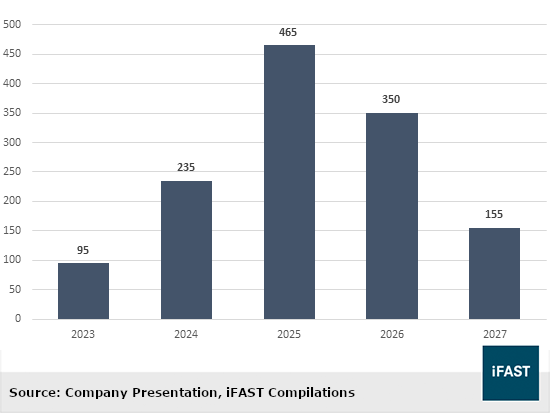
PARAGON REIT has a total borrowing of SGD 1,271m, of which SGD 94.9m is to be repaid within 1 year period. With cash and cash equivalent sitting at SGD 125m, and another SGD 225m through available bank facilities, PARAGON REIT is unlikely to see any issues repaying its short-term debts. Of all its borrowings, the majority are fixed at 84% of the total borrowings through the use of interest rate swaps. In this case, we see efforts by PARAGON REIT in mitigating interest rate risks, reflected by their average cost of debt for FY22 sitting at 2.05% as well.
Its gearing ratio as at 31 December 2022 is 29.8%, while its net gearing ratio is estimated to be 26.9%. Against the average gearing ratio of 37.7% across REITs in Singapore, PARAGON REIT has substantial headroom for additional borrowings if necessary. With respect to the gearing regulatory limit of 50% (that requires the REIT to have a minimum interest coverage ratio of at least 2.5 times), its additional headroom is estimated to be about SGD 1.7b. The interest coverage ratio sits at 6.8 times, well above the required minimum of 2.5 times for the 50% gearing regulatory limit.
PARAGON REIT’s credit profile is resilient amidst the rising interest rates, showing prudence in their management of interest rate risk with extensive use of hedging. The gearing ratio has also been kept low to manage financing costs, with its gearing ratio being one of the lowest across REITs in Singapore. The hardest period is likely over for PARAGON REIT, with interest rates unlikely to see hikes to the extent of 2022 and financing costs expected to become more manageable. We have expectations for PARAGON REIT’s credit profile to remain strong in the years ahead.
Recommendations
Table 3
Perpetual issuances from REITs
|
Issue |
Price |
Current Yield |
Yield to Call |
Years to Call |
Reset Rate |
|
94.99 |
5.90% |
7.30% |
3.36 |
Prevailing SGD 7Y SOR + Distribution Step-up (300 bps) + Initial Spread (4.06%) |
|
|
93.19 |
4.13% |
6.72% |
2.64 |
Prevailing SGD 5Y SOR + Initial Spread (3.292%) |
|
|
96.50 |
5.57% |
6.55% |
3.35 |
Prevailing SGD 5Y SORA OIS + Initial Spread (4.654%) |
|
|
97.75 |
5.78% |
6.52% |
2.85 |
Prevailing 5-year SOR + Initial Spread (4.73%) + Step Up Margin (200 bps) |
|
|
93.80 |
4.53% |
6.47% |
3.14 |
Prevailing SGD 5Y SOR + Initial Spread (3.290%) |
|
|
97.38 |
4.21% |
6.26% |
1.35 |
Prevailing SGD 5Y SOR plus the Initial Spread (2.517%) |
|
|
Sources: Bloomberg Finance L.P., Bondsupermart, iFAST Compilations. Data as of 27 April 2023. |
|||||
PARAGON REIT offers SPHRSP 4.100% Perpetual Corp (SGD), a perpetual bond with a yield to next call at 6.26% and the first call/reset date being 30 August 2024. Considering PARAGON REIT’s credit profile, it is advantageous for it to call back the perpetual. PARAGON REIT has shown a prudent management of its interest cost and the current coupon is considerably higher than its average cost of debt at 2.05%. In the event of a reset, considering 5Y Swap-Offer Rate (“SOR”) at 3.082% as of 27 April 2023 and the initial spread of 2.517%, the coupon will reset to 5.599%. While we do not expect interest rates to remain as high until then, it remains likely for the coupon to reach 5% given the short years to call at 1.35 years.
PARAGON REIT’s low gearing should enable them to refinance the perpetual with secured bank borrowings. With substantial headroom for more borrowings, and no development plans thus far that require additional borrowings, PARAGON REIT is in a good position to utilise bank borrowings instead of financing the perpetual. Considering the current average cost of debt at only 2.05%, it is highly probable for PARAGON REIT to obtain secured bank borrowings at a lower cost of financing than the perpetual.
Given its credit profile, we believe there is a good chance for PARAGON REIT to redeem the perpetual on the first call date. In addition, SPHRSP 4.100% Perpetual Corp (SGD) offers a reasonable yield to call with much shorter years to call as compared to other better yielding perpetuals by REITs in Table 3. However, we would still like to highlight the possibility of non-call risk as observed in the recent period.
Due to higher interest rates, we are seeing greater concern in non-calls by perpetual issuers. We have seen several issuers this year not redeeming their perpetuals on the first call date, and out of the 5 callable year-to-date, only 1 under ESR-LOGOS REIT was called back. Across the better yielding perpetuals issued by REITs, ARASP 5.600% Perpetual Corp (SGD) and ESRCAY 5.650% Perpetual Corp (SGD) stand out with a good yield to call and also a step-up margin in the respective reset rates – which might be a stronger reason for the issuers to redeem their perpetuals on the first call date.
For investors considering perpetuals after taking into account non-call risk in their portfolio, SPHRSP 4.100% Perpetual Corp (SGD) may be a good consideration for its yield and shorter years to call. In the event of a non-call, SPHRSP 4.100% Perpetual Corp (SGD) is likely to reset to around 5% coupon level and should provide for some level of capital appreciation with interest rates expected to fall in late-2024.
Overall, PARAGON REIT is well-positioned to further benefit from the post-COVID-19 narrative, where tourism is likely to keep retail demand at a high. We expect the resiliency in its credit profile to continue, especially considering its optimal management of interest rate risk and keeping financing costs low.
Declaration: For specific disclosure, at the time of publication of this report, IFPL (via its connected and associated entities) holds a position in AAREIT 5.375% Perpetual Corp (SGD), ESRCAY 5.650% Perpetual Corp (SGD) and the analyst who produced this report holds a NIL position in the abovementioned securities. Cuscaden Peak is a substantial shareholder of iFAST Corporation Ltd (parent of IFPL) through its subsidiary, CP Invest Ltd, at 13.25%.
Our podcast series, Yield Hunters, is available on Spotify, iTunes Podcasts and Google Podcasts. We share our thoughts on new bond issues and hold discussions on the fixed income space. Listen to our latest episode below and follow us!