- Chip Eng Seng recorded a strong financial performance in 2021, with all of its business segments other than property investment & others showing considerable revenue growth.
- For 2022, we believe that the Group can keep up with the growth momentum as global economies continue to pick up and its competitive advantage in its construction business can help to leverage on the positive construction landscape this year.
- Despite recording a net loss for the year, the Group has strong credit metrics to service its debt obligations and it remains cautious in replenishing its land bank to manage its capital and debt position.
- We think that the CHIPEN 6.500% bond is attractive within the SGD high yield space, given its strong interest servicing ability and manageable debt levels.
Financial Highlights
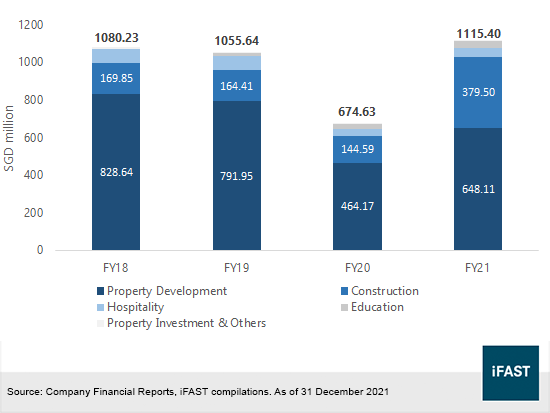
For the year ended 31 December 2021 (“FY21”), Chip Eng Seng recorded a 113.4% jump in gross profit from SGD 65.24m to SGD 139.22m. Revenue posted a 65.3% increase from a year ago, as all of its business segments except for property investment & others saw a substantial improvement from 2020. Total revenue for 2021 has also surpassed its pre-pandemic levels in 2018 and 2019 (Figure 1). However, the Group still made a net loss after tax of SGD 21.63m last year, even though it has significantly narrowed compared to 2020 with a net loss after tax of SGD 78.49m. This was largely due to disruptions in supply chain for construction materials, labour shortages and increased operating costs during the year that resulted in higher cost of sales for the Group.
Construction Segment Remains Healthy but Rising Costs Could Pose Challenges
Across all of its business divisions, Chip Eng Seng’s construction segment posted the largest percentage increase in revenue of approximately 162.5% from a year ago. This was mainly due to the low base in 2020, as construction activities were largely disrupted as a result of the circuit breaker and cross-border restrictions imposed. The Group managed to acquire new projects from the Housing and Development Board (“HDB”) in 2021, such as Pasir Ris Neighbourhood 5 C26 & 27 projects worth SGD 244.8m, as well as replaced the contractor for the BTO project at Marsiling Grove in Woodlands. These projects contributed significantly to its construction order book inflows and revenue in 2021.
As at 31 December 2021, its construction order book stood at SGD 1.36b, slightly down from SGD 1.40b six months ago. Nonetheless, the order book was higher by SGD 50m compared to 2020, and the Group’s construction order book to sales ratio still remains healthy at approximately 3.6x in 2021, which provides good revenue visibility to its construction segment for the next 3 years.
However, we should still be mindful of the rising prices for key building materials due to supply constraints, as well as labour shortages that could still impact the margins of its construction business this year. To counter this problem, the Group has been improving the efficiency and productivity of its construction segment by harnessing technologies such as 3D printing so that there is reduced reliance on manual labour. Chip Eng Seng believes that the use of technologies can help the Group to hedge against the risks of manpower shortages and reduce the costs associated with labour shortages.
Going forward, the overall construction landscape in Singapore is expected to continue improving in 2022. The Building and Construction Authority (“BCA”) projects that construction contracts worth between SGD 27b and SGD 32b will be awarded this year, supported by a strong pipeline of public housing projects. Construction demand is expected to reach a steady range of SGD 25b to SGD32b per annum over the next 3 years. As such, Chip Eng Seng aims to capitalize on this demand using its expanded capabilities in its building, infrastructure, and construction project management business.
Cooling Measures Likely to Impact Property Development Segment
Chip Eng Seng’s property development segment remains as the largest revenue contributing division in 2021. Revenue increased 39.6% from a year ago, mainly attributable to the sale of development sites at Gladstone Street and South Melbourne, as well as greater contributions from Park Colonial, Kopar at Newton, and Parc Komo. As at 31 December 2021, the sales of Park Colonial, Kopar at Newton and Parc Komo reached 100%, 68.3%, and 89.5% respectively, notably higher compared to a month ago (Table 1). Sales of the 28 Lyall in Western Australia also improved slightly to 51.8%, of which the Group has a 70% equity stake in the joint venture to redevelop the project.
Table 1: Sales of ongoing property development projects
|
Development projects |
Country of project |
Sales as at 8 Nov 2021 |
Sales as at 31 Dec 2021 |
|
Park Colonial |
Singapore |
100.0% |
100.0% |
|
Kopar at Newton |
Singapore |
58.2% |
68.3% |
|
Parc Komo |
Singapore |
80.1% |
89.5% |
|
28 Lyall (70% stake in JV) |
Australia |
50.0% |
51.8% |
|
Source: Company Financial Reports, Company Website, iFAST compilations |
|||
Park Colonial managed to obtain its Temporary Occupation Permit (“TOP”) in December 2021. On the other hand, both Kopar at Newton and Parc Komo experienced delays in construction due to the ongoing pandemic. As a result, both of the developments were not able to meet their construction milestones, which adversely impacted their revenue recognition and progressive payments from property buyers. The Group now expects to complete both of the development projects in 2023.
Looking at the latest property cooling measures imposed by the Singapore government, we do foresee the sales of new private homes to slow down this year due to the higher additional buyer’s stamp duty (“ABSD”) rates imposed on property buyers. This implies that new sales at Parc Komo and Kopar at Newton could potentially ease this year. Nonetheless, we still expect the sales and construction of these 2 ongoing projects to be completed before the 5-year ABSD remission deadline for developers. Parc Komo and Kopar at Newton were launched in May 2019 and March 2020 respectively. Referring to Table 1, as at 31 December 2021, Parc Komo is 89.5% sold with approximately 2.2 years of runway before the ABSD deadline, while Kopar at Newton is 68.3% sold with approximately 3.0 years left.
Education Division Still a Focus Despite Regulatory Crackdown
Chip Eng Seng has been diversifying extensively towards its education segment in recent years. Revenue has been progressing steadily since 2018, growing at approximately 142% CAGR over the past 3 years. However, its education revenue was negatively impacted in 2021 due to the regulatory crackdown by the Chinese government targeting the tuition industry. As a result, the Group had to record an impairment loss of SGD 14.4m, mainly on its investment in Guangzhou Yuanda Information Development Co. Ltd (“Yuanda”).
Despite the regulatory crackdown, Chip Eng Seng’s education revenue in 2021 still grew by 34.2% from SGD 14.5m to SGD 19.4m due to higher contributions from Perse School, Primus Schoolhouse and Invictus-brand international schools. The Group expects an enrolment growth for their K-12 schools and preschools this year, as the global economic recovery will help to spur the relocation of international families and students who are looking to seek education in Singapore.
Chip Eng Seng has also developed its proprietary Invictus Global Schoolhouse programme (“IGSH Programme”) that aims to help students from non-English speaking countries to prepare for the Cambridge International A-level examinations. The programme currently remains on track to launch in second half of this year, and the Group expects to scale the programme to expand its education business over the next few years.
Earlier in January 2022, Chip Eng Seng’s Chief Financial Officer (“CFO”), Mr Law Cheong Yan, stepped down from his role to become the Group Chief Corporate Officer and Chief Operating Officer of its education division. Mr Law was appointed as the Group CFO in 2013, and he was also the Group’s Financial Controller from 1999 to 2004. As such, he has a requisite track record and extensive working experience in the company. We believe that this change in appointment is a further testament from the Group to continue diversifying and growing its education division in the future, as Mr Law will now be responsible for its business and day-to-day operations.
Hospitality Segment Expected to Continue Recovering This Year
Chip Eng Seng’s hospitality business has been negatively affected in recent years due to the pandemic. Its contribution to the Group’s overall revenue has also declined over the past few years (Figure 1), and it currently takes up approximately 4.13% of the total revenue in 2021. Nonetheless, 2021 was a good year for its hospitality business as revenues grew 85.9% from SGD 14.7m in 2020 to SGD 27.3m due to higher contributions from all hotels except for Park Hotel Alexandra.
Going forward, we believe that the rising vaccination rates across most countries will likely provide a boost to its hospitality segment, as more countries look to ease their cross-border restrictions. Looking at the geographical exposure of Chip Eng Seng’s hospitality division, the Group is largely exposed to Singapore, Australia, and Maldives, which have a high vaccination rate of 86.8%, 80.2%, and 68.7% respectively as of March 2022.
Singapore remains committed to reopen its borders through the opening of vaccinated travel lanes and extending them to more countries in the future. Meanwhile, Australia has also reopened its international borders in February 2022 for the first time in 2 years, which is highly encouraging to its tourism industry. As for Maldives, 2021 was a good year for its tourism industry, as visitor arrivals reached more than 80% of pre-pandemic levels according to World Bank statistics. This was largely due to high tourist confidence as a result of the government’s strict hygiene protocols.
As such, we can expect the tourism sector in these countries to continue recovering this year due to the high vaccination rates, unless the Covid-19 situation takes a turn for the worse and countries start re-imposing border restrictions again. This will largely benefit Chip Eng Seng’s hospitality segment in 2022, as the uptick in travel will be positive for its recovery in occupancy rates and revenues for its hotels.
Credit Discussion
Table 2: Credit Metrics Comparison as at 31 December 2021
|
Property Developer |
Current Ratio |
Net Gearing |
LTM EBITDA Coverage |
Total Debt/Total Asset |
Net Debt/LTM EBITDA |
|
Chip Eng Seng |
2.06 |
1.22 |
2.69 |
51.69% |
11.57 |
|
Oxley Holdings |
1.05 |
2.01 |
1.80 |
57.31% |
10.01 |
|
Tuan Sing Holdings |
1.13 |
0.75 |
1.22 |
48.94% |
17.34 |
|
Heeton Holdings |
2.38 |
1.20 |
1.59 |
55.17% |
19.14 |
|
Koh Brothers |
1.70 |
0.73 |
2.40 |
41.77% |
11.39 |
|
Source: Company Financial Reports, iFAST estimates |
|||||
Chip Eng Seng has shored up its cash position in 2021 in view of the ongoing Covid-19 situation and reclassification of borrowings from non-current to current liabilities. As at 31 December 2021, the Group has SGD 505.9m of cash and short-term deposits, which is substantially higher than SGD 374.0m in 2020, and it is more than sufficient to cover its short-term loans and borrowings of SGD 500.3m. Among the SGD 500.3m of borrowings, SGD 440.2m is secured by a collateral, while the remaining SGD 60.1m is unsecured.
Going forward, we remain cautiously optimistic of the Group’s liquidity position. The recent cooling measures and rising interest rate environment could have an implication on the sales of its remaining unsold units, thus, affecting the monetization of its development properties for cash. Nonetheless, the Group’s current ratio as at 31 December 2021 is approximately 2.06x (31 December 2020: 4.57x), which is higher relative to other comparable high yield property developers besides Heeton Holdings Limited (Table 2). Furthermore, with a majority of its short-term borrowings secured by a collateral, we believe that Chip Eng Seng’s refinancing risk is low, hence, allowing it to access more funds to service its debt obligations if necessary.
In terms of net gearing, Chip Eng Seng has seen a notable improvement in its net debt-to-equity ratio from the previous year. Net gearing for 2021 was 1.22x compared to 1.74x in 2020. This was mainly due to the repayment of bank borrowings for development properties and redemption of its SGD 13m term notes upon its maturity. Net debt-to-EBITDA ratio currently stands at 11.57x, which is more manageable as compared to other property developers as shown in Table 2.
In view of the ongoing Covid-19 situation, Chip Eng Seng has pledged to be more selective and careful in terms of acquiring new land plots to shore up its land bank for future projects. The latest enbloc acquisition of Maxwell House and Peace Centre through a joint tender further demonstrates its prudence, as it recognizes the property market volatility due to the pandemic and prefers to enter into a joint venture with other well-established developers to manage its execution and financial risks. We believe that this is largely positive for the Group as it remains cautious in managing its capital outlay and leverage during this period of market volatility.
Notably, Chip Eng Seng’s EBITDA coverage ratio (EBITDA/Interest Expense) at 2.69x is the highest among all the other comparable property developers. Despite recording a full year net loss before tax, Chip Eng Seng’s operating profit increased the most year-on-year (“YoY”) among all the other comparable developers. Looking ahead, we believe that its EBITDA coverage ratio will continue to improve in the near-term, as its outstanding 4.900% 19 May 2022 of SGD15m and 6.000% 15 Mar 2022 notes of SGD39m will mature this year. This means that the Group’s interest expenses will decline following the expiry of the notes, which will likely provide a boost to its interest servicing ability.
Overall, we think that Chip Eng Seng’s credit profile remains healthy in terms of its liquidity, leverage, and interest coverage ratios. Among other comparable high yield property developers, Chip Eng Seng has one of the better credit metrics in terms of its liquidity and coverage. We also appreciate the Group’s conservative approach in managing its cash going forward to navigate the market volatility and manage its financial risks. As such, we believe that the Group is well-positioned to meet its debt obligations.
Relative Valuations
Table 3: Comparable High Yield Bonds with Similar Years to Maturity
|
Bond |
Issuer |
Issue Date |
Remaining Years to Maturity |
Ask Price |
Ask Yield to Maturity |
|
OHLSP 6.900% 08Jul2024 Corp (SGD) |
Oxley Holdings |
08 Jul 2021 |
2.32 |
99.82 |
6.98% |
|
TSHSP 6.900% 18Oct2024 Corp (SGD) |
Tuan Sing Holdings |
18 Oct 2021 |
2.61 |
102.11 |
6.01% |
|
CHIPEN 6.500% 06Dec2024 Corp (SGD) |
Chip Eng Seng |
06 Dec 2021 |
2.74 |
102.20 |
5.62% |
|
Source: Bloomberg Finance L.P., iFAST compilations. As at 10 March 2022 |
|||||
In our opinion, the CHIPEN 6.500% bond is fairly priced within the SGD high yield space. Comparing it with the OHLSP 6.900% bond, even though Oxley’s note is trading at a higher yield to maturity (“YTM”) with a shorter remaining duration, we feel that it is largely reflective of the issuer’s higher net gearing ratio and lower interest servicing ability (Table 2).
Revenues for Oxley Holdings for 1H2022 (six months ended 31 December 2021) declined 13% from a year ago, which is lackluster compared to Chip Eng Seng’s latest financial results (28% YoY increase for six months ended 31 December 2021). Furthermore, Oxley’s liquidity profile is weaker as its cash and cash equivalents (SGD 199.7m) is insufficient to cover its short-term borrowings of SGD 1.7b. As such, we think that the lower YTM of the CHIPEN 6.500% bond is fair, considering that Chip Eng Seng is in a better position to pay off its debt obligations.
Comparing the CHIPEN 6.500% bond with TSHSP 6.900% bond, we find that Tuan Sing’s bond is currently trading at a higher YTM of 39 basis points (“bps”) with a shorter remaining time to maturity. Tuan Sing Holdings has healthy credit metrics, with net gearing of 0.75x as at 31 December 2021. However, a significant portion of its net profit for the year comprises of a one-off gain on disposal of a subsidiary. If we were to adjust its net profit for non-recurring income, we find that Chip Eng Seng has a better interest servicing ability as compared to Tuan Sing Holdings (Table 2). Nonetheless, we think that both of their notes are attractive due to their strong credit profile and high YTM, particularly in a rising inflation environment.
Conclusion
In a nutshell, we think that the CHIPEN 6.500% bond is attractive. For its 2021 financial results, all of its business segments other than its property investment & others division posted strong revenue growth. This year, despite the cooling measures imposed by the government, we believe that Chip Eng Seng will continue to register strong top and bottom-line growth as it continues to enhance its competitive edge and diversify its business to navigate through the pandemic. Despite having a healthy liquidity and credit profile, the Group remains cautious in managing its cash and debt position going forward. As such, investors who are looking for a high yield name can consider the CHIPEN 6.500% 2024’s that is currently yielding around 5.62%.
Declaration: For specific disclosure, at the time of publication of this report, IFPL (via its connected and associated entities) holds positions in OHLSP 6.900% 08Jul2024 Corp (SGD), TSHSP 6.900% 18Oct2024 Corp (SGD) and CHIPEN 6.500% 06Dec2024 Corp (SGD), and the analyst who produced this report holds a NIL position in the abovementioned securities.
Our podcast series, Yield Hunters, is available on Spotify, iTunes Podcasts and Google Podcasts. We share our thoughts on new bond issues and hold discussions on the fixed income space. Listen to our latest episode below and follow us!