-
Cathay Pacific had a challenging start to 2022 due to the tightened government measures earlier this year, but following the decision to ease quarantine rules and lift travel bans from nine countries, we believe this is largely positive for the airline.
-
We expect passenger services to improve slightly in the near-term due to pent-up demand, while cargo services segment also looks more positive as Cathay Pacific looks to resume flights to major markets like the US and UK.
-
The Group has sufficient liquidity and committed undrawn debt facilities to cover its short-term borrowings, hence, we believe that the airline should be able to redeem the 2023 notes with ~9.6 months left to maturity.
The CATHAY 3.375% 22Jan2023 Corp (SGD) currently has an annualized yield to maturity of ~4.54% (Holding period gross return: ~3.60% pro-rated for 9.6 months), which is one of the most attractive short duration opportunities compared to other airline bonds, and investors can look to redeploy their capital early next year following the maturity of the bond.
Following the Hong Kong government’s recent decision to ease certain travel restrictions such as lifting flight bans from nine countries and cutting down hotel quarantine for residents to 7 days, we have seen a slight rebound in the bonds of Cathay Pacific Airways (“Cathay Pacific”).
However, the airline is still running at substantially reduced capacities due to the ongoing global pandemic and restrictions imposed. In this article, we will take a closer look at the carrier’s financials to explain why the CATHAY 3.375% 22Jan2023 Corp (SGD) is still a worthy investment for investors.
Financial Highlights
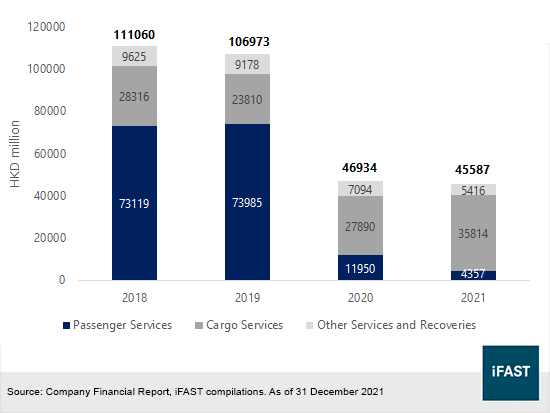
For the full year ended 31 December 2021, revenue for Cathay Pacific declined 2.9% year-on-year (“YoY”) from HKD 46.93b to HKD 45.59b as passenger services slumped considerably due to the government’s Covid-19 restrictions and mandatory quarantine measures for Hong Kong-based crew. The airline carried an average of 1,965 passengers per day for 2021, which is 84.5% fewer than in 2020. Passenger load factor, which measures the capacity utilization of the airline, fell to 31.0% in 2021 compared to 58.0% in 2020 as inbound demand and traffic fell substantially.
As a result of the underperformance of its passenger services segment, Cathay Pacific pivoted heavily towards its cargo services segment for 2021 (Figure 1). Its cargo services revenue increased 31.8% YoY as its cargo load factor improved notably by 8.1 percentage points (“ppt”) 81.4%. Cargo demand grew ahead of the traditional peak season in the second half of 2021, and in the months leading up to the end of last year, Cathay Pacific operated its freighter fleet at peak capacity and added cargo-only passenger flight operations due to the holiday season demand. As such, its cargo services segment helped to offset the decline in revenues from other segments for 2021.
Figure 1: Total Revenue Breakdown
Despite the fall in revenue, operating loss for 2021 narrowed significantly to HKD 1.44b (2020: HKD 18.14b loss) as the Group remained disciplined in cutting costs and managing its expenses. Cathay Pacific implemented measures such as executive pay cuts, employee furlough, leave without pay, voluntary separation and early retirement schemes for a broad range of employee groups to reduce its staff costs by ~HKD 4.48b. Even though fuel costs rose last year due to higher fuel prices, the Group managed to bring down its net fuel expenses by ~HKD 4.35b in 2021 due to its effective hedging strategy. Therefore, Cathay Pacific’s continued focus on effective cash and cost management helped to cushion its monthly operating cash burn, such that it was marginally cash generative in the second half of 2021.
Outlook for 2022
Passenger services segment expects slight improvement ahead but remains challenging
Cathay Pacific’s passenger services segment had a challenging start to 2022 following the emergence of the Omicron variant. Travel and operational restrictions continued to limit its ability to operate more passenger flight capacity for the first 2 months of this year. January saw a reduction of 82% month-on-month (“MoM”) in total flight passenger capacity, while February also posted a decline of around 28% MoM.
As a result of renewed outbreaks within the city, the Hong Kong government temporarily banned all flights from 9 countries on 8 January 2022, including Australia, Canada, UK and the US. Passengers from high-risk places were also banned from transiting through Hong Kong International Airport. These tightened measures had negative implications on the carrier, as Cathay Pacific had to operate less than 2% of pre-covid passenger flight capacity for January and February.
However, towards the end of March, the Hong Kong government announced the lifting of flight ban from those 9 countries from 1 April 2022 onwards, and reduced the hotel quarantine period from 14 to 7 days for Hong Kong residents if they tested negative. This move was largely welcomed by businesses and residents as a signal to relax their “dynamic zero” restrictions, after the Hong Kong economy was bearing the brunt of such stringent measures for a long time.
Even though we think that there will be a slight pick-up in passenger services in the near-term due to pent-up demand, we do not expect a significant improvement for this segment going forward. The Group estimates that the segment will likely remain constrained at ~2% of pre-covid passenger flight capacity this year as long as restrictions are still in place. However, given the rising global vaccination rates and gradual reopening of international borders, we could start to see a bottoming-out for its passenger services segment this year.
Cargo services segment to remain as its focus
Cargo services segment has been the bright spot for Cathay Pacific following the pandemic, providing a backstop to the Group’s revenue as its passenger services segment remains battered. As the Group expects to continue operating well-below its pre-covid passenger flight capacity, it will continue to rely on its cargo services and increase its cargo capacity as much as practicable.
Similar to passenger services, Cathay Pacific’s cargo services segment was negatively impacted by the temporary flight ban imposed by the government in January, closing off its access to major markets such as the US and UK. In the first 2 months of 2022, total tonnage decreased by 27.1%, against a 59.1% drop in capacity and a 59.6% decline in revenue tonne kilometers (“RFTK”) compared to a year ago. As a result of additional quarantine measures imposed on the Hong Kong-based aircrew, Cathay Pacific operated 21% and 25% of its pre-covid cargo flight capacity for January and February respectively.
Nonetheless, following the lifting of travel ban, we can expect cargo services to return to ~33% of pre-covid levels as the Group looks to increase its long-haul cargo flight capacity. Cathay Pacific saw encouraging demand for its cargo services within regional routes during the first 2 months of 2022, particularly through its delivery of Rapid Antigen Test kits to Hong Kong. The Group also re-deployed freighters to North Asia and the Indian sub-continent to open up more opportunities within the region. As such, overall demand from other markets continues to strengthen despite the headwinds from the tightened measures in January.
According to estimates from the International Air Transport Association (“IATA”), global air cargo demand for 2022 is expected to exceed 2019 levels by 13.2% as indicators such as manufacturing output and inventory levels remain favorable. The impact of the Russia-Ukraine conflict on the global air cargo market is expected to be low, as Russia only accounted for just 0.6% of global air cargo last year. Therefore, we can expect cargo services to remain as an area of resiliency for airlines this year.
Credit Discussion
Table 1: Credit Metrics Comparison. Figures as at 31 December 2021
|
Airlines |
Current Ratio |
Net Gearing |
LTM EBITDA Coverage |
Total Debt/Total Asset |
Net Debt/LTM EBITDA |
|
Cathay Pacific |
0.67 |
0.98 |
3.55 |
45.70% |
7.56 |
|
Singapore Airlines* |
2.72 |
0.12 |
2.03 |
33.96% |
4.10 |
|
Malaysia Airlines |
0.90 |
0.51 |
1.23 |
26.34% |
4.79 |
|
Korean Airlines |
0.75 |
1.20 |
6.00 |
46.24% |
5.72 |
|
Delta Airlines |
0.76 |
5.22 |
3.04 |
37.15% |
4.89 |
|
United Airlines |
1.19 |
2.40 |
0.95 |
44.53% |
8.26 |
|
Source: Company Financial Reports, iFAST estimates. *As at 30 September 2021. |
|||||
In terms of Cathay Pacific’s credit profile, the airline still has manageable liquidity despite having the lowest current ratio among the rest of the airlines as shown in Table 1. As at 31 December 2021, the Group has HKD 19.28b of liquid funds, as well as committed undrawn facilities of HKD 11.11b, less pledged funds of HKD 0.14b. As such, total available unrestricted liquidity was HKD 30.25b as at the end of last year, which is still sufficient to cover its short-term borrowings of HKD 22.35b. To further bolster its current liquidity position, Cathay Pacific issued HKD 6.7b of convertible bonds last year, as well as medium term notes in USD and RMB denominations totaling HKD 5.3b.
Interest servicing ability still remains strong with an EBITDA coverage of 3.55x, which is considerably higher as compared to other airline counterparts such as Malaysia Airlines, Delta Airlines and United Airlines. Even though Cathay Pacific’s operating profit was impacted as a result of the flight ban in the first quarter of 2022, we do expect its operations to pick up in subsequent months, and its 2022 EBITDA should remain more than sufficient to cover its interest expenses. Looking at the CATHAY 3.375% 22Jan2023 Corp (SGD) with an issue size of SGD 175m (~HKD 1.01b), we do not think that there will be any issues for the airline to repay the interest expenses and principal amount next year, judging based on their current liquidity, undrawn debt facilities and EBITDA coverage ratios.
As for the Group’s net gearing ratio, its net debt-to-equity ratio improved slightly from 1.01x in 2020 to 0.98x as at 31 December 2021, as net borrowings declined by 4.4% YoY to HKD 70.57b. Excluding lease liabilities previously classified as operating leases, net debt-to-equity ratio would have been at 0.75x, which is much lower than its borrowing covenants of 2.0x. As such, we think that Cathay Pacific still has room to tap into capital markets and borrow more funds to fund its existing operations and refinance its borrowings if needed.
Cathay Pacific is Hong Kong’s flagship carrier, and it is majority-owned by UK conglomerate Swire Group (~45%) and China’s flagship airline Air China (~30%). During the peak of the Covid-19 pandemic, Cathay Pacific received a government-led bailout of HKD 39b as the government acquired a 6.08% stake in the airline. Hong Kong Chief Executive Carrie Lam and Financial Secretary Paul Chan said that the bailout was necessary to protect Hong Kong’s role as a leading international aviation hub that is crucial to its economy.
Existing shareholders including Swire Group, Air China and Qatar Airways also injected fresh liquidity into the flagship carrier by subscribing to its HKD 11.7b rights issue. As such, Cathay Pacific is backed by a strong government and shareholder support, and we could expect the government and shareholders to provide some form of backstop to the airline if it gets badly hammered again.
Relative Valuation
Figure 2: Relative Valuation as at 7 April 2022
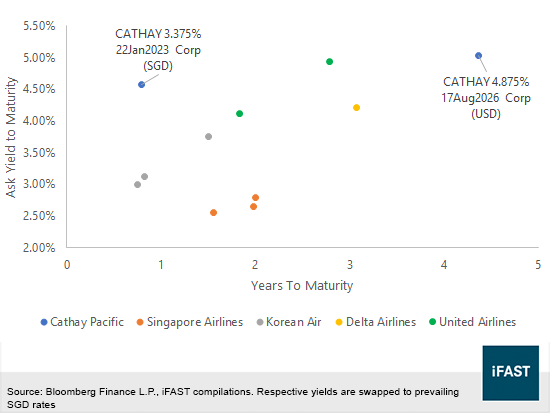
Looking at Figure 2, we find that the CATHAY 3.375% 22Jan2023 Corp (SGD) is the most attractive among other comparable bonds. The bond is currently trading at a yield to maturity (“YTM”) of ~4.54%, with approximately 0.79 years left to its maturity date. Relative to other straight bonds issued by comparable airlines, the CATHAY 3.375% 22Jan2023 Corp (SGD) offers the highest YTM with the shortest time to maturity.
Comparing the CATHAY 3.375% 22Jan2023 Corp (SGD) to other short duration bonds of Singapore Airlines (“SIA”), even though SIA’s credit metrics are much better relative to Cathay Pacific as seen from Table 1, we think that the trade-off for higher yields is still fair, considering that Cathay Pacific still has sufficient amount of liquidity to cover its short-term borrowings.
We think that the bond offers great value to investors, especially in a quantitative tightening cycle where investors should turn to shorter duration securities to shield their portfolios from the rising interest rates. Investors can earn a decent annualized yield of ~4.54% with around 9.6 months left to maturity, so that they can subsequently redeploy their capital to other securities.
Conclusion
In conclusion, we think that the CATHAY 3.375% 22Jan2023 Corp (SGD) is an attractive short duration opportunity for investors that is currently yielding ~4.54%. In light of the Hong Kong government’s decision to ease travel restrictions from April, we think that this should provide a positive backdrop for the airline as Cathay Pacific will look to resume more flight operations from major markets like the US and UK. The Group has sufficient liquidity and bank facilities to cover its short-term borrowings, coupled with a strong backing from the government and shareholders, we do not think that there is any issue for them to redeem the 2023 notes upon maturity next year. As such, investors looking for a short-term opportunity should consider the CATHAY 3.375% 22Jan 2023 Corp (SGD) so that they can subsequently redeploy their capital early next year.
Declaration: For specific disclosure, at the time of publication of this report, IFPL (via its connected and associated entities) holds positions in CATHAY 3.375% 22Jan2023 Corp (SGD), and the analyst who produced this report holds a NIL position in the abovementioned securities.
Our podcast series, Yield Hunters, is available on Spotify, iTunes Podcasts and Google Podcasts. We share our thoughts on new bond issues and hold discussions on the fixed income space. Listen to our latest episode below and follow us!