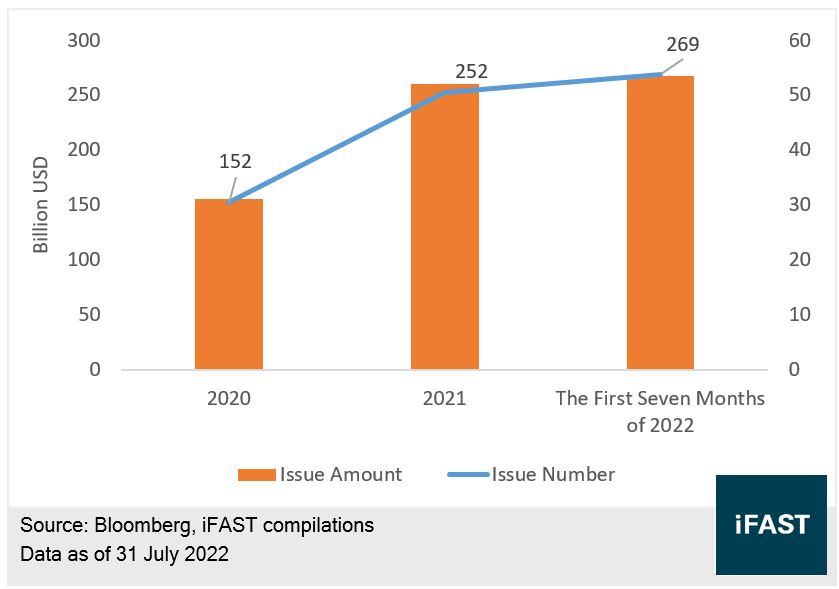
Credit risks have been arising frequently in the Chinese real estate industry since the second half of last year, causing the issue of relevant USD bonds to bottom, and even almost a suspension of high-yield issues. However, we noticed a growing number of Korean issuers entering the USD bond market (Chart 1). The number of issue stood at 269 for the first seven months of this year, which already surpassed the total issue number of 2021. Concurrently, the amount of issue reached USD 43.5 billion, and the amount of issue full year is expected to exceed 2021’s.
Chart 1: Number and Amount of Korean USD Bond Issue
It is noteworthy that these are all investment-grade bonds, their yield to maturity swelled subsequent to interest rate hikes. Besides, the return of these bonds is more attractive than other investment-grade peers. In this article, let’s take a look at some decent bonds for investors’ consideration.
Highlighted B-rated Korean Issuers at a Glance
1. Hyundai Capital
Hyundai Capital is the subsidiary of Hyundai Group. As of December 2021, Hyundai Group and KIA Group owned 60% and 40% stakes respectively. Hyundai Capital is the largest non-bank financial institution in Korea in terms of asset base. Revenue-wise, its total revenue amounted to KRW 2.7 trillion in the first nine months of 2021, up 15.8% YoY. Its net income rose by 20.2% to KWR 348.8 billion, and net margin slightly improved to 14.2%, showing rather good profitability.
Hyundai Capital has a healthy credit profile considering the fact that receivables make up a big part of Hyundai Capital’s asset as well as the lowest non-performing rate of 2.4% over recent years. It is also represented by the 14.6% adjusted capital adequacy ratio which is an improvement over previous years.
Bond Details
|
Bond |
Issuer/Guarantor |
Bond Credit Rating |
Years to Maturity |
YTM |
|
HYUCAP 2.125% 24Apr2025 Corp (USD) |
Hyundai Capital |
BBB+/BBB+ (S&P/ Fitch) |
2.7 |
4.6% |
|
Sources:
Bondsupermart |
||||
2. Korean Kookmin Bank
Established in 1963, Kookmin Bank is the largest bank in Korea that principally provides private and commercial banking services. The company marked a net interest income of KRW 11.2 trillion which is a 15.5% YoY increase while net income rose by 25.2% to KRW 4.4 trillion.
In terms of credit profile, the nonperforming loan ratio of Kookmin Bank was 0.9% as of December 2021, which is an improvement compared to 2020 (1.0%). The NPL Provision coverage was 348.2%, suggesting decent loss absorbing and risk management ability. Furthermore, the CET1 ratio and capital adequacy ratio of Kookmin Bank were 13.4% and 15.8% respectively, surpassing the regulatory requirements (4% and 8%). The overall credit profile is fair.
Bond Details
|
Bond |
Issuer/Guarantor |
Bond Credit Rating |
Years to Maturity |
YTM |
|
CITNAT 2.125% 15Feb2025 Corp (USD) |
Kookmin Bank |
A+/A (S&P/ Fitch) |
2.5 |
4.0% |
|
Sources: Bondsupermart |
||||
3. Hyundai Heavy Industries
Founded in 1972, Hyundai Heavy Industries has a wide range of business segments in shipbuilding, industrial equipment and engine manufacturing. Hyundai Heavy Industries is the world's largest shipbuilder with approximately 10% market share in the global shipbuilding industry. Influenced by the declining number of orders, Hyundai Heavy Industries’ revenue in 2021 reached KRW 8.3 trillion, which is close to last year. As the world gradually steps into the post-epidemic era and the maritime industry recovers, we expect stable growth in revenue.
Looking into the credit profile, as of December 2021, total debt/total equity ratio of Hyundai Heavy Industries stood at 169.4%, a dip from 173.4% in 2020; net debt/total asset ratio experienced a downward movement from 34.9% in 1H2021 to 21.0%, alleviating the debt burden. Although the heavy industry is highly leveraged by nature, we think Hyundai Heavy Industries has good fundraising ability and solvency given its large asset base and Korea Development Bank’s guarantee.
Bond Details
|
Bond |
Issuer/Guarantor |
Bond Credit Rating |
Years to Maturity |
YTM |
|
HYUNHI 3.179% 28Mar2027 Corp (USD) |
Hyundai Heavy Industries (Korea Development Bank is guarantor) |
N.R (Guarantor credit rating is AA/AA- (S&P/Fitch)) |
4.6 |
4.2% |
|
Sources:
Bondsupermart |
||||
4. Korea Expressway Corporation
Korea Expressway Corporation is a company that owns management rights of 33 expressways in Korea. Its main businesses involve toll and expressway construction. The company was established in 1969 and is 99.9% owned by the Korean government through various public organizations, mainly the Ministry of Land, Infrastructure, and Transport. Its revenue in 2021 rose by 10.2% to KRW 10.5 trillion, of which toll and expressway construction accounted for 40% and 50% of total revenue, respectively. The two segments grew by 5.4% and 13.7% YoY, respectively. EBITDA moved up 5.4% to KRW 2.5 trillion, which is a remarkable growth.
As for credit profile, as of December 2021, the total asset reported by Korea Expressway Corporation was around KRW 73.4 trillion; the leverage ratio was at a mild level with the liability-asset ratio of 45.3% and gearing ratio of 77.2%. Additionally, the debts that mature in 10 years or above made up 50% of its total debt, giving the company less repayment pressure short-to-mid-term.
Bond Details
|
Bond |
Issuer/Guarantor |
Bond Credit Rating |
Years to Maturity |
YTM |
|
HIGHWY 3.625% 18May2025 Qsov (USD) |
Korea Expressway Corporation |
AA (S&P) |
2.7 |
3.8% |
|
Sources:
Bondsupermart |
||||
5. Korea Electric Power Corporation
Founded in 1961, Korea Electric Power is the largest electricity supply company in Korea. Since 51% of the share is owned by the Korean government, Korea Electric Power is seen as a quasi-government company. The company recognised an operating income of KRW 60.6 trillion in 2021, rose by 3.4% YoY. Owing to the growing cost of power generation, the company recorded a KRW 5.9 trillion operating loss in 2021, compared to a profit of KRW 4.1 trillion in 2020.
In terms of credit profile, Korea Electric Power witnessed a notable increase in leverage and debt repayment stress, its total debt to EBITDA ratio surged from 5.1x in 2020 to 13.2x in 2021. Backed by its large asset base and government background, Korea Electric Power has an outstanding capability of refinancing, with a borrowing rate averaging 2.6% over the past three years. We believe the credit profile will remain decent with the support of the Korean government.
Bond Details
|
Bond |
Issuer/Guarantor |
Bond Credit Rating |
Years to Maturity |
YTM |
|
KORELE 3.625% 14Jun2025 Qsov (USD) |
Korea Electric Power |
AA/AA- (S&P/Fitch) |
2.8 |
4.1% |
|
Sources:
Bondsupermart |
||||
6. Hanwha Energy
Hanwha Energy is solely owned by Hanwha Group, which was founded in 1952 and is a large Korean conglomerate with businesses in chemical, energy, construction, finance and insurance, and retail sectors. Looking at its revenue, benefitting from the expansion of installed capacity, Hanwha Energy marked a total income of USD 390 million in 2021, swelling by 670%. However, it reported an ongoing net loss due to large capital expenditure. It is expected that the net loss will go on given the company's aggressive schemes of expansion.
In terms of credit profile, the total interest-bearing debt of Hanwha Energy spiked to USD 830 million, translating into moderately high leverage with a total debt/total equity ratio of 143.7%. Considering the guarantee provided by the Korea Import and Export Bank for bonds of Hanwha Energy, we expect the fundraising ability and liquidity to keep at a decent level.
Bond Details
|
Bond |
Issuer/Guarantor |
Bond Credit Rating |
Years to Maturity |
YTM |
|
HWEUHC 4.125% 05Jul2025 Corp (USD) |
Hanwha Energy (Korea Import and Export Bank is guarantor) |
AA (S&P) (Guarantor credit rating is AA-/AA (S&P/Fitch)) |
2.9 |
4.1% |
|
Sources:
Bondsupermart |
||||
7. Korea Gas Corporation
Established in 1983, Korea Gas Corporation is the largest gas supply company in Korea that supplies gas and constructs gas pipelines. Revenue of Korea Gas amounted to KRW 27.5 trillion in 2021, up 32.2% YoY. EBITDA experienced a 16% increase to KRW 2.9 trillion and EBITDA margin stood at 10.5%, showing good operation results. As it is a utility company, we estimate the further development of the company to remain stable.
From the perspective of the credit profile, the company's total debt to EBITDA ratio was 9.6x, remaining the same as last year. Total debt/total equity ratio for the last three years were 327.2%, 312.4%, and 309.6%, respectively, hinting at a high leverage. However, given the Korean government background, Korea Gas has a favorable fundraising ability and credit profile.
Bond Details
|
Bond |
Issuer/Guarantor |
Bond Credit Rating |
Years to Maturity |
YTM |
|
KORGAS 3.875% 13Jul2027 Corp (USD) |
Korea Gas Corporation |
AA/AA- (S&P/Fitch) |
4.9 |
4.2% |
|
Sources:
Bondsupermart |
||||
8. LG Chem
Founded in 1947, LG Chem is the seventh-largest chemical company in the world and the largest in Korea. Petrochemicals and electric vehicle (EV) batteries are the major businesses of LG Chem. Driven by the high demand for EVs, LG Chem’s revenue in 2021 surged by 41.9% to KRW 42.7 trillion, and operating profit amounted to KRW 5.0 trillion, rallying by 180% YoY.
Credit-wise, LG Chem’s current ratio was around 1.4x in 2021, a slight improvement from 1.3x in 2020. The net gearing ratio was 47.1%, and the total debt to EBITDA ratio stood at 1.9x, reflecting low leverage and debt repayment pressure. The overall credit profile looks decent.
Bond Details
|
Bond |
Issuer/Guarantor |
Bond Credit Rating |
Years to Maturity |
YTM |
|
LGCHM 4.375% 14Jul2025 Corp (USD) |
LG Chem |
BBB+ (S&P) |
2.9 |
4.2% |
|
Sources:
Bondsupermart |
||||
9. Korea Hydro and Nuclear
Korea Hydro and Nuclear is fully owned by Korea Electric Power which is the largest electricity supply company in Korea. Since 51% of the share of Korea Electric Power is owned by the Korean government, Korea Electric Power is seen as a quasi-government company. In 2021, Korea Hydro and Nuclear reported a revenue of KRW 9.5 trillion, close to that of last year. Owing to an increase in operating cost, its EBITDA declined roughly 11% to KRW 3.3 trillion. Looking ahead, the Korean government plans to upsize nuclear power generation, we believe the company has a large upside potential in development.
In terms of credit profile, the company's total debt to EBITDA ratio moved up from 3.0x in 2020 to 3.7x in 2021. Despite an increase in leverage, it is still at a manageable level. Short-term and long-term debts were KRW 1.5 trillion and 9.7 trillion, respectively; cash and cash equivalents totalled KRW 0.5 trillion, suggesting the company might face a liquidity crunch. On the other hand, given the parent company's robust credit and government background, we believe the company has a good fundraising ability and credit profile.
Bond Details
|
Bond |
Issuer/Guarantor |
Bond Credit Rating |
Years to Maturity |
YTM |
|
KOHNPW 4.250% 27Jul2027 Corp (USD) |
Korea Hydro and Nuclear |
AA/AA- (S&P/Fitch) |
4.9 |
4.2% |
|
Sources:
Bondsupermart |
||||
10. POSCO
POSCO is the sixth-largest steel producer in the world and the largest in Korea, with a market share of 52.5% in Korea. POSCO recognized KRW 39.9 trillion revenue in 2021, up by 50% YoY; EBITDA experienced a 150% surge to KRW 9.0 trillion. Concurrently, the EBITDA margin stood at 22.7%, which was outstanding. Considering Korea’s good presence in automobile and shipbuilding and thus a strong demand for steel, we think the revenue of POSCO will likely remain at a desirable level.
Credit-wise, the cash and cash equivalents of POSCO was around KRW 11.6 trillion as of December 2021, higher than the total debt of KRW 8.6 trillion. It suggests that the company has favorable liquidity with a net cash status. In addition, the total debt to EBITDA ratio of POSCO experienced a downward movement from 2.3x in 2020 to 1.0x in 2021, and the current leverage is one of the lowest in the steel industry. The company faces a decent credit profile with less debt repayment pressure.
Bond Details
|
Bond |
Issuer/Guarantor |
Bond Credit Rating |
Years to Maturity |
YTM |
|
POHANG 4.375% 04Aug2025 Corp (USD) |
POSCO |
A- (S&P) |
2.9 |
4.4% |
|
Sources:
Bondsupermart |
||||
11. KT Corporation
KT, formerly known as Korea Telecom, is the largest telecommunications company in Korea and has also been involved in the media and real estate sectors. The company recorded an operating income of KRW 24.9 trillion in 2021, up 4.1% YoY; EBITDA rose by 9.6% to KRW 5.3 trillion. As the company principally involves in utility, it is estimated that the revenue will remain stable in the future.
In relation to credit profile, as of December 2021, the total debt to EBITDA ratio stood at 1.6x, which was close to last year. The company has low leverage and decent solvency. Besides, the CFO/total debt ratio was around 50.4%, indicating a relatively low reliance on external financing and a good overall credit position.
Bond Details
|
Bond |
Issuer/Guarantor |
Bond Credit Rating |
Years to Maturity |
YTM |
|
KOREAT 4.000% 08Aug2025 Corp (USD) |
KT Corporation |
A-/A(S&P/Fitch) |
2.9 |
4.0% |
|
Sources:
Bondsupermart |
||||
12. SK Hynix
Founded in 1983, Hynix’s major business comprises the production of memory chips. Hynix is the fourth largest semiconductor company in the world in terms of total sales volume in 2021, trailing behind Samsung Electronics, Intel, and TSMC. Owing to the rapid development of 5G devices, AI, as well as the internet of things, the demand for storage chips has witnessed exponential growth—Hynix’s revenue in 2021 rose by approximately 35% to KRW 43.0 trillion and its operating income reached KRW 12.4 trillion with the operating income margin of 28.8%.
In relation to credit profile, as of December 2021, the company’s net gearing ratio declined to 12.1% and the total debt/EBITDA ratio also saw a downward movement, from 2.6x in 2020 to 1.5x in 2021. As an asset-based manufacturing company, Hynix’s financial leverage is quite low and its overall solvency is outstanding.
Bond Details
|
Bond |
Issuer/Guarantor |
Bond Credit Rating |
Years to Maturity |
YTM |
|
HYUELE 1.000% 19Jan2024 Corp (USD) |
Hynix |
BBB- (S&P) |
1.4 |
4.5% |
|
Sources:
Bondsupermart |
||||
For specific disclosure, at the time of publication of this report, IFPL (via its connected and associated entities) and the analyst who produced this report hold a NIL position in the abovementioned securities.