Receive first-hand news on the latest bond issues, credit updates and special events when you join us on our Telegram channel at https://t.me/bondsupermart!
Highlights:
- The Rakuten Group has a broad range of businesses, with good performance in e-commerce and finance. But the mobile communications business saw continuous substantial losses, resulting in an operating loss of over JPY 300 billion for Rakuten Group in 2022, and a low chance of achieving breakeven in the near future.
- The credit quality is pretty decent for the financial sector, which maintains a low delinquency ratio. The non-financial segment is highly leveraged with thin liquidity. The IPO of Rakuten Bank and Rakuten securities is expected to improve liquidity. Given the recent substantial progress of equity financing, we are still bullish on its short-term solvency.
- Investors can take note of its short-term bond, which will mature in 2024 with a yield to maturity of around 10%. We think the bond proffers an attractive risk premium when coupled with a BB-rated credit rating, and investors interested in Japanese bonds can consider it.
Generally speaking, the structure of the Japanese bond market is relatively monotonous and there are only a handful of high-yield issuers. In addition to the well-known SoftBank Group, Rakuten Group, Inc (Rakuten Group) is also a high-yield issuer that investors could pay attention to.
Company Background
Rakuten Group was founded in 1997 and is headquartered in Tokyo. The group is listed on Tokyo Exchanged with a stock code of 4755.TYO. The market capitalisation reached roughly JPY 1.2 trillion at the market close on 27 July 2023.
It is important to note that Rakuten Group has the same Chinese name as Lottie Group in Korean, but they are different entities without any association.
The core business of Rakuten Group consists of three segments, namely E-commerce, financial services as well as mobile telecom. Rakuten is the largest domestic E-commerce company in Japan, in terms of Gross Merchandise Volume (GMV) in 2022. The financial service segment includes Rakuten Bank, Rakuten Securities, and so on. In addition, Rakuten Group formed Rakuten Mobile in 2018 to launch into the mobile communications market.
Stable Development of E-commerce and Financial Service Business
For a long time in the past, the pace of development in E-commerce is relatively slow and lagged behind most developed economies due to low acceptability by Japanese consumers. However, E-commerce is rapidly growing in recent years, and the total market size has been ranked third in the world.
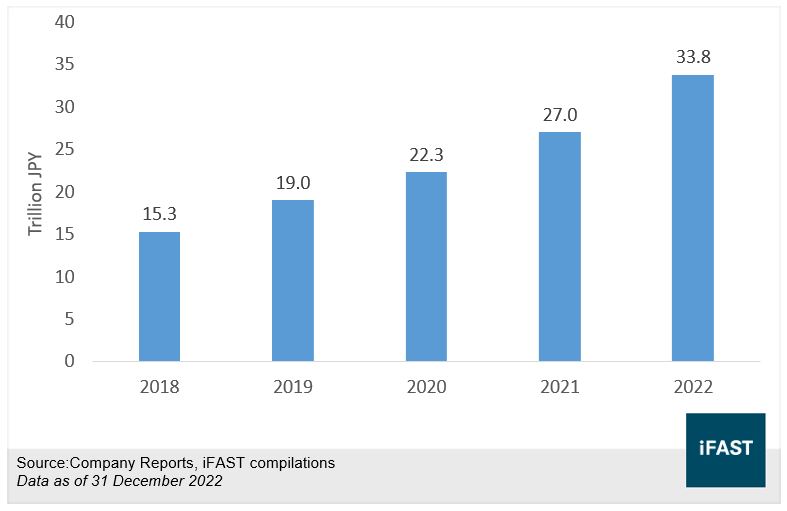
Rakuten Group’s E-commerce business is moving aggressively, as total GMV rose from JPY 15.3 trillion in 2018 to JPY 33.8 trillion in 2022 (Chart 1), with a compound annual growth rate of 17%. The number of monthly active users also swelled from 10 million to 39 million over the same period. As a consequence, the Group's revenue from the e-commerce business grew by 12.6% year-on-year to JPY 0.8 trillion in 2022, while operating profit surged 36.6% year-on-year to JPY 95.6 billion.
Chart 1: GMV of Rakuten Group
 To
support its E-commerce business, Rakuten Group established a financial services
division to provide mobile payments, credit cards, consumer loans, and other
related services. Later on, the financial business spreads to
banking, securities, and insurance. Owing to its fast-growing e-commerce
business, Rakuten marked a robust result in financial services, with revenue
rising by 7.2% YoY to JPY 0.6 trillion and operating profit growing by 10.8%
YoY to JPY 98.7 billion.
To
support its E-commerce business, Rakuten Group established a financial services
division to provide mobile payments, credit cards, consumer loans, and other
related services. Later on, the financial business spreads to
banking, securities, and insurance. Owing to its fast-growing e-commerce
business, Rakuten marked a robust result in financial services, with revenue
rising by 7.2% YoY to JPY 0.6 trillion and operating profit growing by 10.8%
YoY to JPY 98.7 billion.
Over the long term, given a less than 80% coverage ratio for E-commerce in Japan by the end of 2022, we believe Japanese E-commerce could be able to remain a high growth rate in the years ahead and continue to be bullish on Rakuten’s E-commerce and Financial service segments, which are expected to grow at a double-digit rate.
Mobile Telecom Weighs On Operation Performance
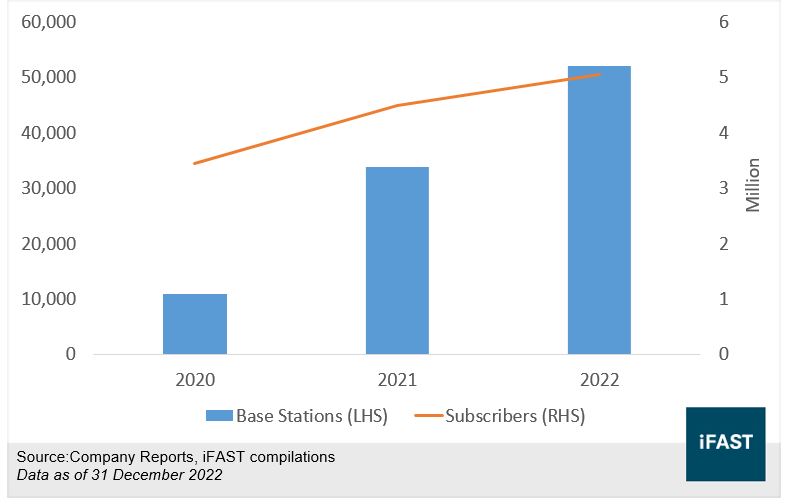
Although Rakuten engaged in the telecom business since 2018, it remains in an early development phase, leading to a higher focus on base station building and client soliciting. The base stations amounted to 52,000 at the end of 2022, a significant increase from 11,000 in 2020. By the end of 2022, Rakuten Mobile had more than 5 million subscribers and 1,200 business sites, making it the fastest-growing telecom service provider in Japan.
Chart 2: The Number of Subscribers and Base Stations
 It is worth mentioning that rapid-gowning subscribers are due to
extremely low charges on telecom services. The average telecom fee Rakuten
Mobile charges is much lower than peers, and the company even provided
free-of-charge telecom service to attract clients. As a result, coupled with
high expending on the base station building, the results are not that sound for
Rakuten Mobile, which delivered revenue of JPY 368.7 billion, up 62% YoY. But
the operating loss amounted to JPY 492.8 billion, even with a larger loss than
that in 2021.
It is worth mentioning that rapid-gowning subscribers are due to
extremely low charges on telecom services. The average telecom fee Rakuten
Mobile charges is much lower than peers, and the company even provided
free-of-charge telecom service to attract clients. As a result, coupled with
high expending on the base station building, the results are not that sound for
Rakuten Mobile, which delivered revenue of JPY 368.7 billion, up 62% YoY. But
the operating loss amounted to JPY 492.8 billion, even with a larger loss than
that in 2021.
All in all, the total revenue for Rakuten Group rose by 14.6% to JPY 1.9 trillion in 2022, and an operating loss of JPY 325.6 billion was incurred during the same period due to the poor performance of the telecom segment. In view of ongoing large-size spending on base station building in the next few years and low-price promotion strategy, we consider Rakuten Group will continue to be in red in the foreseeable future.
Decent Credit Quality for Financial Sector
Since Rakuten Group has exposure to the financial sector, which has a unique analytical approach in comparison to other business sectors. Therefore, the consolidated financial statements from Rakuten Group are not rather indicative, and we have to analyze business sectors separately.
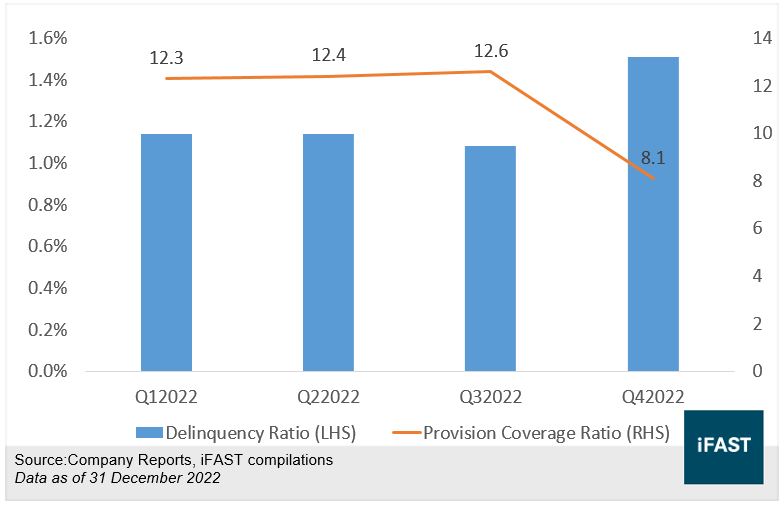
From the perspective of the financial services sector, generally speaking, consumer lending has a higher delinquency ratio than traditional bank loans, for example, the delinquency ratio for credit cards averages 5%. Chart 3 illustrates that the delinquency ratio for Rakuten is around 1.1% in 2022, which is still remarkably lower than the market average, despite rising to 1.5% in 4Q2022. In addition, the provision coverage ratio for bad debt over the past four quarters was 12.3x, 12.4x, 12.5x, and 8.1x, respectively, indicating a strong ability to manage credit risk and absorb loan loss.
Chart 3: Delinquency Ratio and Provision Coverage Ratio
Non-financial Sectors Face Thin Liquidity
Looking into non-financial sectors, we would like to pay close attention to the telecom business, given the moderate debt obligation for asset-light sectors like E-commerce. As of December 2022, the total debt outstanding from the telecom sector amounted to JPY 933 billion, which translated into a gearing ratio of 639%, based on the total equity of JPY 146 billion. The high gearing ratio suggests that the company faces a very high leverage and debt burden.
Rakuten Group aims to spend a record JPY 300 billion on telecom business, mainly on the base station building. We thus think the credit profile for the telecom sector might further deteriorate moving forward. Considering the fact that the telecom business can hardly be profitable, Rakuten Group has to use the cash generated from other business sectors to fill the funding shortfall, dragging down the credit quality of the whole group to a certain extent.
We cannot figure out the amount of funding shortfall directly, but the tight liquidity has been seen by the market due to corporate actions over the past few years. On one hand, Rakuten Group continues to dispose of assets for bolstering liquidity. For example, Rakuten sold 20% of ownership in Rakuten Securities to Mizuho Group for JPY 80 billion (about USD 550 million) last October. Besides that, the group's management has repeatedly and publicly stated their desire to carve out Rakuten Bank and Rakuten Securities to raise more funds.
To wrap up the points above, Rakuten reports a robust credit quality in both financial and E-commerce sectors, while the telecom business significantly weighs on the overall credit profile. The liquidity is expected to remain tight until the group makes substantial progress on its financing plan.
Substantial Progress on Equity Financing, Short-term Credit Risk is Manageable
To alleviate liquidity stress, Rakuten Group launched an initial public offering (IPO) for Rakuten Bank amid the market turmoil caused by the collapse of Silicon Valley Bank and Credit Suisse in April this year. The IPO was well received by the market and raised approximately JPY 83 billion for the Rakuten Group, making it the largest IPO in Japan over the past five years.
The group's equity financing continues, as it announced a public offering of new shares and a share placement in May this year, with the aggregated raised amount of JPY 332 billion. The issuance of 550 million shares, representing about 34% of the company's current shares, is quite rare and reflects the urgency of the company's financing. Following the completion of the listing of Rakuten Bank and the new issuance of shares, the group could get a cash inflow of JPY 415 billion, which is enough to cover the capital expenditure on the telecom segment in 2023 and significantly improve liquidity. Moreover, the group is attempting another IPO for Rakuten securities, and expected additional cash inflow could reach tens of billion Japanese Yen if the scheme works out.
Even so, it should be noted that the raised fund by equity financing in recent is no match for the future capital expenditure and debt repayment obligation. We thus believe that the credit risk is manageable in the short term, but the uncertainty of its credit profile remains high in the long term.
Bond Price Rebounded, Investment Opportunity Arises
We have one bond issued by Rakuten Group on our platform. The specification is shown below:
|
Bond |
Bond Credit Rating |
Years to Maturity |
Ask Price |
YTM |
|
RAKUTN 10.250% 30Nov2024 Corp (USD) |
BB (S&P) |
1.3 |
100.5 |
9.8% |
|
Source: Bondsupermart Data as of 28 July 2023 |
||||
We noted that the bond price rebounded significantly after the substantial progress on equity financing, gradually recovering from $94 in March to $ 100 now, suggesting the market's bullishness on its credit profile. The bond is currently yielding 10%, which is one of the highest return levels among Japanese corporate bonds.
Although the previous liquidity looked tight, the listing of Rakuten Bank and the new issuance of shares notably improved the liquidity. We believe the current liquidity is sufficient to meet indebtedness payment and credit risk in the short-term is manageable. Accordingly, the 2024 USD bond, with an investment horizon of just 1.3 years, has high investment attractiveness and is one of few Japanese corporate bonds that could proffer roughly 10% return, making it worthwhile for investors to consider.
Corporate Risk
Investors should be mindful of the following risk. Firstly, If Rakuten Group expands its capital expenditures in the future, the liquidity might shrink significantly, which may affect the group’s ability to repay its debt.
Second, if the subsequent financing plans, such as the listing of Rakuten Securities, do not progress as well as expected, the longer-term credit quality may deteriorate and then there is a higher likelihood of credit risk.
Conclusion
The Rakuten Group has a broad range of businesses, with good performance in e-commerce and finance. But the mobile communications business saw continuous substantial losses, resulting in an operating loss of over JPY 300 billion for Rakuten Group in 2022, and a low chance of achieving breakeven in the near future.
The credit quality is pretty decent for the financial sector, which maintains a low delinquency ratio. The non-financial segment is highly leveraged with thin liquidity. The IPO of Rakuten Bank and Rakuten securities is expected to improve liquidity. Given the recent substantial progress of equity financing, we are still bullish on its short-term solvency.
Investors can take note of its short-term bond, which will mature in 2024 with a yield to maturity of around 10%. We think the bond proffers an attractive risk premium when coupled with a BB-rated credit rating, and investors interested in Japanese bonds can consider it.
Declaration: For specific disclosure, at the time of publication of this report, IFPL (via its connected and associated entities) and the analyst who produced this report hold a NIL position in the abovementioned securities.
Our podcast series, Yield Hunters, is available on Spotify, iTunes Podcasts and Google Podcasts. We share our thoughts on new bond issues and hold discussions on the fixed income space. Listen to our latest episode below and follow us!