- StarHub is the second largest telecommunication company in Singapore with a large consumer subscriber base and strong cash-generative abilities.
- FY21 free cash flow grew by 25% year-on-year, while its service revenue and EBITDA margin also exceeded guidance on the back of its transformation strategies.
- Going forward, with the launch of DARE+ initiatives, the Group expects to achieve a combined growth and savings of SGD 500m over the next 5 years.
- Its net debt position is well-supported by its operating metrics, but we could potentially see higher leverage over the next 2 years due to service EBITDA margin compression.
- We think that it makes sense for StarHub to skip call for its 3.95% perpetual bond on 16 June 2022, since the first reset date only falls in 2027. Following its announcement to skip call, the perpetual bond yield has risen due to a fall in price, and we think that its valuation looks more attractive compared to its peers.
- The yield to reset on 16 June 2027 is ~4.38%, following which there will be a 100 bps step-up if StarHub decides not to redeem in 2027. This incentivizes the issuer to call back its perp in 2027, otherwise the coupon rate could be reset higher.
- For more information, investors may refer to the bond factsheet here.
Company Background
StarHub Ltd. (“StarHub”) is a leading telecommunication company in Singapore that delivers entertainment, communications and digital services to customers. The Group also provides solutions to corporations and government entities, including artificial intelligence, cybersecurity, data analytics, Internet of Things and robotics.
Listed on the Singapore Exchange mainboard since 2004, StarHub has a total market capitalization of SGD 2.11b as of 17 June 2022. It is a component stock of the SGX iEdge SG ESG Leaders and Transparency Indices as well as the ESG-focused FTSE4Good Index Series, thus demonstrating its commitment to sustainability. As of 31 December 2021, StarHub’s largest shareholder is Singapore Technologies Telemedia Pte Ltd (with ~56% of deemed interest), which is also a wholly-owned subsidiary of Temasek Holdings (Private) Limited.
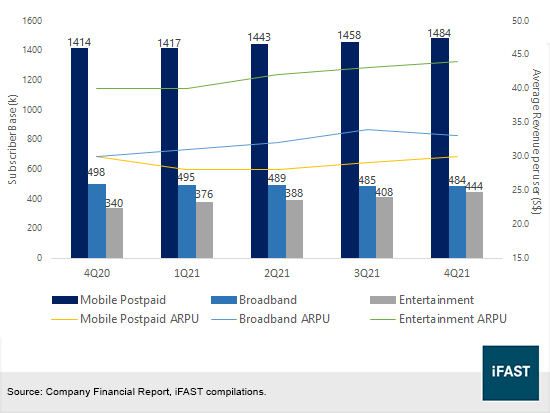
The Group mainly operates through 3 segments: 1) Consumer 2) Enterprise Business and 3) Equipment Sales. Consumer and Enterprise Businesses make up its total service revenue. Its Consumer segment comprises of mobile, broadband and entertainment services such as StarHub TV+ that offers more than 100,000 hours of content and 10 popular over-the-top (“OTT”) brands for customers to access. 1 in 2 households in Singapore is a StarHub customer, and the Group has approximately 2m mobile subscribers, 484k broadband subscribers and 444k entertainment subscribers as of 2021.
Meanwhile, its Enterprise Business segment consists of network solutions, cybersecurity services and regional information communications technology (“ICT”) services. With complementary capabilities and network from StarHub’s subsidiaries such as Ensign and Strateq, the Group is well-positioned to offer converged solutions in cybersecurity, cloud, and connectivity to support businesses. As for its Equipment Sales segment, StarHub mainly sells devices such as 5G handsets, set-top boxes, business routers and optical network terminal units.
Financial Highlights
For the full year ended 31 December 2021 (“FY21”), total revenue increased slightly by SGD 13.9m year-on-year (“YoY”) to SGD 2.04b, mainly due to higher contributions from its Broadband and Enterprise Business, which partially offset lower revenues from Mobile, Entertainment and Sales of Equipment (Figure 1). Operating profit for FY21 remained steady at SGD 231.8m despite a one-off inventory write-down and lower JSS payouts recognized, supported by lower operating expenses and higher Broadband revenues.
Figure 1: Total Revenue Breakdown
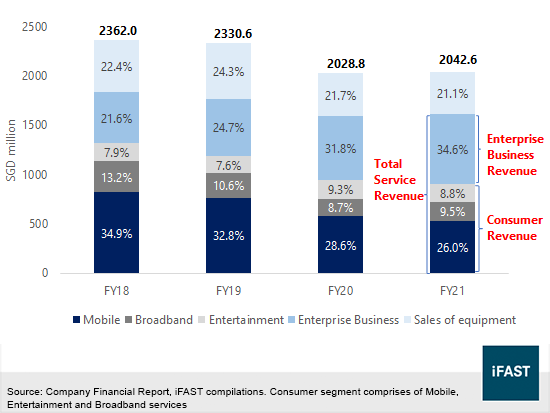
StarHub’s Consumer segment recorded a 10.4% YoY increase in total revenue, as postpaid mobile continued to register sequential quarterly growth, coupled with a turnaround for its Entertainment business as the Group migrated from linear Pay TV to Hybrid TV+ and OTT platforms.
Consumer segment average revenue per user (“ARPU”) increased across most of the segments (Figure 2), as its early strategies surrounding Infinity Play, which is a cross-product bundle integrating services such as OTT content and cloud gaming helped to offer a differentiated service from the rest of its competitors.
Notably, its consumer segment subscriber base has also exhibited a steady growth momentum in FY21 (Figure 2), particularly through its digital fighter brand, giga!, which offers consumers with a seamless end-to-end digital engagement by incorporating its Super App platforms.
Figure 2: Consumer Average Revenue Per User ("ARPU") and Subscriber Base
Meanwhile, StarHub’s Enterprise Business registered a 9.4% YoY growth in FY21, mainly driven by a higher contribution from in its Cybersecurity services (+21.7% YoY) due to stronger business demand, as well as consolidation of Strateq under its Regional ICT Services (+128.1% YoY) following its acquisition.
Its Enterprise 5G coverage has also seen encouraging demand with growing interest from the energy and commercial property developer sector. Nonetheless, revenue for its Enterprise Business was partially offset by lower contributions from its Data & Internet, Managed Services and Voice Services as a result of the Covid-19 restrictions and global chip supply shortage.
Business Outlook
DARE+ initiatives expected to generate cost savings and unlock performances
StarHub unveiled its DARE+ transformation and growth plans back in November last year, following the completion of its 3-year DARE 1.0 program at the end of October 2021 which resulted in total cost savings of SGD 273m. DARE+, which stands for “Digital in everything we do”, “Accelerating value creation”, “Realizing growth without frontiers”, and “Experiences that enrich customers’ lives”, will be a 5-year strategy to transform StarHub from a traditional telco services company into a digital-first brand by integrating its growing ecosystem of products and services to offer customers with differentiated solutions.
Following the implementation of DARE+ strategy, the Group expects to achieve a cumulative gross profit growth of SGD 220m and expected savings of SGD 280m from FY22 to FY26. Thereafter, its net profit after tax is also projected to grow at a stable run rate of SGD 80m per annum from FY26 onwards. This projection excludes potential synergies from existing and future acquisitions as well as the recovery in roaming as international borders gradually reopen.
…but EBITDA margin likely to compress over the next 2 years due to upfront investments
Nonetheless, its FY22 service EBITDA margin will likely narrow as a result of frontloading operating expenditure investments for IT and Digital Transformation, talent acquisition, rollout of entertainment content and ongoing network, as well as a steep increase in utility costs this year arising from higher electricity taxes. Furthermore, competition in its core connectivity business segments may also impact its EBITDA margin.
Despite the margin compression, StarHub still guided its FY22 service EBITDA margin to be at least 20% this year (FY21: 30%), while FY23 margin is projected to improve to 23% or more as its DARE+ strategy starts yielding higher returns from the second half of next year. FY22 service revenue is forecasted to grow by at least 10% YoY due to higher contributions from its mobile, broadband, cybersecurity and regional ICT services, coupled with the consolidation of newly acquired subsidiaries. Meanwhile, FY23 service revenue is targeted to grow 5 – 10% YoY as StarHub starts to realize the benefits from its DARE+ initiatives.
M&A remains crucial for StarHub’s growth strategy
Mergers and acquisitions (“M&A”) will remain as a key pillar for its growth strategy and DARE+ initiatives. StarHub has undertaken a number of M&A deals in recent years, including the acquisition of Strateq and HKBN JOS Singapore and Malaysia. Notably, the Group recently completed a 50.1% acquisition of MyRepublic Broadband in March. Following the transaction, StarHub’s broadband market share expanded to 40%, and we think that the acquisition will offer opportunistic synergies to help accelerate its growing range of product and service offerings.
Within an increasingly saturated telecom market, we believe that inorganic growth through M&As and joint ventures into different business areas will continue to play an important role for StarHub to enhance its capabilities and remain competitive. However, we should also note that inorganic growth through M&As have a considerable amount of operational and financial risks, especially if StarHub fails to integrate the new businesses to generate synergies or ends up overpaying/over-leveraging to acquire some of its target companies.
Credit Discussion
Table 1: Credit Metrics Comparison as at 31 December 2021
|
Company |
Current Ratio |
Net Gearing |
LTM EBITDA Coverage |
Total Debt/Total Asset |
Net Debt/LTM EBITDA |
|
StarHub Ltd. |
1.47 |
0.76 |
11.35 |
42.08% |
1.04 |
|
Singtel Limited* |
0.90 |
0.35 |
9.33 |
24.16% |
2.59 |
|
AT&T Inc. |
0.70 |
0.85 |
6.71 |
32.15% |
3.38 |
|
Verizon Communications Inc. |
0.78 |
1.78 |
14.08 |
41.15% |
3.06 |
|
Deutsche Telekom AG |
1.00 |
1.62 |
8.81 |
39.62% |
3.26 |
|
Source: Company Financial Reports, iFAST estimates *As at 31 March 2022 |
|||||
Net debt position well-supported by its operating metrics: Despite a challenging backdrop caused by the pandemic last year, StarHub’s operating parameters have remained strong with a 25% YoY growth in free cash flow, while EBITDA also remained steady at SGD 510.9m (FY20: SGD 537.8m). Even though StarHub’s total debt-to-asset ratio is the highest compared to other large diversified telcos with strong domestic market positions (Table 1), we take comfort in its healthy operating profit and higher guided service revenue over the next few years. Notably, StarHub’s net debt position lowered from SGD 757.0m in FY20 to SGD 531.9m as of 31 December 2021 on the back of higher cash and cash equivalents. Net debt-to-EBITDA ratio subsequently improved to 1.04x from 1.41x a year ago, which is the lowest as compared to its peers (Table 1).
…but expect leverage to rise with higher capex and potential acquisitions: FY22 and FY23 service EBITDA margins will likely narrow on the back of higher capital and operating expenditure due to the rollout of its DARE+ initiatives and higher electricity tariffs. StarHub has guided its capex commitment to a range of 12 – 15% of total revenue for FY22 and FY23, which is notably higher as compared to its BAU capex of 4% in the previous financial year. Furthermore, synergistic acquisitions remain integral to StarHub’s DARE+ vision as it will continue to look for potential opportunities in the market to expand its capabilities. As such, StarHub could take on more debt in the future to finance its capex and potential acquisitions. Nonetheless, its strong free cash flow position and low net debt-to-EBITDA ratio should provide sufficient debt headroom for the Group to fund its capex and acquire accretive target companies.
Short-term liquidity and interest servicing ability remain strong: As of 31 December 2021, StarHub has total cash and cash equivalents of SGD 821.5m, excluding restricted cash and fixed deposits as well as bank overdraft. This is more than sufficient to cover its short-term borrowings of SGD 226.2m. Meanwhile, its EBITDA/Interest expense ratio stood at ~11.35x last year, which still remains healthy even though EBITDA could potentially come down this year due to the frontloading of operating expenditure and upfront investments.
Relative Valuation
Table 2: Relative Valuation of Comparable Bonds
|
Bond |
Issue Date |
Next Reset Date |
Years to Next Reset Date |
Ask Price |
Ask Yield to Reset |
Step-up on Next Reset Date |
|
STHSP 3.950% Perpetual Corp (SGD) |
16Jun2017 |
16Jun2027 |
5.00 |
98.3 |
4.38% |
100 bps |
|
SINTEC 4.100% Perpetual Corp (SGD) |
02Jul2020 |
02Jul2027 |
5.05 |
99.98 |
4.10% |
100 bps |
|
SINTEC 5.000% Perpetual Corp (SGD) |
17Jan2019 |
17Jan2029 |
6.59 |
101.65 |
4.71% |
100 bps |
|
SINTEC 4.200% Perpetual Corp (SGD) |
03Nov2021 |
03May2029 |
6.88 |
98.75 |
4.41% |
100 bps |
|
STSP 3.300% Perpetual Corp (SGD) |
14Apr2021 |
14Oct2031 |
9.33 |
96.3 |
3.77% |
25 bps |
|
Source: Bloomberg Finance L.P., iFAST compilations. Figures as of 17 June 2022 |
||||||
StarHub announced that it will not be redeeming the STHSP 3.950% Perpetual Corp (SGD) on its first call date (16 June 2022). We think that it makes sense for the Group to skip call, considering that the perpetual bond (“perp”) will not be reset this time round since the first reset date falls on 16 June 2027. Factoring in the rising interest rate environment, we believe that it is more economical for StarHub to skip call and continue financing its perp at 3.95%, instead of refinancing it at a higher coupon rate.
Following the announcement to skip call on 13 May 2022, the ask price of STHSP 3.950% Perpetual Corp (SGD) has fallen from 100.1 to 98.3 as of 17 June with a yield to next reset of 4.38%. Consequently, valuations of the perpetual bond have become more attractive. Referencing to Table 2, if we were to compare StarHub’s 3.95% perpetual bond with SINTEC 4.100% Perpetual Corp (SGD) due to their similar years to reset, the 3.95% perp offers a yield pickup of ~28 bps over ST Telemedia’s 4.1% perp.
If the perpetual bond is not redeemed on the next reset date on 16 June 2027, the coupon rate will then be reset based on the 10-Year SGD Swap Offer Rate (“SOR”) plus an initial spread of 171.5 bps and a step-up margin of 100 bps. Even though it is hard to accurately predict where the 10-year SOR will be 5 years from now, we think that the additional step-up of 100 bps will incentivize the issuer to call back its perpetual bond on the next reset date.
Even if StarHub decides to skip call on 16 June 2027, the yield-to-worst (lowest possible yield) of the perp is 4.38%, which implies that investors can still earn at least 4.38% (or higher) per annum from a stable credit issuer based on the current ask price.
Conclusion
As Singapore’s second largest telco, we think that StarHub is positioned as a defensive play with steady cash flows over the years despite economic downturns. Its strong operating metrics offer sufficient debt headroom and financial flexibility to pursue aggressive growth strategies to expand its capabilities and remain competitive with other telcos in the market. We think that the recent non-call event of its 3.95% perpetual bond provides investors with an attractive opportunity (yield to next reset: 4.38%), considering that the bond has a 100-bps step-up on its next reset date in 2027 which incentivizes the Group to redeem the perp.
Declaration: For specific disclosure, at the time of publication of this report, IFPL (via its connected and associated entities) holds positions in SINTEC 4.200% Perpetual Corp (SGD) and STSP 3.300% Perpetual Corp (SGD) and the analyst who produced this report holds a NIL position in the abovementioned securities.
Our podcast series, Yield Hunters, is available on Spotify, iTunes Podcasts and Google Podcasts. We share our thoughts on new bond issues and hold discussions on the fixed income space. Listen to our latest episode below and follow us!