Highlights:
- LG Chem, the second-largest EV battery producer in the world, marked a YoY growth of 46.5% in 2021. Driven by the global trend toward EVs, we expect the revenue of LG Chem to remain a rapid growth.
- Although LG Chem situates in the asset-heavy industry, its leverage ratio is low. LG Chem owns a large amount of cash and cash equivalents, resulting in decent liquidity.
- Bond due 2025 is currently yielding 4.2%, offering moderate investment attractiveness.
Company Background
Founded in 1947, LG Chem was listed on Korea Exchange in 1969 (Stock Code: 051910. KS). The current market capitalisation reached KRW 40 trillion.
In terms of ownership, LG group owns 33% share of LG Chem as of December 2021, making LG Group the largest shareholder.
Petrochemicals, electric vehicle (EV) batteries, as well as pharmaceuticals principally constitute the major business of LG Chem. As of December 2021, LG Chem is the seventh-largest chemical company in the world and the largest in Korea in terms of sales volume.
Petrochemicals Delivered Robust Results in 2021
Referring to the revenue breakdown (Chart 1), as of December 2021, the petrochemicals segment is the largest revenue source for LG Chem, accounting for 41% of total revenue.
Chart 1: LG Chem’s Revenue Breakdown
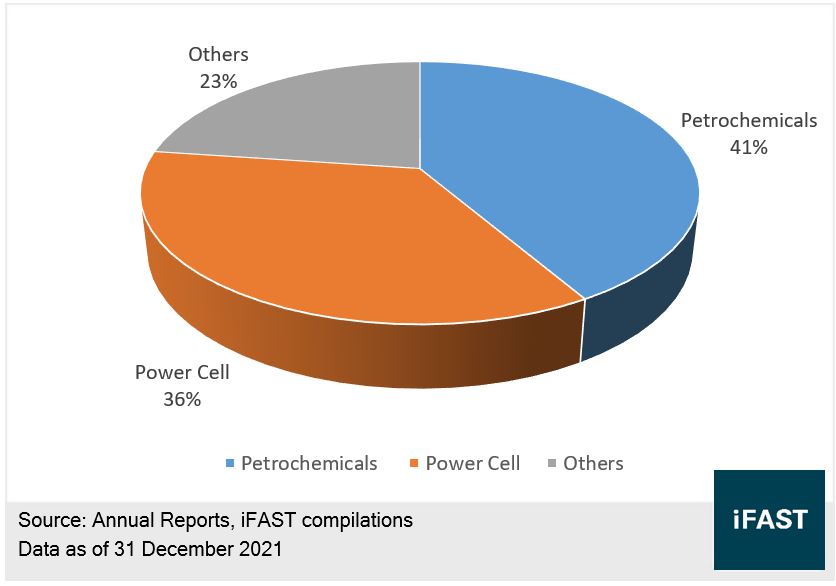
LG Chem’s petrochemical production includes plastic materials such as ABS, PE, etc. As an upstream player in petrochemical production, LG Chem’s production is mainly exported to China. Owing to the effect of low base and high demand from the Chinese market, LG Chem delivered robust results with revenue from the petrochemical segment rising by 44.4% to KRW 20.8 trillion in 2021.
However, given that petrochemical productions are derived from oil refining, the production cost is highly correlated with the oil price. Influenced by this year’s Russia-Ukraine war, the soaring oil price will undoubtedly have an adverse impact on LG Chem. We noted that the revenue performance of LG Chem exhibited some resilience in 1Q2022 as it grew by 10% compared to 4Q2021. Yet the operating margin saw a plunge from 20% in 2021 to 10.6% in 2022. We believe the weak profitability will continue this year since the crude oil price remains high.
Looking ahead, as the policies on the use of traditional plastic products are tightening globally, the entire industry is shifting towards biodegradable plastic. LG Chem owns many relevant patents and plans to build the first PBAT plant in 2H2022. It is also expected that LG Chem might become the industry leader.
A Beneficiary of the Global EV Trend
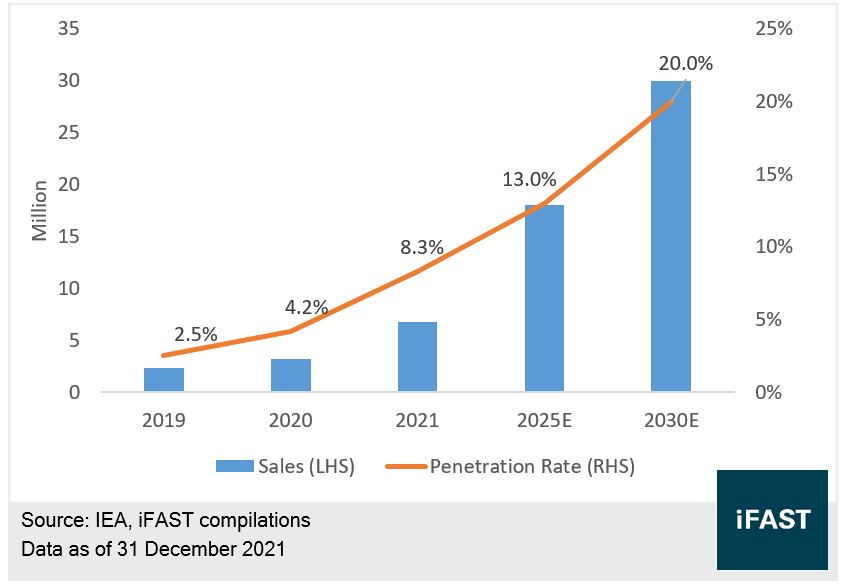
Investors may have heard that many countries proposed to ban the sales of traditional vehicles after 2030 owing to environmental considerations like carbon emission. EV is one of the alternatives. According to the data released by the International Energy Agency (Chart 2), only 2.3 million EVs (including PHEVs) were sold worldwide in 2019 but the number jumped to 6.8 million at the end of 2021 with a penetration rate of 8.3%. The International Energy Agency also estimates the annual sales to reach 30.0 million by 2030 and a penetration rate of over 20%, which translates into a CAGR of 18% during that period. The world is stepping into the EV era.
Chart 2: Sales of EV and Penetration Rate
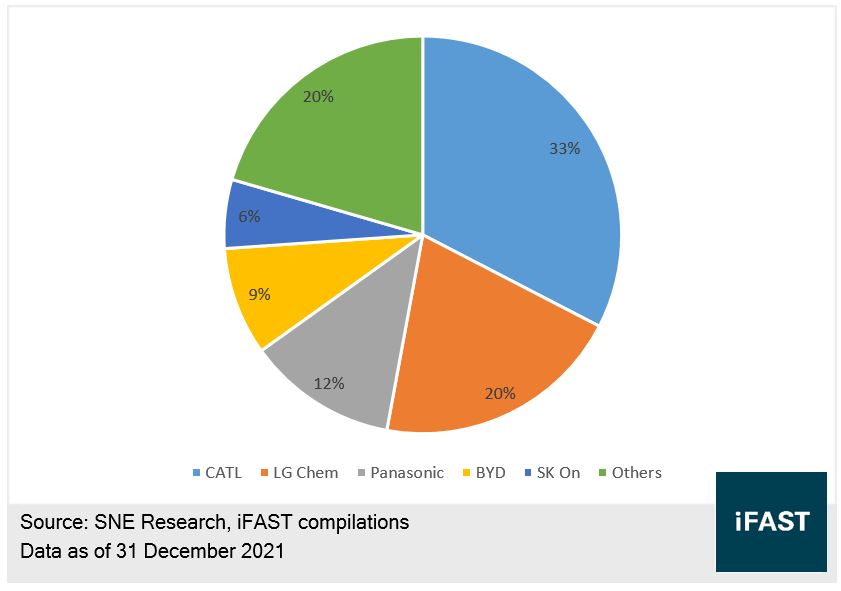
As the most important component of EVs, the demand for batteries will increase along with sales of EVs. As a result, it is undoubted that battery producers will benefit much from this. Data retrieved from SNE Research (Chart 3), an authoritative research institute, shows that LG Chem is the second-largest power cell producer in the world after CALT in 2021. LG Chem holds a market share of 20.6% and has an installed capacity of 60.3 GWh. It is noteworthy that most well-known EVs such as Tesla Model 3, Model Y, Porsche Taycan, and Audi E-tron use batteries manufactured by LG Chem.
Chart 3: Power Cell Market Breakdown
LG Chem carved out the battery production segment in 2020 as LG Energy Solution which became a Korea-listed company (Stock Code: 373220. KS) earlier this year via the biggest IPO in Korea. LG Energy Solution’s current market capitalisation has reached KRW 96 trillion, making it the second largest listed company in Korea after Samsung.
Revenue from LG's battery production segment has seen a surge from KRW 8.4 trillion in 2019 to KRW 17.9 trillion in 2021, with a CAGR of roughly 50%. Besides, the profitability of the segment improved in 2021, it recorded positive operating profit of KRW 0.8 trillion for the first time.
On the whole, the revenue of LG Chem totaled KRW
20.8 trillion, swelling by 46.5% YoY. LG Chem’s operating profit marked an
approximately 100% YoY growth to KRW 4.1 trillion. Its operating margin spiked
to 19.7% as well, its track records are outstanding. Both petrochemical and
batter segments are facing a promising future with ample room for further
development.
Leverage Slightly Moved Upwards but Is Still Healthy
Looking into LG Chem’s credit profile, as of December 2021, its short-term and long-term debt were KRW 3.5 trillion and KRW 11.3 trillion respectively. The varying degrees of rise from 2020 is mainly due to the increased borrowings for capacity expansion. LG Chem’s Cash and Cash equivalents amounted to KRW 3.8 trillion, just enough to cover its short-term debt. It suggests that the overall liquidity is not that loose. On the other hand, the leverage ratio in 2021 moved upwards, the net gearing ratio rising by 15 percentage points to 47.1%. Nevertheless, LG Chem’s current leverage is still at a healthy level and its debt repayment stress is manageable.
Table 1: Credit Metrics of LG Chem
|
(Trillion KRW) |
2021 |
2020 |
|
Short-term Debt |
3.5 |
1.5 |
|
Long-term Debt |
11.3 |
8.6 |
|
Cash and Cash equivalents |
3.8 |
3.3 |
|
Net Gearing Ratio |
47.4% |
36.8% |
|
Source: Annual Reports, iFAST compilations Data as of 31 December 2021 |
||
Aggressive Production Capacity Expansion Has Manageable Impacts on Credit
Driven by the tremendous demand for EV batteries, LG Chem is highly aggressive in production capacity expansion in recent years. Last year, LG Chem announced its proposal of investing USD 4.5 billion in the US production facilities expansion by 2025 and to become the world's largest battery manufacturer by 2024. With such an aggressive expansion plan, is LG Chem’s credit profile likely to deteriorate?
Although the expansion plan looks aggressive, it is still rational. For example, LG Chem’s capital expenditure in 2021 was KRW 3.1 trillion, a 20% increase YoY. Concurrently, the cash flow from operations amounted to KRW 5.0 trillion. These statistics suggest that the cash generated by operation is enough to cover its capital expenditure. We believe that its expansion plan hinges on cash balance to a certain extent. The likelihood of notable deterioration in liquidity is rather low.
Moreover, given LG Chem's large asset base and its involvement in a promising battery production industry, the company could get refinancing easily. In late July this year, the U.S. Department of Energy loaned USD 2.5 billion to LG Chem's joint venture with General Motors to build a new battery production facility. Taken together, LG Chem's aggressive expansion plan is expected to have a limited impact on its credit profile.
Bond due 2025 Yields Moderate Attractiveness
Currently there is only one bond issued by LG Chem that can be traded on our platform, the bond details are listed below (see Table 2):
Table 2: Bond Investment of LG Chem
|
Bond |
Years to Maturity |
Ask Price |
YTM |
|
LGCHM 4.375% 14JUL2025 CORP (USD) |
2.9 |
100.4 |
4.2% |
|
Source: Bondsupermart Data as of 12 August 2022 |
|||
The bond’s credit rating is BBB+, currently yielding approximately 4.2% with a three-year investment horizon. In spite of fair investment attractiveness among investment-grade issuers, investors interested in LG Chem or Korean issuers may consider LG Chem’s bond.
Corporate Risk
Investors should be aware of the following risks. First, a surge in raw material price for the battery will likely weigh on the profitability. The robust demand for lithium, which is required for EV battery production, drives up the price. For example, the price of lithium carbonate swelled from approximately USD 7,700 per ton in early 2021 to USD 69,000 per ton now. The almost-tenfold increase in price will further pump up the production cost of LG Chem, thus affecting its profitability.
Also, LG Chem mainly produces Nickel-Cobalt lithium batteries which have larger energy density and capacity. But the production cost is much higher than Lithium iron phosphate batteries produced by LG Chem’s Chinese rivals. This is to say, the low-price battery might erode LG Chem’s market share and limit its further development.
Conclusion
LG Chem marked a 46.5% YoY growth in 2021, making it the second-largest EV battery producer in the world. Driven by the global trend toward EVs, we expect the revenue of LG Chem to remain rapid growth.
Although LG Chem situates in the asset-heavy industry, the leverage ratio is low. LG Chem owns a large amount of cash and cash equivalents and thus has decent liquidity.
Bond due 2025 is currently yielding 4.2%, offering moderate investment attractiveness.
For specific disclosure, at the time of publication of this report, IFPL (via its connected and associated entities) and the analyst who produced this report hold a NIL position in the abovementioned securities.