- BNP Paribas is a highly diversified multi-national
bank with its footprints all over the world.
- While it did not benefit much from rising interest
rates, it continues to see a stable stream of revenue and income despite
fluctuations in the global economy.
- Outlook is stable for BNP Paribas, which we
believe that it will have an advantage when the global economy finally
recovers.
- SGD issuances from BNP Paribas will be better for
conservative investors, given a more stable profile as compared to HSBC.
Introduction
BNP Paribas SA (“BNP Paribas”) is a France-based multi-national bank, which is also the overall banking leader across the European Union. BNP Paribas has footprints across the globe, with almost 184,000 employees situated in 64 countries – with the majority (>145,000) in Europe – as of 31 March 2023. In Europe, the bank oversees four key domestic markets – Belgium, France, Italy and Luxembourg, while also tapping into the Eastern European markets and Turkey.
BNP Paribas defines its business into three major operating divisions, each with highly diversified across numerous business lines other than the traditional banking business –
- Corporate & Institutional Banking (“CIB”): primarily provides for corporate and institutional clients worldwide, which is further divided into Corporate Banking, Global Markets (for services related to capital markets) and Securities Services (for securities clearing, custody and services).
- Commercial, Personal Banking & Services (“CPBS”): primarily constitutes the commercial banking network serving the following countries – France, Belgium, Italy, Luxembourg, Turkey, Ukraine, Poland, Algeria, Morocco and China. It also includes other smaller business lines, such as digital banking services in Germany and India.
- Investment & Protection Services (“IPS”): includes four
specialized business lines – Insurance, Asset Management, Private Banking and
Real Estate, primarily catered towards the clients of the other divisions.
The roadmap for BNP Paribas has always been clear. From 2017 to 2020, it worked on its business model, solidifying its base and making it profitable. Between 2020 to 2021, it focused on supporting clients during the pandemic. Now, for its “2025 Strategic Plan”, BNP Paribas placed upon itself ambitious targets primarily focusing on these areas – growth, technology and sustainability. Some of its financial targets set out in this plan are:
- Compounded annual growth rate (“CAGR”) for revenue >3.5% across 2021 to 2025
- Net income CAGR of >7% across 2021 to 2025
- CET1 ratio of 12.9% by 2024, and reducing further to 12.0% by 2025
- Jaws effect of >2.0 percentage points averaged across 2021 to 2025
- Return on Tangible Equity
(“RoTE”) of >11% by 2025
Financial Highlights
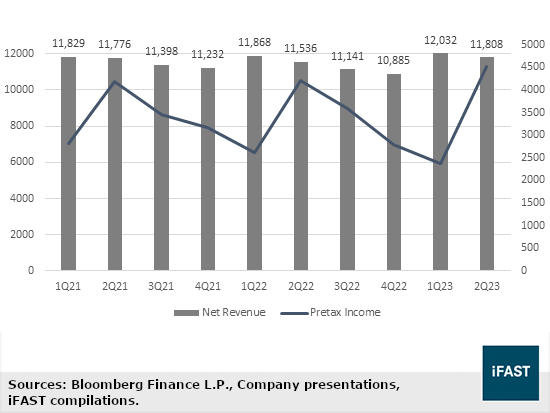
BNP Paribas generally records a stable stream of revenue and pre-tax income. While pre-tax income fluctuates about a certain range, revenues are relatively stable for BNP Paribas across the previous quarters (Chart 1), seemingly resilient from economic changes.
For most banks, aggressive rate hikes resulting in higher interest rates have allowed them to benefit from a higher net interest income. However, for France-based banks like Credit Agricole and Societe Generale (due to restrictive France legislations), higher interest rates tend not to materially impact net interest income (“NII”) due to higher deposit pass-throughs. Net interest income mostly stayed stagnant for these French banks, although we note that banks which have diversified beyond France, like Credit Agricole and BNP Paribas, enjoy the support of higher interest rates more.
Chart 1
Quarterly
revenue results and pretax income in recent years (in EUR m)
On
the other hand, we see the benefits of being globally diversified with multiple
business lines. For BNP Paribas, despite having limited opportunities to ride
on the tailwinds of high interest rates, the enormous scale where it operates contributes
to stable revenue. Fluctuations might arise due to changing operational
requirements across the year, but overall, we see its income stabilizing to a
certain extent as well.
For the half year ended 30 June 2023 (“1H23”), revenue fell from EUR 23,404m in 1H22 to EUR 23,395m in 1H23 – largely due i) a EUR 833m cost associated with changes in terms and conditions for targeted longer-term refinancing operations (“TLTRO”) and ii) EUR 125m for litigations. Looking solely at the financial results of the three operating divisions, revenues instead saw an increment of 2.6% YoY in 1H23 as compared to 1H22, +1.1% through CIB, +4.6% through CPBS and +0.5% through IPS.
The operating expenses for BNP Paribas increased by 3.5% from EUR 15,533 in 1H22 to EUR 16,080m in 1H23. Excluding exceptional items of EUR 512m associated with restructuring and adaptation plans, BNP Paribas highlighted a smaller increase in operating expenses at 1.4% and a positive jaws effect of 2.7 percentage points.
The
cost of risk fell from EUR 1,409m in 1H22 to EUR 1,331m in 1H23 – 30 basis
points (“bps”) of customer loans outstanding. The cost of risk remains
relatively low, although BNP Paribas had guided for the cost of risk to
normalize upwards slightly to <40 bps between 2022 and 2025.
Outlook for BNP Paribas
We expect earnings outlook for BNP Paribas to remain resilient amidst the uncertain economic outlook. In recent years, even as economic conditions fluctuate, we do not see much volatility in the bank’s revenue. We think this reflects the bank’s strong advantage – being able to adapt to changing market environment given its multiple business lines in various markets. With Europe’s growth likely softening moving ahead and interest rates staying elevated, BNP Paribas’ diverse business operations should provide income stability on a group level.
That said, the diversity of the BNP Paribas’ operation might limit upside in earnings. In particular, the bank’s ability to capture higher net interest income and margin may be limited as compared banks that focuses on traditional banking. Additionally, business cycle will likely have to improve, for the bank’s profitability to improve. Given the above considerations, we think the bank may lack the drivers to attain its 2025 targets.
Overall,
the earning outlook for BNP Paribas continues to remain stable but the 2025
financial targets might appear overly ambitious. Nonetheless, when the business
cycle do improve, we believe BNP Paribas will enjoy relatively strong earnings
upside, while banks reliant on the traditional banking business will experience
headwinds from peaking, or even falling, net interest margins.
Credit and Solvency Profile
Chart 2
Capital
ratios of various major and regional banks in Europe
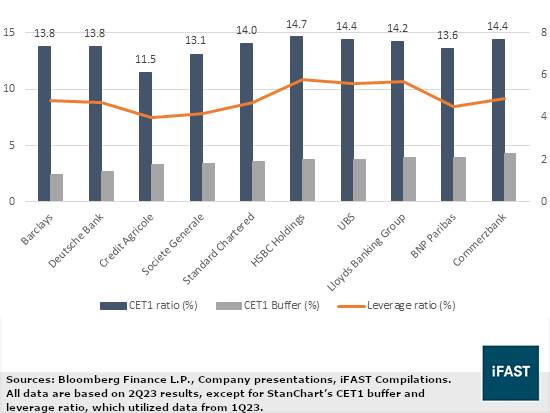
All data are based on 2Q23 results, except for StanChart’s
CET1 buffer and leverage ratio, which utilized data from 1Q23.
BNP Paribas’ CET1 ratio stands at 13.6% as of 30 June 2023, constant against the previous quarter. Despite organic capital growth across 2Q23, the gain was offset by dividend payouts and the establishment of new partnerships under CPBS. BNP Paribas’ capital ratios stand relatively well against other European banks (Chart 2), where its CET1 buffer against the requirement is one of the highest across the various banks at ~390 bps.
We note that BNP Paribas’ CET1 ratio saw a relatively large jump from 12.3% as of 31 December 2022 to 13.6% as of 31 March 2023. It was primarily due to the sale of its subsidiary Bank of the West in February, resulting in a considerable reduction in risk-weighted assets (“RWA”) across the period. BNP Paribas has a historical CET1 ratio of between 12% to 13%.
The high-quality liquid assets (“HQLA”) fell from EUR 426b as of 1Q23 to EUR 404b as of 2Q23, largely due to the EUR 44b repayment of TLTRO. HQLA continues to cover a large proportion of total deposits at approximately 52%. We expect further reductions to HQLA considering there remains outstanding TLTRO valued at EUR 20.5b, in which BNP Paribas is likely to repay soon given the increased interest rates on the loans as determined by the European Central Bank (“ECB”). The liquidity coverage ratio has been increasing since 3Q22, which currently stands at 143%, above the regulatory requirement of 100%.
We would like to highlight BNP Paribas’ plan to reduce the CET1 ratio gradually from here, to 12.9% by 2024 and 12.0% by 2025. While this aims to improve the capitalization structure of the bank, investors ought to note that this will also result in a smaller buffer for loss absorption.
At
the moment, we do not see it as a red flag as this is a normalization of the CET1
ratio to its historical levels rather than a material decline. However, this
would sound alarm in the event that the CET1 ratio falls below the historical
range of 12~13%, or if BNP Paribas’ loan profile deteriorates considerably,
given its decreased capacity to absorb any major impacts.
Recommendations
Table 1
SGD
senior bank papers
|
Issue |
Ask Price |
Yield to Call/Maturity |
Years to Call/Maturity |
Bond Credit Rating (S&P/Fitch) |
|
BNP 3.650% 09Sep2024 Corp (SGD) |
99.80 |
- / 3.90% |
0.95/ - |
A-/ A+ |
|
HSBC 4.500% 07Jun2029 Corp (SGD) |
100.92 |
4.28%/ 4.42% |
4.70/5.70 |
A-/ A+ |
|
MQGAU 4.500% 18Aug2026 Corp (SGD) |
100.50 |
4.21%/ 4.65% |
1.89/2.89 |
BBB+/ A |
|
Sources: Bloomberg Finance L.P., Bondsupermart, iFAST Compilations. Data as of 27 September 2023. |
||||
Table 2
SGD
Tier 2 subordinated papers
|
Issue |
Ask Price |
Yield to Call/Maturity |
Years to Call/Maturity |
Bond Credit Rating (S&P/Fitch) |
|
BNP 4.350% 22Jan2029 Corp (SGD) |
99.85 |
4.79%/ 6.18% |
0.32/ 5.32 |
BBB+/ A- |
|
BNP 3.125% 22Feb2032 Corp (SGD) |
93.93 |
5.09%/ 4.97% |
3.43/ 8.43 |
BBB+/ A- |
|
BNP 5.250% 12Jul2032 Corp (SGD) |
101.00 |
4.95%/ 5.57% |
3.81/ 8.81 |
BBB+/ A- |
|
HSBC 5.300% 14Mar2033 Corp (SGD) |
101.30 |
4.97%/ 5.14% |
4.46/ 9.46 |
BBB/ A- |
|
HSBC 5.300% 26Mar2034 Corp (SGD) |
100.99 |
5.09%/ 5.25% |
10.50 / 5.50 |
BBB/ A- |
|
ANZ 4.500% 02Dec2032 Corp (SGD) |
99.88 |
4.53%/ 4.88% |
4.18/ 9.19 |
BBB+/ A- |
|
Sources: Bloomberg Finance L.P., Bondsupermart, iFAST Compilations. Data as of 27 September 2023. |
||||
BNP Paribas is rated Aa3 (Stable), AA- (Stable) and A+ (Stable) by Moody’s, Fitch and S&P respectively. Among its SGD issuances, it offers the senior non-preferred BNP 3.650% 09Sep2024 Corp (SGD) and three Tier 2 subordinated papers of varying tenors.
A close comparison to BNP Paribas would be HSBC – generally offering higher yields despite having similar credit ratings. For the consideration of yields, we continue to favour the bonds from HSBC, coupled with the optimistic outlook in the near term for HSBC. Investors who want to harness yield pick-ups can look at HSBC 4.500% 07Jun2029 Corp (SGD) (senior paper) and HSBC 5.300% 26Mar2034 Corp (SGD) (Tier 2 subordinated).
However, we think that BNP Paribas would appeal better to investors who might be more conservative – given the overall profile of the bank as compared to other major and regional banks. Firstly, BNP Paribas’ diversified business profile should provide earnings stability in an increasingly uncertain macroeconomic environment. Secondly, HSBC has a slightly riskier loan book with exposure to the troubled Chinese commercial real estate sector. As such, BNP Paribas’ safer profile might be more suited to conservative investors.
Amidst the SGD Tier 2 bonds from BNP Paribas, we prefer BNP 3.125% 22Feb2032 Corp (SGD) considering the higher yield to call at 5.09% with about 3.43 years remaining to call. Banks are incentivized to call upon their Tier 2 securities, as the Basel III regulations require Tier 2 capital to be amortised past its call date. As such, we believe non-call risk is low given that the incentive to refinance Tier 2 securities and maintain Tier 2 capital levels.
Once again, we would like to highlight the risk of loss absorption on the Tier 2 subordinated bonds, which might not cater to all investors.
Declaration: For specific disclosure, at the time of publication of this report, IFPL (via its connected and associated entities) holds a position in HSBC 5.300% 14Mar2033 Corp (SGD) and ANZ 4.500% 02Dec2032 Corp (SGD), and the analyst who produced this report holds a NIL position in the abovementioned securities.
Our podcast series, Yield Hunters, is available on Spotify, iTunes Podcasts and Google Podcasts. We share our thoughts on new bond issues and hold discussions on the fixed income space. Listen to our latest episode below and follow us!