Highlights:
- Phoenix Group is a large insurance company in the UK. The main businesses are wealth management, pension fund management and retirement solutions. It has assets under administration of GBP 260 billion. Almost all shareholder investments are fixed-income investments. The operating performance remains robust.
- The Group takes advantage of risk management strategies to lock in cash flows. Its long-term free cash could rise steadily. The liquidity remains strong, with a better-than-peers leverage ratio.
- Investors could consider its USD or GBP Bonds, with yield to maturity of 6.6% to 7.6%.
Focus on Wealth Management and Pension Fund Management
Phoenix Group is a large insurance company in the UK. The main businesses are wealth management, pension fund management and retirement solutions. As shown in Chart 1, it has assets under administration of GBP 260 billion.
The Group is currently listed on the London Stock Exchange (Stock Code: PHNX.LN), with a market capitalization of around GBP 5.36 billion.
Chart 1: Phoenix Group’s Asset Under Administration Breakdown
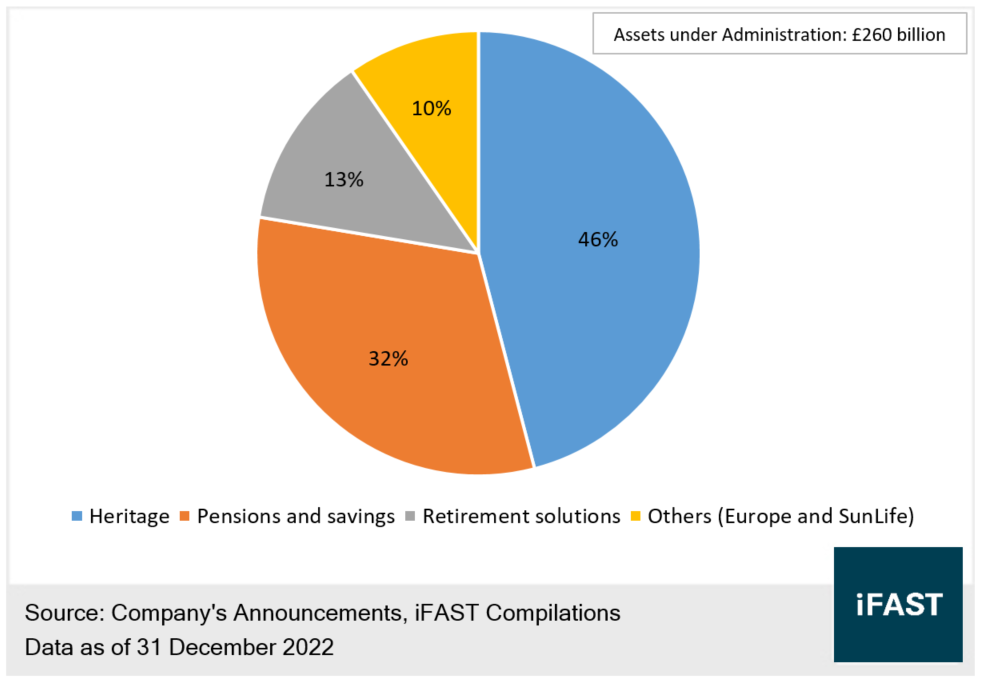
The heritage business is the old insurance contracts due to past acquisition or other reasons. The contracts include wealth management and pension insurance contracts. The Group almost suspended the sales of this kind of contract. The contracts will be settled and expired from the time being. While it is hard for the Group to update or change the investment strategies under these old contracts, it can save the administrative costs to improve the proceeds.
Pensions and Savings is the focus of the current development. New clients are accepted to subscribe the wealth management products and pension solutions. It is the Group's main growth driver.
Retirement solutions include defined benefit pensions, individual annuities and home equity release.
Other segments include Europe and the subsidiary, Sun Life. As both make a low contribution to earnings and are non-UK based businesses, the Group has classified them as part of the same segment.
Almost All Shareholder Investments are Fixed-income Investments
The investment portfolio of insurance companies can be divided into two categories: policyholders’ investments and the insurance company’s shareholder investments. The latter is the key to the profitability and solvency of insurance companies.
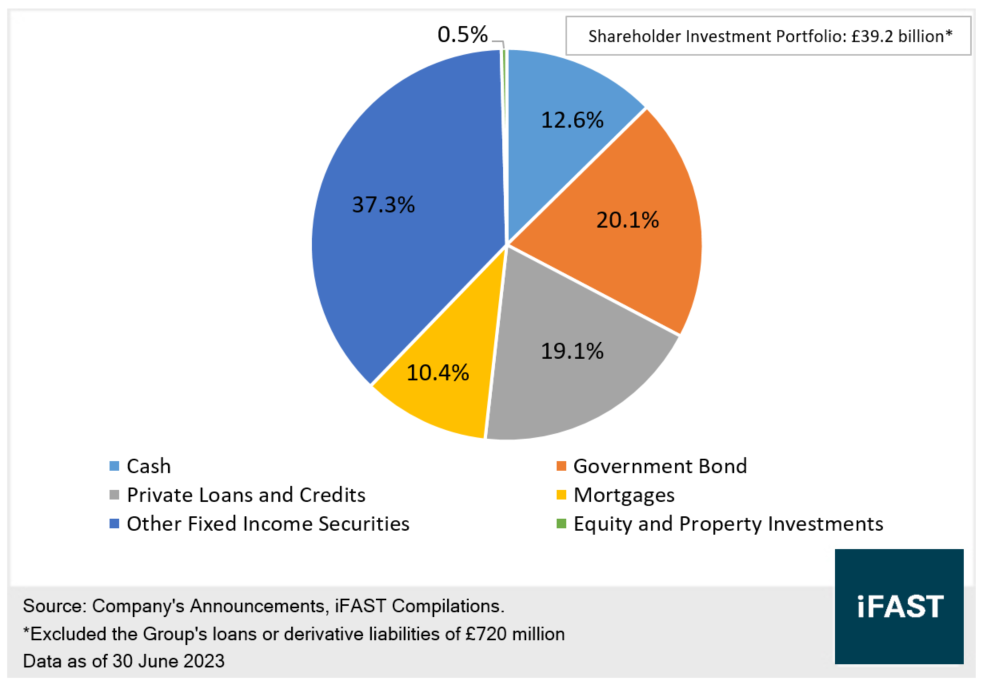
As shown in Chart 2, in addition to cash, almost all of Phoenix Group's shareholder investments are fixed-income investments, with a wide range of asset classes, including government bonds, private credit, private loans, mortgages and corporate bonds, etc. Only less than 1% is in equity or real estate investments, which have a higher risk. The portfolio is quite defensive.
Chart 2: Phoenix Group’s Shareholder Investments
Robust Operating Performance
In the first half of 2023, Phoenix Group’s operating companies’ cash generation was GBP 0.9 billion, within the annual target of GBP 1.3 billion to GBP 1.4 billion. Incremental new business long-term cash generation doubled YoY to GBP 890 million, driven by retirement solutions. This implied a certain cash flow growth in the next few years. The overall operating performance remained robust.
The operating companies’ cash generation means the actual cash flows from the Group’s subsidiaries to the holding company level. This indicator could measure the actual operating performance and cash flow situations. The cash generation could be used for debt repayment, coupon payment and distribution of dividends, so it affects the Group’s debt repayment ability.
The incremental new business long-term cash generation means the expected cash generation in the next few years of the new business acquired within the period. The figure would be reflected gradually in the future results and the operating companies’ cash generation. It is to foresee the future growth in the cash flows.
Table 1: Phoenix Group’s Main Operating Indicators
|
2023 1H |
2022 1H |
YoY (%) |
2022 Full Year |
2021 Full Year |
|
|
Operating Companies’ Cash Generation (GBP billion) |
0.90 |
0.95 |
-5% |
1.50 |
1.72 |
|
Incremental New Business Long-term Cash Generation (GBP billion) |
0.89 |
0.43 |
+106% |
1.23 |
1.18 |
|
Assets under Administration (GBP billion) |
269.0 |
268.8 |
0% |
259.0 |
310.4 |
|
Sources: Company’s Reports, iFAST compilations Data as of 30 June 2023 |
|||||
A Steady Rise in Long-term Free Cash Due to Risk Management Strategies to Lock in Cash Flows
Phoenix Group estimated its latest long-term free cash was GBP 12.5 billion, increased by around GBP 0.33 billion from the end of 2022. This was driven by the new business and expected performance of acquisitions, reflecting its ability to continue to grow its net business value and cash flow performance over the long term.
It is worth noting that the Group's long-term free cash could rise steadily, thanks to the use of a number of risk management strategies. These make its long-term free cash and total eligible own funds virtually immune to any of the more common market conditions, ensuring the Group's liquidity and locking in future cash flows. This is where the Group's strategy differs significantly from that of its peers.
The hedging strategies could handle the following situations: a fall in the stock market, a rise in interest rate, an increase in the long-term inflation rate, widening credit spreads, GBP depreciation and bond rating downgrades.
Along with the new business, synergy effects from acquisitions and the risk management strategies to lock in cash flows, we believe that it is far more robust than its peers, more resilient to market volatility and has a stable credit profile.
Liquidity Remains Strong, with Better-than-Peers Leverage Ratio
As shown in Chart 3, in the first half of 2023, Phoenix Group’s shareholder capital coverage ratio (total eligible own funds / solvency capital requirement) slightly decreased to 180%, which was within the guidance range of 140% to 180%. The liquidity remains strong.
Chart 3: The Group’s Shareholder Capital Coverage Ratio
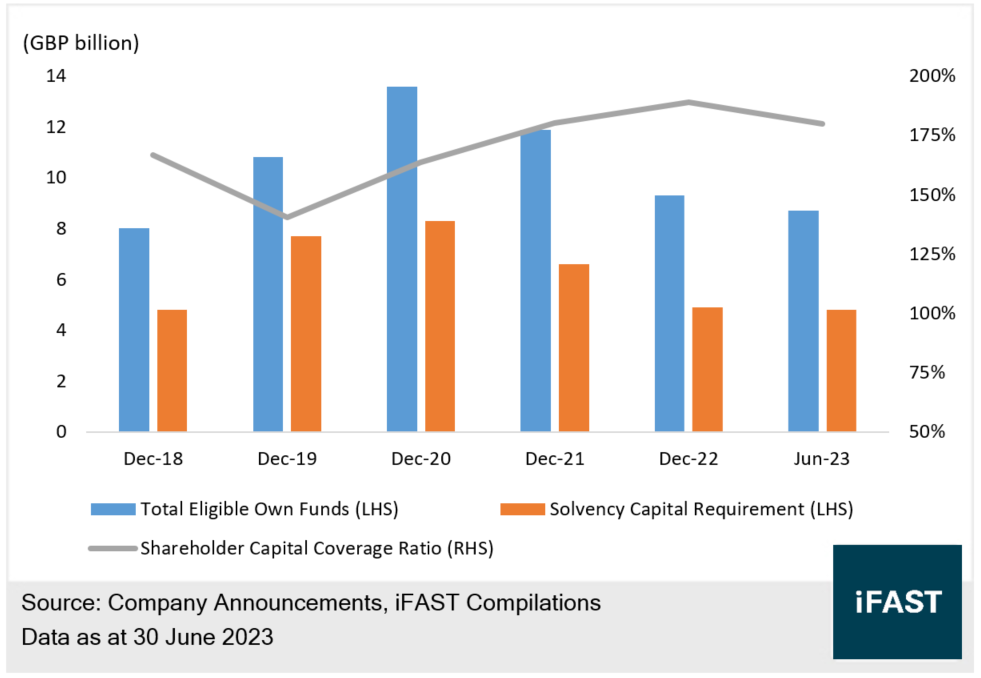
Compared to the peers (see Table 2), the Group’s shareholder capital coverage ratio was slightly lower than the peers’, but it was still much larger than the Solvency II regulatory requirement, i.e. 100%. Nevertheless, the Group’s leverage ratio was better than its peers’. The leverage level is quite decent.
Table 2: The Peers’ Shareholder Capital Coverage Ratios and Leverage Ratios
|
|
Shareholder Capital Coverage (%) |
Leverage Ratio (%)* |
|
Phoenix Group |
180% |
25% |
|
Legal & General |
230% |
28% |
|
Aviva |
202% |
30% |
|
Just Group |
204% |
22% |
|
Admiral Group |
182% |
53% |
|
*Leverage Ratio = Total Debt / (Total Debt + Total Equity + Contractual Service Margin), the lower is better Sources: Bloomberg Finance L.P., Company Reports, iFAST Compilations Data as at 30 June 2023 |
||
Investors Could Consider its USD or GBP Bonds, with yield to maturity of 6.6% to 7.6%
Investors can consider Phoenix Group’s USD or GBP bond, with a yield to maturity of 6.6% to 7.6%.
The Group’s issuer rating is A+ (Fitch), and this bond credit rating is BBB+ (Fitch), which belongs to the investment grade category.
Table 4: Phoenix Group’s Bonds
|
Bond Name |
Currency |
Tenor |
Ask Price (Investors Buy) |
Yield To Maturity (%) |
|
GBP |
2.2 |
99.7 |
6.6% |
|
|
GBP |
2.7 |
92.3 |
7.2% |
|
| PHNXLN 5.375% 06Jul2027 Corp (USD) | USD |
3.7 |
93.1 |
7.6% |
|
Source: Bondsupermart Data as of 6 October 2023 |
||||
This bond does not have a call date, nor does it have a coupon reset date. But there are two features of this bond, namely deferred interest payment and extendable tenor. If the regulatory authority makes a judgement that the Group falls into operation crisis, the Group might need to suspend paying coupons (and accumulate the coupons until the regulatory authority approves it to pay coupons again) or/and delay the maturity date of the bond. Under these circumstances, the bond is not still considered as defaulted.
Bond Related Risks
Features of the bond include deferred interest payment and extendable tenor. Hence, the bond credit rating is lower than the issuer’s credit rating. It is riskier than general bonds.
The Group’s shareholder asset portfolio consists of around 30% illiquid assets. It has a higher proportion of illiquid assets than its peers. Once the Group needs to liquidate its assets in exchange for liquidity, it might need to dispose of its illiquid assets at a larger discount, or may not be able to sell these assets, thus affecting its solvency.
Conclusion
Phoenix Group is a large insurance company in the UK. The main businesses are wealth management, pension fund management and retirement solutions. It has assets under administration of GBP 260 billion. Almost all shareholder investments are fixed-income investments. The operating performance remains robust.
The Group takes advantage of risk management strategies to lock in cash flows. Its long-term free cash could rise steadily. The liquidity remains strong, with a better-than-peers leverage ratio.
Investors could consider its USD or GBP Bonds, with yield to maturity of 6.6% to 7.6%.