Receive first-hand news on the latest bond issues, credit updates and special events when you join us on our Telegram channel at https://t.me/bondsupermart!
Highlights:
- Steel production ramped up in 2021 with a notable improvement in operation. But some production facilities halted due to a typhoon in September, and this year's production is expected to be lower. The company is diversifying its business models and targets battery materials as a new growth driver.
- The cash balance is rather ample, with modest total borrowings. The solvency is at a decent level in the coming years.
- Investment-wise, 2025 USD bond issued by POSCO is rated A- from S&P and is currently yielding 5.7%, which is one of the highest returns among upper Investment-grade Korean issuers and represents a high-value investment.
Korean bond issuers proved to be the "hot ticket" in the Asian USD bond market this year, with both the number and the size of issuances increasing dramatically, but the yields generally are too low to appeal to investors. POSCO, an A-rated company is an exception, with bonds yielding over 5.7%.
Company Background
Found in 1965, POSCO is headquartered in Pohang. The company is listed on both Korea Exchange and New York Exchange with stock code 5490.KS and PKX.US, and has a current market capitalization of approximately KWR 24 trillion.
Steel production and processing of steel products constitute the major business of POSCO. Data from World Steel Association depicts that POSCO is the 6th largest steelmaker in terms of crude steel production in 2021, with a market share of 2%, and POSCO’s stainless production capacity accounts for 9% of the world. POSCO is the largest steelmaker in Korea with a market share of over 50%. In addition, POSCO engages in chemical and energy segments, including the supply of electricity and natural gas.
Steel Production Picks Up with Improved Operation Results
The pandemic weighs on the global economy and steel demand in 2020, as we saw that the crude steel production of POSCO fell from 38.0 million tons in 2019 to 36 million tons, and the capacity utilization rate also decreased to 88.3% (Chart 1).
Chart 1: POSCO’s Crude Steel Production and Capacity Utilization Rate
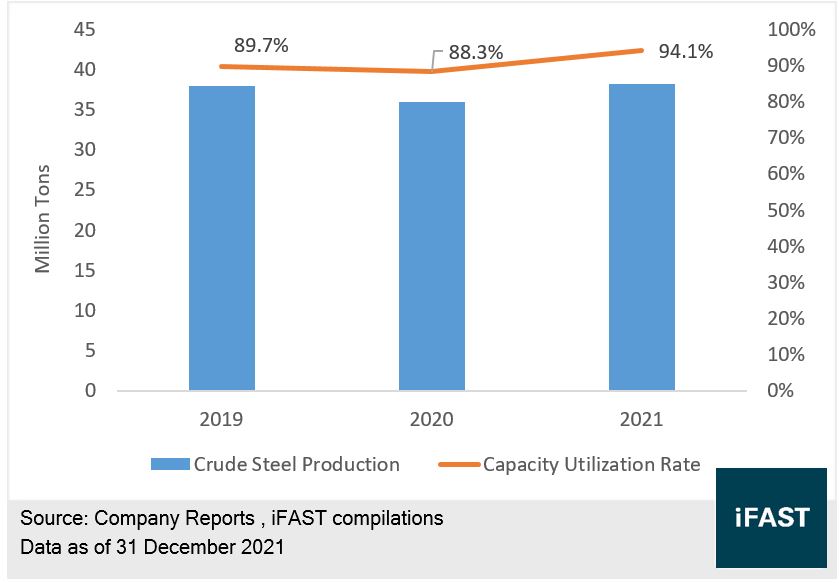
The situation improved notably in 2021, with crude steel production ramping up to 38.3 million tons, which is close to the pre-pandemic level. The capacity utilization rate also rose to 94%, resulting in a full-scale improvement in operation results, as revenues, operating profit, and even operating profit margins all moved upward to varying degrees (Table 1). The company maintains momentum in the first half of 2022, posting revenue and operating profit of KRW 44.3 trillion and KRW 4.4 trillion respectively, increased 29.1% and 16.1% year-over-year, representing a solid operating performance.
Table 1: POSCO’s Revenue and Profit
|
(Trillion KRW) |
Revenue |
Operating Income |
Operating Margin |
|
2019 |
64.4 |
3.9 |
6.1% |
|
2020 |
57.8 |
2.4 |
4.2% |
|
2021 |
76.3 |
9.2 |
12.1% |
|
1H2022 |
44.3 |
4.4 |
9.9% |
|
Source: Company reports, iFAST compilations Data as of 30 June 2022 |
|||
It's noteworthy that POSCO's domestic capacity utilization rate is approaching saturation, and the company thus expands its capacity overseas, by investing KRW 12 trillion overseas to increase overseas crude steel production capacity from 5.1 million tons to 23.1 million tons prior to 2030. However, we do not expect any significant increase in crude steel production capacity in the next three years as the new overseas facilities will be commissioned in 2024 at the earliest.
Demand for Steel Remains High, but steel production in 2H2022 might Be Dragged Down by Flooding
Generally speaking, construction and infrastructure are the primary consumer markets for steel, followed by transportation equipment such as automobiles. According to data announced by the Korea Automobile Industry Association, Korea produced 3.5 million vehicles in 2021, making it the 5th largest automobile producer in the world. Moreover, Korea has a good presence in the shipbuilding industry, which accounted for 37.1% of the world's new orders in 2021, particularly in the ultra-large tankers, Korea gains nearly 90% of the market share. In conclusion, we expect POSCO's revenue to remain stable in the future, given the strong demand for steel from Korea's well-developed automotive and shipbuilding industries.
On the other hand, the demand for iron ore in China dropped sharply due to the economic downturn, making the iron ore price trend downward from USD 120 per ton to roughly USD 90 per ton. Considering that nearly all iron ore POSCO uses are imported, the falling iron ore price will boost the company further improves profitability.
However, due to the flooding caused by Super Typhoon Hinnamnor, the facilities in Pohang halted for over one week, we thus expect the steel production in 2H2022 to contract a bit, and the revenue will be also dragged down.
Diversifying Business Model, Battery Materials to be A New Growth Driver
Limited by the production capacity in Korea, POSCO is diversifying its business models. It is well known that Korea is well developed in batter production, with large-sized batter producers like LG Chem and SK On. These battery producers will undoubtedly become beneficiaries of the global electrical vehicles trend, and POSCO is taking a ride on this trend and developing into an upstream supplier for battery manufacturers, by producing cathode and anode materials, including lithium, nickel, and other metals.
The company produced 4,500 tons of cathode material and 6,900 tons of anode material in 2021 and plans to increase cathode material production by 133% to 10,000 tons and anode material production by 19% to 8,200 tons in 2022. Additionally, POSCO is expanding its production capacity. Pilbara Lithium Solution, a joint venture with Australian giant Pilbara Minerals, is under construction, with the expected commission in 2023, and the Lithium brine facility in Argentina will be commissioned in 2024.
The new business segments contributed around KRW 1.5 trillion combined in 1H2022, accounting for roughly 3% of total revenue, but the percentage is about to climb along with commencing of oversea facilities, and battery materials are expected to become a new growth driver.
Leverage Remains Modest with Low Payment Obligation
Looking into the credit profile, as of 30 June 2022, the cash and cash equivalents POSCO owned was KRW 17.9 trillion, slightly declined from the beginning of this year. Total borrowings rose by 17.5% from the year-to-date to KRW 25.5 trillion. Even so, the current cash balance could cover 70% of total borrowings without consideration of external refinancing. The current ratio reached 2x, which is rather outstanding for an asset-heavy firm, and the liquidity is reasonably adequate.
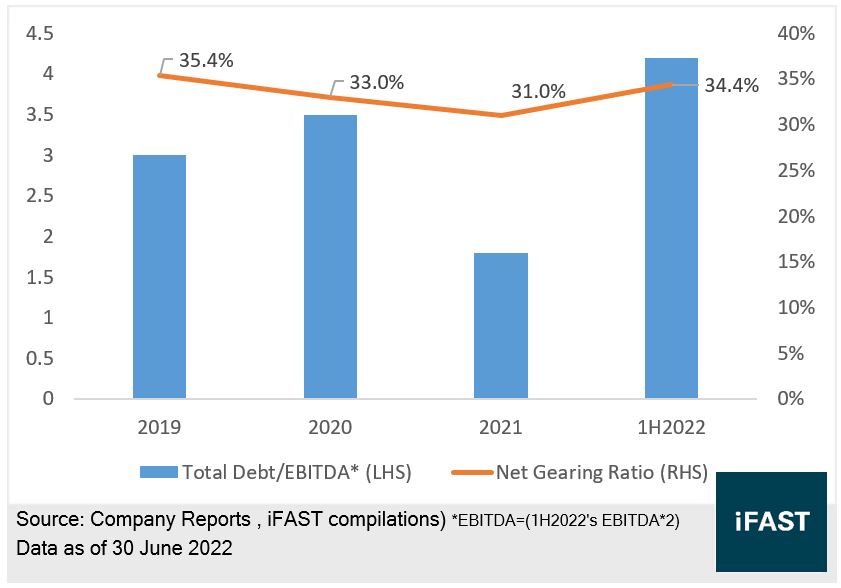
POSCO also manages the leverage at a decent level, from Chart 2, the total debt/EBITDA ratio from 2019 to 2021 were 3x, 3.5x, and 1.8x, respectively, and the number rose to 4.2x in the first half of this year due to upsizing debt amount. Furthermore, the net gearing ratio was maintained at around 30% over the past few years, a remarkably low level in the industry. To wrap up the points above, we think POSCO is facing a manageable debt obligation with favorable solvency.
Chart 2: POSCO’s Gearing
Give Priority to 2025 USD Bond
Investment-wise, POSCO issued two USD bonds (Table 2), with investment horizons ranging from 3 to 5 years and credit rating of A- from S&P. Two bonds are trading at a similar yield to maturity, which are 5.7% and 5.6%, respectively, investors thus can give priority to 2025 USD bond.
In comparison to bonds issued by upper Investment-grade Korean issuers, A-rated bonds usually trade 100 bps higher than the US treasury rate, translating into approximately 5% yield to maturity for bonds with 3 to 5 years of the investment horizon. While the bond of POSCO is yielding 5.7%, even higher than that of BBB-rated ones, suggesting that the bond is very attractive and deserved to be highlighted for investors interested in Korean issuers.
Table 2: Bonds Issued by POSCO
|
Bond |
Bond Credit Rating |
Years to Maturity |
Ask Price |
YTM |
|
POHANG 4.375% 04Aug2025 Corp (USD) |
A- (S&P) |
2.7 |
96.7 |
5.7% |
|
POHANG 4.500% 04Aug2027 Corp (USD) |
A- (S&P) |
4.7 |
95.7 |
5.6% |
|
Source: Bondsupermart Data as of 2 December 2022 |
||||
Corporate Risk
Investors should be mindful of the following risk. First, we noted that the capital expenditure of POSCO significantly increased from KRW 6 trillion in 2020 to KRW 8.1 trillion in 2022 subsequent to the announcement to launch into new business models, like battery material production. If the company keeps aggressive development, the credit metrics would likely get weakened.
Besides, smelting steel consumes a large amount of coal, and the price of coal POSCO purchased increased by more than 30% since the beginning of the year. If the price of coal continues to rise, it will significantly escalate the company's production costs and then affect the stability of its operations.
Conclusion
Steel production ramped up in 2021 with a notable improvement in operation. But some production facilities halted due to a typhoon in September, and this year's production is expected to lower. The company is diversifying its business models and targets battery materials as a new growth driver. The cash balance is rather ample, with modest total borrowings. The solvency is at a decent level in the coming years.
In terms of Investment-wise, 2025 USD bond issued by POSCO is rated A- from S&P and is currently yielding 5.7%, which is one of the highest returns among upper Investment-grade Korean issuers and represents a high-value investment.
Declaration: For specific disclosure, at the time of publication of this report, IFPL (via its connected and associated entities) and the analyst who produced this report hold a NIL position in the abovementioned securities.
Our podcast series, Yield Hunters, is available on Spotify, iTunes Podcasts and Google Podcasts. We share our thoughts on new bond issues and hold discussions on the fixed income space. Listen to our latest episode below and follow us!