Highlights:
- The global oil demand will continue to grow, which drives the oil price to remain higher for longer. Oil companies are still restrained in increasing production and investment. The industry's long-term underinvestment still exists.
- The oil companies do not respond to high oil prices and increase their capacity as they have in the past. Besides, the oil companies give the first priority to debt reduction and shareholders’ return. The era of increasing production as much as possible under high oil prices might be over.
- The market concern about the Middle East situation is priced in the oil price, which is favorable to oil companies. We believe that oil bonds are effective tools to hedge some geopolitical risks.
- Those oil companies with worse credit ratings benefit most from the current high oil price environment. During this cycle of high oil prices, they have the opportunity to significantly improve their credit profile. Investors could consider oil companies with lower credit ratings to achieve higher yields and take advantage of this great opportunity given the high oil price cycle.
We discussed the reasons why we were bullish on oil prices and oil bonds in “Idea of the Week: Unravelling the Investment Logics of Oil Bonds”. After one year, most of the views were fully confirmed, such as “With long-term underinvestment and supply constraints, it is difficult for oil prices to fall significantly”, “oil companies continuing to lay flat” and “bullish on oil prices to remain higher for much longer”, “oil Producers would thus benefit” and “given their significant cash flows, they might choose to exercise their call options”. These factors are structural issues, which cannot be solved overnight, not to mention other side factors (such as geopolitical risks). All of the results in a higher for longer oil outlook.
This article will update some industry trends, and how investors can take advantage of this opportunity.
Global Oil Demand will Continue to Grow, which Drives Oil Prices to Remain Higher for Longer
For the demand side, according to the International Energy Agency’s World Energy Outlook 2023, the traditional energy will continue to grow until 2030. In fact, in the past few years, the market predicted that renewable energy could gradually replace traditional energy, together with the rise of ESG concepts resulting in the decarbonisation of European countries and the US At that moment, the market once predicted the oil demand would be the peak in the next few years (i.e. today). However, renewable technology is yet to be stablised. The European countries and the US are still dependent on traditional energy, where the demand for oil remains strong.
For developing countries (except China and India), the cost of renewable energy (including related materials, renewable energy infrastructure, and the salary of experts) is even unaffordable.
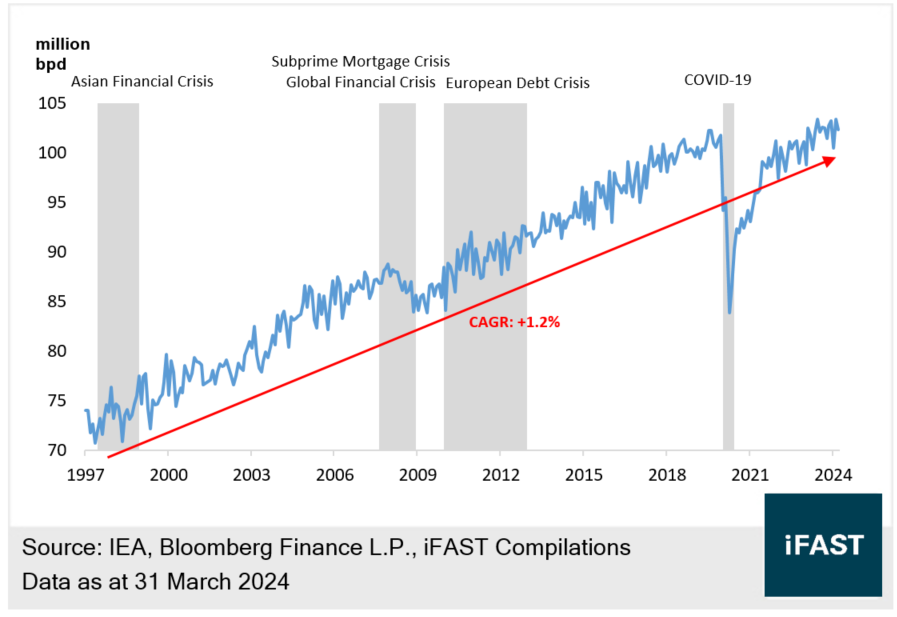
As shown in Chart 1, in December 2023, the global oil demand reached a record high of 103 million barrels per day. Despite a few financial crises, the oil demand maintained a CAGR of around 1.2% over the past two decades. We believe that the global oil demand will continue to grow, primarily due to the economic growth in large developing countries, such as India, Brazil, Mexico and Indonesia (which currently account for about 12% of total demand), where industrialization, urbanization and surging wages will drive demand for automobiles, transportation and industrial needs.
Chart 1: Global Oil Demand (Consumption)
The US soft-landing and re-industrialization are also supporting the oil demand. Under the high interest rate environment, the local economy still has a certain degree of growth momentum, which can keep the oil demand high and drive the oil price to remain higher for longer.
Industry Long-term Underinvestment Still Exists
On the supply side, as shown in Chart 2, in 2022, the global upstream oil and gas producers’ ("oil companies") capital expenditure was USD 499 billion, which increased by 39% YoY. Thanks to the high WTI oil price of $98 per barrel on average in 2022, the oil companies will naturally lead to a corresponding increase in capital expenditures.
However, compared to 2014, when the oil price was as high as in 2022, the capital expenditures of oil companies in 2022 were down by 37%, reflecting oil companies are still restrained in increasing production and investment. The industry's long-term underinvestment still exists.
Chart 2: Capital Expenditures by Global Upstream Oil and Gas Producers
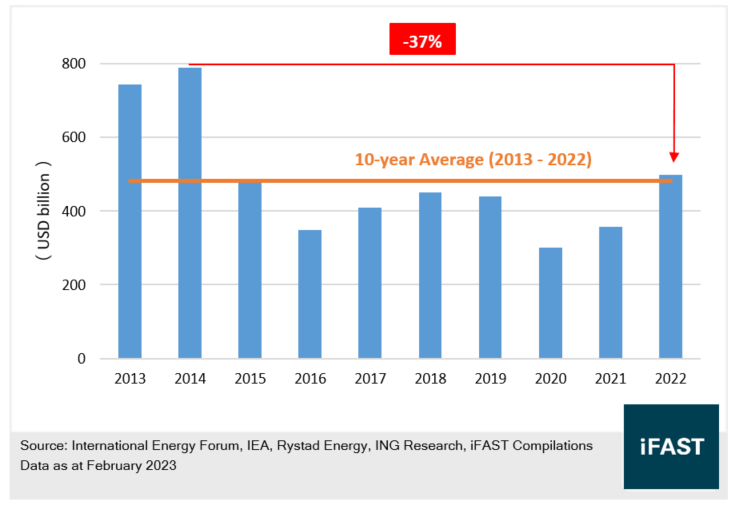
It is worth emphasizing that oil companies' capital expenditures are a very important forward-looking supply indicator (the higher the capital expenditure, the higher the immediate or future supply of oil will generally be). Their capital expenditure plans will affect the potential supply over the next few years and beyond. One of the core reasons we feel more confident about this oil cycle is that oil companies do not return to the level of capital expenditures they spent during the shale oil revolution between 2010 and 2014, even in a high oil price environment.
Oil companies Do not Respond to High Oil Prices as they have in the past
The US accounts for about 20% of the world’s oil production, making it the world’s top oil production country. It is also the most influential shareholder except for the OPEC and its allies. We can pay attention to some oil supply indicators to predict the trend of oil supply in the future.
In general, when oil companies expect oil prices to rise, they will increase the supply of crude oil to maximize profits. The oil supply can be represented by two leading indicators (see Chart 3): (i) Rig Counts – a direct indicator of current crude oil production and (ii) Drilled But Uncompleted Wells (DUCs) – Since oil is a natural resource with a naturally declining feature, to maintain crude oil production, oil companies have to spend a large amount of upfront substantial capital expenditure for preliminary exploration and drilling, and then wait for the wells to be drilled and exploited, with a preparation time of approximately nine to twelve months, this data could reflect the potential supply of crude oil in the medium to long term.
Chart 3: US Rig Counts, Drilled But Uncompleted Wells (DUC) and WTI
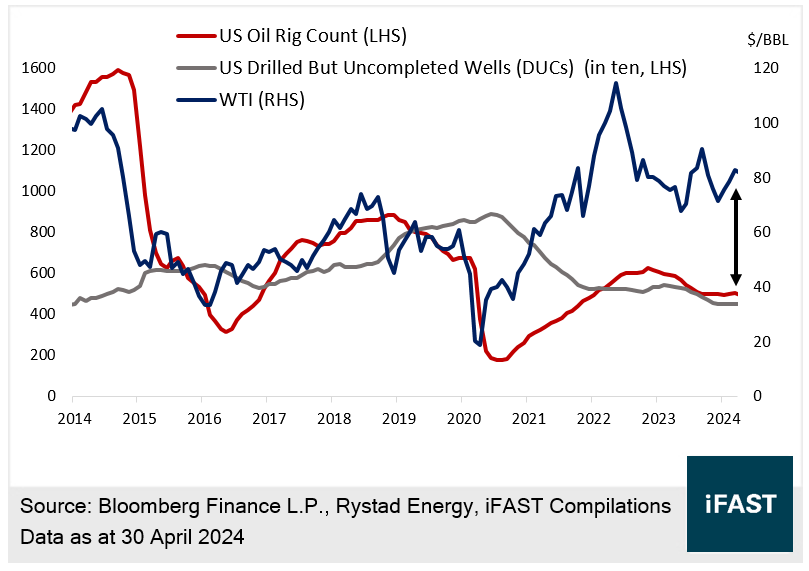
In the previous cycle (2016-2019), when oil prices were in an upward trend, the number of drilled but uncompleted wells (DUCs) continued to rise, showing the oil companies continued to add capital expenditures to expand the future production capacity. However, since COVID-19 in 2020, the oil price movement diverged from the two leading indicators. Despite the higher crude oil price over the period, the oil companies intentionally controlled the number of wells drilled to keep the crude oil supply growth in line with the demand growth. On the other hand, the number of DUCs fell to a 10-year low. Even after earning huge amounts of free cash flows, the oil companies instead focused on shareholder returns and debt reduction and were restrained in reinvesting the cash flow in capital expenditures.
Therefore, it is reasonable to assume that as long as oil companies do not change their current capital allocation, these key indicators will remain low. The growth of US crude oil production capacity will be well constrained, supporting oil prices to remain higher for longer. The oil companies do not respond to high oil prices as they have in the past.
Give First Priority in Debt Reduction and Shareholders’ Return; Era of increasing production as much as possible under High Oil Prices might be Over
During the high oil price period, the Federal Reserve Bank of Dallas interviewed the executives from 132 oil companies to understand the reasons why they did not largely increase their capital expenditures (See Chart 4). Amongst these, the most common answer is “investor pressure to maintain capital discipline”, meaning that shareholders put pressure on the company’s management to give the first priority to debt reduction and shareholders’ return, instead of increasing the capital expenditures and capacity.
Chart 4: Reasons of Oil Companies Not Largely Increase Capital Expenditures
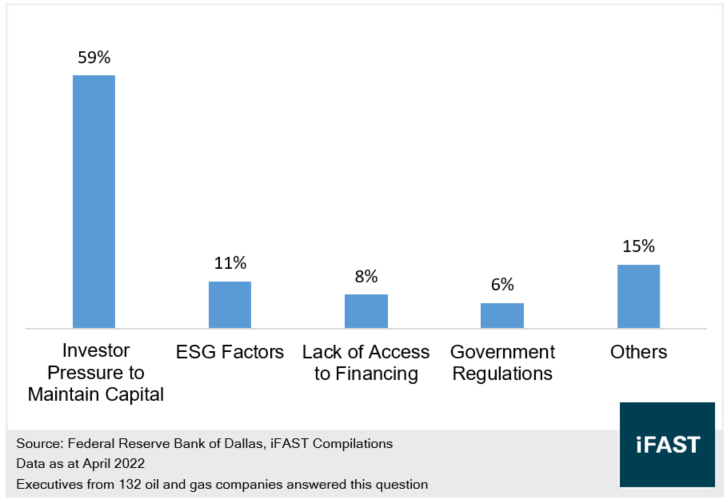
During this high oil price cycle (From 2021 to now), there is a structural shift compared to the previous high oil price cycles. The new normal for the industry is to reduce debt and increase dividends and shareholders.
As shown in Table 1, compared to 2014, the reinvestment rate of oil companies is obviously low. Most of their operating cash flows are used for either debt repayment, dividend payment and share buybacks. This is quite favorable to their credit profile. The ongoing debt reduction will lower their interest expenses and credit risk. On the other hand, we can expect that the industry supply will remain tight in the future. The era of oil companies increasing production as much as possible under high oil prices might be over. The overall investment incentives for the oil industry remain low.
Table 1: Partial Financial Data of Ten Mega Oil Companies*
|
Unit: USD billion (Total of Ten) |
2014 Full Year |
2021 Full Year |
2022 Full Year |
2023 Full Year |
|
Operating Cash Flow |
242.8 |
249.4 |
294.0 |
293.0 |
|
Capital Expenditures |
213.2 |
86.1 |
112.7 |
130.9 |
|
Reinvestment Rate (Capital Expenditures / Operating Cash Flow) |
94% |
35% |
31% |
46% |
|
Net Repayment of Debts (negative figures mean an increase in debts) |
-39.4 |
88.0 |
66.7 |
30.4 |
|
Dividends and Net Repurchases of Shares |
82.0 |
65.4 |
144.3 |
152.4 |
|
Average WTI Price ($ per barrel) |
$93 |
$67 |
$98 |
$78 |
|
*Include Exxon Mobil (XOM), Chevron (CVX), TotalEnergies SE (TTE), BP Plc (BP), Shell (SHEL), ConocoPhillips (COP), Equinor (EQNR), Canadian Natural Resources (CNQ), EOG Resources (EOG), Occidental Petroleum (OXY) Source: Company’s Reports, Bloomberg Finance L.P, iFAST compilations Data as of 31 December 2023 |
||||
Market concern about Middle East is Priced in Oil Price; Oil bonds are Effective Tools to Hedge Some Geopolitical Risks
To a certain extent, the geopolitics and the escalation of conflicts will affect the movement of oil prices. Recently, the tensions between Israel and Iran led to the possibility of the Israeli-Hamas war (or Israeli-Palestinian conflict) spreading to a wider region, including Lebanon, Syria and Iran. This also signals a possible intensification of the confrontation between the pro-Western and Chinese-Russian camps.
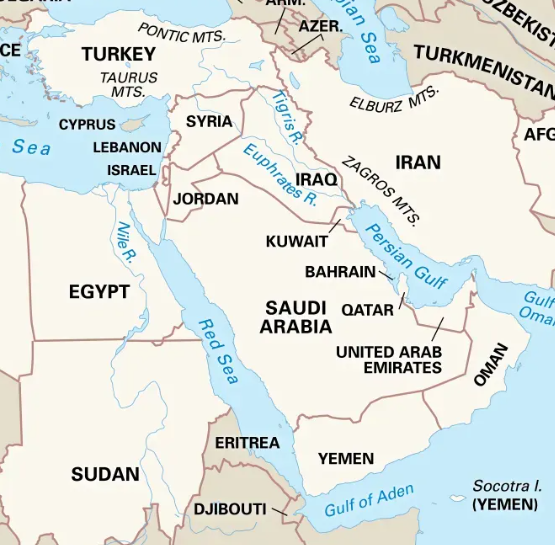
In the current situation, we believe a direct war between Israel and Iran is unlikely. In terms of geography, there are two countries, Iraq and Jordan, between Israel and Iran (see Chart 5). This makes it more difficult for Israel and Iran to engage in ground combat, which means a limited direct impact on the oil supply.
Chart 5: Map of the Middle East
Source: Britannica
However, the market concern about the Middle East situation is priced in the oil price, which is favorable to oil companies. In addition, if Arab countries choose to take countermeasures on the oil supply due to the Israeli-Palestinian conflict (like the oil embargo in the Yom Kippur War in 1973), the oil price would be stimulated again. Therefore, we believe that oil bonds are effective tools to hedge some geopolitical risks.
Could Consider Oil Companies with Lower Credit Ratings to Take Advantage of this Great Opportunity
At the bond investment level, those oil companies with worse credit ratings benefit most from the current high oil price environment. These oil companies had lower credit ratings as they were more leveraged than their peers for a variety of reasons or/and their oil production costs might be higher.
During this cycle of high oil prices, they can significantly improve their credit profile. Their default risks are being reduced considerably. Therefore, investors could consider oil companies with lower credit ratings to achieve higher yields and take advantage of this great opportunity given the high oil price cycle. The oil bonds could be one of the high-yielding instruments in the investor portfolio.
We have listed some non-investment grade oil bonds for investors' reference (see Table 2):
Table 2: Non-investment Grade Bonds in Bondsupermart
| Bond Name | Issuer / Guarantor | Issuer / Guarantor Credit Rating (S&P / Fitch) | Years To Maturity | Yield To Maturity | Yield To Call | Related Article |
Occidental Petroleum | BB+ / BB+ | 1.3 | 5.4% | 5.3% (Jun 25) | / | |
Occidental Petroleum | BB+ / BB+ | 3.2 | 6.9% | 5.5% (Jan 27) | / | |
Murphy Oil | BB+ / BB+ | 3.5 | 5.7% | 5.4% (Dec 25) | ||
Murphy Oil | BB+ / BB+ | 4.2 | 5.9% | 4.8% (Jul 25) | ||
California Resources | BB- / N.R | 1.7 | 6.2% | 5.0% (Feb 25) | / | |
SM Energy | BB- / BB- | 1.0 | 5.3% | / | / | |
SM Energy | BB- / BB- | 2.3 | 6.6% | / | / | |
SM Energy | BB- / BB- | 2.7 | 6.5% | 5.8% (Jan 25) | / | |
SM Energy | BB- / BB- | 4.2 | 6.4% | 5.9% (Jul 25) | / | |
VTLE 7.750% 31Jul2029 Corp (USD) (Bond Express New Member) | Vital Energy | B / N.R | 5.2 | 7.4% | 6.8% (Jul 26) | |
Vital Energy | B / N.R | 6.4 | 7.7% | 6.6% (Jan 28) | ||
Petroleos Mexicanos | BBB / B+ | 2.2 | 8.7% | / | / | |
Petroleos Mexicanos | BBB / B+ | 2.7 | 8.1% | / | / | |
Petroleos Mexicanos | BBB / B+ | 2.8 | 8.0% | / | / | |
Source: Bondsupermart Data as of 17 May 2024 | ||||||
Declaration: For specific disclosure, at the time of publication of this report, IFPL (via its connected and associated entities) holds positions in VTLE 7.750% 31Jul2029 Corp (USD) and the analyst who produced this report holds a NIL position in the abovementioned securities.
Our podcast series, Yield Hunters, is available on Spotify, iTunes Podcasts and Google Podcasts. We share our thoughts on new bond issues and hold discussions on
the fixed income space. Listen to our latest episode below and follow us!