- The Straits Trading Company posted a record high EBITDA of SGD 401m in FY21, while net profit after tax was ~4 times higher compared to the previous year.
- Its Resources segment will continue to benefit from the supportive tin prices, while its Real Estate segment remains well-positioned for stronger growth and expansion.
- The Group still maintains a strong balance sheet despite the pandemic, and the sale of ARA Asset Management will provide a boost to its liquidity position.
- The STRTR 4.100% 04May2026 Corp (SGD) is currently yielding ~3.91% with slightly less than 4 years left to maturity.
- Compared to other bonds of diversified property businesses with similar years to maturity, its 2026 bond offers the highest yield despite having a stronger credit profile than some of its peers.
- For more information, investors may refer to the bond factsheet here.
Company Background
The Straits Trading Company Limited (“STC”) is a conglomerate-investment company with operations across different business segments such as metal production, property development and investments, as well as hospitality. Besides having a well-diversified property portfolio through its subsidiaries, STC also owns a majority stake in the world’s third-largest tin producer, Malaysia Smelting Corporation.
The Group operates mainly through 3 segments: 1) Resources, 2) Real Estate and 3) Hospitality. Its Resources segment is driven by its 52.2%-owned subsidiary, Malaysia Smelting Corporation (“MSC”), which is listed on both the Singapore Exchange and Bursa Malaysia with a market capitalization of MYR 1.59b (~SGD 498m) as of 18 May 2022. It is largely engaged in the upstream and downstream activities of the tin value chain through its mining, tolling and smelting businesses.
Meanwhile, its Real Estate segment comprises of majority stakes in property developers and real estate investment companies such as Straits Development Pte. Ltd., STC Property Management Sdn. Bhd., Straits Real Estate Pte. Ltd. and Straits Investment Management Pte. Ltd. Besides that, the Group also owns a minority interest in ESR Cayman Limited, which is APAC’s largest real estate and real assets fund manager, as well as Suntec REIT that owns a large portfolio of retail and commercial properties in Singapore and Australia.
As for its Hospitality segment, it is mainly driven by Far East Hospitality Holdings Pte Ltd (“FEHH”), which is a 30%-owned joint venture with Far East Orchard Limited. FEHH has a combined portfolio of over 18,000 rooms under management across 105 hotels and serviced residences in 9 countries. Some of its unique brands include Oasia, Quincy, Rendezvous and Adina Hotel. Despite the pandemic, FEHH still managed to grow its hospitality management portfolio with the launch of 8 new hotels comprising of 1,600 rooms in 2021.
Financial Highlights
For the full year ended 31 December 2021 (“FY21”), total revenue increased by 28.4% year-on-year (“YoY”) on the back of stronger performances for its real estate and resources segment. The Group posted a record high EBITDA of SGD 401m in FY21, which was approximately 3 times higher as compared to an EBITDA of SGD 133.8m in the previous financial year.
Net profit after tax that is attributable to shareholders of the company also jumped by ~355% YoY to SGD 234.3m. This was largely due to a substantial increase in its interest income, share of results of associates and joint ventures, as well as net fair value gains in investment properties from its logistics portfolio in Australia.
Figure 1: Breakdown of total profit before interest and taxes
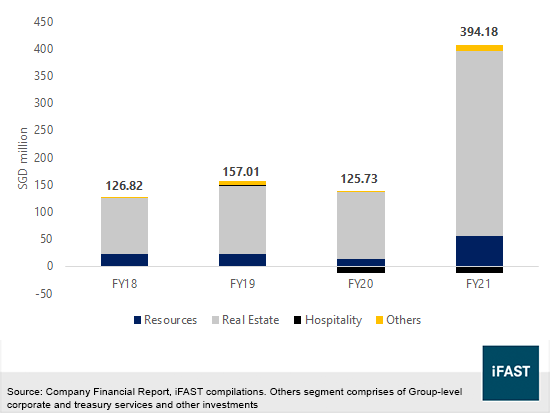
For its Resources segment, MSC’s revenue rose by 32.4% YoY to RM 1.08b, while its pre-tax profit and net profit after tax increased to an all-time high of RM 158.4m and RM 118.1m respectively. This was mainly attributable to higher tin prices due to a strong consumer demand for electronic goods, coupled with a shortage of tin supply. The higher tin prices also resulted in a five-fold increase in net profit for MSC’s tin mining segment. Even though MSC’s tin smelting output was impacted last year as a result of the Movement Control Order (“MCO”), it still recorded a net profit increase of ~378% YoY to SGD 12.1m, as the Group managed to reverse the write-down of inventories and achieve higher profit margins from the sales of refined tin.
STC’s Real Estate segment remained strong despite the pandemic headwinds, posting an improvement of ~233% in profit after tax and non-controlling interest (“PATNCI”). Notably, its wholly-owned investment management subsidiary, Straits Real Estate Pte. Ltd. (“SRE”) posted a 200% increase in net profit after tax of SGD 220m from the previous year. The Group also holds ~4.8% stake in ESR Cayman Limited (“ESR”) following the sale of its position (~19%) in ARA Asset Management. STC received approximately SGD 134.8m in cash, on top of the ESR shares and convertible vendor loan notes worth over SGD 1.0b from the sales transaction.
As for its Hospitality segment, the covid-19 pandemic continued to pose challenges to the travel and tourism industry. Its losses before interest and taxes worsened slightly to SGD 12.4m for FY21. During the year, its Hospitality business was largely supported by government contracts to use some of its hotels as isolation facilities. Domestic consumption in Singapore was also supported by staycations, particularly during the festive season towards the end of the year.
Business Outlook
Strong tin demand continues to hold up prices in the near-term
Tin prices have rallied over the past year on the back of strong global demand for electronics and supply constraints. Notably, tin prices averaged 83% higher in 2021 at USD 35k per ton as compared to USD 17k per ton in 2020. According to the International Tin Association (“ITA”), overall demand growth in March 2022 was ~23% YoY. Tin prices were mainly held up by higher energy prices, environmental restrictions in Indonesia, as well as the smelting limitations in China. Meanwhile, supply tightness continues to persist as the London Metals Exchange (“LME”) inventory levels for tin only increased by 640 tons since the start of this year, topping out at a critically low level of 2,685 tons.
As a result, we believe that the supportive tin prices will continue to provide a positive backdrop for its Resources segment. Notably, MSC reported its 1Q22 results recently on 18 May 2022, with net profit soaring ~190.9% higher to RM 64.34m on the back of higher tin prices and operational efficiencies. The Group remains positive on the outlook of tin, as it expects demand to outpace supply in line with higher electronics consumption and rising application for other uses such as electric vehicles.
Real Estate segment to leverage on growing macro trends
With a rising e-commerce growth and stronger warehouse demand, SRE has diversified its portfolio of assets by tapping into the APAC logistics sector. For instance, the Group has completed the construction of the Arenas Yeongjong (Sky Logis) logistics facility in Incheon last year. Following which, it received strong leasing interest from major tenants such as Lotte Global Logistics, Coupang and other e-commerce operators due to its prime location near the air cargo terminal at Incheon International Airport. The demand for well-located warehouse facilities remained strong last year, particularly in Korea and Australia as the Group looks to expand its logistics portfolio to diversify its geographical footprint and income stream.
Besides venturing into the logistics sector, SRE also expanded into warehouse retail parks in the UK as a source of diversification towards more defensive sectors. The retail properties have remained resilient during the pandemic with active tenants such as homeware and food stores. Meanwhile, property leases of STC’s investment management subsidiary are also indexed to inflation to help grow its rental income, which will likely benefit its REIT portfolio amid the rising inflationary environment. As such, we believe that STC’s Real Estate segment remains well-positioned for growth as it looks to capitalize on growing trends such as e-commerce and urbanization, while diversifying into defensive sectors to preserve its earnings stability.
Hospitality segment slightly more optimistic due to borders reopening
With the easing of travel restrictions and reopening of borders, we could expect an improvement in the travel and tourism industry this year. Notably, a majority of FEHH’s hotel portfolio lies in 9 countries, namely Singapore, Australia, Austria, Denmark, Japan, Germany, Hungary, Malaysia and New Zealand. Recently, a majority of these countries have further relaxed their travel restrictions by opening up to vaccinated travellers and tourists. As such, we could expect its Hospitality segment to benefit from a pent-up demand. Nonetheless, we should note that the path to recovery for this segment remains highly uneven as the covid-19 situation could worsen in the future, causing countries to reimpose tough border restrictions.
Credit Discussion
Table 1: Credit metrics comparison as at 31 December 2021
|
Company |
Current Ratio |
Net Gearing |
LTM EBITDA Coverage |
Total Debt/Total Asset |
Net Debt/LTM EBITDA |
|
Straits Trading Company |
0.93 |
0.47 |
12.49 |
32.81% |
2.26 |
|
Keppel Land Limited |
1.50 |
0.37 |
15.74 |
30.69% |
5.27 |
|
OUE Ltd |
1.21 |
0.40 |
3.66 |
31.28% |
6.12 |
|
City Developments Limited |
1.49 |
0.99 |
2.90 |
47.81% |
17.49 |
|
Source: Company Financial Reports, iFAST estimates |
|||||
Moving on to STC’s credit profile, the Group still maintains a healthy net debt-to-total equity ratio of 0.47x (0.51x if adjusted for non-controlling interests) as of 31 December 2021. Current ratio stood at 0.93x as at the end of last year, but we do note that the Group had received SGD 134.8m of cash consideration from the sales transaction of ARA Asset Management in January this year. Furthermore, STC has recently raised funds by issuing a 4-year senior debt with a total size of SGD 170m.
As such, its pro-forma current ratio following the sales transaction and capital raising would be approximately 1.41x, which still remains manageable in terms of its liquidity position. Its cash and short-term deposits were SGD 141.6m as at 31 December 2021, which is notably lower as compared to its short-term borrowings of SGD 540.7m. However, if we were to add in the cash consideration from ARA’s transaction and capital raised from the latest bond issuance, its total cash position would increase to ~SGD 446.4m, which is closer towards meeting its short-term borrowings.
Moreover, management is of the opinion that the Group is able to further refinance its short-term borrowings when they fall due, hence, we remain confident that STC will be able to meet its short-term debt obligations. Furthermore, out of SGD 540.7m of short-term borrowings, SGD 361.1m are secured against its assets such as investment properties, securities and joint ventures. This means that in the event if the Group is unable to pay off its current borrowings, they can still use their collateralized assets to repay the debt.
We have selected certain diversified real estate developers for its peer comparison, as these companies also focus on other similar business segments such as hospitality and investment management besides real estate development. Compared to other diversified property developers as seen from Table 1, STC has one of the strongest interest servicing abilities, largely driven by the strong operating performances of its resources and property segments.
Meanwhile, we also note that its pro-forma net gearing ratio and net debt-to-EBITDA ratio following the ARA sales transaction would be ~0.43x and 1.92x respectively, demonstrating a healthy leverage position. Even though SGD 562.6m (~53.8%) of its total borrowings are secured by its collateralized assets, we estimate its unencumbered asset coverage ratio to be ~5.54x, which measures the number of times its total assets (less collateral) is able to cover its unsecured net debt. As such, STC still maintains a healthy financial position and remains well-positioned to meet its debt obligations.
Relative Valuation
Table 2: Relative valuation of comparable bonds
|
Bond |
Issue Date |
Maturity Date |
Remaining Years to Maturity |
Ask YTM |
|
STRTR 3.750% 29Oct2025 Corp (SGD) |
29Oct2020 |
29Oct2025 |
3.45 |
3.58% |
|
CITSP 2.300% 23Mar2026 Corp (SGD) |
23Mar2021 |
23Mar2026 |
3.84 |
3.26% |
|
STRTR 4.100% 04May2026 Corp (SGD) |
04May2022 |
04May2026 |
3.96 |
3.91% |
|
KPLDSP 2.000% 28May2026 Corp (SGD) |
28May2021 |
28May2026 |
4.02 |
3.37% |
|
CITSP 3.480% 15Jun2026 Corp (SGD) |
15Jun2016 |
15Jun2026 |
4.07 |
3.51% |
|
OUESP 3.500% 21Sep2026 Corp (SGD) |
21Sep2021 |
21Sep2026 |
4.34 |
3.85% |
|
CITSP 2.000% 16Jun2026 Corp (SGD) |
16Dec2020 |
16Dec2026 |
4.58 |
3.24% |
|
Source: Bloomberg Finance L.P., iFAST compilations. Figures as at 20 May 2022 |
||||
Referring to Table 2, we think that STC’s 2025 and 2026 bonds look more attractive as compared other bonds of comparable diversified property developers with similar time to maturity. Notably, the STRTR 3.750% 29Oct2025 Corp (SGD) is currently yielding ~3.58% with 3.45 years left to maturity, while the STRTR 4.100% 04May2026 Corp (SGD) is yielding ~3.91% with 3.96 years left to maturity.
Looking at the credit metrics comparison in Table 1, we think that STC has comparable liquidity (using a pro-forma current ratio of 1.41x), leverage (pro-forma net gearing of ~0.43x) and interest coverage ratios to Keppel Land. Nonetheless, the Keppel Land 2026 bond (i.e., KPLDSP 2.000% 28May2026 Corp (SGD)) is currently yielding at ~54 basis points (“bps”) lower as compared to STC’s 2026 bond, even though both of them have similar remaining years to maturity.
Between the STC’s 2025 and 2026 bond, we think that the 2026 bond looks slightly more attractive as it offers ~33 bps of yield pickup over the 2025 bond, despite having a slight difference of 0.5 years to maturity. So far, we see that most of the new SGD bond issuances have a tenure of 5 – 7 years. The STRTR 4.100% 04May2026 Corp (SGD) was issued back in April with a tenure of 4 years. Therefore, it offers investors with a shorter duration and attractive return for a diversified property developer with a healthy financial position and strong operating performance.
Conclusion
In conclusion, STC has a healthy balance sheet with strong operating income from its property and resources segment. Its Resources segment will continue to benefit from the supportive tin prices going forward, while its Real Estate segment is well-positioned for growth following the expansion of its logistics portfolio and foray into the warehouse retail space. Currently, its 2025 and 2026 bonds are trading at more attractive levels as compared to other diversified property developers, and between the 2 bonds, we think that the 2026 bond offers more value with ~33 bps of yield pickup despite having a slight difference in time to maturity. As such, investors who are looking for a diversified property business with exposures to the metal and mining industry may consider the STRTR 4.100% 04May2026 Corp (SGD).
Declaration: For specific disclosure, at the time of publication of this report, IFPL (via its connected and associated entities) holds positions in STRTR 4.100% 04May2026 Corp (SGD) and the analyst who produced this report holds a NIL position in the abovementioned securities.
Our podcast series, Yield Hunters, is available on Spotify, iTunes Podcasts and Google Podcasts. We share our thoughts on new bond issues and hold discussions on the fixed income space. Listen to our latest episode below and follow us!