- Barclays saw strong growth in FY22, but profits fell
due to higher operating expenses.
- Over-issuance of securities in 2022 resulted in excess
litigation and conduct charges of more than GBP 1b
- Barclays is given a positive outlook by S&P, while
Moody’s placed it on positive watch and review for upgrade.
- We think BACR 8.300% Perpetual Corp (SGD) is a great
option among the AT1 perps, especially for its high coupon rate and high
initial spread on reset
This bank is nearly five centuries old
Barclays PLC (“Barclays”) is a British multinational bank, primarily operating in the United Kingdom although its footprints can be found across the globe. Recognised as a systemically important bank by the Financial Stability Board, its long history traces back to the 1600s. It is primarily listed on the London Stock Exchange with the ticker BARC and is part of the FTSE 100 Index, while its secondary listing is on the New York Stock Exchange with the ticker BCS.
Barclay’s operations are segregated into two divisions, Barclays UK and Barclays International, while its operations are supported by its service company, Barclays Execution Services. Between the two operating divisions, the Barclays UK (“BUK”) business mainly caters to consumers in the United Kingdom, consisting of Personal Banking, Business Banking and Barclaycard Consumer UK. On the other hand, Barclays International operates two other crucial businesses – Corporate and Investment Bank (“CIB”) and Consumer, Cards and Payments (“CC&P”).
Similar to many financial institutions, in its strategic priorities, Barclays plans on further integration of technology to lower costs and increase the accessibility of financial services for its consumers. On its ESG plan, it intends to capitalise on the transition towards a low-carbon economy for both its businesses and clients.
The last but most crucial among its strategic priorities, Barclays highlighted the importance of its CIB business which positioned them as one of the top six global investment banks. It further highlights the focus to sustainably grow the CIB business, outlining the plan to invest in the high-growth sectors, develop digital initiatives in Global Markets and grow its Corporate Banking business in both US and Europe.
Barclays’ performance in 2022
Since 2022, the Bank of England raised the benchmark interest rates to the current 4.00%, with the recent hike coming in February 2023 raising 50 basis points (“bps”). Most banks benefitted on the backdrop of the rising interest rates, and Barclays undoubtedly rode on this tailwind. For the year ended 31 December 2022 (“FY22”), Barclays saw growth across all three operating businesses and its income grew from GBP 21.9b in FY21 to GBP 25.0b in FY22. In FY22, CC&P saw a significant 35% growth in income, while BUK and CIB recorded 11% and 8% growth respectively.
Disappointingly, Barclays recorded an attributable profit after tax of GBP 5.97b in FY22, a substantial drop from the recorded GBP 7.06b in FY21 despite the much higher income generated in FY22. It attributed the drop to higher operating expenses in FY22 at GBP 16.7b (versus GBP 14.6b in FY21), largely arising from higher litigation and conduct charges (“L&C”) charges with the over-issuance of securities. Excluding the L&C charges, total operating expenses were up by only 6%, in line with the effects of foreign exchange and inflation in 2022.
With regards to the over-issuance of securities, Barclays came to the realisation only in March 2022 that it had issued securities materially in excess of the amount it had registered with the US Securities and Exchange Commission (“SEC”), involving structured products and exchange-traded notes. Just for the over-issuance of securities alone, despite measures taken to mitigate the impact, Barclays paid L&C charges of GBP 1.0b, plus a monetary penalty of GBP 165m to the SEC.
Chart 1
Attributable
Profit of individual operating segments
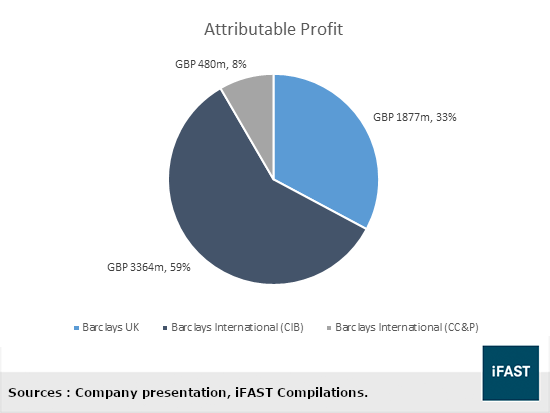
Although the overall performance was underwhelming for Barclays, individually its business segments still saw strong prospects in FY22.
- BUK had been the most profitable by RoTE at 18.7%, as compared to RoTE of 10.0% and 10.2% for CC&P and CIB segments respectively.
- Although CC&P contributed the least in income and profit generated, there had been a considerable growth at 35% inclusive of an acquisition of a partnership credit card portfolio from Gap in FY22.
- CIB is responsible for most of the profit that Barclays is drawing in at 59% (Chart 1), in which its financing business has recorded a 16% CAGR since 2019. CIB continues to be Barclays’ main focus for growth, especially in the upcoming years.
For its mid-term plans, it listed several targets for its financials – of note, its Return on Tangible Equity (“RoTE”) and cost-income ratio. With the fall in profits, Barclays consequently saw its overall RoTE falling to 10.4% in FY22, compared to a RoTE of 13.1% in FY21. But the RoTE technically remains well within its target, as Barclays stated the plan was to sustain a RoTE greater than 10.0% in 2023 and the medium term. On the other hand, for its cost-income ratio, which remained at 67% across FY22 and FY21, it plans on lowering the ratio closer to 60% in 2023, and below 60% over the medium term.
A significant driver of revenue for Barclays was the net interest income, riding on the tailwind of rising global interest rates. Its net interest margin across the three businesses rose by 61 bps, rising from 2.93% in FY21 to 3.54% in FY22. In Barclays’ projection of interest rate, for a 25 bps upward parallel shift in interest rate curves, Barclays expect an increment in the income of approximately GBP 200m in the first year, GBP 350m in the second year and GBP 500m in the third year. While the projections might not be able to accurately reflect the trend of changing interest rates, it nevertheless provides an expectation of Barclays’ outlook given impending hikes in interest rates.
Chart 2
Implied Rate for Bank of England (“BoE”) benchmark interest rate (%)
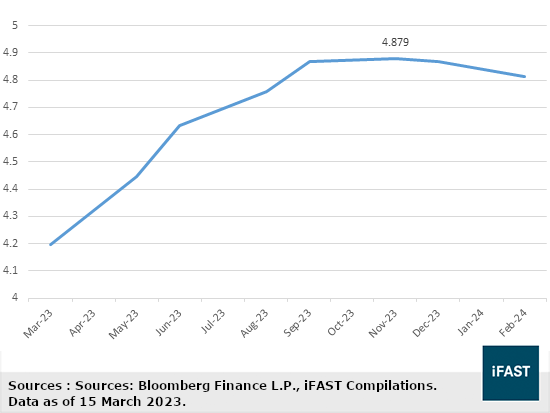
As shown in Chart 2, from the current 4% target rate by the BoE, the implied benchmark interest rate by market expectations is to reach a peak of 4.879% in the November 2023 meeting. Although this only reflects the interest rate changes in the UK, considering that a substantial net interest income comes from the BUK business, further rate hikes by BoE will likely push up Barclay’s net interest margin.
Despite Barclays’ lower profit in FY22, we believe that it had been taking the right direction in its business developments, which had enabled it to take profits from various operating segments instead of being limited to interest income. We see commendable diversification in income sources for Barclays, where there would be an increased focus on its CIB business, while its net interest income will continue to get boosted on the tailwind of rising interest rates. We expect Barclays’ strong performance to continue beyond 2023, especially in consideration of the over-issuance being a one-off event.
Credit Profile
While Barclay’s CET1 ratio was at a considerably strong 15.1% in FY21, it fell to 13.9% as of FY22. The drop in CET1 ratio was primarily due to regulatory changes introduced on 1 January 2022 causing a decrease of approximately 80 bps, while the distributions of dividends in FY22 contributed another decrease of 79 bps. While it did seem to be a substantial fall in the CET1 ratio, Barclays reflected that its CET1 ratio was between its target of 13~14% for the medium-term. At the same time, the CET1 ratio of 13.9% remains well above the requirement for Barclays at 11.3%.
Chart 3
Barclays’
loan loss rate (“LLR”) and credit impairment charges over the years
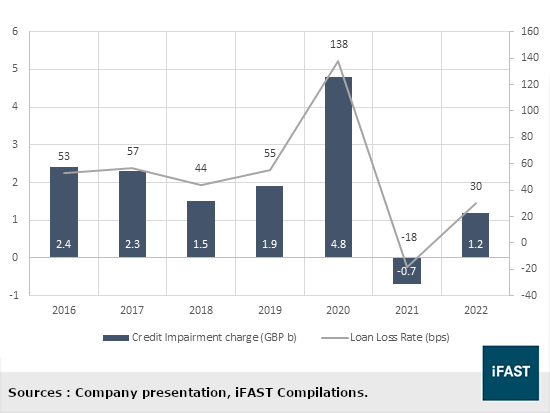
From Chart 3, Barclays saw an increment in credit impairment charge from the GBP 0.7b release in FY21, to GBP 1.2b charge in FY22 – arising from macroeconomic deterioration and a gradual increase in loan delinquencies. While the LLR of 30 bps in FY22 remains below the average LLR pre-COVID-19 period, Barclays expect the LLR in 2023 to normalise between the range of 50~60 bps given the current macroeconomic outlook.
For its liquidity coverage ratio (“LCR”), Barclays saw minimal changes in FY22, which fell from 168% as of FY21 to 165% as of FY22. Against a regulatory requirement of 100%, the LCR remains considerably strong. The net stable funding ratio stands at 137% as of FY22, which Barclays indicates a holding of GBP 155b surplus over the 100% regulatory requirement.
While generally the ratios are kept well above the regulatory requirement, more attention should be placed on its CET1 ratios movement – given that considerable significant movements were observed in FY22, and that the normalisation of loan loss rate to pre-COVID-19 levels could implicate its risk-weighted assets. Beyond that, we are optimistic about Barclays’ credit profile – given its ability to adequately meet its required ratios, diversified income sources across three business segments, and a good outlook going into 2023.
Possible credit rating upgrade to its investment-grade issuer status?
The long-term issuer credit rating for Barclays is BBB (Positive)/ Baa1 (Stable)/ A (Stable) by S&P/Moody’s/Fitch respectively. Based on the rating agencies’ latest opinions on Barclays, there are reasons to believe that Barclays is likely to obtain a further upgrade on its credit rating.
S&P Ratings had previously revised Barclays’ outlook from Stable to Positive in 2021, which S&P reflects that “Barclays is delivering a stronger business profile and stably stronger financial performance”. There are high expectations for Barclays to continue its profitability trend amidst the current macroeconomic outlook in 2023, despite inflation and geopolitical risks. As a result of the positive outlook on Barclays, there remains a good possibility of an upgrade of credit rating by S&P should Barclays “demonstrates sustained competitive advantage in line with that of higher-rated global peers”.
A similar situation is observed in Moody’s credit rating for Barclays. Previously in December 2022, Moody’s had placed Barclays on a positive watch and a review for upgrade. It highlighted that there had been improvements in earnings, “driven by repositioning and investments in the capital markets and US credit cards businesses, higher net interest income following rate hikes in the UK, US and EU, and low cost of risk.”
The difference between Barclays with Silicon Valley Bank and Credit Suisse
A key reason for the bank run in Silicon Valley Bank (“SVB”) was its specialised clientele base, primarily serving VC firms and tech start-ups within the technology and life sciences sectors. While it was taking in deposits, it was unable to capitalise on earning the spread between its deposits and loans, as the majority of its clients could not qualify as high-quality borrowers. As a result, it turned to purchasing safe assets – which inadvertently fell to the demise of the rapidly rising interest rates, while failing to manage its interest rate and duration risk adequately.
At the same time, with tighter monetary policies in place, greater difficulty to borrow money resulted in these companies burning through their cash – which ultimately required them to withdraw, and SVB in turn had to sell its safe assets at a loss in an attempt to meet the withdrawal demand.
Barclays differ greatly in two aspects – diversification of its deposits base and having a structural hedge. Barclays’ deposit base is adequately diversified across its retail and corporate customers, rather than serving a specific set of clients. Of the total GBP 512b deposits as of December 2022, CC&P accounted for GBP 258b of the deposits, while CIB and BUK accounted for GBP 172b and GBP 82b respectively. In addition, Barclays has a structural hedge in place valued at GBP 263b. The hedge allows the bank to reduce the impact of the changes in interest rates on its assets, which helped Barclays to mitigate approximately GBP 2.2b worth of losses in 2022.
For more information regarding the saga surrounding SVB, you may refer to our article here. For our fixed income view on SVB, you may find it here as well.
Compared to Credit Suisse (“CS”), its malperformance in 2021 and 2022 arising from scandals and the collapse of Archegos Capital had been the key reason for outflows of deposits and a need for restructuring. While Barclays had its own problem of over-issuance of securities, it still saw a considerably strong performance with higher income in FY22, despite its profits lacking the same results. We think Barclays’ outlook is much more optimistic than CS, especially in consideration of the current macroeconomic situation.
For our fixed income view on the recent CS incident, you may refer to our article here.
Barclays’ SGD Issuances
Table 1
Tier 2 Subordinated Issues
|
Issue |
Ask Price |
Years to call/maturity |
Yield to call/maturity |
Bond Credit Rating (S&P/Fitch) |
|
101.21 |
4.30/9.56 |
5.18%/5.42% |
BBB-/ BBB+ |
|
|
100.42 |
4.32/9.32 |
5.14%/5.39% |
BBB+/ A- |
|
|
101.00 |
4.28/9.29 |
4.98%/5.19% |
BBB/ A- |
|
|
98.29 |
2.19/7.19 |
4.59%/4.81% |
N.R/ BBB+ |
|
|
Sources: Bloomberg Finance L.P., Bondsupermart, iFAST Compilations. Data as of 17 March 2023. |
||||
BACR 3.750% 23May2030 Corp (SGD) is currently the only SGD Tier 2 subordinated note offered by Barclays. Considering the bond credit rating and the yield to maturity, we believe that there are slightly better options available in terms of both the yield and credit rating, even though it is likely for Barclays to be looking at an upgrade in credit rating in the near future.
Table 2
Barclays’ Additional Tier 1 (“AT1”) Perps
|
Issue |
Ask Price |
Current Yield |
First call date/reset date |
Years to first call/ reset |
Yield to first call |
Reset rate |
|
102.80 |
8.07% |
15 Sept 2027 /15 Dec 2027 |
4.500/ 4.750 |
7.62% |
5-year SORA-OIS + the Margin (5.641%) |
|
|
98.00 |
7.45% |
15 June 2028 /15 Sept 2028 |
5.258/ 5.508 |
7.84% |
5Y SORA OIS + Initial Margin (3.929%) |
|
|
Sources: Bloomberg Finance L.P., Bondsupermart, iFAST Compilations. Data as of 17 March 2023. |
||||||
Among the available AT1 SGD perps, both notes by Barclays offer considerably much higher coupon rates as compared to the others that mostly fall in the 5~6% coupon range given a similar credit rating profile. Given the high-yield nature of the notes, interest rate risk is lessened due to the smaller degree of change on higher coupons.
Between the two issuances, we prefer BACR 8.300% Perpetual Corp (SGD) for its higher coupon at 8.30% and current yield at 8.07%. While both notes are looking at a comparable yield to first call, BACR 8.300% Perpetual Corp (SGD) has an advantage with a higher initial spread at 5.641%. If the perps do not get redeemed by Barclays, based on the 5Y SORA-OIS as of 17 March 2023 at 2.99%, the reset rate will be at 8.631% - allowing investors to continue earning a high current yield in such a case.
On the other hand, because of the high initial margin on BACR 8.300% Perpetual Corp (SGD), it is likely for the note will be redeemed on the first call date, considering that the Option Adjusted Spread is currently at 435 bps and Barclays is in the midst of credit rating upgrade by Moody’s – significantly below the initial spread of 5.641%. We would like to highlight the risk on AT1 perps, which for BACR 8.300% Perpetual Corp (SGD), there is a loss absorption feature in place resulting in the conversion or write-down of the AT1 should the CET1 ratio falls below 7.0%. The risk involved might not be suitable for all investors.
Overall, we prefer BACR 8.300% Perpetual Corp (SGD) for its higher coupon and current yield, and likely to continue having a high coupon rate upon reset. Despite being a high yield issue, it may be a strong consideration given the likely upgrade on its credit rating as Barclays continue to perform – similarly upgrading the bond credit rating by an equivalent notch.
Declaration: For specific disclosure, at the time of publication of this report, IFPL (via its connected and associated entities) holds a position in BACR 8.300% Perpetual Corp (SGD) and the analyst who produced this report holds a NIL position in the abovementioned securities.
Our podcast series, Yield Hunters, is available on Spotify, iTunes Podcasts and Google Podcasts. We share our thoughts on new bond issues and hold discussions on the fixed income space. Listen to our latest episode below and follow us!