- The real estate development segment had been barely profitable in the past two years, despite being a core business segment and major revenue driver.
- Assuming the lack of refinancing, it had spent ~SGD 271m of its cash, out of the SGD 364m available by end of 1H22.
- Thankfully, we see projects that are expected to bring in relatively substantial earnings for Tuan Sing.
- Although Tuan Sing is preferred over Oxley for its credit quality, we feel investors should be prudent in looking at high-yielding issues – given the impending global economic outlook.
A real estate investor and developer, just a few of the many hats
A regional investment holding company, Tuan Sing Holdings Limited (“Tuan Sing”) has its core business in the conventional real estate investment, real estate development, and hospitality business. In its Golden Jubilee year in 2019, it began to reposition itself from a niche developer to a major regional player in various key Asia-Pacific cities.
Beyond the conventional few, Tuan Sing had diversified itself in a variety of other businesses with the following being crucial to the discussion later - a commodities trading business, SP Corporation Limited (“SP Corp”), and a printed circuit board manufacturer, Gul Technologies Singapore Pte Ltd (“GulTech”), some of the major few.
Their main business is supposed to be real estate development
Chart 1
Revenue and Adjusted EBIT in 1H21 and 1H22 (SGD
m)
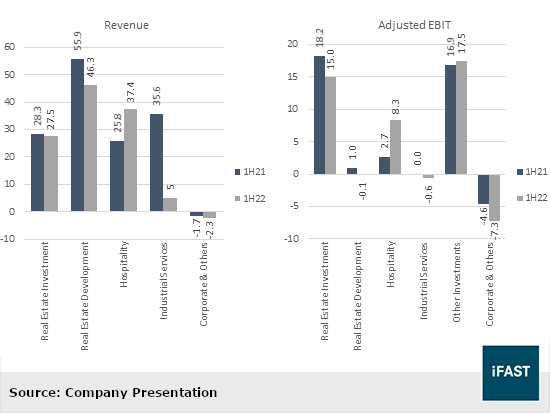
Looking at the first six months of 2022 (“1H22”), real estate development continues to form the majority of their total revenue at SGD 46.3m. Compared with 1H21, real estate development and industrial services (that consists of SP Corp) fell the most at 17% and 86% respectively. The firm cited the absence of revenue from Kandis Residence after attaining Temporary Occupation Permit (“TOP”), while SP Corp saw an absence of coal delivery.
Diving deeper into their adjusted earnings before income and taxes (“EBIT”) by segment, the main contributors were from real estate investments, other investments (consisting of GulTech) and hospitality. Of which, hospitality saw a significant growth against 1H21 at a 204% increment – which benefited from the improved hotel operations in Australia with the easing of COVID-19 restrictions at the beginning of 2022.
Total revenue fell from SGD 143.9m in 1H21, to SGD 113.9m in 1H22. However, adjusted EBIT fell to a lesser degree, from SGD 34.2m in 1H21 to SGD 32.8m in 1H22.
Chart 2
Revenue and Adjusted EBIT in 2020 and 2021 (SGD
m)
A key
concern is the profits arising from real estate development, which sees a
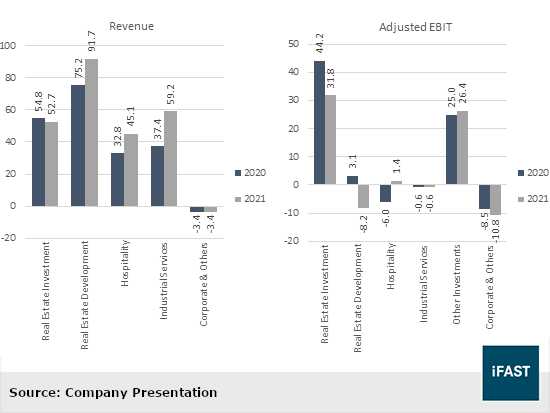
negative EBIT once again after a similar result in 2021. For the whole of 2021
(“FY21”), real estate development recorded a negative EBIT of SGD 8.2m, against
a positive EBIT of SGD 3.1m in FY20. This is despite an increase in segment
revenue at SGD 91.7m in FY21, against a lower SGD 75.2m in FY20. Tuan Sing
attributed it to the construction delays occurring alongside increased
construction costs, due to a shortage of labour and price hike in construction
materials. A similar reason was indicated for the negative EBIT in 1H22,
primarily due to higher construction costs arising from the delays.
While higher total revenue was recorded in FY21 at SGD 245.3m against FY20 at SGD 196.8m, total adjusted EBIT fell significantly to SGD 40.0m in FY21, from SGD 57.2 in FY20. This does not include the cashflow from divestment in 2022 – the sale of 39 Robinson contributing SGD 88.9m gain on disposal of a subsidiary. The divestment will not be material to the discussion given the one-off nature of the divestment, in contrast to their continuous business operations of concern.
Projecting the earnings for 2H22, a large contributor to revenue would be in the real estate development segment. Two major developments in Singapore will be reaching their key milestones in 2H22; Kandis Residence is expected to attain Certificate of Statutory Completion, while Mont Botanik is expected to attain TOP. Based on the estimated gross development value of the two properties, approximately ~SGD 50m will be provided in terms of revenue for Tuan Sing, likely at minimal additional costs as both developments are drawing near the end of their construction phase.
On the other hand, earnings in the other segments are expected to stay relatively similar, or at best slightly better in Tuan Sing’s hospitality segment – considering the resurgence in travel demand that supports the hospitality sector. As such, there are some expectations of a significant boost to their profits in FY22, in contrast to FY21 which had a significant contribution coming from the divestment.
Despite being a core business operation providing substantial revenue, the real estate development arm has had lacklustre results – understandably so given the increased construction costs and delays arising from the pandemic. If anything, it affirms the need for the company to reposition itself, and to look out for more opportunities beyond conventional real estate development. We expect to see improved results in this segment as the developments in Singapore get completed.
Tuan Sing might have a cash problem
Looking into Tuan Sing’s credit and liquidity profile, there are certain issues we would like to highlight. Tuan Sing’s credit profile is generally decent – as of 30th December 2021, of total borrowings at SGD 1,352.7m, a significant 85% of it is secured, while only 37% of their borrowings are fixed. As of 30th June 2022, we observe that the current borrowings amounted to SGD 712m out of the SGD 1,334m total outstanding borrowings. Tuan Sing had indicated SGD 400m worth of secured bank loans and medium-term notes (“MTN”) are expected to mature in October 2022, which they were “in documentation stage for the refinancing of these loans and borrowings” as of the report release. In addition, another secured bank loan of SGD 270m is set to mature in June 2023.
It is understood that the SGD 200m MTN TSHSP 2.800% 18Oct2022 Corp (SGD) had previously matured on 18 October 2022, without any refinancing through the issuance of notes. As such, we would like to make an initial, conservation assumption that Tuan Sing had drawn down from its cash reserves for the redemption of the note, instead of through a credit facility or refinancing given the lack of announcements. With this information in mind, let us look into Tuan Sing’s cash position over the past years.
Table 1
Tuan Sing’s Cash and Cash Equivalent across the
years
|
Year |
1H22 |
FY21 |
FY20 |
FY19 |
FY18 |
FY17 |
|
Cash and Cash Equivalent (SGD m) |
364.4 |
405.0 |
274.4 |
172.3 |
133.0 |
216.8 |
|
Source: Company presentation. |
||||||
Tuan Sing had consistently sustained a healthy cash position across the years, which has enabled them in making necessary acquisitions for the development of the business. However, we would like to note several extensive cash usages in 2H22 for financing activities.
- With the assumption of drawdown in cash for the redemption of TSHSP 2.800% 18Oct2022 Corp (SGD), SGD 200m would be utilised for the matured notes.
- Tuan Sing had a tender offer for its TSHSP 6.900% 18Oct2024 Corp (SGD), of which SGD 59.25m of the notes were redeemed at a price of 101 per cent.
- Recently, it completed the acquisition of the remaining equity in SP Corp in an attempt to privatise the commodities trading company, for which the sale consideration was valued at approximately SGD 11.0m.
- Financing costs are likely to be similar to 1H22 in 2H22, which was approximately SGD 31m.
With these considerations in mind, the cash reserves that Tuan Sing potentially possesses significantly decrease to approximately ~SGD 63m, exclusive of operating and investing cashflows. A critical question that requires confirmation would be the refinancing of the MTN in October 2022 – if Tuan Sing had redeemed the notes with cash proceeds from further secured bank borrowings, or from its cash reserves. While we have confidence in Tuan Sing’s ability to seek refinancing on the secured MTN through bank borrowings, the lack of information until the release of their FY22 financial results provides severe uncertainty over the company’s liquidity and credit position.
TSHSP 6.900% 18Oct2024 Corp (SGD)
Tuan Sing currently only has TSHSP 6.900% 18Oct2024 Corp (SGD), with yield to maturity of 6.14% at the ask price of 101.25 and maturity term of 1.785 years. After the tender offer on 17th November 2022, outstanding issue size of SGD 141.75m remains. As such, Tuan Sing has an annual coupon of SGD 9.78m to service on the outstanding note.
Taking a conservative stance, based on the assumption that Tuan Sing is indeed left with approximately SGD 63m exclusive of operating and investing cashflows, there still remains sufficient cash for Tuan Sing to continue servicing the coupon payments until maturity and to seek refinancing of the MTN through the issuance of debt. Looking at Tuan Sing’s past issuance, it had been refinancing its higher-yielding notes – the current TSHSP 6.900% 18Oct2024 Corp (SGD) was previously issued to refinance the TSHSP 7.750% 19May2022 Corp (SGD) which they exercised the early call option on 29th October 2021. However, it ought to be highlighted that the availability of refinancing ultimately depends on the interest rates then.
Should Tuan Sing choose not to refinance the maturing note in 2024, a significant sum of SGD 141.75m would be needed. Thankfully, a series of projects are lined up for completion in 2023 and 2024 that should ideally provide for a healthier cashflow.
- The 7.8%-owned Sanya project in Hainan, China is expected to be completed in 1H23; with a gross development value of RMB 5b and cost of RMB 1.6b, it ideally provides for a maximum of approximately ~SGD 50m of earnings for Tuan Sing though this segment is likely to be equity accounted for.
- The 50:50 Joint Venture with Mitsubishi Estate Co., Ltd. for The Grand Outlet – East Jakarta in Karawang, Indonesia has a target opening date in the fourth quarter of 2023, accounted for under the Real Estate Investment segment with a leasable area of approximately 26,000 square metres.
- Peak Residences in Singapore is expected to attain TOP in 1H24, which should provide for significant revenue in Real Estate Development (although this depends on the demand of the property, which is estimated only 48% sold, in contrast to its other Singapore properties that are either fully or close to fully sold).
As such, it is highly doubted that Tuan Sing would lack the cash position to redeem the maturing note in 2024. But it is also clear that existing bondholders have to monitor Tuan Sing’s financial statements closely, given the uncertainty over the recent actions and their consequences.
Oxley and Tuan Sing – Which is preferred?
Table 2
Oxley's and Tuan Sing's MTN
|
Issue |
Ask Price |
YTM |
Years to Maturity |
|
TSHSP 6.900% 18Oct2024 Corp (SGD) |
101.25 |
6.14% |
1.785 |
|
OHLSP 6.900% 08Jul2024 Corp (SGD) |
95.75 |
10.01% |
1.508 |
|
Sources: Bondsupermart, iFAST Compilations. Data as of 5 January 2023. |
|||
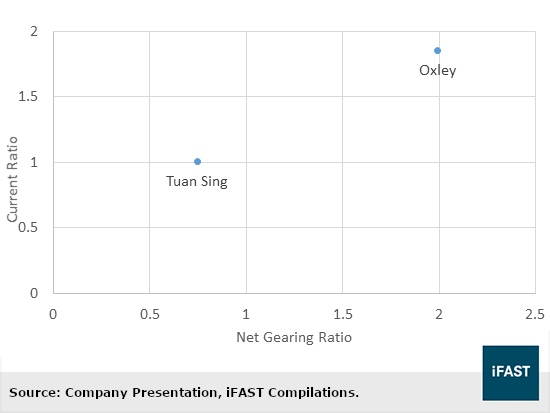
Oxley Holdings Limited’s (“Oxley”) OHLSP 6.900% 08Jul2024 Corp (SGD) is highly similar to Tuan Sing’s issue – both coming from a real estate developer, coupon offering 6.90% and a similar maturity term. Oxley’s issue offers significantly higher YTM given the below-par ask price of 95.75. Looking into the I-spread for both issues, Oxley’s issue is significantly higher at 800 basis points (“bps”) in comparison to Tuan Sing’s issue at 377 bps. On the other hand, looking at the chart below, Tuan Sing’s current ratio and net gearing ratio is comparatively better against Oxley, suggesting a poorer credit profile by Oxley in alignment with the higher I-spread.
Chart 3
Oxley
and Tuan Sing Current Ratio and Net Gearing Ratio
If
investors have to choose, Tuan Sing’s credit profile would look better given
the lower leverage utilised by the company in both the short and long term. Similarly,
in terms of higher-yielding notes in the SGD market, TSHSP 6.900% 18Oct2024
Corp (SGD) is undeniably attractive compared to the other available options. However,
with the impending global economic slowdown, we remain firm on the preference
for investment-grade issuers. Although Tuan Sing cites “a cautiously optimistic
outlook for the real estate market”, high-yield issuers are comparatively more
vulnerable to the economic changes we expect to see. As such, we believe
investors ought to be more prudent, in view of an increased likelihood of
deteriorating credit and liquidity profiles across the market. For Tuan Sing,
investors might want to keep on a lookout for their FY22 financial results
before making any moves, considering the uncertainty in their recent actions.
Declaration: For specific disclosure, at the time of publication of this report, IFPL (via its connected and associated entities) holds a position in TSHSP 6.900% 18Oct2024 Corp (SGD) and OHLSP 6.900% 08Jul2024 Corp (SGD), and the analyst who produced this report holds a NIL position in the abovementioned securities.
Our podcast series, Yield Hunters, is available on Spotify, iTunes Podcasts and Google Podcasts. We share our thoughts on new bond issues and hold discussions on the fixed income space. Listen to our latest episode below and follow us!