Highlights:
- Along with the end of the semiconductor industry down cycle, the company saw a full-scale improvement in operational track records and returned to a profitable position in 3QFY24. The merger with Kioxia collapsed in favor of spinning off the storage chip segment.
- The company's leverage remains at a reasonable level. Debt is moderately sized and most of it will mature after 2026, leaving a decent credit profile.
- The bond due in 2026 is currently yielding about 6.3%, coupled with its credit rating of BB and sound credit outlook, making it a rare high-yield choice among semiconductor bonds.
Western Digital Corporation (WDC) is one of the highest-yielding semiconductor issuers and is favored by some bond investors. What is the company's current operational and credit profile? Is it still worthwhile for investors to consider? In this Idea of this Week, we will answer these questions based on the company's latest financial results.
Industry Down Cycle Came to an End and Company' operation Signs of Recovery
As investors may know, the semiconductor industry entered a downward cycle since the second half of 2022, particularly in the space of the storage chip market, where oversupply led to a significant drop in product prices, and major players like Samsung Electronics delivered their worst results in history.
It is important to point out that the down cycle came to an end after a year and a half of recuperation. Data from Trendforce, an authoritative research organization in the semiconductor industry (Table 1), reveals that the price of storage chips rebounded since the fourth quarter of 2023, rising by 13-18% in the same quarter and recording a price increase of more than 20% in the first quarter of this year. It is estimated by Trendfoce that the storage chip price will likely soar by over 30% in 2024, driven by the demand of enterprise clients, including AI and Cloud Storage.
Table 1: Storage Chip Price Movement and Forecast
|
1Q2023 |
Down 10%-15% |
|
2Q2023 |
Down 10%-15% |
|
3Q2023 |
Down 5-10% |
|
4Q2023 |
Up 13-18% |
|
1Q2024 |
Up 23-28% |
|
2Q2024 (E) |
Up 13-18% |
|
Source: Trendforce, iFAST Compilations Data as of 31 March 2024 |
|
WDC’s performance is showing signs of recovery as demand picks up and product prices rise. Chart 1 shows that the company’s revenue bottomed out since 3QFY23 (from April to June 2023) and stood at USD 3.5 billion in 3QFY24, which rose by 14.2% QoQ and 23.6% YoY, respectively. Meanwhile, WDC returned to a profitable position with net income reaching USD 140 million in 3QFY24, much better than the previous quarters.
Chart 1: WDC’s Revenue and Profit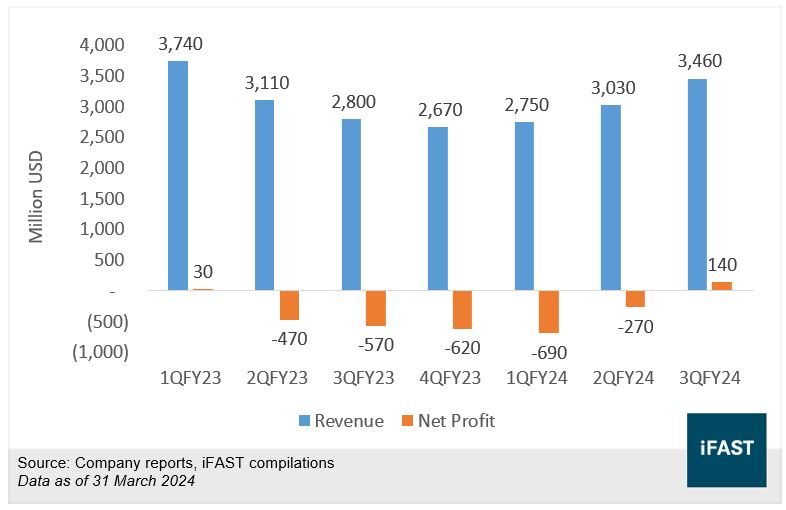 Looking
at the revenue breakdown, HDDs are still the company's largest source of
revenue, with revenues of USD 1.7 billion, or 50.7% of total revenues, recorded
in the second quarter of 3QFY2024. It is noteworthy that the shipment of HDDs inevitably
slumped during the industry down cycle, while its gross margin remained at over
20% for multiple quarters. We believe this is due to the market situation, which
is a three-way tie with Seagate Technology and Toshiba Electronics. They thus
shaped strong bargaining power in the consumer market, making them maintain solid
profit margins. On the other hand, as not a top-tier player in the storage chip
market, WDC highly relies on Kioxia, a joint venture partner, in terms of
R&D, and is short of a competitive edge in the industry and performing
poorly in the market downturn, with even negative gross margins from 3QFY23 to
1QFY24. With the rebound in storage chip prices, coupled with somewhat stronger
demand in the market, the gross margin of the storage chip segment increased
sharply to 27.4% in the third quarter of FY24. Additionally, the company also
ramped up the production capacity from less than 75% during the industry down
cycle to 90%, we thus have good confidence that the company's operations will
continue to perform well in the coming quarters, with a high probability of
double-digit growth in revenues and profits.
Looking
at the revenue breakdown, HDDs are still the company's largest source of
revenue, with revenues of USD 1.7 billion, or 50.7% of total revenues, recorded
in the second quarter of 3QFY2024. It is noteworthy that the shipment of HDDs inevitably
slumped during the industry down cycle, while its gross margin remained at over
20% for multiple quarters. We believe this is due to the market situation, which
is a three-way tie with Seagate Technology and Toshiba Electronics. They thus
shaped strong bargaining power in the consumer market, making them maintain solid
profit margins. On the other hand, as not a top-tier player in the storage chip
market, WDC highly relies on Kioxia, a joint venture partner, in terms of
R&D, and is short of a competitive edge in the industry and performing
poorly in the market downturn, with even negative gross margins from 3QFY23 to
1QFY24. With the rebound in storage chip prices, coupled with somewhat stronger
demand in the market, the gross margin of the storage chip segment increased
sharply to 27.4% in the third quarter of FY24. Additionally, the company also
ramped up the production capacity from less than 75% during the industry down
cycle to 90%, we thus have good confidence that the company's operations will
continue to perform well in the coming quarters, with a high probability of
double-digit growth in revenues and profits.
Storage Chip Segment Expected to Be Spun Off
As we mentioned last year, WDC sought to merge with Kioxia to become the world's largest memory chip maker. However, the merger was not approved by Kioxia’s shareholder SK Hynix, the world's second-largest storage chip marker, leading to the collapse of the merger in October 2023.
Following the termination of the merger, WDC announced a new plan to spin off the HDD segment and storage chip segment, with the two subsidiaries to be listed independently. We believe that spinning off the storage chip segment is not a detriment at all, due to the fact that the technology profiles of HDDs and SSDs are very diverse, and the two segments are not likely to generate synergy. Instead, the operational efficiency of the two separate entities after the spin-off should be higher.
Leverage Remains at Reasonable Level; Debt Structure Looks Desirable
From the perspective of credit metrics, the net gearing ratio stood at 58.1% ending 31 March 2024, almost unchanged from the previous quarters, reflecting that the leverage is still at a reasonable level in the industry and the indebtedness repayment obligation is limited. We believe that the company maintains reasonable leverage against the backdrop of the industry down cycle due to continued declining capital expenditures. At the beginning of the industry down cycle, WDC quickly adjusted downward its capital expenditure to around USD 30.0 million in a single quarter, which enabled the company's cash and cash equivalents to reach USD 2.5 billion by the end of March 2024 instead of decreasing in recent quarters.
Diving into the borrowings profile, the total debt amounted to USD 7.8 billion, slightly higher than previous quarters. The short term is around USD 450 million, and over 80% of debt will mature in 2026 and thereafter, leaving ample time for fundraising and hinting at a favorable debt structure.
It is worth noting that the unused credit facilities of WDC were around USD 2.2 billion, together with the cash balance of USD 2.5 billion, the total liquidity WDC owns reached more than USD 4.7 billion, enough to fulfill the requirements of debt repayment and production capacity expansion in the years ahead. More importantly, given the planned spin-off of the storage chip segment, the company is expected to obtain a considerable cash inflow, we thus believe the liquidity will remain at a relatively sound level in the coming years and that the credit risk will also be manageable.
Chart 2: WDC’s Debt Maturity Profile 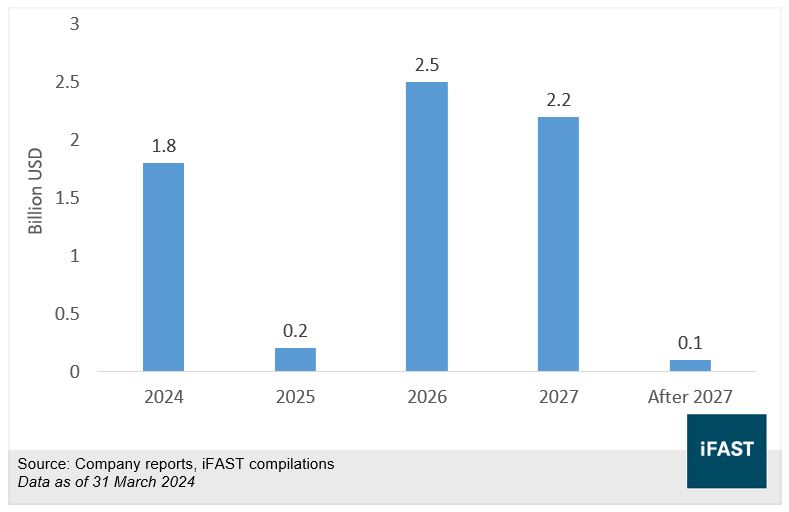
Bond Yields Top Among Peers
Two bonds issued by WDC are available on our platform and maturing in 2026 and 2029. Both are assigned credit ratings of BB-/BB (S&P/Fitch). Other information is as follows.
Table 2: WDC’s Bond Investment
|
Bond |
Bond Credit Rating |
Years to Maturity |
YTM |
|
BB-/BB (S&P/Fitch) |
1.8 |
6.0% |
|
| WDC 2.850% 01Feb2029 Corp (USD) | BB-/BB(S&P/Fitch) |
4.8 |
6.3% |
|
Sources: Bondsupermart Data as of 9 May 2024 |
|||
The improvement in industry fundamentals drove down the credit spread and bond yields. The yield to maturity of bonds due in 2026 dropped from 7% at its peak to roughly 6%. Nonetheless, the bond yield still outperforms most USD investment-grade corporate bonds. Given the company’s strong liquidity position and manageable potential investment risk, we believe WDC’s bonds are pretty attractive for investment. Although the bond due in 2029 offers higher returns, investors may give priority to the bond due in 2026 one due to the larger potential uncertainty associated with longer maturity.
If we compare with other USD bonds issued by other semiconductor companies (Chart 2), most issuers are high investment-grade with flat yield curves, suggesting there is little difference between the yield on long-dated and short-dated bonds at 5% to 6%. In contrast, the yields on WDC are top among semiconductor issuers. Considering its rather decent credit metrics, we believe that WDC is a good high-yield choice from the semiconductor space.
Chart 3: Bonds Issued by Semiconductors 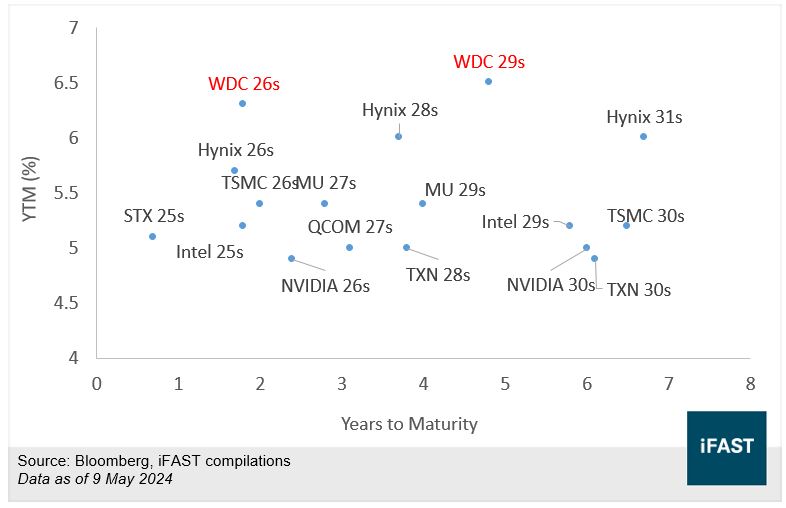
Corporate Risk
Investors should be aware of the following risks. Firstly, if the recovery of the semiconductor industry is not as good as expected, the sales performance of WDC would face great uncertainty, which would adversely affect the cash balance and credit profile.
Secondly, the company's floating-rate debt is relatively large, reaching USD 2.9 billion as of 31 March 2024. Under an interest rate hike environment, WDC is facing higher debt payment amounts, which may weaken the credit quality.
Conclusion
Along with the end of the semiconductor industry down cycle, the company saw a full-scale improvement in operational track records and returned to a profitable position in 3QFY24. The merger with Kioxia collapsed in favour of spinning off the storage chip segment.
The company's leverage remains at a reasonable level. Debt is moderately sized and most of it will mature after 2026, leaving a decent credit profile.
The bond due in 2026 is currently yielding about 6.3%, coupled with its credit rating of BB and sound credit outlook, making it a rare high-yield choice among all semiconductor bonds.
Declaration: For specific disclosure, at the time of publication of this report, IFPL (via its connected and associated entities) and the analyst who produced this report hold a NIL position in the abovementioned securities.
Our podcast series, Yield Hunters, is available on Spotify, iTunes Podcasts and Google Podcasts. We share our thoughts on new bond issues and hold discussions on
the fixed income space. Listen to our latest episode below and follow us!