Receive first-hand news on the latest bond issues, credit updates and special events when you join us on our Telegram channel at https://t.me/bondsupermart!
Highlights:
- Western Digital delivered rather stable tracking records in FY21 and FY22. Owing to the downtrend cycle, both revenue and profit were seen a large drawdown. The company proposes to merge with Kioxia, the world's second-largest memory chip maker. The prospect would turn positive if the plan progresses well as expected.
- The company's current debts are not massive, and most of them will mature after 2026. In addition, the company has ample liquidity and the pressure of debt repayment is manageable.
- Following the weakening of industry fundamentals, the yield spread widened significantly. The bond due in 2026 is currently yielding around 6.8%, with a credit rating of BBB, making it an attractive investment choice.
Company Background
Founded in 1970, WDC is listed on New York Exchange with the stock code WDC.US. The market capitalisation reached roughly USD 12.0 billion at the market close on 3 March 2023.
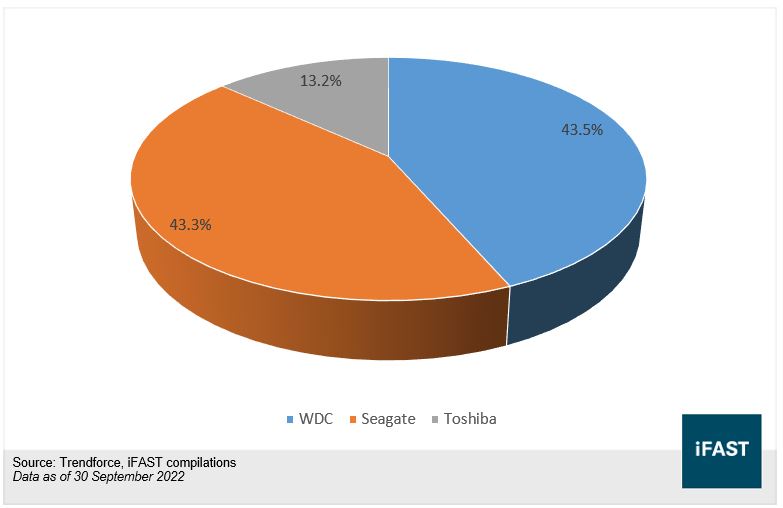
WDC's major business comprises the production of memory chips which are mainly divided into hard disk drive (HDD) and storage chips (Flashing Memory). In terms of HDD, WDC is the largest producer in the world, with a market share of approximately 44% as of September 2022 (see Chart 1), a three-way tie with Seagate Technology and Toshiba Electronics.
Chart 1: Market Share of HDD
 As for memory chips, WDC acquired SanDisk for USD 19 billion in
2015 to enter the industry and established a joint venture with Kioxia, a
subsidiary of Toshiba Electronics. Currently, the company's products include
solid-state drives (SSDs) and memory cards.
As for memory chips, WDC acquired SanDisk for USD 19 billion in
2015 to enter the industry and established a joint venture with Kioxia, a
subsidiary of Toshiba Electronics. Currently, the company's products include
solid-state drives (SSDs) and memory cards.
Shrinking HDD Market Results in Poor Performance
HHD is the most widely used storage tool in the past few decades and the largest source of revenue for WDC, accounting for over 90% of revenue at its peak. Although SSD has been around for a long time, it could hardly challenge the market position of HDDs due to its extremely high production costs.
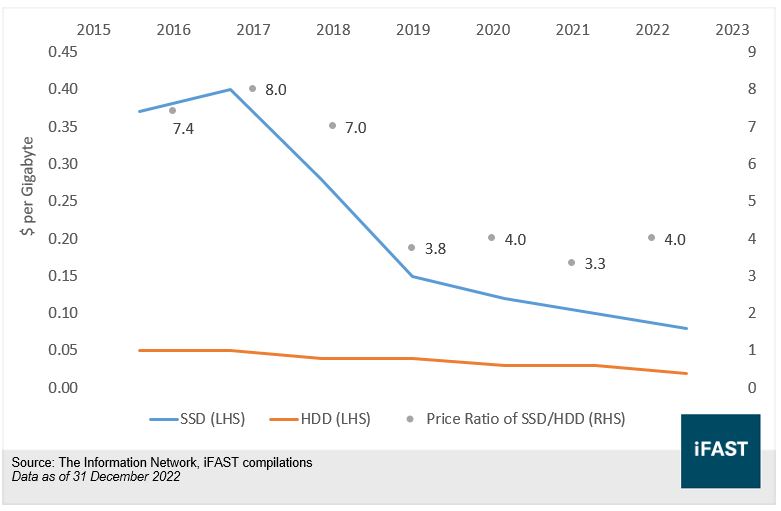
Chart 2 shows that the average selling price of SSD per gigabyte was roughly $0.4 in 2017, eight times higher than that of HDD. Yet the situation changed in recent years, as the ratio of the price of SSD/HDD narrowed to four times in 2022, following the production ramp-up of SSD. More importantly, given a faster read/write speed and longer life span, SSD has a notably comprehensive advantage over HDD. As a consequence, HDD is rapidly replaced by SSD, particularly for laptops.
Chart 2: HDD and SSD Comparison
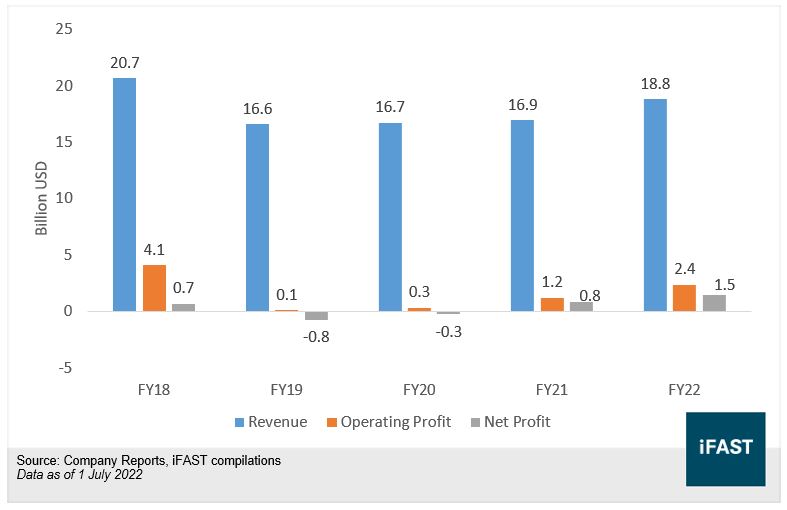
We note that the company's financial position has been on a downward spiral since FY18 (from 30 June 2017 to 29 June 2018) along with the prospect of the HDD market turned bleak (see Chart 3). Although the revenue in FY 22 rose by 11% to USD 18.9 billion, due to the expanding demand for electric devices amid the pandemic outbreak, its performance is incomparable with that of FY18.
Chart 3: Operation Performance of WDC
 To add insult to injury, the semiconductor industry entered a down
cycle in the second half of 2022, with a significant reduction in electronic
equipment shipments. WDC is facing greater downside risks, especially in the
second quarter of FY23 (4Q2022), which saw a 36% year-on-year slump in revenue
to USD 3.1 billion. We expect this downturn cycle to continue for one to two
years and WDC's revenue to decline by 20% during the period.
To add insult to injury, the semiconductor industry entered a down
cycle in the second half of 2022, with a significant reduction in electronic
equipment shipments. WDC is facing greater downside risks, especially in the
second quarter of FY23 (4Q2022), which saw a 36% year-on-year slump in revenue
to USD 3.1 billion. We expect this downturn cycle to continue for one to two
years and WDC's revenue to decline by 20% during the period.Plans to Merge with Kioxia to Become the world's Largest Memory Chip Maker
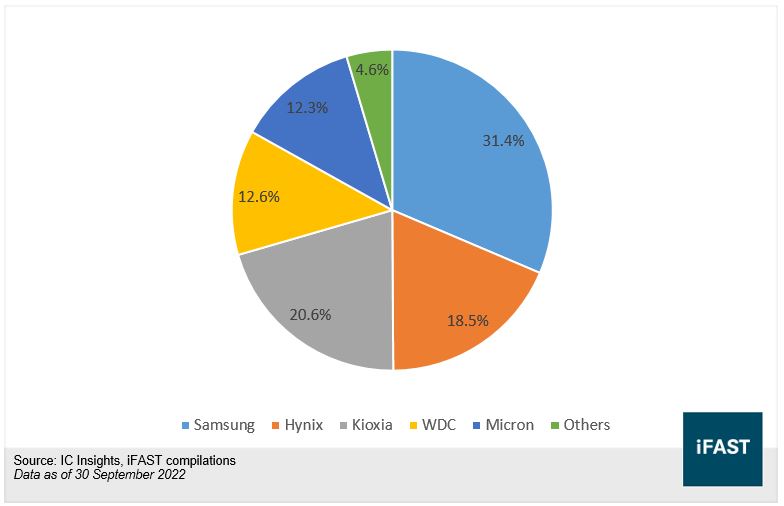
Given the bleak prospect of the HDD market, WDC's business strategy is tilting to SSD production. For example, as of September 2022, WDC is the fifth largest NAND SSD producer with a market share of roughly 13% (see Chart 4).
Chart 4: Market Share of NAND SSD
It is important to point out that HDD and SSD are on very different technical paths, and the technical barriers for SSD are relatively high. In practice, Kioxia, the company's joint venture, is responsible for the production of memory chips, while WDC is involved only in chip packaging and testing. In other words, WDC's market share may look good, but it is not a top-tier player in the industry.
In order to further engage in the field of memory chips, WDC sought to merge with Kioxia multiple times. In early January, Bloomberg News cited that WDC has resumed merger talks to spin off its memory chip business and merge it with Kioxia into a single company, which is expected to be listed on both the US and Japan. Considering that WDC and Kioxia have been in partnership for nearly 20 years with diverse products, the merge is expected to proffer synergy for both, coupled with the fact that the merger may strengthen their leading positions in the midst of a market downtrend cycle. With this in mind, we believe that the merger has a higher probability of success, and if the merger is successful, the new company will mark a 33% market share, surpassing Samsung Electronics and becoming the world's largest memory chip manufacturer.
In summary, the current operating performance of WDC is rather poor, and the market downtrend might accelerate the deterioration of WDC's revenue. However, if its merger with Kioxia is successful, we are still positive about the company’s long-term development. On the other hand, the merger plan needs to be approved by multiple regulatory authorities, so it may not be possible to make substantial progress in the near future.
Leverage Remains Low with Limited Repayment Obligation
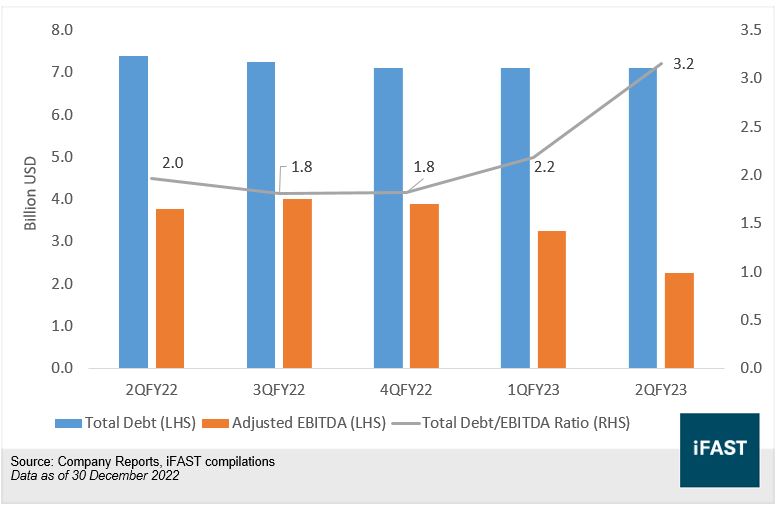
Credit-wise, as of 30 December 2022, the total debt of WDC amounted to USD 7.0 billion, a slight decline compared to the last few quarters. In terms of debt, no short-term borrowing is shown on WDC's balance sheet, and over 80% of debt will mature in 2026 and thereafter, hinting at a favorable debt structure.
From the leverage perspective, WDC's total debt/EBITDA ratio remained at roughly 2x from 2QFY22 to 1QFY23, which is below the industry average and suggests a limited indebtedness repayment obligation in the future. But the leverage is on a trend of upward subsequent to the weakening of industry fundamentals, as the total debt/EBITDA ratio rose to 3.2x for 2QFY22 and is expected to continue to climb in coming quarters.
Chart 5: WDC’s Debt and Leverage
 As of the end of 2022, the cash balance of WDC was close to USD 1.9 billion, which is slightly lower than the average level in previous quarters, reflecting the adverse impact of the industry downturn on the company's liquidity. On the other hand, the company has managed to maintain its operating cash inflow in recent quarters, but we expect a net outflow from 3QFY23.
It is noteworthy that the unused credit facilities of WDC stood at USD 2.3 billion, enough to fulfill the requirement of debt repayment in the coming years. Besides, the company also plans to trim down the capital expenditure for the next quarters in response to the market downturn. Furthermore, Apollo Global Management, Inc, a well-known investment company, injected USD 900 million to WDC at the end of January this year. Overall, the above actions will likely benefit the company's liquidity, and we believe that the liquidity will remain at a relatively sound level in the coming years and that the credit risk will also be manageable.
Consider the Bond due in 2026
Two bonds issued by WDC are available on our platform and maturing in 2026 and 2029. Both are assigned credit ratings of BB/BBB- (S&P/Fitch). Other information is as follows.
Table 1: Bond Investment of WDC
|
Bond |
Bond Credit Rating |
Years to Maturity |
Ask Price |
YTM |
|
WDC 4.750% 15Feb2026 Corp (USD) |
BB / BBB- (S&P/Fitch) |
3.0 |
94.5 |
6.8% |
|
WDC 2.850% 01Feb2029 Corp (USD) |
BB / BBB- (S&P/Fitch) |
5.9 |
78.2 |
7.5% |
|
Source: Bondsupermart Data as of 3 March 2023 |
||||
The decline in industry sentiment drove up the yield spread of bonds, of which the 2026 bond's Z-spread gained from 110 bps at the beginning of 2022 to 250 bps as of now, resulting in a bond yield of 6.8%, which is higher than most US investment grade corporate bonds. Given the company's strong liquidity position and manageable potential investment risk, we believe the bonds are pretty attractive for investment.
Although the bond due in 2029 offers higher returns, investors may give a priority to the bond due in 2026 one due to the larger potential uncertainty associated with longer maturity.
Corporate Risk
Investors should be aware of the following risk. Firstly, the Company's floating-rate debt is relatively large, reaching USD 2.7 billion as of December 30, 2022. Under an interest rate hike environment, WDC is facing higher debt payment amounts, which may weaken the credit quality.
Secondly, if the industry down cycle lasts longer than expected, it would adversely affect the cash balance and credit profile.
Conclusion
Western Digital delivered rather stable tracking records in FY21 and FY22. Owing to the downtrend cycle, both revenue and profit saw a large drawdown. The company proposes to merge with Kioxia, the world's second-largest memory chip maker. The prospect would turn positive if the plan progresses well as expected. The company's current debts are not massive, and most of them will mature after 2026. In addition, the company has ample liquidity and the pressure of debt repayment is manageable.
Following the weakening of industry fundamentals, the yield spread widened significantly. The bond due in 2026 is currently yielding around 6.8%, with a credit rating of BBB, making it an attractive investment choice.
Declaration: For specific disclosure, at the time of publication of this report, IFPL (via its connected and associated entities) and the analyst who produced this report hold a NIL position in the abovementioned securities.
Our podcast series, Yield Hunters, is available on Spotify, iTunes Podcasts and Google Podcasts. We share our thoughts on new bond issues and hold discussions on the fixed income space. Listen to our latest episode below and follow us!