Note: This article was first published on the Business Times on 9 May 2023.
- There has been a divergence of trend from the
continued hikes in US Fed funds rate.
- Singapore Treasury Bills had been seeing a drop in
yields as the banking crisis unfolded, although not a direct cause.
- Stability in Singapore’s environment had stabilised
the interest rates.
- Retail bonds with high credit ratings might be a good alternative to the current T-bills.
T-bills - Where is it going from here?
The Singapore Treasury Bills (“T-bills”) had been a hot topic since the rise of interest rates in 2022. As the Monetary Authority of Singapore (“MAS”) do not manage the monetary policy through interest rates, the interest rate environment in Singapore had mostly been dictated by the changes in the United States. Most importantly, the US had been the leader in the rate hikes observed since 2022 – being one of the first major economies to raise its interest rates – with this cycle being one of the most aggressive rate hike cycles in history.
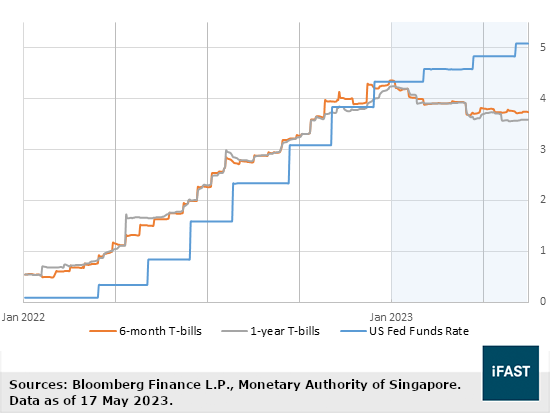
Chart 1US Fed Funds Rate versus SGD 6-months, 1-year T-bills
since 2022
Favourable
sentiments on T-bills rose significantly as the yields increased considerably
alongside the rise in the US Federal funds rate. Yields on 6-month T-bills hit
a peak of 4.4% during the auction in November 2022. Against comparable
instruments such as Singapore Savings Bonds (“SSBs”) and fixed deposits in
Singapore, T-bills seemingly offered a higher yield with a shorter tenor to
mitigate the interest rate risks. It was not surprising to see the popularity
of T-bills rising so quickly, especially with a large number of investors
looking for a short-term pivot out of the equity market during this economic
downturn.
But that was for 2022. Heading into 2023, things began to change considerably for the yields on T-bills, which started falling despite the US Fed funds rate continuing with the hike to combat the still-elevated inflation in the US. Inflation remained higher than expected in early-2023, staying above 6% until its recent fall to 5% in March 2023.
It was mostly similar in Singapore, with inflation only falling to 5.5% most recently in March while it had been staying at more than 6% since last year. MAS chose to remain on the current appreciating path for its S$NEER, instead of further tightening the monetary policy – likely necessary after seeing a GDP contraction in the first quarter of 2023.
Yields on T-bills went against expectations – despite rates only going higher in the US, yields began falling in Singapore. Against the trend observed throughout 2022, yields on T-bills appear to have reached their peak in end-2022, and it continues falling even as the market just saw another rate hike by 25 basis points before potentially coming to a rate pause.
Chart 2
Yields on 6-months and 1-year T-bills and significant
events in US
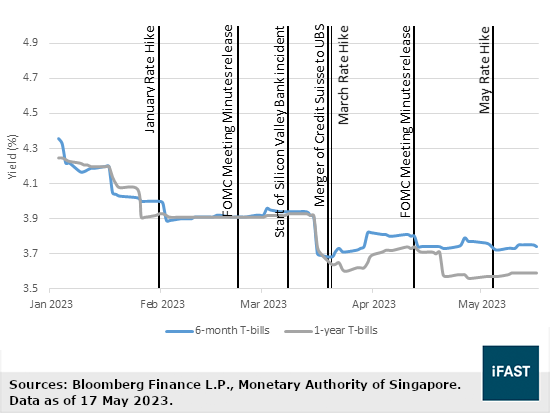
While
unlikely to be a direct effect of the banking crisis, we had seen a general
drop in the yields of T-bills as it happens. In the US, the banking crisis
resulted in a drove of investors buying into the US Treasury as they looked for
a safe haven to park their monies. Yields on the US Treasury bonds fell as a
result, despite the US Fed Reserve hiking the rate by another 25 basis points
in the March meeting.
In Singapore’s case, the incident only further highlighted the stability and strength of the monetary environment in Singapore. The stability in Singapore’s financial system is likely the underlying reason for the rapidly changing sentiments with regard to the interest rates environment, contributing to the drop in yields of T-bills while interest rates in the US continue to rise further. In addition, SGD had been appreciating significantly against USD since October 2022, when USD had strengthened against most currencies in 2022 due to the aggressive rate hikes carried out – further drawing the divergence against the continued rise in interest rates in the US.
Across the previous rate hike cycles in history, most notably in 2007 and 2019 during the transition into a rate pause, yields on the Singapore Government Securities had been observed to start falling off at the start or even before the rate pause. Alongside market expectations for the US Fed Reserve to begin its rate pause in the June meeting, the yields on T-bills are quite unlikely to see an upward trend from here.
Furthermore, the inflation narrative driving the need for higher interest rates is likewise slowing down. Singapore’s core inflation rate fell to 5% in the March 2023 readings, from 5.5% in January, while MAS projects the core inflation rate to fall to 2.5% by end-2023. Accounting for the increase in Goods and Services Tax at the start of 2023, it is not unfair to say that inflation had softened.
Moving forward, we believe the optimal case is for the yields for T-bills would hover around the current level, or else gradually taper off. For the 6-month T-bills yield to break past its glorious 4.4% record, it would require a sharp spike in inflation to drive further drastic rate hikes. While the recent OPEC+ announcement on oil production cuts might be an unknown variable in this inflation equation, weakening demand for energy alongside lower consumption across the globe reduces the likelihood of such an event.
Table 1
Investment-grade SGD retail bonds
|
Issue |
Ask Price |
Yield to Call |
Callable Date |
Bond Credit Rating (S&P/Fitch) |
|
99.73 |
4.11% |
20 June 2024 |
A+/AA- |
|
|
95.70 |
4.64% |
18 March 2026 |
A+/A+ |
|
|
99.97 |
4.13% |
27 May 2027 |
A+/A+ |
|
|
Sources: Bondsupermart, iFAST Compilations. Data as of 17 May 2023. |
||||
For investors considering retail alternatives, they may want to look at investment-grade retail bonds. We recommend ASTLC 3.000% 18Mar2031 Corp (SGD) - Class A-1 with a bond rating of A+ from both S&P and Fitch Ratings. At the ask price of 95.70, it has an estimated yield to call of 4.64% - a considerable pick-up over the T-bills at estimated 3.6% to 3.7% yields. Investors will be able to lock in higher yields as the likelihood of a recession grows stronger, while the strong credit quality allows for greater stability amidst this volatile period.
Declaration: For specific disclosure, at the time of publication of this report, IFPL (via its connected and associated entities) holds a position in ASTLC 3.250% 18Mar2031 Corp (USD) - Class A-2, BY23100X; SITB ZERO 30Jan2024 Govt (SGD), BS23109E; SITB ZERO 14Nov2023 Govt (SGD), BS23107V; SITB ZERO 17Oct2023 Govt (SGD), BY23101W; SITB ZERO 23Apr2024 Govt (SGD), BS23105W; SITB ZERO 19Sep2023 Govt (SGD) and NX15100Z; SIGB 2.375% 01Jun2025 Govt (SGD), and the analyst who produced this report holds a NIL position in the abovementioned securities.
Our podcast series, Yield Hunters, is available on Spotify, iTunes Podcasts and Google Podcasts. We share our thoughts on new bond issues and hold discussions on the fixed income space. Listen to our latest episode below and follow us!