Highlights:
- Vital Energy is a small US oil and gas company. It has around 250 thousand of net acres and produces around 37 MMboe pear. In recent years, it issued and placed news shares for equity financing for a few times, which could lower the leverage level and be favourable to the credit profile.
- Vital Energy’s operating performance is significantly improved. We expect the free cash flow in 2024 would be the highest level in history. This brings a higher visibility to its operating and credit profile. The company is increasing its oil-to-gas ratio, which could make it more resilient to the next down cycle.
- Vital Energy’s credit profile is stabilising. Thanks to its strong debt and equity financing ability, improving operating condition and cash flows, the company's credit risk in the short- to medium- term is under control. Investors could consider its bond due on January 2028, with a yield to maturity of 9.6%.
Vital Energy is a small US oil and gas company with oil fields located in Delaware and Midland Basins in the US. The company currently has around 250 thousand of net acres and produces around 37 million barrels of oil equivalent (MMboe) per year or around 103 Mboe/d, with oil, natural gas and natural gas liquid accounting for around 48%, 26% and 26% of its total production respectively.
Vital Energy is listed on New York Stock Exchange (Stock Code: VTLE.US), with a current market capitalisation of around USD 1.24 billion (same currency below).
Issued and Placed New Shares for Equity Financing, which is Favourable to Credit Profile
As shown in Table 1, Vital Energy acquired five oilfield projects during the year. All or most of the consideration was in the form of new shares. These acquisitions are expected to increase the company's production, which is expected to boost earnings and cash flows, and enlarge shareholder equity. The overall leverage level is expected to be reduced. It is clearly favorable to the credit profile.
Table 1: Vital Energy’s M&A Deals Since Year To Date
|
Project Name |
Transaction Date |
Net Acres |
Total Consideration |
|
Driftwood |
3 April |
11.2 thousand |
Around 1.58 million new shares and USD 120 million cash |
|
Forge |
30 June |
24 thousand |
Around USD 392 million in cash |
|
Henry |
13 September |
15.9 thousand |
Around 3.72 million new shares and 4.98 million mandatory exchanged shares |
|
Maple |
13 September |
15.5 thousand |
Around 3.58 million new shares |
|
Tall City |
13 September |
21.45 thousand |
2.27 million new shares and USD 300 million cash |
|
Sources: Company’s Reports, iFAST compilations Data as of 30 September 2023 |
|||
Meanwhile, Vital Energy issued and placed new shares in September to raise the proceeds of around USD 140 million, for the repayment of some secured loans and general corporate proposes. These reflect that the company has a strong equity financing ability.
With Significant Improvement in Operating Performance, Free Cash Flow in 2024 would be the Highest Level in History
As shown in Chart 1, in the first nine months of 2023, Vital Energy's Adjusted EBITDA was $740 million, up 2.5% YoY, while the company's free cash flow fell 19.3% YoY to $150 million. However, the company has provided full-year 2023 free cash flow guidance of $210 million, which will narrow the year-over-year decline to 4.5%. Despite the different oil price environment in the two years, with WTI averaging about $95 a barrel in 2022 and only about $75 a barrel in 2023, the company can achieve similar adjusted EBITDA and free cash flow as the previous year, indirectly reflecting the significant improvement in the company's operating performance.
Chart 1: Vital Energy’s Adjusted EBITDA, Free Cash Flow and Reinvestment Rate in Recent Years
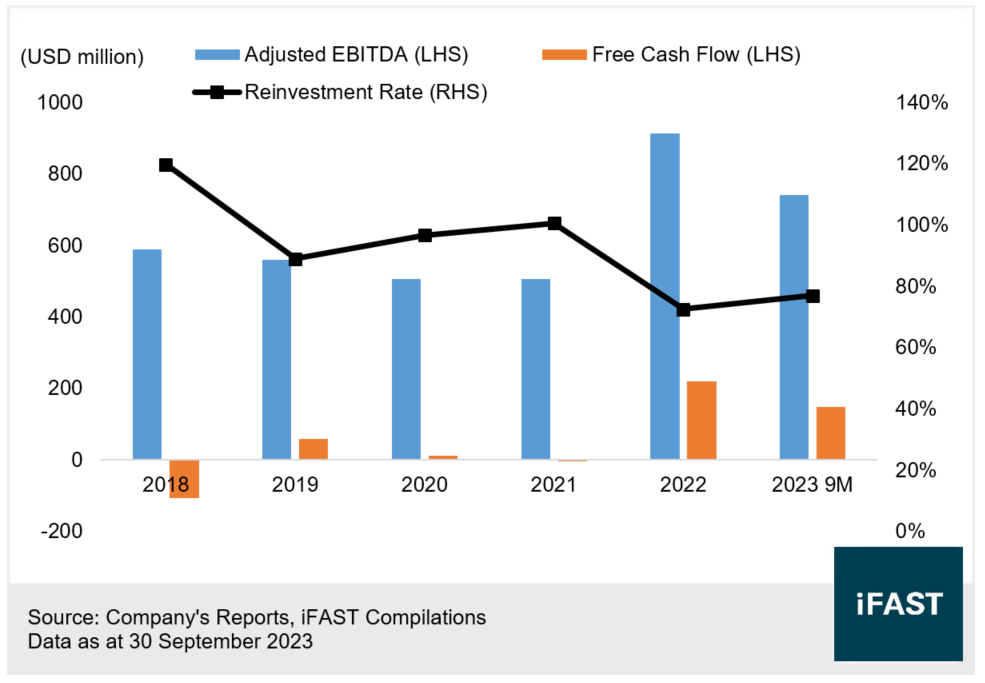
In addition, Vital Energy provided free cash flow guidance for the year 2024. Assuming WTI at $80 a barrel, the company will record a free cash flow of around $355 million, which would be the highest level in the company's history.
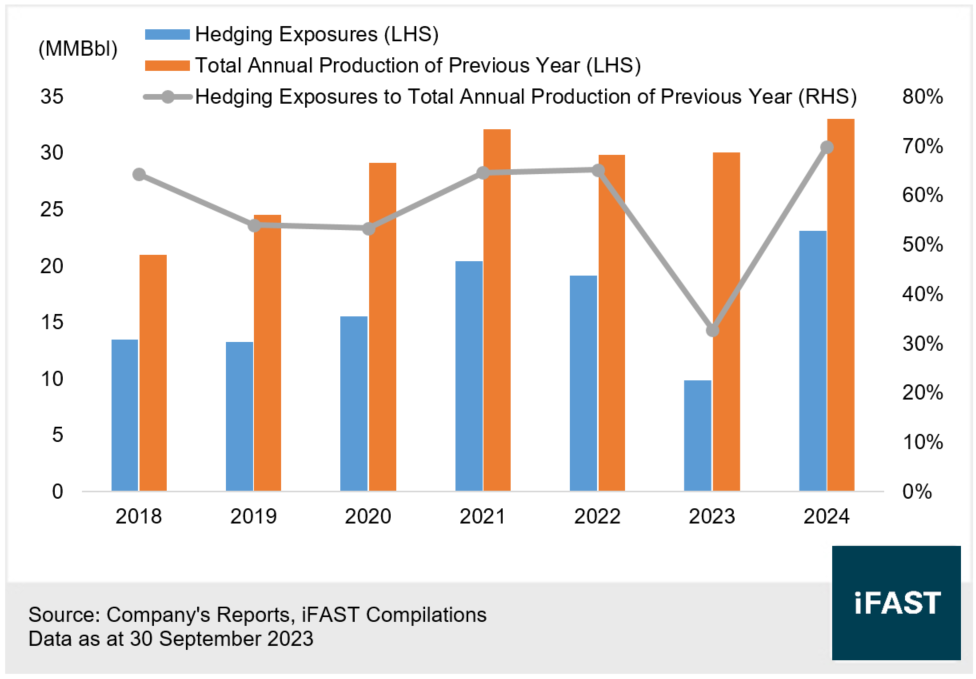
Vital Energy expects to generate higher free cash flow next year, not because the company expects oil prices to rise, but because the company hedged close to 90% of its oil exposures (or 70% of its oil equivalent exposure, see Chart 2) at an average WTI price of around $75 a barrel. The company completed a number of oil field acquisitions this year, which is expected to increase the production volume. The period of higher capital expenditure is over. Therefore, we believe that the company should achieve or approach this $355 million target, which brings a higher visibility to its operating and credit profile.
Chart 2: Vital Energy’s Hedging Exposures and Annual Total Production
Increasing its Oil-To-Gas Ratio could make it more Resilient to the Next Down Cycle
Vital Energy is improving its product mix with a view to increasing its oil production and the oil to gas ratio. Given that Permian basin has a relatively more frequent oversupply of natural gas or natural gas liquids and that the company does not have an advantage in energy transportation and exports, the company sold natural gas and natural gas liquids at a significant discount to market prices for many years.
Nevertheless, Vital Energy acquired some oil field projects with a higher oil to gas ratio and take advantages of different methods to boost the overall oil to gas ratio. It could improve its margins and lower its overall breakeven point, making it more resilient to the next down cycle.
With Stabilising Credit Profile, the Credit Risk in the Short- to Medium- term is Under Control
About the credit profile, as shown in Table 2, as of the end of September 2023, Vital Energy’s total debt was around $1.41 billion, an increase of around 23.7% from the end of last year, mainly due to the new issuance of bonds (see Table 3). The proceeds were used to acquire the oilfield projects. The company expects its net debt to remain at about $1.5 billion, which is similar to the current situation. It means that the company would not increase its leverage.
Meanwhile, Vital Energy's leverage level is moderate, with net debt/adjusted EBITDA and net debt/free cash flow at 1.4 times and 7.2 times respectively (see Table 2). We expect the company's earnings levels and cash flow performance to continue to improve. The company has provided its leverage guidance, targeting a reduction in net debt/adjusted EBITDA to 1.0 times by the end of 2024. In addition, the company's interest coverage ratio remains high at 5.6 times and its overall credit profile is stabilising.
Table 2: Vital Energy’s Credit Indicators
|
Dec 21 |
Dec 22 |
Sep 23 |
|
|
Net Debt (USD billion) |
1.38 |
1.14 |
1.41 |
|
Undrawn Credit Facility (USD billion) |
0.58 |
0.87 |
1.25 |
|
Net Debt / Adjusted EBITDA (times) |
2.7x |
1.2x |
1.4x |
|
Net Debt / Free Cash Flow (times) |
-v.e fcf |
5.2x |
7.2x |
|
Net Debt / Market Capitalisation (%) |
135% |
137% |
121% |
|
Interest Coverage Ratio (times) |
4.5x |
7.3x |
5.6x |
|
Average Cost of Borrowings (%) |
8.6% |
9.5% |
8.3% |
|
Sources: Company’s Reports, iFAST compilations Data as of 30 September 2023 |
|||
Table 3: New Bond Issuance, Bond Repurchase and Early Redemption History
|
Bond Name |
Issuance / Repurchase / Redemption Principal Amount |
Issued Price |
Net Proceeds |
|
|
Retap |
VTLE 10.125% 15Jan2028 Corp (USD) |
USD 400 million |
$101 |
Around USD 370 million |
|
New Issuance |
VTLE 9.75% 15Oct2030 Corp (USD) |
USD 500 million |
$98.74 |
Around USD 480 million |
|
Repurchase |
VTLE 9.500% 15Jan2025 Corp (USD) |
Around USD 48.45 million |
/ |
/ |
|
VTLE 10.125% 15Jan2028 Corp (USD) |
Around USD 28.04 million |
/ |
/ |
|
|
VTLE 7.75% 31Jul2029 Corp (USD) |
Around USD 76.01 million |
/ |
/ |
|
|
Early Redemption (15 January 2024) |
VTLE 9.500% 15Jan2025 Corp (USD) |
Around USD 456 million |
/ |
/ |
|
Sources: Company’s Reports, iFAST compilations Data as of 27 November 2023 |
||||
Vital Energy refinances its January 2025 maturity bond early. As a result, the company will early redeem this bond (see Table 3). They plan to draw the credit line (the debt will be tentatively due in 2027 in the amount of approximately $985 million) in order to extend the debt maturity.
Combined with the recently issued or re-tapped bonds
totaling $900 million mentioned above, the proven track records of equity
financings and the expected $985 million credit line to be drawn down, the
company’s financing ability is strong. Coupled with the significant improvement
in operating conditions and free cash flow, and the more favorable debt
maturity profile, we believe that the company's credit risk in the short- to
medium- term is under control.
Investors could Consider its Bond due on January 2028, with a Yield to Maturity of 9.6%
The current credit rating of Vital Energy is B from S&P, belonging to the high-yield issuer. However, thanks to its strong financing ability (both debt and equity financing) and improving operating conditions and cash flows, the company's credit risk in the short- to medium- term is under control. Investors could consider its bond due on January 2028, with a yield to maturity of 9.6%.
For longer-term bonds, we believe investors should take a wait-and-see approach towards longer-term bonds, because of the volatility of oil prices and the uncertainty of long-term supply and demand pictures for conventional energy.
Table 4: Vital Energy’s Bonds
|
Bond Name |
Years to Maturity |
Ask Price (Investors Buy) |
Yield To Maturity |
| VTLE 10.125% 15Jan2028 Corp (USD) | 4.1 |
102.4 |
9.6% |
| VTLE 7.75% 31Jul2029 Corp (USD) | 5.6 |
93.0 |
9.5% |
| VTLE 9.75% 15Oct2030 Corp (USD) | 6.8 |
103.3 |
9.3% |
|
Sources: Bondsupermart Data as of 23 December 2023 |
|||
Related Risks
The company's revenues are primarily from the sale of crude oil and natural gas, which are highly volatile. This could result in its revenues being volatile as well. The oil price might unexpectedly go down, and the low oil price might persist for a longer period. This could affect its expected cash flow performance.
The company hedged heavily in the past when oil prices were low, resulting in low cash flows. In the future, the company may misjudge oil price trends again, implying a higher execution risk. As a result, the company's profit and cash flows might be weaker than its peers.
In addition, the company's oil fields are all located in the Permian-Midland Basin, where there is a greater chance of short-term oversupply of natural gas and natural gas liquids. Moreover, the company does not have a significant advantage in energy transportation and exports, and its realised prices of natural gas and natural gas liquids are generally much lower than the market prices. During the oil downturn, these could seriously affect the company's operating performance.
Conclusion
Vital Energy is a small US oil and gas company. It has around 250 thousand net acres and produces around 37 MMboe per year. In recent years, it issued and placed news shares for equity financing for a few times, which could lower the leverage level and be favourable to the credit profile.
Vital Energy’s operating performance is significantly improved. We expect the free cash flow in 2024 would be the highest level in history. This brings a higher visibility to its operating and credit profile. The company is increasing its oil-to-gas ratio, which could make it more resilient to the next down cycle.
Vital Energy’s credit profile is stabilising. Thanks to its strong debt and equity financing ability, improving operating conditions and cash flows, the company's credit risk in the short- to medium- term is under control. Investors could consider its bond due on January 2028, with a yield to maturity of 9.3%.
Declaration: For specific disclosure, at the time of publication of this report, IFPL (via its connected and associated entities) holds positions in VTLE 9.500% 15Jan2025 Corp (USD) and the analyst who produced this report holds a NIL position in the abovementioned securities.