Receive first-hand news on the latest bond issues, credit updates and special events when you join us on our Telegram channel at https://t.me/bondsupermart!
Highlights:
- Benefiting from the reopening of China, the insurance revenue saw a rebounding in the first half of this year, and the underwriting profit turned around to a positive position. The underwriting combined ratio remains decent in the industry with solid profitability. Tech and banking business are expected to become a new growth driver, leaving the company ample room for further development.
- Credit-wise, Zhongan’s core solvency margin ratio is well above the regulatory requirement and industry average, resulting in a strong capability to withstand risks.
- As a result of the selloff of Chinese names, the yield to maturity of Zhongan's 2026 bond rose to roughly 8.5%, which is one of the highest levels among investment-grade financial companies. Given the excellent credit profile and solvency, investors can consider it to seize the rather rare investment opportunity.
Company Background
Zhongan Insurance was established in 2013 with capital contributions from Ant Group, Tencent, and Ping An Group. Ant Group is the largest shareholder of the company with ownership of approximately 10.4%. Zhongan Insurance became a listed company in 2017 with stock code 6060. HK. The market capitalization reached HKD 26 billion at the market close on 28 December 2023.
Zhongan Insurance is the first virtual insurance company in China, that is, the company does not have any agent or branch. Zhongan's core business comprises non-life insurance products, which are quite diversified and unique compared to traditional P&C insurers, offering E-commerce insurance products. Zhongan is the ninth largest P&C insurer in terms of premiums.
In the overseas market, ZA Bank, a subsidiary of Zhongan Insurance, became the first virtual bank in Hong Kong in 2020, offering 24-hour digital banking services such as deposits, loans, investment, and corporate banking. ZA Bank's retail customers amounted to 700,000 ending 30 June 2023 and has been a leader for the past three years.
Premiums Are Growing Rapidly, underwriting profitability Stands Out Among the Industry
Since its establishment, Zhongan Insurance is maintained a relatively fast pace of development, with premium income amounting to RMB16.7 billion, RMB20.4 billion, and RMB23.7 billion from 2020 to 2022 (Table 1), representing a compound annual growth rate of approximately 13% during the period, which is above the average growth rate of the property and casualty (P&C) insurance industry. Meanwhile, the underwriting profit trends upward and turned positive position to RMB 70 million in 2021 and further improved to RMB 330 million in 2022.
Table 1: Premium and Underwriting Profit
|
Premiums (Billion RMB) |
Underwriting Profit (Million RMB) |
|
|
2020 |
16.7 |
-410.0 |
|
2021 |
20.4 |
70.0 |
|
2022 |
23.7 |
330.0 |
|
Source: Company reports, iFAST Compilations Data as of 31 December 2022 |
||
The company delivered favorable results with total premiums rising by 23.9% YoY to RMB 12.7 billion in the first half of this year. In terms of premium breakdown, Zhongan's premiums mainly come from digital lifestyle insurance and health insurance, of which digital life premiums grew 42.5% year-on-year, accounting for 40.4% of the total premium income, and is the main driving force behind the company's rapid development in recent years. Digital lifestyle insurance is primarily linked with the E-commerce space covering scenarios such as shipping return, product quality, and after-sales services. Given that China's online retail sales are growing at double-digit rates (13.1% for 1H2023), we expect digital lifestyle insurance to maintain a very high growth rate in the years ahead.
Table 2: Zhongan’s Premiums in 1H2023
|
Premiums (Billion RMB) |
YoY Change |
Underwriting Combined Ratio |
|
|
Health |
4.0 |
5.9% |
92.5% |
|
Digital Lifestyle |
5.7 |
42.5% |
99.8% |
|
Consumer Finance |
2.3 |
17.0% |
90.7% |
|
Auto |
0.7 |
35.9% |
97.3% |
|
Overall |
12.7 |
23.9% |
95.8% |
|
Source: Company reports, iFAST Compilations Data as of 30 June 2023 |
|||
Looking into profitability, the Underwriting Combined Ratio is an important indicator for an insurance to measure operation and profitability, consisting of Expense Ratio and Loss Ratio. The lower the figure is, the better the capability to manage costs and the better profitability. Zhongan's underwriting combined ratio stood at 95.8% in the first half of this year, so how is the company's profitability in the industry? The chart below depicts that the underwriting combined ratio averaged 98.9% for the large-sized P&C insurers, and Zhongan's number is just slightly above that of PICC, indicating that Zhongan's profitability is at an excellent level in the industry. We attribute the decent profitability of Zhongan to its unique business model, which could lower the operational cost to a certain extent due to the absence of branches.
It is worth noting that P&C insurers usually face a higher underwriting combined ratio with limited profitability in comparison to life insurers. Consequently, a growing number of P&C insurers have started to reform, using artificial intelligence and other tools to assist companies in completing underwriting and shifting to online operations. As a pioneer of the new business model, Zhongan is now assisting its other insurers in the digital transformation, and the revenue from technology export in the first half of this year reached RMB 270 million, an increase of about 22% year-on-year.
Overall, we are more optimistic about the company's business model, especially the higher profit margins brought about by the online operation, and believe that Zhongan could be able to maintain double-digit premium income growth in the next few years.
Chart 1: Underwriting Combined Ratio
for Large P&C Insurers 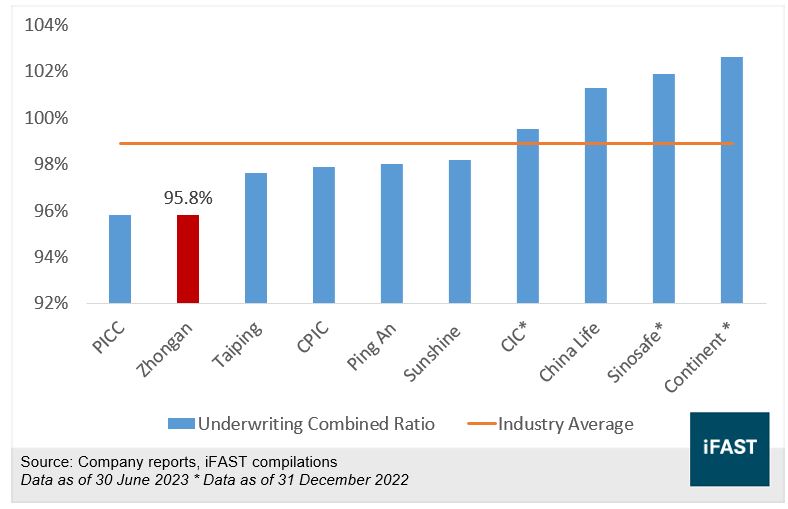
Snowballing Development of ZA Bank, but Profit Quality Has Room for Improvement
Apart from the insurance business, virtual banking is one of the core businesses. Since its opening in 2020, ZA Bank has maintained a very impressive pace of development, with customers growing from 500,000 in 2021 to 700,000 ending 30 June 2023 (Chart 2), and the size of customers' deposits saw a remarkable growth to HKD 10.7 billion, both of which are the highest level among virtual banks in Hong Kong.
Owing to the rate-rising environment, ZA Bank's net interest margin rose to 1.9%, and net revenue amounted to HKD 150 million, up 13.0% YoY. Considering the fact that the company is in the early stage of expansion, there is still much room for improvement in business quality and operational efficiency, and Zhongan has been operating at a loss since its establishment. However, with the increase in customer base and loan size, the net loss ratio has narrowed from 191.6% in 1H2022 to 131.8% in 1H2023, and it is believed that there is room for further improvement in the future.
Chart 2: ZA Bank’s Customers Base and Deposits 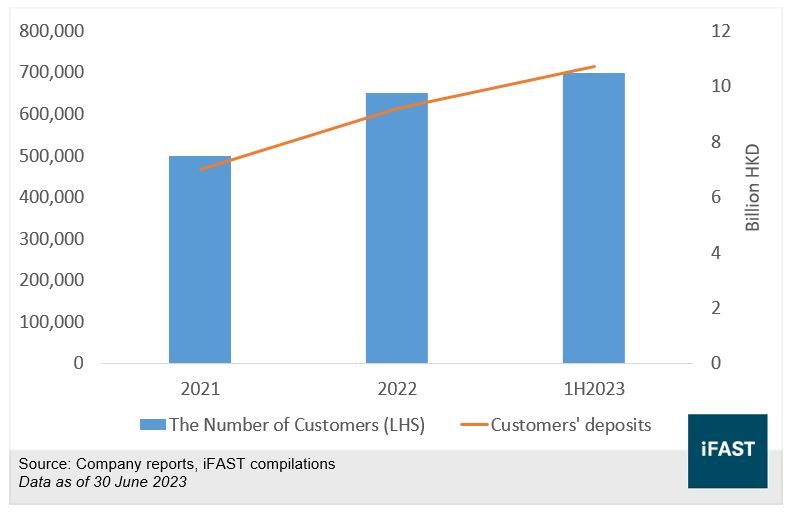
Investment Business Picks Up and Continues to Benefit from Onshore Bullish Bond Market
As mentioned earlier, the underwriting profit is rather limited for insurers, and earning quality usually hinges on the performance of the investment business. Investment return could be the only source of profit for insurers with over 100% underwriting combined ratio.
We see that the vast majority of the investment assets of Zhongan are located in China, totaling RMB 36.2 billion, of which fixed-income assets took up around 80% ending 30 June 2023. The fixed-income assets Zhongan owns principally consist of Chinese government bonds and high investment-grade corporate bonds. Supported by the easing monetary policies in China, the onshore bond market is in a bullish trend, and the bond yield of the 10-year Chinese treasury in the first half of this year dropped around 20 bps, driving Zhongan's investment return to increase from RMB 110 million in 1H2022 to 720 million in 1H2023, with the corresponding total investment yield improving to 4% from 0.6% in 1H2022. Given the significant downside pressure of China's economy, we believe the possibility of a lower interest rate environment is very likely, suggesting that the investment business of Zhongan will continue to benefit the bullish onshore bond market. On the liability end, Zhongan adopts an immunization strategy to match asset and liability duration, making the company immunize the volatility of the interest rate environment.
Chart 3: Zhongan’s Investment Assets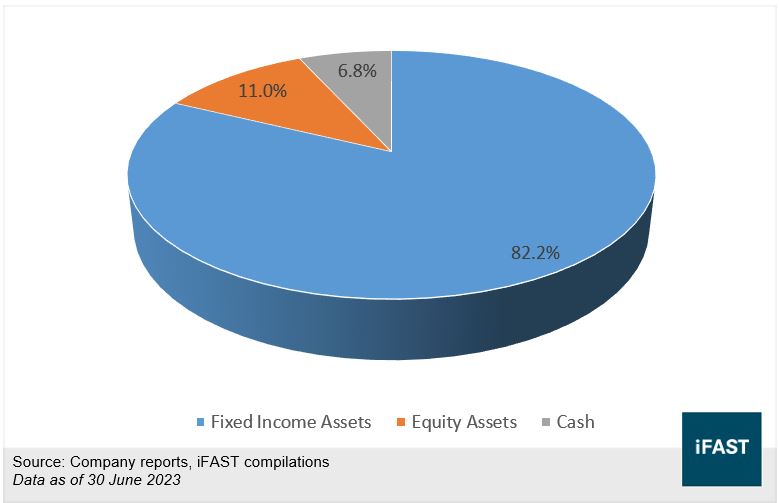 All in all, Zhongan's total revenue in 1H2023 was around RMB 14.2
billion, rising by 28.3% from one year ago. Net profit turned from RMB -690
million in 1H2022 to RMB 30 million due to the robust performance of the
investment business. Looking ahead, the banking and tech sectors are expected
to become the new growth drivers. We
thus believe the upside potential for the company remains ample, and the growth
rate of revenue will be ahead of the average for large P&C insurers.
All in all, Zhongan's total revenue in 1H2023 was around RMB 14.2
billion, rising by 28.3% from one year ago. Net profit turned from RMB -690
million in 1H2022 to RMB 30 million due to the robust performance of the
investment business. Looking ahead, the banking and tech sectors are expected
to become the new growth drivers. We
thus believe the upside potential for the company remains ample, and the growth
rate of revenue will be ahead of the average for large P&C insurers.
Solvency Outperforms the Industry Average with Desirable Credit Quality
From the perspective of solvency, the solvency ratio is an important supervisory indicator to assess the capital adequacy of insurance companies. As of 30 June 2023, Zhongan's core solvency margin ratio (defined as core capital/minimum required capital) hit 263%, well above the regulatory requirement of 100% and the industry average of 226%, reflecting that the company is well-capitalized with better-than-average solvency.
It is important to take note that Zhongan's current core solvency margin ratio experienced a marked downward movement in comparison to that of 2021, does it mean that there is a deterioration in solvency? The fact behind this is that the China Banking and Insurance Regulatory Commission introduced Regulatory Rules on Solvency of Insurance Companies ("Rules II Phase ROSS-C ") at the end of 2021, and the new regulatory policies resulted in a decrease in core capital of P&C insurers and core solvency margin ratio. Nevertheless, Zhongan's solvency buffers over regulatory requirements remains adequate and is also well above the industry average.
Chart 4: Zhongan’s Core Solvency Margin Ratio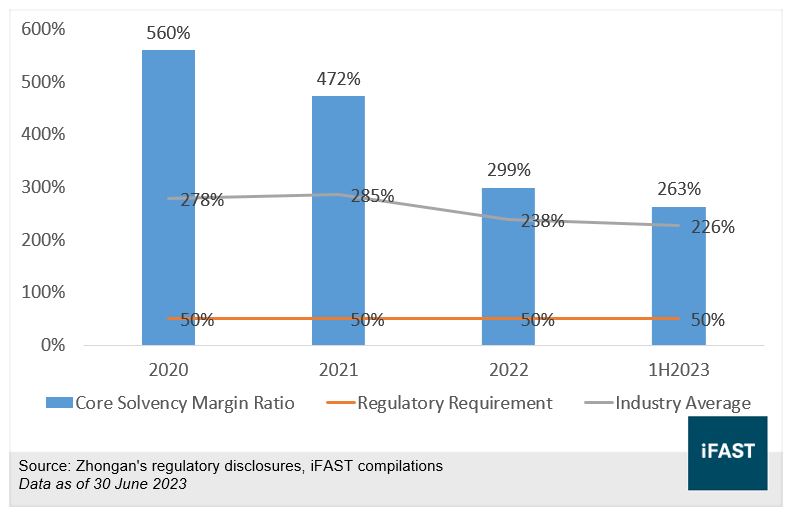 In terms of liquidity, generally speaking, the liability duration
of P&C insurers is much lower than that of life insurers, meaning that the
liquidity requirement of P&C insurers is significantly larger, and the
liquidity risk management does matter. According to the regulatory disclosure,
the company's 3-month and 12-month liquidity coverage ratios under the base
case scenario were 107.6% and 103.1% respectively (Table 2), meeting the
regulatory requirement of 100%. Furthermore, no matter whether asset disposal
is considered for realization, the liquidity coverage ratios under stressful
scenarios are still above the regulatory requirement, indicating that Zhongan's
liquidity position is pretty robust and the overall credit profile looks
favorable.
In terms of liquidity, generally speaking, the liability duration
of P&C insurers is much lower than that of life insurers, meaning that the
liquidity requirement of P&C insurers is significantly larger, and the
liquidity risk management does matter. According to the regulatory disclosure,
the company's 3-month and 12-month liquidity coverage ratios under the base
case scenario were 107.6% and 103.1% respectively (Table 2), meeting the
regulatory requirement of 100%. Furthermore, no matter whether asset disposal
is considered for realization, the liquidity coverage ratios under stressful
scenarios are still above the regulatory requirement, indicating that Zhongan's
liquidity position is pretty robust and the overall credit profile looks
favorable.
Table 2: Zhongan’s Liquidity Coverage Ratio
|
3-month |
12-month |
Regulatory Requirement |
|
|
Base Scenario |
107.6% |
103.1% |
100% |
|
Stressful Scenario (with Asset Realization) |
320.2% |
153.1% |
100% |
|
Stressful Scenario (without Asset Realization) |
103.4% |
94.4% |
50% |
|
Source: Zhongan's regulatory disclosure, iFAST Compilations Data as of 30 June 2023 |
|||
Investment Attractiveness Tops Among Insurer Bonds, Yield to Maturity Close to 8%
As for bond investment, Zhongan is an investment-grade issuer with a credit rating of Baa2 (equivalent to BBB). There are two bonds issued by Zhongan available on our platform, maturing in 2025 and 2026 respectively, other details are set out below:
Table 3: Bond Issued by Zhongan
|
Bond |
Years to Maturity |
Ask Price |
YTM |
|
ZHONAN 3.125% 16Jul2025 Corp (USD) |
1.6 |
93.0 |
8.0% |
|
ZHONAN 3.500% 08Mar2026 Corp (USD) |
2.2 |
90.5 |
8.5% |
|
Source: Bondsupermart Data as of 29 December 2023 |
|||
Bond due in 2025 is currently yielding roughly8.0%, while the bond yield of 2026 USD bond is relatively higher at 8.5%. We believe that the two bonds have a difference of about half a year in investment maturity with similar investment risk, but the latter has a higher yield of 0.5%, making it more attractive, investors may give priority to the bonds due in 2026.
Compare this to the insurance industry as a whole, where most insurers are investment-grade, but bond yields are significantly lower than those of Zhongan. For example, FWD, which has a close credit rating, has a bond yield of 5.5% for the bond due in September 2024. We attribute the higher yield of Zhongan to the selloff of Chinese name issuers, which are not favored by the market following the default crisis of Chinese real estate developers, and the higher risk premium required pushed up the bond yield of the remaining Chinese issuers. However, given the company's promising growth prospects and decent credit quality, we view the potential investment risk of Zhongan as manageable and the investment attractiveness of bonds tops among the insurers, and it is rare that an investment-grade insurer offers a yield to maturity of roughly 8.5%, investors interested in Zhongan could seize the unique investment opportunity at this point.Corporate Risk
Investors should be aware of the following risks. Firstly, the investment business of Zhongan faces significant uncertainty as it has some exposure to onshore equity-related assets aside from fixed-income portfolios. The downturn pressure of China's economy may weigh on the performance of equity assets, leading to unexpected loss of investment assets and negative impacts on operations.
Secondly, Ant Group, the major shareholder of Zhongan is currently in the midst of regulatory turmoil, implying that the policy risk may be passed on to Zhongan, resulting in the company being affected in areas such as refinancing.
Conclusion
Benefiting from the reopening of China, the insurance revenue saw a rebounding in the first half of this year, and the underwriting profit turned around to a positive position. The underwriting combined ratio remains decent in the industry with solid profitability. Tech and banking business are expected to become a new growth driver, leaving the company ample room for further development.
Credit-wise, Zhongan’s core solvency margin ratio is well above the regulatory requirement and industry average, resulting in a strong capability to withstand risks.
As a result of the selloff of Chinese names, the yield to maturity of Zhongan's 2026 bond rose to roughly 8.5%, which is one of the highest levels among investment-grade financial companies. Given the excellent credit profile and solvency, investors can consider it to seize the rather rare investment opportunity.
Declaration: For specific disclosure, at the time of publication of this report, IFPL (via its connected and associated entities) and the analyst who produced this report hold a NIL position in the abovementioned securities.
Our podcast series, Yield Hunters, is available on Spotify, iTunes Podcasts and Google Podcasts. We share our thoughts on new bond issues and hold discussions on the fixed income space. Listen to our latest episode below and follow us!