Note: This is an edited version of an article published earlier by our affiliates on 2 Aug 19.
Highlights:
- Although Ronshine’s strong sales growth slowed down in 1H19, its sales target remains achievable.
- The management’s decision to deleverage has proved to be effective, and we believe that the company has promising medium-to-long term prospects due to its abundant land reserve.
- Bond yields are attractive given the issuer’s improving credit profile. With more USD bonds issued this year, investors now have more options.
Ronshine China Holdings Limited recently issued a number of USD bonds, and investors now have as many as seven bonds to choose from. We take a look at the company's recent performance and its bonds to decide whether they are worth investing in now.
About Ronshine
A second tier property developer in China
Ronshine China Holdings Limited was founded in 2003 in Fujian, as a Chinese real estate developer. The company is listed on the Hong Kong Stock Exchange (stock code: 3301.HK), with a market capitalization of about HKD 17.0 billion (as of 1 Aug 19).
According to property researcher CRIC, the company is ranked 32nd among all Chinese developers in terms of attributable contracted sales in the first half of 2019 (“1H19”, see Figure 1). We consider the company as a member of tier-2 Chinese developers, which include the top 20 to 50 developers.
Figure 1: 1H19 property developer ranking by contracted sales
| Rank | Company | Contracted Sales 1H19 (RMB 100m) |
|---|---|---|
| 1 | Country Garden | 2,798 |
| 2 | Evergrande | 2,687 |
| 3 | Vanke | 2,010 |
| 4 | Poly | 1,651 |
| 5 | China Overseas | 1,595 |
| 6 | Greenland | 1,534 |
| 7 | Sunac | 1,476 |
| 8 | Seazen | 876 |
| 9 | China Resources | 804 |
| 10 | Longfor | 736 |
| 32 | Ronshine | 345 |
| Source: CRIC, iFAST compilations Data as at June 2019 |
||
A luxury residential developer in major cities
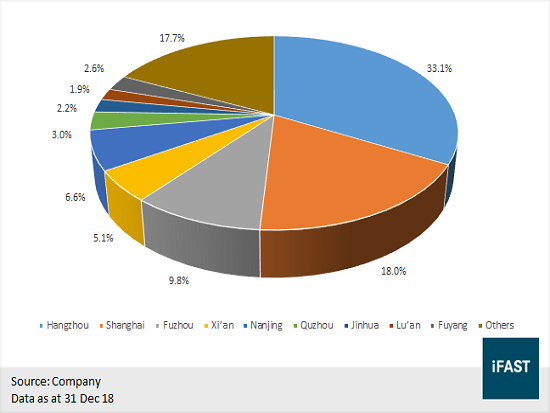
Ronshine’s development projects are concentrated in first- and second-tier cities. In 2018, Hangzhou (tier 2) and Shanghai (tier 1) contributed over 50% of the company’s total sales (see Figure 2).
Figure 2: Contracted sales by geography
The company also mainly develops high-end residential buildings. In 2018, the average selling price (“ASP”) of its sales reached RMB 21,672 per square meter (“sqm”). According to property consultancy Guandian, only twelve Chinese developers out of the top 100 were able to achieve the RMB 20,000 mark. Among the top 100 developers, twelve had ASPs below RMB 10,000 per sqm, and their projects were usually distributed in third- to fifth-tier cities.
Company Updates
Slowdown in 2019 sales growth
In 1H19, Ronshine delivered mediocre results to investors. Attributable contracted sales were RMB 34.5 billion (1H18: RMB 38.9 billion), representing a drop of 12.8% YoY. The number was especially disappointing if we compared it to the impressive 70.6% YoY growth in 2018.
One reason behind the decline was that the company had more joint-venture projects in the first half of this year, causing the attributable ratio (sales attributable to the company divided by total contracted sales) to drop to 60.9% (2018: 68.1%). As a result, attributable sales declined despite the fact that total contracted sales in 1H19 were actually higher than the same period last year.
With a contracted sales target of RMB 140 billion, Ronshine had only achieved 40.5% (RMB 56.7 billion) of its target, which was lower than many other large developers, as well as the average target completion rate in the industry (see Figure 3).
Figure 3: Contracted sales—target vs 1H19 completion—of selected top developers
| RMB 100m | 1H19 Contracted Sales | 2019 Sales Target | Target Completion Rate (%) |
|---|---|---|---|
| Evergrande | 2,928.7 | 6,000 | 48.8% |
| Poly | 2,387.3 | 5,000 | 47.7% |
| Sunac | 2,139.0 | 5,500 | 38.9% |
| China Overseas | 1,668.4 | 2,985 | 55.9% |
| Seazen | 1,239.8 | 2,700 | 45.9% |
| China Resources | 1,163.0 | 2,400 | 48.5% |
| Longfor | 1,051.9 | 2,200 | 47.8% |
| CMSK | 1,011.8 | 2,000 | 50.6% |
| Shimao | 1,003.5 | 2,100 | 47.8% |
| Yango | 900.0 | 1,800 | 50.0% |
| CIFI | 876.4 | 1,900 | 46.1% |
| Jinke | 820.5 | 1,500 | 54.7% |
| Jinmao | 784.6 | 1,500 | 52.3% |
| Greentown | 743.1 | 2,000 | 37.2% |
| Zhenro | 713.1 | 1,300 | 54.9% |
| R&F | 618.4 | 1,600 | 38.7% |
| Sino-Ocean | 600.0 | 1,400 | 42.9% |
| Agile | 582.0 | 1,130 | 51.5% |
| Ronshine | 566.8 | 1,400 | 40.5% |
| Aoyuan | 536.3 | 1,141 | 47.0% |
| Binjiang | 516.7 | 1,000 | 51.7% |
| Average | 47.6% | ||
| Source: China Index Academy, iFAST compilations Data as at June 2019 |
|||
Moreover, with mounting pressure from tightening property market regulations, Ronshine’s results have further deteriorated in the second quarter. Total contracted sales of the company fell by 9.2% YoY and 9.5% YoY in May and June respectively.
The management indicated that they had planned for the sales target to be achieved in a 40:60 ratio between the first and second half of the year. They expected sales and marketing efforts to ramp up in the second half and the sales number to accelerate accordingly, and deemed the sales target as still achievable.
Abundant land reserve
At the end of 2018, attributable land reserve had a total value of RMB 85.6 billion, and approximately 75% of land was located in prime areas of first- and second-tier cities. The portfolio of acquired land parcels is quite large relative to Ronshine’s scale.
Since then, Ronshine expanded its land bank by RMB 7.4 billion. We note that the company was able to acquire land through low-cost channels, such as a redevelopment project in Taiyuan.
We believe that its abundant land reserve can help Ronshine to remain resilient over the medium to long run in the current tightening funding environment.
Rating upgrades due to deleveraging progress
Ronshine set the goal of speeding up its deleveraging process in 2019, which indicated that they would no longer place growth rate as the top priority, with the focus shifted to increasing profit margins and balancing the leverage level.
The company’s financial discipline was recognized by major rating agencies. In April, S&P and Moody’s upgraded the company’s credit rating (S&P: revised outlook from stable to positive; Moody’s: upgraded rating from B2 to B1). The company’s senior unsecured notes were upgraded to B2 by Moody’s.
In 2018, the company’s net gearing ratio improved significantly to 105% (2017: 165%), and its total interest-bearing debt also dropped to RMB 62.5 billion (2017: RMB 69.5 billion). The improvement in credit profile was very significant, and we expect net gearing to drop further by the end of 2019, given its recent share placement and relatively conservative land banking approach.
Well prepared for debt repayment through refinancing
Ronshine has a large amount of onshore bonds due in 2019, and we notice that the company has been actively tapping the bond market recently. Apart from a RMB 4.0 billion onshore bond issuance in July 2019, the company has also launched 5 USD bonds and re-taps since December 2018, with a total issued amount of USD 1.34 billion. We think the tightening financing policies in China are the cause for Ronshine turning to the overseas market for refinancing.
The money raised from these new bonds will be used to cover the principal and interest payments for bonds totaling RMB 6.2 billion, due between March 2019 and February 2020. Ronshine has also raised funding through other methods, such as two private placements of shares completed in June 2018 and April 2019, which raised gross proceeds of around HKD 2.3 billion. We consider this a good news for bond investors.
Strong debt servicing ability
As of end-2018, the company was holding a cash balance of RMB 25.0 billion, which was already sufficient to pay off its short-term debt of RMB 24.8 billion. The company’s current ratio was 1.4x, which would increase to about 2.1x if we took away contract liabilities. In addition, in light of the refinancing activities mentioned above, we believe Ronshine should have little difficulty in servicing its short-term debt.
Ronshine’s net debt-to-EBITDA ratio also improved to 6.08x in 2018 from 11.16x in 2017. Considering the real estate sector’s inherent nature of delayed revenue recognition, and the tremendous sales of Ronshine last year, the actual number might even be lower than 4.0x, which is quite healthy amongst industry peers.
However, Ronshine capitalized 98% of its interest expense in 2018. We think interest coverage will likely be below 2.0x in 2019, despite the growth in EBITDA. With the rise in coupon rates of the USD bonds issued this year, interest expense is expected to increase. We think the situation should be a cause of concern for management, and priority should be placed on reducing the principal amount of debt.
The Ronshine bonds
Yields are attractive as credit profile improves
After Ronshine’s issuance of five new USD bonds over eight months, investors have more options to choose from now. Figure 4 lists the 7 bonds available on iFAST’s investment platforms.
Figure 4: Ronshine’s USD bonds
| Bond | Maturity Date | Amount Outstanding | Net Ask YTM |
|---|---|---|---|
| RONXIN 6.950% 08DEC2019 CORP (USD) | 8-Dec-19 | 123,625,000 | 3.94% |
| RONXIN 11.500% 03JUL2020 CORP (USD) | 3-Jul-20 | 200,000,000 | 5.54% |
| RONXIN 8.250% 01FEB2021 CORP (USD) | 1-Feb-21 | 344,589,000 | 6.62% |
| RONXIN 11.250% 22AUG2021 CORP (USD) | 22-Aug-21 | 600,000,000 | 7.24% |
| RONXIN 10.500% 01MAR2022 CORP (USD) | 1-Mar-22 | 500,000,000 | 8.29% |
| RONXIN 8.750% 25OCT2022 CORP (USD) | 25-Oct-22 | 435,000,000 | 8.66% |
| RONXIN 8.950% 22JAN2023 CORP (USD) | 22-Jan-23 | 300,000,000 | 8.91% |
| Source: Bloomberg, iFAST; data as at 1 Aug 19 | |||
With a B/B+ (S&P/Fitch) credit rating, the YTMs of Ronshine’s bonds are close to their peers. Some other issuers such as China Evergrande Group and Fantasia Holdings Group offer higher returns, but against substantially higher credit risk. We think Ronshine’s recent deleveraging efforts offer adequate protection for bond investors, and current yields on the company’s bonds are attractive.
The RONXIN 8.25% ‘21s and RONXIN 10.5% ‘22s are preferred
Based on the maturity profile of Ronshine’s outstanding bonds, the company will face the highest need for bond redemption in 2021 (see Figure 5).
Figure 5: Bond maturity distribution over the next five years
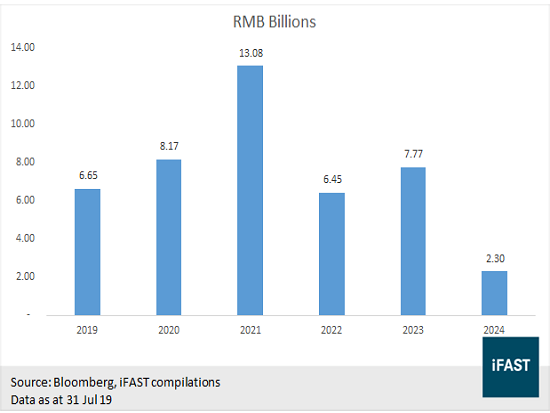
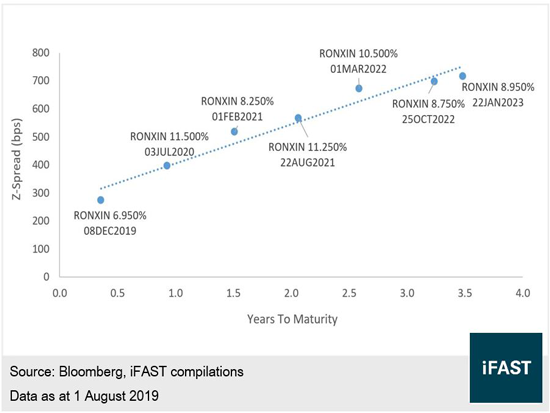
The RONXIN 8.250% 01FEB2021 CORP (USD) avoids the two large-size bonds maturing in the second half of 2021, and its yield of 6.61% is decent compared to the other Ronshine bonds (see Figure 6). The puttable option of the RONXIN 8.25% ‘21s is not quite meaningful at current prices, but we think it can still offer a cushion for investors from the policy uncertainty in the housing market.
If Ronshine continues to deleverage, and maintain a strong liquidity position instead of spending aggressive in land acquisitions, we think the long-term bonds are also worth investing in. The RONXIN 10.500% 01MAR2022 CORP (USD) offers over 8% yield, and the amount of bonds due within 2021 is not high. With the high coupon rate of 10.5%, we think the RONXIN 10.5% ‘22s are attractive.
Figure 6: Relative valuation
Conclusion
Although Ronshine’s sales growth has slowed down in 2019, its performance is still within expectation. We are heartened by management’s determination in deleveraging, and the results thus far have been encouraging.
With a better credit profile and decent returns, we think now is a good time to invest in Ronshine.
Declaration:
For specific disclosure, at the time of publication of this report, IFPL (via its connected and associated entities) has a principal position in COGARD 6.600% 23Feb2023 Corp (MYR), EVERRE 8.250% 23Mar2022 Corp (USD), EVERRE 7.500% 28Jun2023 Corp (USD), and RONXIN 10.500% 01Mar2022 Corp (USD). The analyst(s) who produced this report holds a NIL position in the abovementioned securities.