- In FY2025, revenue and profit before tax (PBT) declined by 14% and 37%, respectively, mainly due to cautious market sentiment throughout the year.
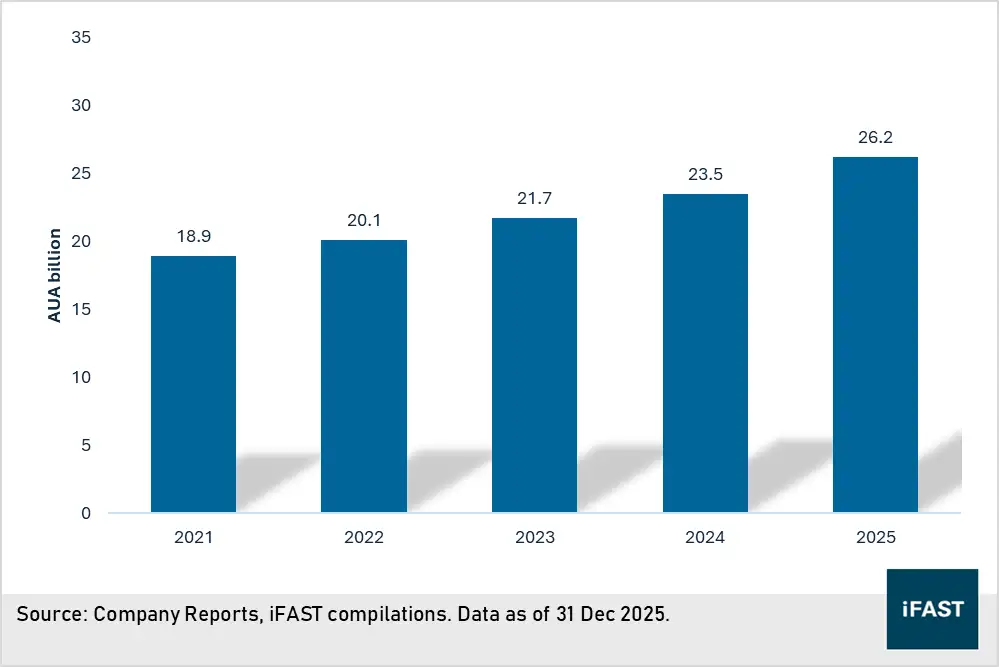
- Beyond the stockbroking and investment segments, the asset management division serves as a key diversifier to Kenanga’s earnings profile, with AUA growing at a commendable pace to a record high of RM26.2 billion (+9.7% YoY).
- The credit profile remains robust, with a CET1 ratio of 17.34% as at end-December 2025, well above the regulatory minimum of 4.5%.
- Net impaired loan ratio increased to 6.11% due to weaker market conditions. We view the risk as manageable, supported by adequate ECL buffers and the potential for some provision reversals going forward
- Investors should be mindful of key risk exposures, including intensifying competition in the Malaysian brokerage industry and broader macroeconomic risks.
- Investors with higher risk tolerance may consider the upcoming AT1 perpetual issuance, with an indicative yield of 6.1% (~ +270bps over the 5-year MGS). However, investors should be aware of the inherent risks associated with AT1 instruments, including loss absorption features, non-call risk, and coupon deferral.
Kenanga Investment Bank is one of Malaysia’s well-established financial institutions, primarily known for its expertise in investment banking, stockbroking, and wealth management.
Founded in 1973, Kenanga has evolved from a traditional stockbroking firm into a diversified financial services group. The bank offers a broad range of services, including corporate advisory (such as mergers and acquisitions), equity and debt capital markets, asset and wealth management, and Islamic financial services. Through its asset management arm, Kenanga also provides unit trust funds and portfolio management solutions for both retail and institutional investors.
Kenanga is listed on Bursa Malaysia (KLSE: KENANGA 6483), with a market capitalisation of approximately MYR 570.2 million as at 20 April 2026.
Financial highlights
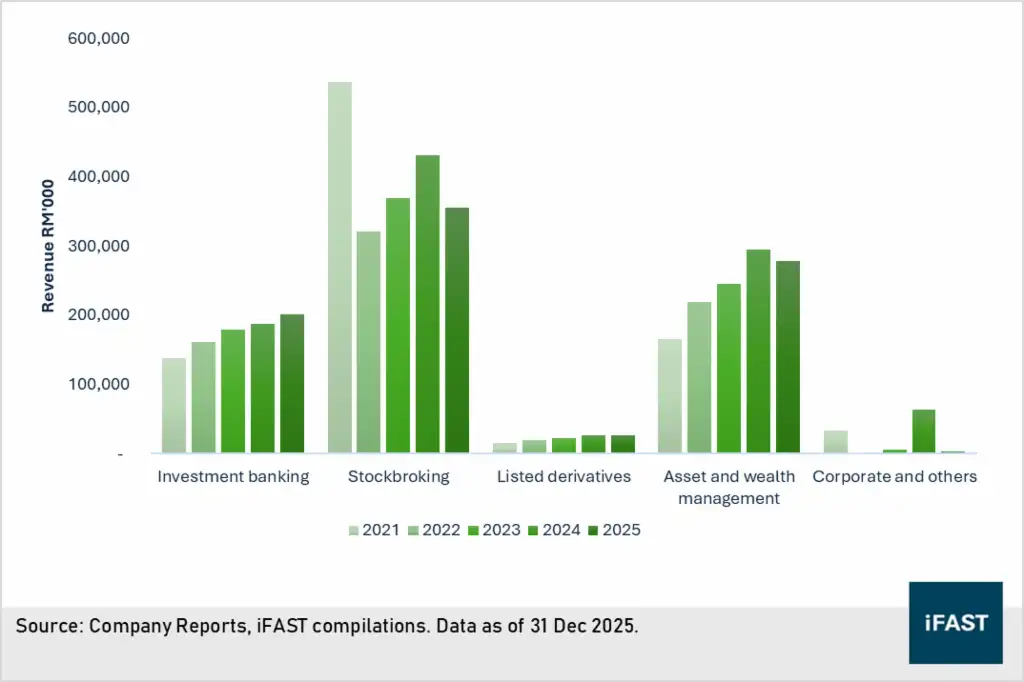
Kenanga operates mainly across five business divisions, including investment banking, stockbroking, listed derivatives, asset and wealth management as well as corporate and others.
Table 1: Segmental reporting
|
Segments |
Descriptions |
|
Investment banking |
Investment banking business, treasury and related financial services |
|
Stockbroking |
Dealings in securities and investment related services; |
|
Listed derivatives |
Futures broking |
|
Asset and Wealth Management |
Management of funds, unit trusts and robo-advisory |
|
Corporate and others |
Money lending and financing, e-services management platform and support services |
In FY2025, the bank’s revenue and profit before tax (PBT) declined to RM865.3 million and RM73.6 million, respectively (–14% YoY and –37% YoY). This was mainly due to geopolitical volatility throughout 2025, which led to cautious market sentiment and, in turn, reduced brokerage income and asset management fee income.
Table 2: Profitability indicators (RM’000)
|
|
2021 |
2022 |
2023 |
2024 |
2025 |
|
Revenue |
891,491 |
723,086 |
821,056 |
1,003,797 |
865,324 |
|
Profit before taxation and zakat |
148,236 |
74,150 |
88,110 |
117,249 |
73,564 |
Source: Company Reports, iFAST Compilations. Data as of 31 December 2025.
In the past five years (excluding FY25), revenue contribution across all business segments has grown steadily. Among all the business segments, the bank’s revenue is primarily anchored by stockbroking segment (34%), asset and wealth management (33%) and investment banking segment (29%).
As mentioned, all business segments reported lower revenue in FY25, reflecting the spillover effects of geopolitical tensions, including “Liberation Day” events, the Russia–Ukraine war, and broader global market uncertainty, which weighed on the Malaysian market.
Chart 1: Segmental Revenue
Stockbroking segment - Consistent Market Share Supporting Growth Outlook
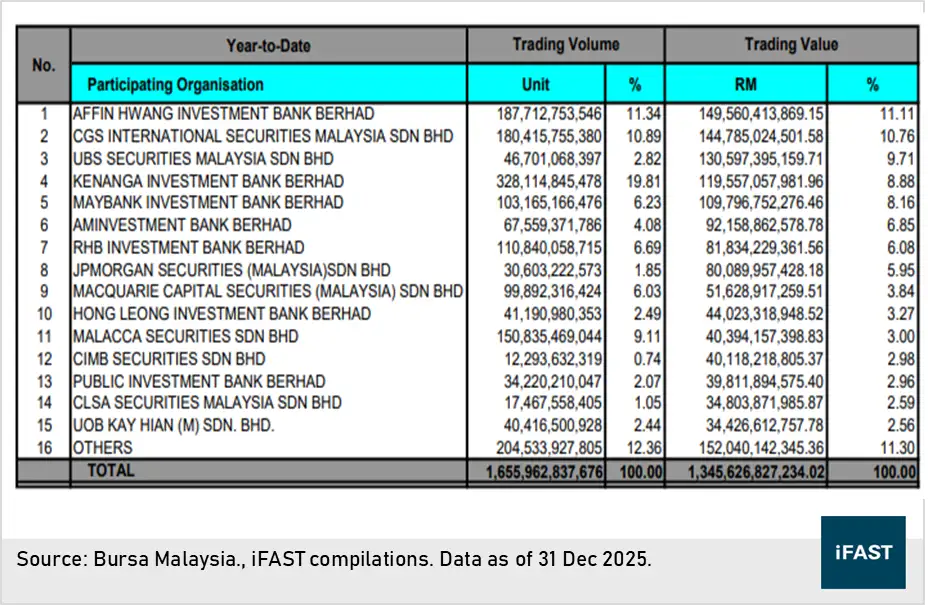
Kenanga Investment Bank Berhad has consistently maintained a strong position within the Malaysian stockbroking industry. According to Bursa Malaysia, Kenanga ranked among the top four brokers by trading value in FY25, reflecting its substantial market participation. This performance indicates that the firm’s revenue base is largely underpinned by its active role in facilitating trading activity and its established positioning within Malaysia’s brokerage landscape.
As a result, stockbroking revenue is expected to remain a key earnings driver into 2026, supported by sustained trading activity and continued investor engagement in the market.
Chart 2: Participation rate
Asset management division acts as a diversifier to Kenanga’s earnings profile
Other than the stockbroking and investment divisions, Kenanga’s earnings profile is further supported by the growing recurring income generated from its asset and wealth management segment. Despite a dip in revenue, AUA stood at a record high of RM26.2 billion in FY2025 and has been growing steadily since 2021. This will continue to serve as a diversification driver for Kenanga’s profitability moving forward.
Chart 2: Assets Under Administration
Malaysia’s equity market in 2026 is expected to maintain its momentum, and we remain constructive given the improving corporate earnings outlook, attractive valuations, and robust economic fundamentals. Against this macroeconomic backdrop, coupled with initiatives under the Capital Market Masterplan (2026–2030), we expect the domestic capital market to remain resilient this year.
Furthermore, Malaysia’s IPO market in 2026 is expected to remain active, with a stronger emphasis on quality and large-scale listings. According to Bursa Malaysia, the market is targeting approximately RM28 billion in IPO market capitalisation for the year. If current momentum is sustained, the total number of IPOs could exceed 60 listings, surpassing the 60 IPOs recorded previously with a combined market capitalisation of RM27.40 billion.
Considering Kenanga Investment Bank’s established role in Malaysia’s IPO landscape—particularly its strong presence in ACE Market listings, alongside selective participation in Main Market deals—the bank is well positioned to capitalise on this continued growth. Historically, Kenanga has been actively involved in various IPO listings, including roles in Sunway Medical (joint underwriter), JRK Holdings (sponsor), and Peoplelogy Berhad (principal adviser, sponsor, and underwriter), Well Chip Group Berhad (Principal Adviser & Joint Underwriter) and more.
As a result, we expect Kenanga to deliver stronger earnings in 2026 considering its performance is closely tied to the market activities.
Credit highlights
Kenanga has maintained a very robust capital position over the past few years. Despite the declining ratio, we remain optimistic about the bank’s capital buffer, as this was mainly attributable to an increase in risk-weighted assets, which form the denominator of the CET1 ratio. In FY2025, Kenanga’s CET1 ratio stood at 17.34%, providing a comfortable buffer against its minimum requirement of 4.5%.
Table 3: CET 1 ratio and RWAs
|
|
2021 |
2022 |
2023 |
2024 |
2025 |
|
CET 1 capital ratio |
20.67% |
20.94% |
21.54% |
16.67% |
17.34% |
|
Risk-weighted assets (RWAs) |
1,358,911 |
1,437,747 |
1,390,445 |
1,911,823 |
1,928,570 |
Source: Company Reports, iFAST Compilations. Data as of 31 December 2025.
We view Kenanga’s decision to issue an AT1 perpetual, despite maintaining a strong buffer above the minimum 4.5% requirement as a forward-looking capital management strategy. This is likely in anticipation of the acquisition of KDX, which may lead to a reduction in the CET1 ratio under Bank Negara Malaysia’s capital framework
Moderate asset quality
Kenanga’s loan portfolio is largely concentrated in share margin financing (~60%), followed by term loans (~38%) and other lending (~2%). In FY25, its net impaired loan ratio rose to 6.11%, mainly driven by weaker equity market conditions which affected collateral values and triggered margin-related stress.
Using 2025 data as an example, Kenanga’s credit risk exposure is backed by collateral coverage of approximately 60%. Considering the bank’s expected credit loss (ECL) of about RM56 million, this provides a sufficient buffer against the impaired loan portfolio. Additionally, we can expect some reversal of provisions as and when the collaterals are sold, although recovery will depend on sustained market performance and effective collateral realisation.
Recent acquisition by Kenanga – KDX (digital asset exchange)
On 19 March 2026, Kenanga Investment announced that it had increased its stake in the digital asset exchange Kinetic DAX Sdn Bhd (KDX) to 81.7%, from 19% previously.
KDX (formerly known as Tokenize Malaysia) is a regulated digital asset exchange based in Malaysia, serving over 80,000 users as of today. Following the acquisition, it has become the first and only bank-backed digital asset exchange (DAX) in Malaysia.
Other than providing investors with access to crypto trading, we view the acquisition as part of Kenanga’s broader strategy to integrate its tokenisation initiatives through Myrra, a platform leveraging the Stellar blockchain to enable the tokenisation of real-world assets. The inaugural deployment on Myrra is the tokenisation of the Kenanga Money Market Fund and the Kenanga Islamic Money Market Fund.
Through this initiative, Kenanga is expected to reduce operational costs and enhance efficiency. Given the accelerating global adoption of digital assets, we believe this could serve as a value-added driver to further strengthen Kenanga’s earnings profile.
Key risks
Intensifying competition in the brokerage industry – Kenanga’s stockbroking segment may face pressure, given the attractive rewards and promotional campaigns offered by competitors such as MooMoo and Webull.
Macroeconomic risk – As an investment bank, Kenanga’s earnings performance is closely tied to the macroeconomic environment. During economic downturns, weaker portfolio and market performance, along with reduced investor participation and trading activity, may weigh on Kenanga’s earnings profile.
Upcoming issuance – AT1 perp NC5
Kenanga is issuing an AT1 perpetual NC5, with an indicative yield of 6.1%. The issuance size is expected to be RM50 million (with an option to upsize). The issuance is non-rated, although the issuer is rated ‘A+’ by MARC.
Given that this is an AT1 instrument, investors should be aware of the inherent risks associated with AT1 perpetual securities:
- Loss absorption feature – The issuance may be written down if Kenanga fails to meet regulatory capital requirements.
- Non-call risk – The issuer may choose not to redeem the instrument on the first call date.
- Coupon deferral – The issuer has the right to cancel periodic distribution (coupon payments).
Target Book Close Date: 04 May 2026
Our view
Kenanga has maintained a resilient earnings profile and a robust capital position at this juncture. The CET1 ratio of 17.34% provides a comfortable buffer against its regulatory minimum requirement. Looking ahead, we are of the view that Kenanga’s earnings should remain anchored.
The upcoming AT1 perpetual NC5 issuance is more suitable for investors with a higher risk tolerance, given the inherent risks associated with AT1 instruments, which rank at the lowest seniority among the capital structure. This also explains the relatively attractive indicative yield of 6.1%, representing a spread of approximately 270bps over the 5-year MGS.
Nonetheless, before investing in AT1 perpetual securities, several key risks should be carefully considered. Investors must understand the inherent features of AT1 instruments, including loss absorption mechanisms, non-call risk, and the potential for coupon deferral. Investment in these securities should only be undertaken by those with a greater risk tolerance and a clear understanding of their complex risk profile.
Table 4: Recommended Bonds
|
Bonds |
Issuer |
Years to next call / maturity |
Yield to next call / maturity |
Bond Credit Rating |
Min / Sub investment (RM) |
|
Kenanga Investment Bank |
5Y / - |
6.1% / - |
- |
250,000 / 50,000 |
Source: BSM, iFAST Compilations. Data as of 31 December 2025.
Declaration: For specific disclosure, at the time of publication of this report, IFPL (via its connected and associated entities) and the analyst who produced this report hold a NIL position in the abovementioned securities.