Keppel Infrastructure Trust is the largest infrastructure business trusted listed on the Singapore Exchange.
Temasek Holdings, by virtue of its interest in Keppel Corporation, is deemed a substantial shareholder of Keppel Infrastructure Fund Management Pte Ltd.
The trust receives regular cash flows from contracts with creditworthy customers.
We recommend the 4.75% perpetual note at its current yield of 4.1%. The note is first callable in June 2029.
Trillions of dollars are heading towards the infrastructure sector and investors should position themselves to capitalise on the new wave of public spending. Many companies, including business trusts that are focused on infrastructure could get a boost from these government spending initiatives.
In the United States, President Joe Biden recently unveiled a USD 2 trillion plan to rebuild highways, roads and bridges. In addition, the President is planning to construct other clean energy infrastructure to lower the country’s carbon emissions and support the use of electric vehicles.
Likewise in Australia, the government is investing AUD 110 billion in transport infrastructure over the next 10 years to provide jobs and improve regional connectivity. Funds will also be allocated for telecommunications projects to improve mobile capacity in small towns. According to estimates by the Asian Development Bank, developing Asian nations will need to invest USD 1.7 trillion annually in infrastructure until 2030 to reduce poverty, fight climate change and maintain economic growth.
Capital expenditures are set to grow in the coming years. Even though these spending programs may not have a direct impact on Keppel Infrastructure Trust (‘KIT’), the brighter outlook on the broader sector should improve its ability to access capital markets. The trust already receives a stable and recurring revenue from its long-term contracts and is looking to expand its portfolio in assets with defensive cash flows and a strong growth potential.
About Keppel Infrastructure Trust
KIT is an infrastructure-focused business trust listed on the Singapore Exchange. With a net asset value of SGD 1.49 billion as at the end of December, the company aims to deliver value to its unit holders through a two-pronged strategy of recurring distributions and capital appreciation over the long term.
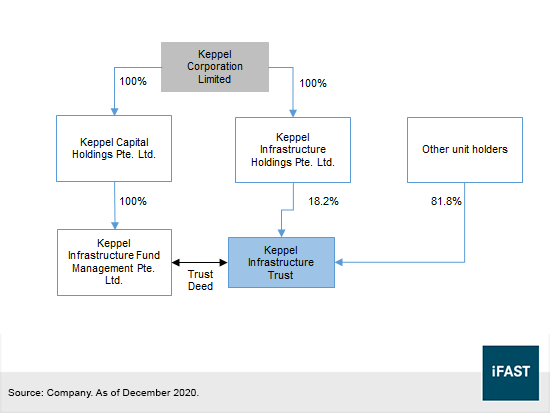
The trust sponsor is Keppel Infrastructure Holdings Pte. Ltd. while Keppel Infrastructure Fund Management Pte. Ltd. is the trustee-manager (see Figure 1). Both entities are subsidiaries of Keppel Corporation Limited.
As of 2 Mar 2021, Temasek Holdings (Private) Limited has a 31.93% deemed interest in the trust. Temasek is deemed to have an interest in the units in which Keppel Corporation Limited and other Temasek linked companies hold.
Figure 1: Trust structure
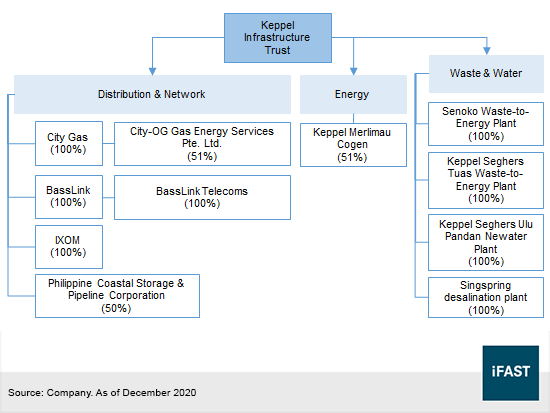
Revenue is recognised through nine core assets that may be categorised according to three operating segments (Figure 2). Distribution & Network accounts for 54.8% of total assets, while Energy, Waste & Water account for 15.7% and 8.8% of total assets respectively. The following sections highlight the services and performance of the various segments.
Figure 2: Trust structure
Distribution & Network - City Gas
City Gas is the owner and operator of the sole production facility of town gas in Singapore. The subsidiary has a 51% stake in City-OG Gas Energy Services Pte. Ltd.; the remaining 49% is owned by a subsidiary of Osaka Gas Co., Ltd.
The joint venture company produces and sells gas to retail and corporate customers. As of March 2021, City Gas provided gas to 870,000 residential, commercial and industrial customers. The subsidiary also sells co-branded gas hobs, dryers, water heaters and other home appliances to retail customers.
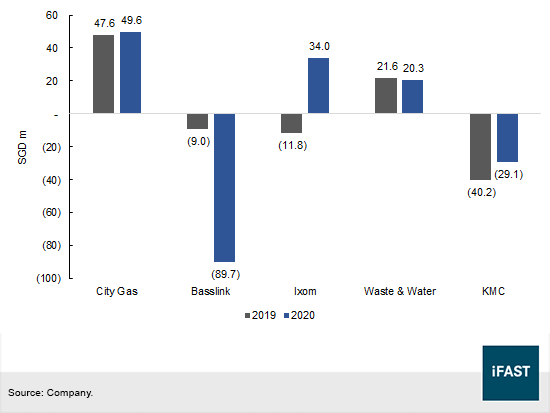
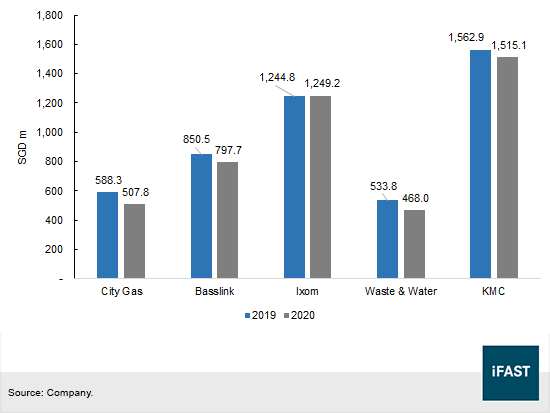
Demand for town gas remained healthy despite the Covid-19 pandemic as its customer base expanded by 0.8% during 2020. Segmental revenue declined last year but it made a profit before tax (“PBT”) of SGD 49.6m (2019: SGD 47.6m) while funds from operations increased slightly to SGD 47.0m (2019: SGD 46.0m).
City Gas has earned the support of the National Research Foundation to work with its partners to use hydrogen and Liquefied Natural Gas as a green energy source. Last year, the unit signed a Memorandum of Understanding with Keppel Data Centres Holding Pte Ltd (a Keppel Telecommunications & Transportation Ltd subsidiary) to explore using hydrogen and LNG to power the Floating Data Centre Park in Singapore.
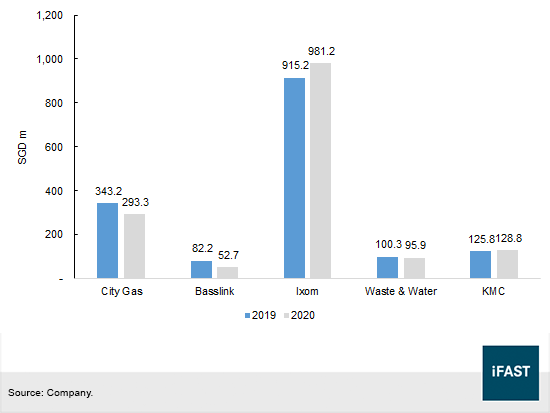
Figure 3: Segment revenue
Distribution & Network - Basslink
Basslink runs a monopole electricity connector that stretches 370km across Victoria and Tasmania, Australia. According to the Basslink Services Agreement that was established in 2006, KIT will receive inflation-linked cash flows for the supply of electricity until 2031.
Hydro Tasmania will pay Basslink a facility fee that is tied to the availability of the connector. The fee is paid in full if total availability equals or exceeds 97%, and will fall proportionately if availability is less than 97%. Over the last 14 years, the cumulative lifetime availability of the connector was 94.7%.
Additionally, the agreement includes a Commercial Risk Sharing Agreement mechanism where both parties share the market risk of electricity prices in Australia. Adjustments are made according to a price difference between the highest and lowest electricity prices, subject to a maximum of a +12.5% increase (where payment is made from Hydro Tasmania to Basslink) and a 12.5% decrease (payment is made from Basslink to Hydro Tasmania) of the facility fee.
Revenue contribution from Basslink is the lowest of the four segments, as it decreased to SGD 52.7m in 2020 from SGD 82.2m in 2019. Basslink is also loss making. It registered a loss before tax of SGD 89.7m last year.
In December, the Australian Court ordered Basslink to pay AUD 38.5m in damages and this was related to a supply outage in 2015. At that time, a six-month downtime of the cable led the state government to intervene and the outage incited a parliamentary inquiry into the cause of the incident.
Distribution & Network – Philippine Coastal
Philippine Coastal is KIT’s latest acquisition. It registered a net profit of USD 9.4m (~SGD 12.6m) and EBITDA of USD 28.8m (~SGD 38.6m) for the financial year ended 31 Dec 2019.
With a land size of nearly 150 hectares, Philippine Coastal Storage & Pipeline Corporation is the operator of the biggest petroleum products import storage facility in the Philippines. Located in the Subic Bay Freeport Zone, there are more than 40 underground storage tanks and more than 40 aboveground storage tanks for petroleum product storage.
The acquisition would be earnings accretive for the trust. Demand for imported petroleum products in the Philippines is expected to grow by 4.1% per annum from 2019 to 2030, while at the same time, the industry is projected to have a capacity shortfall of 7m barrels of petroleum products by 2030 and a capacity shortfall of 11.3m barrels by 2050.
Distribution & Network - Ixom
KIT acquired Ixom in 2019. The Ixom group runs one of the biggest bulk and packaged chemical distribution networks in Australia and New Zealand. Some of its products include liquefied chlorine, caustic soda and hydrochloric acid, which are essential ingredients in a number of manufacturing processes. The Life Sciences arm of the segment provides chemicals for hand sanitisers which were highly sought items during the pandemic.
Last year, Ixom divested its China and Latin American businesses and added Medora Environmental, a US source water management company to its portfolio. The addition of Medora will expand its reach in the US with an enlarged product line.
Ixom is KIT’s second largest segment as it represents 25.3% of total assets. Segmental revenue expanded by 7.2% YoY to SGD 981.2m last year and it made a profit before tax of SGD 34.0m. Meanwhile, segment funds from operations were about SGD 89.0m in 2020, up from SGD 49.3m in 2019.
Figure 4: Breakdown of segment profit before tax
Waste & Water segment
The Waste & Water segment is made up of 4 plants – the Senoko Waste-To-Energy Plant, Keppel Seghers Tuas Waste-To-Energy Plant, Keppel Seghers Ulu Pandan NEWater Plant and the SingSpring Plant. The Senoko WTE Plant is the only waste incineration plant to serve the eastern, northern and central parts of Singapore and has a 15-year Incineration Service Agreement (starting from September 2009) with the National Environmental Agency (“NEA”). Similarly, Keppel Seghers Tuas WTE Plant has a 25-year agreement with the NEA that began in November 2009.
As one of the largest NEWater plants in Singapore, the Keppel Seghers Ulu Pandan NEWater Plant has a 20-year agreement with PUB (the country’s National Water Agency) to meet the water demands of Singapore’s industrial and commercial needs. The agreement ends in 2027.
SingSpring Desalination Plant on the other hand, is 70% owned by KIT and 30% owned by Hyflux Ltd. The latter was placed under judicial management but there has been no disruption to the plant’s operations thus far. Under a 20-year Water Purchase Agreement with PUB expiring in 2025, SingSpring will receive capacity and output payments for the supply of water.
With regard to its performance, the segment generated SGD 20.3m of profit before tax on top of SGD 95.9m of revenue in 2020. This was nearly equal to the SGD 100.3m of revenue and SGD 21.6m of PBT in 2019.
Figure 5: Carrying value of segment assets
Energy segment – Keppel Merlimau Cogen plant
The Keppel Merlimau Cogen (“KMC”) plant is 51% owned by KIT and is considered to be the largest asset in the trust. Located on Jurong Island, the 1,300 MW plant is 49% owned by Keppel Energy Pte. Ltd. The plant delivers electricity, steam and industrial water to customers in Singapore.
Under a 15-year Capacity Tolling agreement with Keppel Electric, KIT is paid tolling fees according to plant availability and capacity targets. These capacity payments do not fluctuate according to electricity demand, and has no tariff exposure not is it susceptible to fuel oil prices.
KMC obtained the KMC Electricity Licence from the Energy Market Authority under the Electricity Act, which allows the company to generate electricity and trade wholesale electricity for 30 years until 31 Dec 2032. In addition, KMC has entered into different regulatory contracts with parties such as SP PowerAssets for electricity market support services.
Revenue from KMC grew by 2.3% to SGD 128.8m but operations have been in the red as losses before tax chalked up to SGD 29.1m. Funds from operations however increased to SGD 46.1m in 2020 from SGD 41.7m in 2019.
Financial results and credit profile
Consolidated revenue fell slightly by 0.9% to SGD 1,551.9m in 2020 primarily due to a fall in contribution from its Basslink and City Gas units. This was because KIT was unable to recover its receivables from Hydro Tasmania due to the recent court ruling. In addition, the trust received lower revenue from City Gas due to a drop in gas tariffs and fuel prices. These tariffs are subject to price control by the Energy Market Authority of Singapore.
Separately, income from non-recurring items swung to an SGD 17.2m loss in 2020 from an SGD 37.5m gain in 2019. KIT alluded this loss to three reasons – (1) the absence of divestment gain in the second half of 2019 (“2H19”), (2) divestment losses from its Latin America and China Life Science businesses and (3) unfavourable fair value movements in financial derivatives.
On the other hand, total operating expenses remained at nearly the same level at SGD 1,576.5m. Other operating expenses increased to SGD 163.3m but this was offset by lower fuel and electricity costs, which fell by 31.9% YoY to SGD 101.6m. Manager fees also declined 52.9% YoY to SGD 12.2m. After taking into account SGD 20.8m of tax expenses, KIT arrived at a loss after tax of SGD 52.1m in 2020 (2019: profit after tax of SGD 10.2m).
Looking ahead, KIT is likely to report higher cash flows. In the recent operational update for the quarter ended 31 Mar 2021 (“1Q21”), KIT reported a slight fall in group EBITDA from SGD 98.1m in 1Q20 to SGD 97.9m in 1Q21. The company delivered SGD 282.2m of EBITDA in 2020, and this was sufficient to cover 1.8x of its interest expenses (including distributions to perpetual securities holders).
Operational cash flows improved from SGD 57.5m in 1Q20 to SGD 66.5m in 1Q21, backed by stable performance from its Ixom unit, a stronger Australian dollar and healthy demand for its chlorine and caustic soda products.
Looking at its balance sheet, the trust had SGD 580.7m of cash and bank deposits at the end of 2020. This may not be sufficient to pay down its SGD 643.9m of current borrowings, but we believe that the trust may rely on its operating cash flow for any shortfall. The trust remains positive cash flow generative as it recorded net cash from operating activities of SGD 345.43m in 2020 and SGD 356.40m in 2019.
Referring back to its latest operational update in March, KIT revealed that its cash position had dropped to SGD 497.0m at 1Q21 while total borrowings increased a tad. The trust had obtained an SGD 300 short term facility to finance the Philippine Coastal acquisition, resulting in a higher net debt position of SGD 1,901m. Net gearing (defined as net debt over total assets) increased to 37.3% in 1Q21 but this is still indicative of a comfortable gearing level.
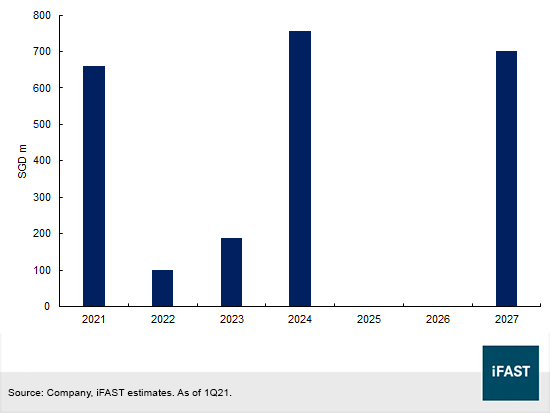
Total borrowings grew from SGD 1,580m in December 2020 to SGD 1,901m in March 2021 and a breakdown of its debt maturity profile is displayed in Figure 6. KIT disclosed that its AUD 640.9m loan maturing in May 2021 would be refinanced upon maturity. Other loans, inclusive of the SGD 100m maturing in 2022, SGD 178m loan maturing in 2024 and AUD 532.4m fixed rate loan maturing in February 2024 would also be refinanced upon maturity.
Figure 6: Estimated debt maturity profile for KIT
With the aforementioned factors in mind, we do not foresee that KIT will face any liquidity problems in the short term. It can be seen that KIT enjoys stable cash flows from long term contracts entered into counterparties linked to the Singapore Government. Within the assets which are located in the country, five of them have agreements with government-linked companies.
For instance, PUB and NEA – which are statutory boards of the Singapore Government - are the counterparties for KIT’s water treatment and waste incineration business. As the counterparty for the 15-year Capacity Tolling agreement, Keppel Electric is a wholly owned subsidiary of Keppel Corporation Limited, which is a large conglomerate that is partially owned by Temasek. Revenue streams and cash flows are therefore backed by institutional customers with a high payment ability and a low risk of counterparty default.
Furthermore, we believe that the trust has good banking support and the ability to access capital markets for liquidity requirements. To a certain extent, KIT may rely on Keppel Corporation Limited’s network and relationship for funding.
Relative valuation
Most of KIT’s financial obligations are represented by bank loans but the firm has SGD 300m of outstanding perpetual securities that are traded in the secondary market. We think that the perps, or KITSP 4.750% Perpetual Corp (SGD) are attractively priced at its indicative yield to next call of 4.12%.
The notes were issued in 2019 soon after the establishment of its SGD 1 billion multicurrency debt issuance programme, coinciding with the Ixom group acquisition. Back then, KIT raised SGD 300m from investors through the issuance of two tranches of perpetual securities.
KITSP 4.750% Perpetual Corp (SGD) has a first call date on 12 Jun 2029. Should the trust choose to leave the notes outstanding after its call date, the distribution rate will reset (and every ten years thereafter) to the sum of the prevailing ten-year SGD swap offer rate (26 Apr 2021: 1.58%), the initial spread of 2.737%, and a step-up margin of 100 basis points.
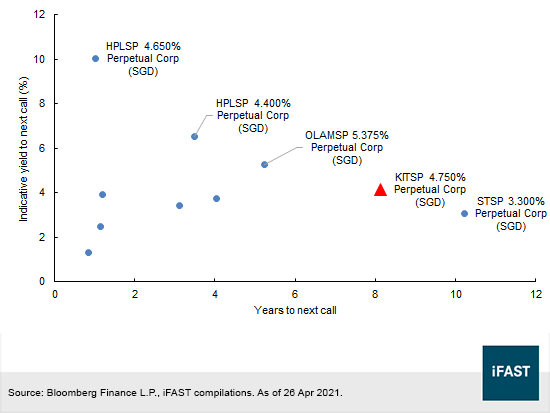
Comparing notes among other SGD perpetual issues, we observed that the KITSP 4.75% perp is the only SGD note that is callable within 8 years (see Figure 7). They may not be directly comparable to other perpetual securities due to their different business sectors, but we also have positive views on the OLAMSP 5.375% Perpetual Corp (SGD) (presently unrated) and STSP 3.300% Perpetual Corp (SGD) (rated A3/BBB by Moody’s/S&P). The current yield to call of more than 4% for the KITSP 4.75% perp is appealing given that there is a low risk of a non-call event at this point.
Figure 7: Relative valuation among SGD non-financial perpetual notes
Declaration:
For specific disclosure, at the time of publication of this report, IFPL (via its connected and associated entities) has a principal position in OLAMSP 5.375% Perpetual Corp (SGD) and STSP 3.300% Perpetual Corp (SGD). The analyst who produced this report is a unitholder of Keppel Infrastructure Trust.
Our podcast series, Yield Hunters, is available on Spotify and iTunes Podcasts and Google Podcasts. We share our thoughts on new bond issues and hold discussions on the fixed income space. Listen to our latest episode below and follow us!