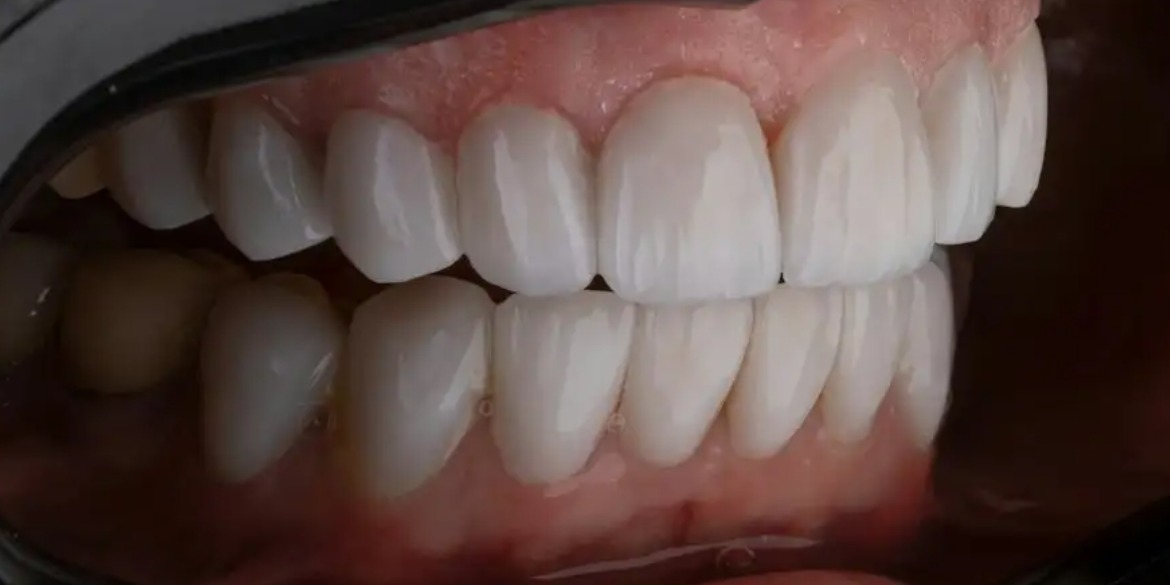
- KWG Group Holdings continued to experience strong growth in contracted sales in 2019 and is expected to hit 100 billion in sales by 2021. With more than 90% of its land bank located in tier-one and tier-two cities in China, the company has strong potential for further development.
- The latest credit metrics deteriorated slightly as compared to last June, but still outperformed the average of its BB-grade peers. KWG’s overall credit profile is largely favourable.
- Bonds issued by KWG are fairly priced, and investors can consider its medium and long term bonds.
BB-grade Chinese real estate bonds seem to be an attractive option that balances both risk and returns. On one hand, BB-rated property developers, mainly medium to large companies, have an advantage over their B-rated peers in operation performance and credit profile. Moreover, BB-rated developers generally yield more than investment-grade developers, which is why the former are more appealing to investors. KWG Group Limited (KWG) is a leading developer with desirable returns and credit among BB-grade property developers.
Company Highlights
Outstanding Sales Performance in 2019
KWG continued to achieve a high growth rate in contracted sales in 2019, as total sales spiked to RMB 86.1 billion (all monetary figures are in RMB, unless otherwise specified), surpassing its annual target of ¥85 billion. Despite the fact that the growth rate has declined over the past few years, it still stood at a respectable 30% and outperformed most of its peers. In our view, the performance of KWG in 2019 was remarkable.
We believe that KWG’s high growth rate is mainly attributable to the attractive location of its properties. As at 31 Dec 2019, 89% of its contracted sales were from tier-one and tier-two cities, where relatively large populations and thriving businesses have led to massive housing demand.
Figure 1: Strong Growth in Yearly Contracted Sales
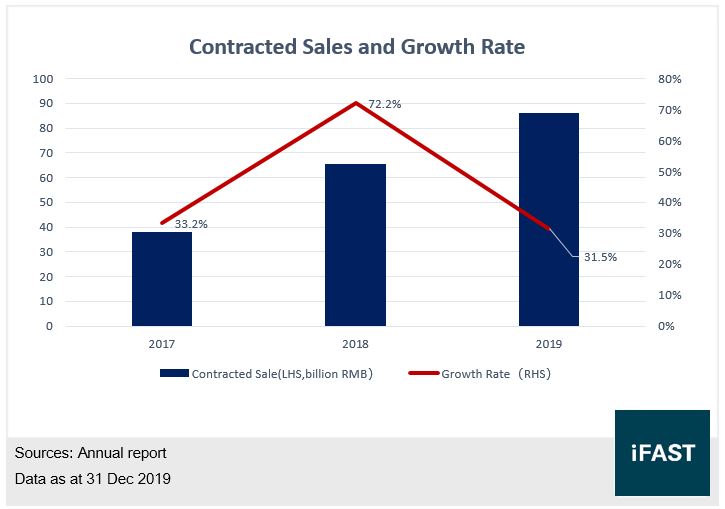
Sales bottomed out in May and are expected to pass the ¥100 billion mark in 2021
1Q2020's contracted sales plunged significantly due to the COVID-19 pandemic, as KWG recorded ¥1.7 billion contracted sales in February, down by 57.9% YoY. However, contracted sales has bottomed out and is now recovering following the containment of the pandemic.
As observed from Figure 2, monthly contracted sales in March and April bounced back to ¥6 billion. In particular, May's contracted sales experienced a strong rebound, soaring 44.8% YoY to ¥9.2 billion. Furthermore, it was up 40.6% compared to April, and pared its 1Q losses. Consequently, contracted sales for the first five months exceeded ¥28.7 billion, and the YoY growth rate has turned positive, reaching 0.8%.
Figure 2: Recovery in Monthly Contracted Sales after 1Q2020
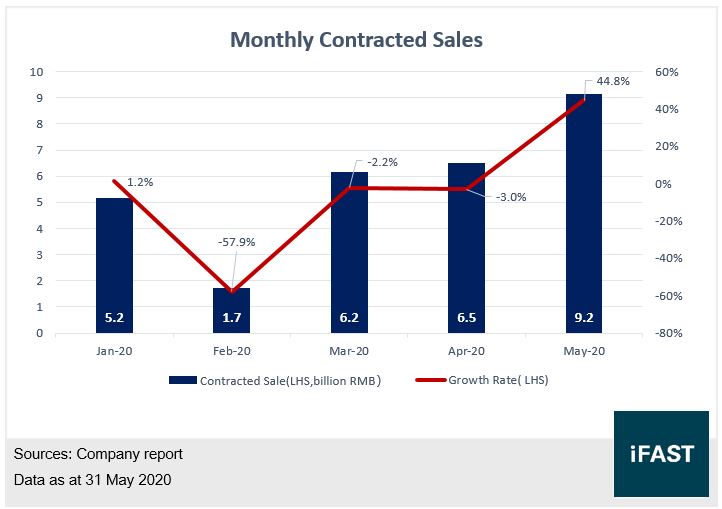
As at 31 Dec 2019, the sellable properties KWG owned totalled nearly ¥170 billion, of which the Greater Bay Area and the Yangtze River Delta region accounted for 42% and 28% respectively. In addition, the geographical distribution of its sellable properties is favourable, with 88% of them located in tier-one and tier-two cities across China.
Moreover, given that the sell-through rate over the last two years has averaged 60% (see Figure 3), we estimate that potential contracted sales for 2020 will increase by 8.6% to ¥93.5 billion based on a conservative 55% sell-through rate, after taking into account the negative impact of the pandemic. It also means that achieving the target of ¥100 billion in contracted sales and becoming a medium to large-sized developer will likely only be achieved in 2021.
Figure 3: KWG Sellable Properties and Sell-through Rate
However, contracted sales of
KWG are mainly concentrated in the second half of the year, especially during
“Golden September, Silver October" peak season for property sales. If KWG
releases more property projects in 2H2020 with attractive promotions and
publicity, the contracted sales stand a chance of reaching their target of ¥100
billion.
Non-Property-Development business records stable growth
In addition to property development, property investment, hotel operation, and property management also play significant roles in the core business of KWG. Property investment-wise, rental revenue in 2019 benefited from two newly opened shopping malls, nearing ¥630 million and surging by 65.3% YoY. More shopping malls will commence operations in the next two to three years, and most of them are located in tier-one and tier-two cities, including Beijing, Guangzhou, and Chengdu.
KWG’s property management business has an outstanding track record, with its revenue rising by 79.3% YoY to ¥1.0 billion. Overall, the total revenue from non-property development sectors amounted to ¥2.4 billion, up 49.0%. In our view, these sectors are likely to grow rapidly and provide a stable stream of revenue for KWG.
Strong land bank despite conservative land acquisition policy
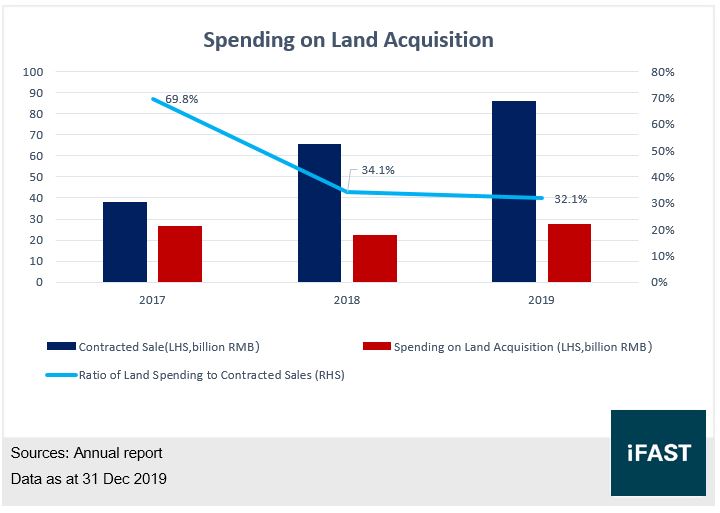
KWG’s spending on land acquisition rose by 23.4% to ¥27.6 billion in 2019, but its ratio of land spending to contracted sales decreased from 34.1% in 2018 to 32.1% in 2019 (see Figure 4), which is a huge slump relative to 2017 (69.8%). The decline suggests that KWG's land acquisition policy has switched from being aggressive to relatively conservative. Nevertheless, KWG’s present land bank totals 17.0 million square meters, which is enough for developments in the next three to five years.
Figure 4: Conservative Land Acquisition Policy
It is worth noting that KWG’s
method of land acquisition is rather unique, as approximately 74% of its new
gross floor area (GFA) was acquired through mergers and acquisitions and joint
developments, instead of land auctions. We believe it is strategic for KWG to
adopt this unique land acquisition method to lower land costs, especially
considering the competitive market for land in China’s tier-one and tier-two
cities.
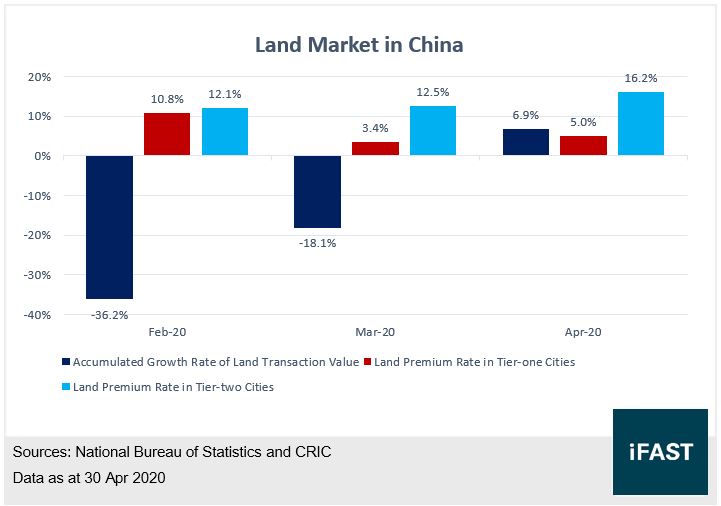
Data from the National Bureau of Statistics shows that the transaction value of land for the first four months of 2020 has achieved an accumulated growth rate of 6.9% (see Figure 5), recording positive growth for the first time since Feb 2019.
Meanwhile, the land premium rate remains high in tier-one and tier-two cities, reaching 16.2% in April. As the land of tier-one and tier-two cities acquired from auctions costs more, it narrows potential profitability. In other words, KWG’s unique land acquisition strategy will help the company maintain its profitability.
Figure 5: Competitive Land Market in China
Credit Profile
Healthy Debt Structure with a Low Borrowing Rate
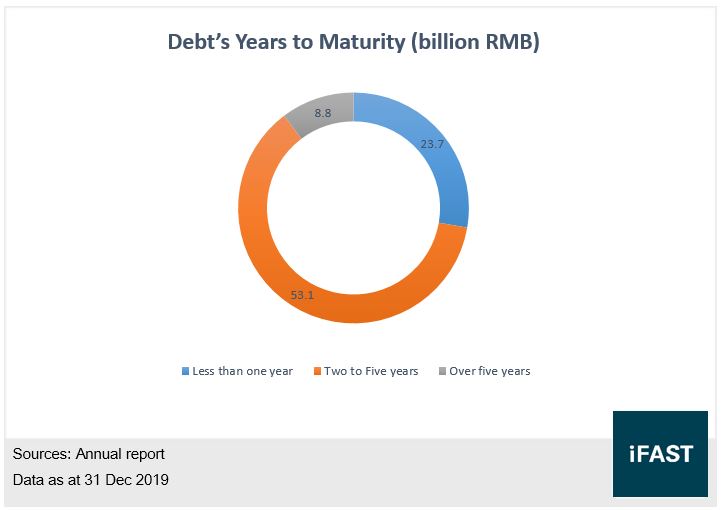
As at 31 Dec 2019, KWG’s total interest-bearing debt totalled approximately ¥85.6 billion. Long-term debt makes up a significant portion of that figure (see Figure 6), and short-term debt only constitutes 28% of the total debt, forming a healthy debt structure.
Figure 6: KWG’s Debt Structure
Looking at KWG’s borrowing rates, the weighted average borrowing rate stood at 6.4% as at 31 Dec 2019, 20bps lower than that in mid-2019, hinting at its strong fundraising ability. However, we believe that the reported weighted average borrowing rate has been overstated because part of its asset-backed securities (ABS) with low interest rates were not taken into account.
For instance, in July 2019, KWG issued a commercial mortgage-backed security (CMBS) with a ¥1.9 billion principal and a coupon rate of 5.3%. Generally speaking, CMBS is a type of off-balance sheet refinancing. As the name suggests, it is not included in the debt balance sheet, leading to a higher reported borrowing rate.
Credit Metrics have Weakened Slightly but remain Healthy
Table 1 shows that some of KWG’s credit metrics have weakened. The ratio of cash to short-term debt has deteriorated remarkably, dropping from 4.4x in mid-2019 to 2.2x at the end of 2019. However, investors need not worry too much about it, as 2.2x ratio of cash to short-term debt is still above the average of its BB-rated peers (around 1.5x), implying a low risk of insolvency. Likewise, interest coverage ratio underwent a slight dip but is above the average of its BB-rated peers (about 2.9x).
On the other hand, net gearing ratio improved slightly from 77.2% in mid-2019 to 75.4% at end-2019, which indicates relatively low leverage. Taken as a whole, the latest credit profile of KWG weakened slightly relative to last June but is still healthy enough, beating out most of its BB-grade property developer peers.
Table 1: Slight Weakening in Credit Metrics
|
Credit Metrics |
Mid-2019 |
End-2019 |
Change |
|
Ratio of Cash to Short-term Debt |
4.4 |
2.2 |
-50.0% |
|
Net Gearing Ratio |
77.2% |
75.4% |
-1.8 percentage points |
|
Interest Coverage Ratio |
3.8 |
3.1 |
-18.4% |
|
Weighted Average Borrowing Rate |
6.6% |
6.4% |
-20 bps |
Source: KWG Annual Report. Data as at 31 Dec 2019
Investing in KWG Bonds
As at 11 June 2020, there have been five bonds issued by KWG with investment horizons between 0.5 to 6.6 years. Their specifications are as follows:
Table 2: Yield-to-Maturity of KWG Bonds
|
Bond |
Years to Maturity |
Ask Price |
YTM |
|
0.5 |
102.3 |
4.40% |
|
|
1.2 |
102.2 |
5.85% |
|
|
2.3 |
97.8 |
6.22% |
|
|
3.7 |
100.1 |
7.35% |
|
|
6.6 |
95.3 |
8.34% |
Source: BSM, Data as of 11 Jun 2020
As observed from Table 2, investors should rule out the bond due 2020 given its short investment term and elevated trading price. For the other four bonds, we think they are all fairly priced with an attractive return. Investors who prefer short-term investments can consider the bond due August 2021, which currently yields approximately 5.85% in 1.2 years.
In view of the excellent credit profile of KWG, investors can also consider longer-term bonds, such as the bonds due 2022 and 2024. Both bonds are trading at a discount, and their current YTM are 6.22% and 7.35% respectively, offering attractive returns. The bond due 2027 has a very long investment horizon and does not seem to be as attractive an option because both the macro-economic and real estate fundamentals may change dramatically, and investment risks are difficult to predict.
Company Risk
Although KWG has a favorable credit profile, investors should be aware of the following risks. The first risk is with regards to the operational efficiency of commercial property. KWG has allocated more capital to commercial property, especially in shopping malls and office buildings. However, there is a relatively high vacancy rate for office buildings in tier-one and tier-two cities nowadays. Should the vacancy rate continue to rise, the performance of commercial property will likely be dragged down.
In addition, as mentioned above, KWG has a large amount of off-balance sheet refinancing, indicating that the company might face a higher amount of debt and greater pressure to pay off its debts.
In addition, investors should not ignore the cash collection risk. Although KWG did not disclose cash collection data for 2019, the cash collection rate of KWG typically averages 60%, lower than the industry average (about 70% to 80%). We believe that a low cash collection rate is due to inter-developer cooperation. If KWG is unable to collect payments on time, a shortage of liquidity could negatively impact its credit profile.
Conclusion
Overall, KWG's contracted sales in 2019 maintained strong growth and is expected to become reach ¥100 billion in 2021. With its strong land bank, we are optimistic about further development. Although KWG’s credit profile has weakened slightly since last June, it still remains healthy and above the average of its BB-rated peers. Investors should prioritize medium to long-term debt, such as the bond due 2024, which currently yields 7.35%.
Declaration: For specific disclosure, at the time of publication of this report, IFPL (via its connected and associated entities) and the analyst who produced this report hold a NIL position in the abovementioned securities.