The Indonesian government has imposed strict social distancing measures since March to fight the coronavirus outbreak, putting the economy into a deep freeze. To cushion against the severe damage on Indonesia’s economy, which recorded the weakest growth since 2001 in the first quarter, the government has abandoned its budget deficit ceiling of 3% of GDP. The Indonesian government now projects a deficit of more than 6% of GDP this year.
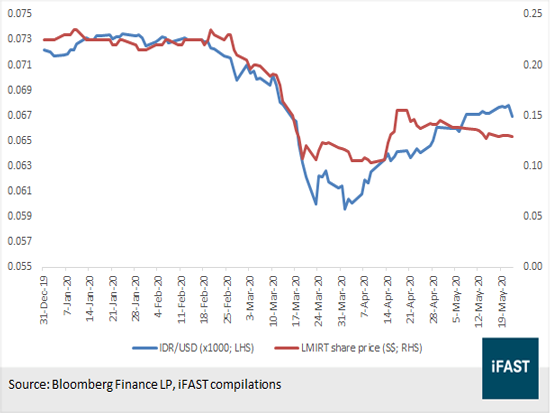
The prospect of a flood of money printing sent foreign investors scrambling for the exit, with capital flowing out of the country at a pace faster than during the 2008 global financial crisis. Meanwhile, the rupiah sank 5.7% in year-to-date 25 May, and ranked among worst performing Asian currencies even after an 11.8% jump since April.
Suffering the triple whammy of a severe economic slowdown, coronavirus restrictions shutting down retail centers, and the fall in rupiah, prices of the units and bonds of Lippo Malls Indonesia Retail Trust (“LMIRT”; LMRT:SP) went into a free fall. The trust’s units lost 43% of their value this year, making it one of the biggest losers among Singapore-listed REITs. We review LMIRT’s credit profile and our opinion on its bonds in this article.
Figure 1: Rupiah plunge and COVID-19 weigh on LMIRT
Retained 76% of 1Q20 distributable income due to COVID-19 impact
LMIRT’s total gross revenue dipped 1.5% year-on-year (“YoY”) to S$64.9m in 1Q20, dragged down by the 2.3% fall in gross rental income (S$36.6m) and 46.6% drop in carpark income (S$2.5m). Most of the decline in revenue was attributable to the expiry of master leases under Lippo Mall Kemang in December, which was partially offset by positive rental reversions (+4.1%) and an increase in service charge and utilities recovery (+9.0% YoY to S$25.3m).
The REIT recorded a lower allowance for doubtful debts in the first quarter, leading to a 35.9% decrease in other property operating expenses to S$2.1m. We like that trade receivables continued to decrease during the quarter, falling from S$27.1m to S$18.4m, of which S$7.3m (31 Dec 19: S$11.2m) were due from related-party tenants (of the Lippo group of companies). Overall, LMIRT’s net property income declined 1.9% YoY to S$39.8m in 1Q20.
At the end of March, LMIRT announced the closure of all of its 23 retail malls and seven retail spaces, apart from essential services such as supermarkets, pharmacies, and clinics. During this closure period, tenants are allowed to continue to operate for online retail and delivery, but we understand that LMIRT is collecting only about 60% of its rents from such tenants. The trust has waived full rentals from all other tenants that are not doing business.
LMIRT had since extended the closure of affected retail properties to at least 4 June. On the bright side, Lippo Plaza Kendari (“LPK”), which generated S$5.0m (1.8%) of gross revenue in 2019, had resumed business operations. The trust is also putting in place plans to progressively resume business in other retail malls and spaces from 22 May to 5 June, although management cautioned that the re-openings are subject to the lifting of social restrictions and could experience further delays.
During LMIRT’s 1Q20 results briefing, CEO James Liew mentioned that master leases under PT Lippo Karawaci Tbk—“LK”; the REIT’s sponsor—are still paying full rent as a show of support, even though LK is not collecting rents from the underlying tenants. LMIRT has also reduced operating costs by 30-40% mainly from reduction in utilities and security and cleaning services, and increased the collection of service charge and utilities recovery from tenants. Despite the above, we understand from management that the REIT is still running at an operating loss of around S$3-4m a month.
The ongoing cash drain and COVID-19 uncertainty have necessitated austerity measures by LMIRT. The REIT decided to deviate from its stated policy of distributing at least 90% of its tax-exempted income, retaining 76% of 1Q20 income available for distribution to unitholders. Dividends for unitholders consequently plunged 78% YoY to just S$3.5m.
We note that a number of other REITs, including those that have substantially larger scale and better financial health, have also opted to cut dividends in light of immense challenges from the pandemic. For instance, CapitaLand Mall Trust, the largest retail S-REIT, retained ~66% of taxable income in the first quarter, leading to a 70% fall in distributions. Liew emphasized that LMIRT will strive to return to its internal policy of distributing 90% taxable income as soon as possible, when cash flows normalize and operating conditions improve.
In April, authorities in Singapore announced several relief measures for S-REITs, including an extension of the timeline for S-REITs to distribute at least 90% of their taxable income, from three months to twelve months (after the end of financial year 2020). However, the tax transparency treatment is not applicable to LMIRT, whose income is derived entirely from Indonesia and thus subject to Indonesia tax. This means that LMIRT is actually not bounded by any law or tax regulations to distribute at least 90% taxable income. Nonetheless, the REIT had been adhering to its distribution policy in the past because it is the market norm for REITs; most people invest in REITs for their dividends.
Credit metrics took a hit from rupiah depreciation
Total borrowings of LMIRT increased from S$721.7m to S$789.8m in the three months ended March, following the drawdown of S$40m from uncommitted revolving credit facilities (“RCF”) and depreciation of SGD against USD—which increased the translated value of the USD 250m LMRTSP 7.250% 19Jun2024 Corp (USD). The trust had entered into hedging arrangements to swap the USD bond and its coupon payments into SGD (at the fixed interest rate of 6.71%), so we think the effective amount of borrowings should be somewhat lower than the reported value. Almost all (96.2%) of LMIRT’s debt is on a fixed-rate basis, which minimizes interest-rate risk to the REIT.
The sharp depreciation of IDR against SGD in the first quarter led to a corresponding fall in the carrying values of LMIRT’s investment properties. As a recap, all of LMIRT’s retail properties are located in Indonesia, and while they were last valued on 31 Dec 19, the valuation figures were recorded in rupiah and translated into SGD using the exchange rate at the end of March. As the SGD/IDR climbed from 10,321 to 11,370 in 1Q20, the value of LMIRT’s property portfolio (including properties held for divestment) fell from S$1.82 billion to S$1.66 billion, and total assets similarly decreased from S$2.01 billion to S$1.88 billion. Given the significant negative impact from the COVID-19 outbreak on the retail sector, we expect LMIRT’s investment properties to face further downward pressure on their valuations.
Due to the combination of higher debt and lower asset value, LMIRT’s reported gearing ratio (debt over assets) climbed from 35.9% to 42.1% in 1Q20. Treating S$260m of perpetual securities (“perps”) as debt, we estimated LMIRT’s adjusted gearing ratio at 55.9%, which was a high level relative to other REITs. Nonetheless, as the rupiah has jumped more than 10% subsequent to end-March, and the trust will be redeeming S$75m of bonds in June, we expect LMIRT’s adjusted gearing ratio to fall back below 50% in the second quarter.
LMIRT’s financial liquidity looks adequate, with management guiding that existing cash of S$145.7m will be used to redeem the S$75m SGD notes due June (see Figure 2). According to management, the S$40m RCF loan due this year was from one of LMIRT’s principal banks that operate its accounts in both Singapore and Indonesia. The trust has been able to refinance its loans with this bank regularly, and it expects to be able to rollover the S$40m loan. LMIRT has also started discussions with banks about refinancing of the S$175m term loan due August 2021.
Figure 2: LMIRT has just S$115m of borrowings due this year
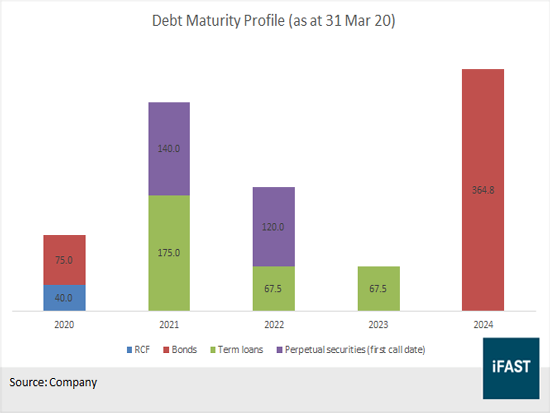
LMIRT’s credit profile is supported by its sufficient liquidity and fully encumbered property portfolio—all existing borrowings are on unsecured basis—which provides financial flexibility to the REIT. However, we think there is now much higher extension risk for the S$140m 7% perpetual securities and S$120m 6.6% perps first callable in September 2021 and December 2022 respectively. Given that management is already contemplating the deferral of coupon payments on the perps (see the next section), raising funds to redeem the perps on first call is probably low on their list of priorities.
The steep fall in LMIRT’s share prices—down more than 40% year-to-date—also adds to the perps’ extension risk, with the REIT’s market cap standing at just S$378m as at 22 May. Weak operating and market conditions have raised the hurdle significantly for LMIRT to redeem the S$260m perps on first call, and we think management are inclined to retain the perps on the trust’s balance sheet as a cheaper form of equity and buffer against the revised regulatory leverage limit of 50%.
LMIRT’s ongoing divestment of Pejaten Village and Binjai Supermall for IDR 1,281 billion (~S$112.6m) will provide substantial financial flexibility. However, we expect the sale to be delayed beyond its target completion date of 2Q20 due to the temporary closure of these two malls. Also, the trust is likely to deploy sale proceeds for its proposed IDR 3,700 billion acquisition of Lippo Mall Puri, although we similarly expect this transaction to be postponed due to heightened market uncertainty.
The LMRTSP perps face high risk of distribution deferral
Based on our calculation, LMIRT’s EBIT (excluding mostly foreign exchange-related other losses) over net interest expenses, if including perpetual bond distributions of around S$4.4m per quarter, was 2.5x in 1Q20. Despite the still manageable interest coverage, LMIRT did not accrue distributions attributable to the perps during the quarter. This is because management has not decide whether to pay the next coupons due in June and September, for the 6.6% perps and 7.0% perps respectively.
It is important to note that the terms and conditions of the perpetual securities allow LMIRT to defer distribution payments, on a non-cumulative basis. Hence, a distribution deferral will not constitute an event of default. Also, if management chooses not to pay the June coupon (for the 6.6% perps), they are not allowed to pay the coupon in September (for the 7.0% perps) as well. The notice requirements (not more than 15 nor less than three business days) specified in bond documents require LMIRT to give notice of a deferral event latest by 16 June.
Besides the non-cumulative deferral clause, offering documents of the perps also stipulated a dividend stopper covenant. This provision prohibits LMIRT from paying dividends to shareholders in the event of a distribution deferral, unless and until the REIT has redeemed the perps in full, paid the next scheduled distributions, or paid “optional distributions” equal to the amount of deferred distributions.
In other words, deferring perp distributions in June would result in LMIRT suspending dividends to unitholders for at least the second quarter, and likely the third quarter as well, unless the REIT makes good on the deferred coupon by paying optional distributions. Liew noted that the dividend stopper clause is an important consideration for management in deciding whether to defer distributions.
We understand from management that another critical factor is the period that LMIRT is forced to close its malls, or more specifically whether the REIT can reopen the malls by early June, when management will have to make the decision on perp distributions. As highlighted earlier, except for LPK, all of LMIRT’s properties are under temporary closure, although the REIT plans to resume operations progressively.
Thus far, only four of Indonesia’s 34 provinces have implemented large-scale social restrictions (“PSBB”), including Jakarta, where LMIRT earns half of its gross revenue. The political sentiment in the country seems to be leaning toward an early reopening of the economy, despite a spike in infections in recent weeks. Jakarta recently extended its social restriction measures until 4 June, which coincides with LMIRT’s latest extension of its mall closures. We think the prevalent opinion in the country is that this is likely the last period of PSBB, hence LMIRT’s plans to progressively resume operations.
According to LMIRT’s management, through discussions with their counterpart at Siloam International Hospitals—the healthcare provider operating at hospitals of First REIT, LMIRT’s sister REIT—their understanding is that the situation is stabilizing in Indonesia. Vacancies actually are gradually climbing in hospitals run by Siloam, a much-improved situation compared to earlier phases of the outbreak, when hospital beds were running out even for COVID-19 patients. On the other hand, the country’s limited testing capabilities have fueled doubts about the accuracy of government-reported statistics.
Obviously, with management deciding not to accrue the distributions to perp holders, the risk of a coupon deferral is high. Weighing the factors listed above, including the dividend stopper and growing economic pressures to relax coronavirus restrictions, we think it is just a tad more likely than 50% that LMIRT would be able to reopen its malls by early- to mid-June and decide to pay both perp distributions in June and September. But the complement of that guesstimate is that chances are about even that the REIT would be forced to extend its closure period and skip the next two perp distributions.
Recommendation
Shortly after LMIRT announced the temporary closure of portfolio properties, both Moody’s and Fitch downgraded the outlook on the REIT, citing adverse effects from the coronavirus pandemic and rupiah depreciation. The two rating agencies rate LMIRT at Ba3 and BB respectively.
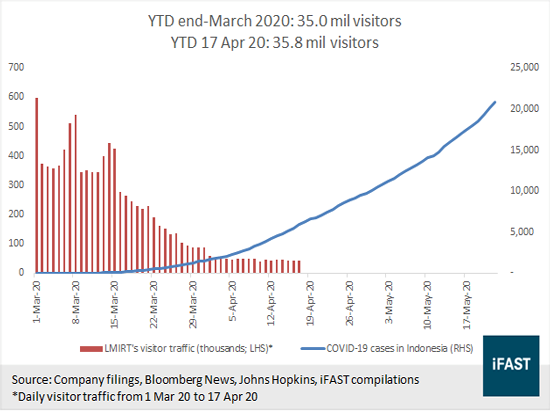
Even as the Indonesia government prepares for the resumption of business activity, and with our base assumption that some social distancing rules will be lifted in June, market and consumer confidence may still struggle to recover quickly given the ongoing climb in the number of new infection cases. The government declared the country’s first confirmed coronavirus case on 2 March, which coincided with a sharp drop in the visitor traffic to LMIRT’s shopping malls (see Figure 3). While the REIT closed all of its malls only in end-March, and Jakarta became the first region to formally apply for the implementation of large-scale social restrictions on 4 April, visitor traffic had already been on a steady downtrend even before that, as the outbreak worsened.
Figure 3: Visitor traffic fell as the virus spread
Against this backdrop, LMIRT’s USD senior unsecured notes and SGD perpetual securities are offering the highest yields in the Singapore REITs space. We think the LMRTSP 7.250% 19Jun2024 Corp (USD) is attractive with its ask yield to maturity (“YTM”) of 12.31%, against the trust’s manageable albeit deteriorating credit metrics. Although not directly comparable, the LMRTSP 7.25% ‘24s are trading much wider than similarly rated USD Asian real estate credits including Central China Real Estate’s (Ba3/B+/BB-) 7.25% ‘24s (ask YTM: 8.29%) and Sunac China’s (Ba3/BB-/BB) 6.5% ‘25s (ask YTM: 7.71%).
On the other hand, given the unprecedented shock to consumer demand, and heightened extension risk and uncertainty of distribution payments, we downgrade our rating on the LMRTSP 7.000% Perpetual Corp (SGD) and LMRTSP 6.600% Perpetual Corp (SGD) to underweight. Assuming the perps are extended to perpetuity, their yields to worst (“YTW”) are around 6.6-7.0%, which are close to the 6.71% (swapped to SGD) cost on the LMIRT’s 7.25% senior USD notes. With economic considerations now likely first and foremost on management’s mind, we think the likelihood of call is very low for the perps, barring a substantial improvement in the REIT’s financial health and market sentiment for its debt.
Declaration:
For specific disclosure, at the time of publication of this report, IFPL (via its connected and associated entities) has a principal position in FIRTSP 5.680% Perpetual Corp (SGD) and LMRTSP 6.600% Perpetual Corp (SGD). The analyst who produced this report holds a NIL position in the abovementioned securities.