Similar to First REIT, Lippo Malls Indonesia Retail Trust (“LMIRT”) is facing problems of their own, namely the uncertain return of positive returns and a significant amount of debt expiring this year.
Recent financial performance
Like many other REITs out there, LMIRT suffered losses in gross rental income with total gross revenue dropping by 58.3% YoY to S$28.9m in the quarter ended 30 Sep 20 (“3Q20”) and 40.4% YoY to S$121.2m in 9M20. Their malls and retail spaces closed at the end of March 2020 and since 3 Jul 20, all 21 retail malls and retail spaces have resumed operations but with shorter operating hours. LMIRT also expects these conditions to continue and rental reliefs being granted until at least 2Q21.
As LMIRT did a revaluation of their assets at the end of July 2020, they registered a huge charge related to the decrease in fair value of investment properties. They also divested two of their properties – Pejaten Village and Binjai Supermall. These items total to an S$181.0m expense from the decrease in property fair value for 3Q20.
The value of investment properties should not be increasing anytime soon too, and may even fall further depending on whether the Indonesian government will be implementing more social distancing measures, and the assumptions of independent external real estate valuers.
After divesting the two properties, LMIRT is acquiring Lippo Mall Puri from its sponsor Lippo Karawaci for an acquisition cost of S$389.2m, out of which S$120.0m will be from debt financings and S$281.0m from a rights issue. LMIRT signed a Vendor Support Agreement (“VSA”) which will guarantee a net property income (“NPI”) of IDR340.0 billion per annum from completion till 31 Dec 24, thus adding about S$8.0m of NPI per quarter.
For 3Q20, net property income came in at S$13.1m. After deducting for financial expenses, administrative expenses and other losses, total loss before revaluation and tax was at S$3.9m. For 9M20, LMIRT registered an S$14.7m profit before revaluation and tax. Due to the loss in 3Q20 and certain covenants from the LMRTSP 7.250% 19Jun2024 Corp (USD) notes, LMIRT elected to not pay the coupons for the LMRTSP 6.600% Perpetual Corp (SGD) in December.
The restriction can be nulled by an equity injection, thus with the recent rights issue, LMIRT announced that they will be paying the December distributions in February 2021. Furthermore, the equity fund raising amounting to about S$280m also gives the company enough buffer to pay distributions even if they do not make a positive distributable income.
LMIRT’s liquidity profile
As it is unlikely that the situation will be normalising anytime soon, we estimate LMIRT’s future performance using 3Q20 numbers and adding in the new cash flows provided by the VSA.
Table 1
Forecasted quarterly NPI and total return
|
S$ millions |
|
|
3Q20 NPI |
13.1 |
|
New NPI with COVID-19 restrictions and post Lippo Mall Puri acquisition |
~20.1 |
|
Total loss/returns after tax |
~2.5 |
|
Source: Company’s 3Q20 financial statement, iFAST estimates |
|
However, despite this tight margin of cash flows, LMIRT still has some cash available to make distributions to perpholders and unitholders.
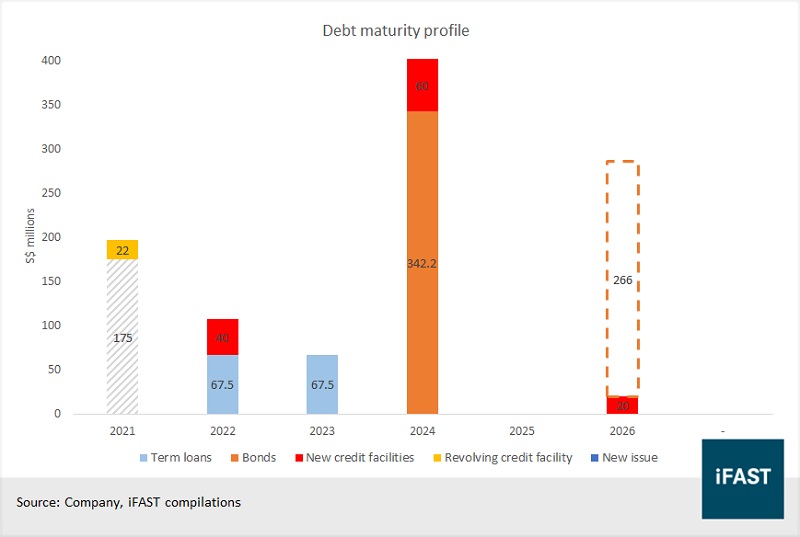
Looking at the company’s debt, LMIRT has an S$175m term loan expiring in August this year. LMIRT has already taken steps to refinance it by securing an USD75m committed line. However, due to extra expenses and the short maturity of the loan, the company has decided to not draw on this committed line. Instead, they will be issuing new debt – the topic of this article.
After including the credit facilities for the acquisition of Lippo Mall Puri and the potential new issuance of US$200m (~S$266m), LMIRT’s debt could increase to ~S$885.2m post transaction.
Table 2
Projected liquidity and debt levels
|
S$ millions |
|
|
Cash Balance |
123.1 |
|
New debt |
266 |
|
Debt to be repaid |
|
|
Term loans |
-175 |
|
Revolving credit facility |
-22 |
|
Remaining cash |
192.1 |
|
Previous debt |
696.2 |
|
Credit facilities for acquisition |
120 |
|
New debt |
885.2 |
|
Source: Company |
|
LMIRT’s cash position of S$123.1m at the end of September 2020 and its new bonds issue should provide the trust sufficient sources of liquidity to cover its S$175.0m of short-term loans. Even if the new bonds were to be met with poor demand, LMIRT can still tap on the US$75m credit facility to repay the loans. Thus, together with the support from its sponsor, we think that the chance of default still remains low. Improvements in NPI will also help lift refinancing prospects for LMIRT.
Its 42.5% gearing, defined as the ratio of debt to total assets, was lower than the MAS gearing limit of 50%. With the acquisition of Lippo Mall Puri, the estimated gearing ratio could fall to about ~40.2%, which is still at a comfortable level in our opinion. However, the ratio of borrowings (including perpetual securities) to total assets rises to ~57.6% at 3Q20. As disclosed in its presentation, the weighted cost of borrowing, including its perpetual securities is 5.85%. Its new debt maturity profile is shown in Figure 1.
Figure 1
Debt maturity profile
Bond pricing
As mentioned above, LMIRT is looking to raise up to US$200m through a new USD issue that will mature in 5 years. The senior notes are callable in three years. Credit ratings for the bonds are expected to be B1 by Moody’s and BB- by Fitch, in line with their issuer ratings. The covenants will follow those of the LMRTSP 7.250% 19Jun2024 Corp (USD) notes, including the dividend stopper provisions and restrictions on payments.
If the issuer raises sufficient capital, the excess funds after repaying the debt can be used for Asset Enhancement Initiatives (AEI) for the Gajah Mada Plaza – a mall that is located in the heart of Jakarta’s Chinatown and along one of the main roads in Jakarta. The mall is more than 30 years old and the funds can be used to refurbish the mall.
There is a considerable lack of comparable Indonesian USD notes with issuers such as Ciputra Development Tbk Pt and Global Prime Capital Pte Ltd having a much better credit profile than LMIRT. Thus, we only compared the initial price guidance (“IPG”) to the LMRTSP 7.250% 19Jun2024 Corp (USD), as well as the two other notes from its sponsor, Lippo Karawaci - LPKRIJ 6.750% 31Oct2026 Corp (USD) and LPKRIJ 8.125% 22Jan2025 Corp (USD) (Figure 2).
Figure 2
Yields of comparable bonds
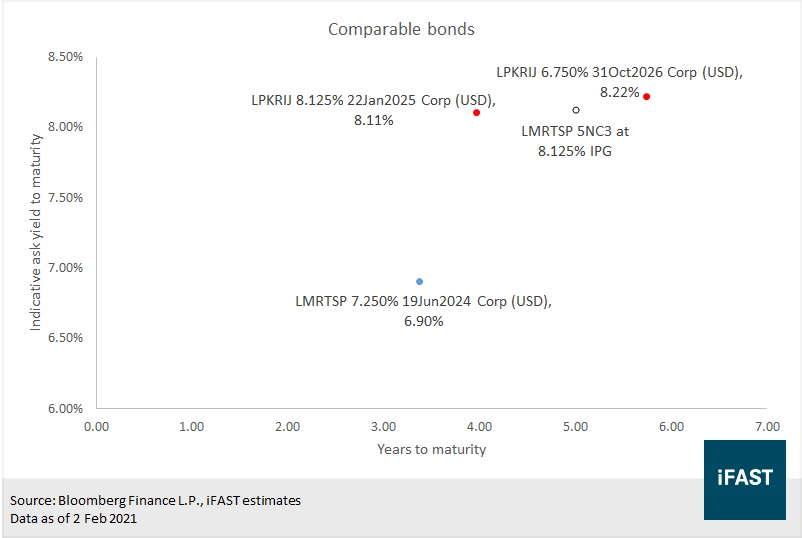
If the issuer calls this new note in three years, the 8.125% IPG would be understandably attractive. However, if it is held to maturity, the 8.125% IPG for a 5-year tenor is priced close to the two Lippo Karawaci bonds. Considering the credit profiles of the issuers, we think that the LPKRIJ 8.125% 22Jan2025 Corp (USD) would be relatively more attractive at an indicative yield to maturity of 8.11%.
Declaration: For specific disclosure, at the time of publication of this report, IFPL and the analyst who produced this report hold a NIL position in the abovementioned securities.
Our podcast series, Yield Hunters, is available on Spotify and iTunes Podcasts and Google Podcasts. We share our thoughts on new bond issues and hold discussions on the fixed income space. Listen to our latest episode below and follow us!